

Researchers who buy Adipotide (FTPP) for research should evaluate the compound through RUO labeling, compound identity, COA documentation, analytical testing, and lot traceability before procurement. Adipotide, also listed as prohibitin-targeting peptide 1, is described by the NCI Drug Dictionary as a chimeric 25-mer peptide built from a CKGGRAKDC targeting motif, a GG linker, and KLAKLAK repeat motifs [1]. This product-page guide keeps the focus on laboratory research documentation and does not convert published literature into product claims.
Researchers evaluating where to buy Adipotide (FTPP) for research should first check RUO labeling, peptide identity, COA availability, HPLC purity documentation, LC-MS identity support, lot traceability, storage notes, and supplier records. Products discussed in this article are intended for laboratory research use only and are not intended for human or animal consumption. Adipotide’s identity should be checked against source records and batch-specific documentation [1], [2].
The phrase “buy adipotide” can be unsafe when it points toward personal-use or outcome-based intent. A research-safe version is “buy Adipotide (FTPP) for research,” which shifts the page toward laboratory procurement, documentation review, compound characterization, and RUO labeling.
That reframing matters because Adipotide (FTPP) has a research literature footprint involving peptide motifs, prohibitin context, adipose tissue vasculature models, and apoptosis-related mechanisms [1], [3]. The product-page task is not to promise findings. It is to help research buyers evaluate whether the documentation is coherent.
Start with identity documentation. The core research file should include the compound name, synonym mapping, sequence record, molecular formula, molecular weight, lot number, COA, and analytical method notes.
PubChem lists Adipotide with the sequence CKGGRAKDCGGKLAKLAKKLAKLAK, molecular formula C111H206N36O28S2, and molecular weight of about 2557.2 g/mol [2]. These identity fields help researchers compare a product listing against independent compound records.
RUO labeling sets the boundary for the product page. It tells the reader that the page is about laboratory research materials, not consumer outcomes or clinical-use language.
FDA guidance for a separate but related category of research-labeled laboratory products emphasizes that RUO labeling should be consistent with research-stage intent and should not be used to support diagnostic positioning [23]. For peptide product pages, the practical lesson is similar: clear labels and clear claims should tell the same story.
Adipotide research belongs in a laboratory documentation lane. The page should help qualified researchers evaluate identity, COA records, lot traceability, and published literature boundaries.
This is especially important for a compound with mechanistic literature. The stronger the mechanistic language becomes, the more carefully the page must separate research findings from product claims.
RUO positioning means the page should describe Adipotide (FTPP) as a research material with documentation, not as a consumer item. That includes neutral language around compound identity, testing, supplier documentation, and literature interpretation.
A product page can say that published research has examined prohibitin-associated targeting motifs in white adipose tissue vasculature models [1], [3]. It should not translate those model-specific findings into claimed product outcomes.
Laboratory research use shapes what a product-page reader should expect to see. The most useful records are not persuasive slogans. They are technical fields.
For Adipotide (FTPP), those fields include peptide sequence, molecular weight, purity testing method, LC-MS identity support, lot number, COA date, storage documentation, and label consistency. When these fields align, procurement teams have a clearer basis for research-material review.
Published literature can describe what investigators examined in a defined model. Product claims describe what a supplier says about a material being sold.
Those are different categories. Kolonin, Saha, Pasqualini, and Arap described a CKGGRAKDC motif associated with white adipose tissue vasculature and prohibitin in a preclinical model [3]. That is literature context, not a claim that any research-use-only material will reproduce the same findings.
Adipotide (FTPP) is commonly discussed as a chimeric peptide or peptidomimetic connected to prohibitin-targeting research. NCI describes prohibitin-targeting peptide 1 as a 25-mer peptide containing a CKGGRAKDC targeting motif, a GG linker, and KLAKLAK repeat motifs [1].
PubChem provides the sequence, molecular formula, molecular weight, computed descriptors, and synonym data for Adipotide [2]. For product-page research content, those details support identity review.

Adipotide FTPP peptide documentation should identify the compound as Adipotide, FTPP, or prohibitin-targeting peptide 1 when those synonyms are relevant. Synonym consistency helps prevent mismatched COA records, mislabeled files, or unclear catalog entries.
The NCI source describes the compound as a chimeric 25-mer peptide [1]. PubChem lists Adipotide as CID 163360068 and provides the formula and sequence fields needed for identity comparison [2].
Peptide sequence is a core identity field because it links a name to a defined primary structure. PubChem lists the Adipotide sequence as CKGGRAKDCGGKLAKLAKKLAKLAK [2].
For research procurement, sequence review should sit alongside molecular weight, mass data, and batch-specific COA documentation. A sequence alone is useful, but it does not replace analytical confirmation.
Prohibitin is central to the literature context for adipotide research. The NCI description states that prohibitin-targeting peptide 1 binds prohibitin in white adipose vasculature and is associated with receptor-mediated internalization in its research description [1].
Prohibitin itself is not a narrow single-function marker. Reviews describe prohibitins as conserved proteins with roles in multiple cellular compartments, including mitochondria, membrane-associated contexts, and nuclear signaling contexts [11], [12]. That broader biology is why careful wording matters.
Adipotide peptide literature grew out of vascular-targeting and phage-display research. In vivo phage display has been used to identify peptide motifs associated with organ- or tissue-selective vascular homing [6], [7].
That background explains why Adipotide (FTPP) is often discussed through targeting motifs, vascular endothelium, prohibitin, and apoptosis-related model interpretation. It does not create product-use guidance.
Prohibitin-targeting literature should be read as mechanistic research. The early Kolonin study identified the CKGGRAKDC peptide motif and reported association with prohibitin in white adipose tissue vasculature models [3].
Later research discussed prohibitin and annexin A2 interactions in adipose tissue biology. Salameh, Daquinag, Staquicini, Pasqualini, Arap, and Kolonin reported that PHB and ANX2 interact on vascular endothelial cells in white adipose tissue and discussed CD36-mediated fatty acid transport in that context [10].
The endothelium matters because vascular beds are molecularly diverse. Rajotte, Arap, Pasqualini, and colleagues used phage-display methods to study molecular heterogeneity across vascular endothelium in different tissues [7].
Adipotide studies sit within that larger research lane. The key concept is not generic “metabolic” language. It is model-specific targeting of peptide motifs to defined vascular contexts.
Apoptosis appears in Adipotide (FTPP) research because the NCI description connects the compound’s ligand/receptor complex with apoptosis in its scientific entry [1]. Kolonin and colleagues also framed the early preclinical research around targeted induction of apoptosis in adipose tissue vasculature models [3].
This is a mechanistic research topic. It should not be used as a product claim or translated into outcome language on an RUO product page.
Pathway context helps researchers understand how a compound appears in literature. For Adipotide (FTPP), the relevant lane includes peptide motif targeting, prohibitin, vascular endothelium, apoptosis-related model findings, and adipose tissue vasculature.
Reviews on vascular phage display explain that peptide libraries can be used to identify ligands associated with specific vascular beds [8], [9]. That helps frame Adipotide research without overextending the product page.
In the literature, receptor and ligand language describes a model of molecular recognition. NCI describes prohibitin-targeting peptide 1 as binding specifically to prohibitin in white adipose vasculature, with receptor-mediated internalization described in the entry [1].
Researchers should treat that language as model context. A product page can discuss receptor and ligand concepts, but it should not imply product performance in a research setting.
Metabolic pathway models can help researchers organize experimental findings. They cannot turn a research-use-only material into a claimed application.
For example, adipose vasculature research has shown that endothelial and vascular processes are deeply connected with adipose tissue function in model systems [14], [15]. That supports pathway context only; it does not support product claims.
Pathway relevance means a compound has been discussed in relation to a molecular target, cell type, or model system. It does not mean a supplier can claim a research material will produce a specific finding.
A safer approach is to name the pathway, cite the literature, and state the limitation. For Adipotide (FTPP), that means discussing prohibitin, endothelium, vasculature, peptide identity, and apoptosis in literature context only [1], [3].
The Adipotide studies most relevant to a product page include early white adipose vasculature targeting literature and later preclinical peptidomimetic research. These sources should be summarized with neutral verbs such as “examined,” “reported,” “described,” or “evaluated.”
The literature should also be ordered by evidence type. In vitro findings, preclinical model findings, registry records, and analytical documentation do not answer the same question.
Barnhart, Christianson, Hanley, Pasqualini, Arap, and colleagues published a Science Translational Medicine study identified as 3(108):108ra112, which evaluated a peptidomimetic targeting white adipose tissue in nonhuman primate models [4]. That source is important because it extended the research context beyond the initial peptide motif work.
Pasqualini and Arap are also connected to the broader vascular-targeting research tradition. Earlier phage-display work showed that peptide motifs could be selected for tissue-associated vascular homing [6], [7].
Science Translational Medicine adds a preclinical evidence layer for adipotide research. Barnhart et al. reported a peptidomimetic research model involving white adipose tissue targeting and metabolic readouts in a nonhuman primate context [4].
For an RUO product page, the right takeaway is not a claim. The right takeaway is evidence classification: this is preclinical literature that helps researchers understand how the compound has been studied.
Nature Medicine is central to the Adipotide research lineage because Kolonin, Saha, Chan, Pasqualini, and Arap reported the CKGGRAKDC motif and prohibitin association in white adipose vasculature research [3]. PNAS or Proceedings of the National Academy of Sciences references should be included only when they directly support a specific model, pathway, or analytical point.
A high-quality page should not cite a prestigious journal name as a stand-in for relevance. Each source must support the exact statement it is attached to.
Evidence should be interpreted through a ladder: compound identity, mechanistic literature, preclinical model data, registry context, and analytical verification. Each rung supports a different kind of statement.
| Research Area | What Literature Examines | Evidence Type | RUO Interpretation |
|---|---|---|---|
| Compound identity | PubChem lists Adipotide sequence, formula, and molecular-weight information [2]. | Official database | Supports identity comparison, not product claims. |
| Prohibitin context | NCI describes prohibitin-targeting peptide 1 as a chimeric 25-mer connected to prohibitin and white adipose vasculature [1]. | Official scientific dictionary | Supports terminology and target-context review. |
| Vascular targeting | Kolonin and colleagues reported CKGGRAKDC motif association with white adipose tissue vasculature [3]. | Preclinical mechanistic literature | Supports literature context only. |
| Preclinical model evidence | Barnhart and colleagues evaluated Adipotide-related peptidomimetic research in a nonhuman primate model [4]. | Preclinical study | Supports evidence classification, not product positioning. |
| Analytical verification | MS and LC-MS are used to support synthetic peptide identity, purity, and impurity characterization [16], [17]. | Analytical chemistry literature | Supports COA and testing review. |
Published findings can support a product page when they explain what a compound is, how it is classified, what model systems have been studied, and which documentation fields are relevant. They cannot support outcome-based product claims.
For Adipotide (FTPP), published sources can support statements about CKGGRAKDC, prohibitin, peptide identity, adipose tissue vasculature models, and analytical verification [1], [2], [3], [16].
Translational limits are the difference between what literature examines and what a product page may claim. A ClinicalTrials.gov record exists for prohibitin-targeting peptide 1 and is marked terminated, but registry context remains outside RUO product positioning [5].
Some published literature outside the scope of RUO product use has examined this compound class in human study settings. That literature should not be interpreted as a use claim for research-use-only materials.
Study models are controlled research contexts. Supplier claims are commercial statements about a research material.
The safest product-page approach is to connect each factual claim to its source and then stop. For Adipotide research, model-specific literature can explain prohibitin context and vascular-targeting methodology, while supplier documentation should focus on COA review, analytical testing, label consistency, and lot traceability [3], [4], [18].

Research literature and product claims should be kept in separate editorial lanes. Literature explains what investigators examined. Product-page documentation explains what the supplier can verify.
Common research-page misunderstandings include:
Commercial searches can drift into product claims when terms are framed around product performance instead of documentation. RUO pages should avoid that drift.
A safer structure is simple: define the compound, cite the literature, explain the evidence level, and return to documentation. This keeps Adipotide research content anchored in compound identity, COA review, HPLC, LC-MS, and lot-level records.
Research pages should emphasize verifiable documentation. That means identity fields, sequence records, molecular weight, supplier records, COA data, chromatogram context, LC-MS identity support, and storage documentation.
They should also emphasize source quality. Peer-reviewed studies, official databases, and recognized analytical guidance are stronger sources than marketing summaries.
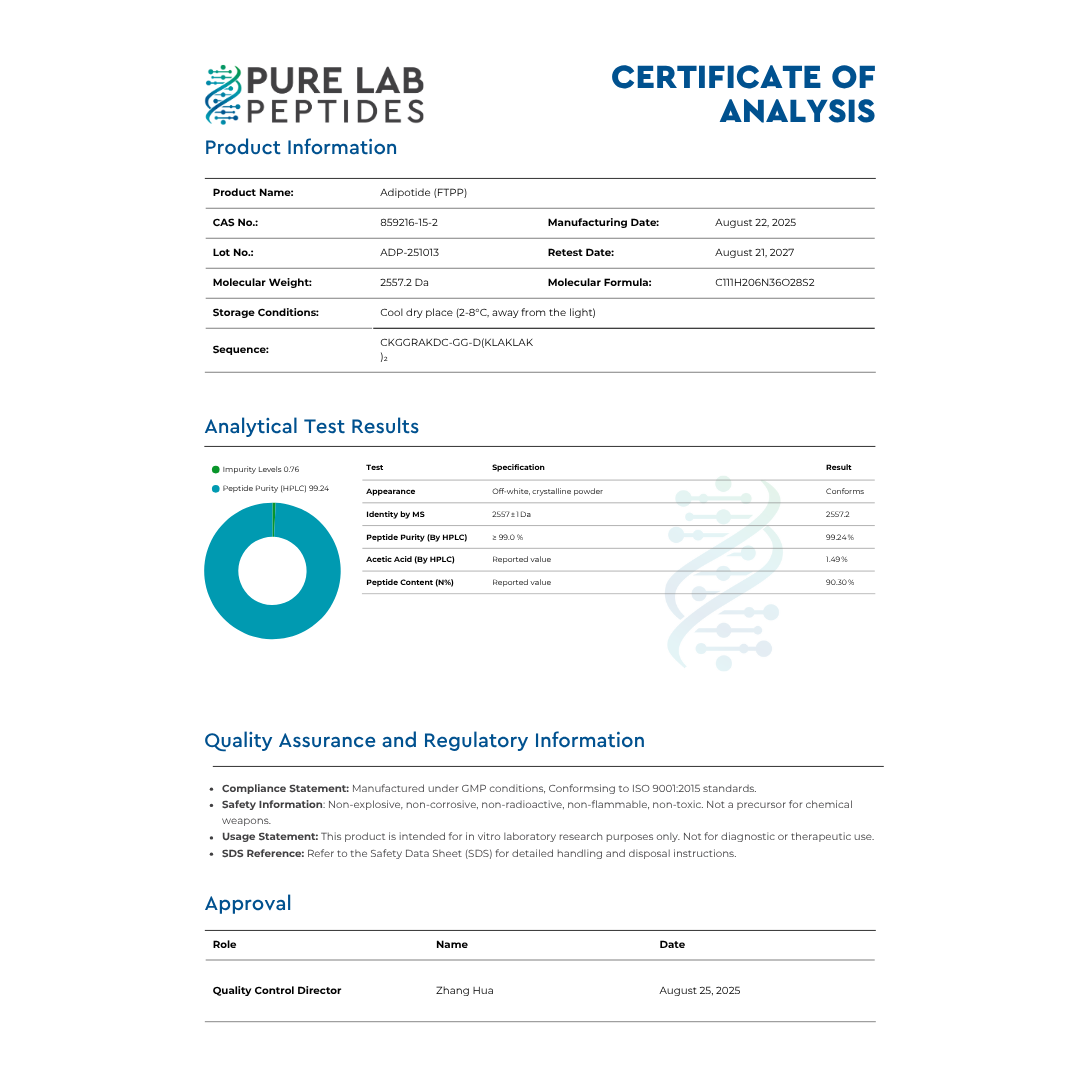
A certificate of analysis should help researchers connect a specific lot to a specific analytical record. It should not function as decorative proof.
For Adipotide peptide review, the COA should align with the product listing, label, lot number, sequence expectations, and analytical testing files. FDA analytical-method guidance describes identity, quality, purity, and related attributes as documentation areas supported by analytical procedures and validation data in regulated analytical contexts [18].

COA details matter because they turn broad quality language into checkable fields. A useful COA should state the compound name, lot number, test date, purity method, identity method, and lab source.
Researchers should also compare COA data against independent identity fields. For Adipotide (FTPP), molecular-weight and sequence expectations can be compared with PubChem and NCI records [1], [2].
Batch-specific documentation should show that the listed material and the tested material refer to the same lot. The lot number on the COA should match the product documentation, label record, and procurement record.
A COA for a peptide should not be evaluated from a headline purity number alone. Analytical literature explains that mass spectrometry and LC-MS can support synthetic peptide identity and purity review when paired with suitable method context [16], [17].
Analytical testing supports the documentation layer of a research peptide product page. HPLC and LC-MS answer related but different questions.
Use this lab-test verification sequence for documentation review:
HPLC is commonly used to separate components in a sample and support purity review. It can show retention-time behavior, peak area context, and whether a dominant peak appears under the stated method conditions.
HPLC should not be read as a complete identity answer by itself. For synthetic peptides, mass spectrometry is well suited for identity and purity analysis, and LC-MS is often used as part of peptide characterization [16], [17].

LC-MS combines separation with mass analysis, which makes it useful for synthetic peptide identity review and impurity characterization. Lian and colleagues describe LC-MS as important for synthetic peptide characterization because peptides can contain complex structural modifications linked to starting materials, manufacturing processes, and storage conditions [17].
For Adipotide (FTPP), LC-MS documentation should be compared with expected mass and sequence information from compound records [2]. When available, it should be reviewed alongside COA and lot data rather than in isolation.
Lot traceability helps connect the material, label, COA, and testing files. It is one of the simplest ways to detect mismatches across product documentation.
A research buyer should be able to follow a clear path from product name to lot number, then from lot number to COA, and from COA to analytical files. If the path breaks, documentation review becomes weaker.
Lot numbers add specificity. They help distinguish a batch-specific COA from a general quality statement.
Analytical guidance emphasizes that method validation and analytical data support defined quality attributes in documented contexts [18], [19]. For research procurement, that principle translates into a practical question: does the lot-level record support the exact material being evaluated?
Traceability supports laboratory records by making each research material auditable. The product listing, COA, label, storage note, and internal receiving record should align.
This is not just paperwork. It protects the integrity of laboratory documentation and helps researchers avoid ambiguity when comparing materials across suppliers or batches.
Supplier documentation should make the Adipotide research material easy to evaluate without relying on promotional language. The strongest supplier records are specific, consistent, and tied to the batch.
A documentation matrix can help:
Supplier records should match product listing details because mismatch creates uncertainty. A listing that says Adipotide (FTPP), a COA that uses a different synonym, and a label with unclear lot data require extra review.
Synonyms can be acceptable when they are clearly mapped. PubChem and NCI records help researchers connect Adipotide, FTPP, and prohibitin-targeting peptide 1 as research identifiers [1], [2].
Research-use labeling supports clear positioning by limiting the product-page promise. It keeps the focus on laboratory research materials, not consumer outcomes.
FDA RUO guidance for research-labeled laboratory products warns that labeling and distribution should be consistent with research intent rather than diagnostic positioning [23]. For a peptide research page, this supports a conservative editorial stance: documentation first, claims last, and only when fully supported.
Storage and handling documentation should state the supplier’s storage conditions and help laboratory teams record receipt, storage location, date, and lot number. The article should not provide preparation steps or personal-use guidance.
Peptides and polypeptides can be sensitive to environmental factors such as temperature changes, oxidation, light, ionic content, and shear, according to ICH Q5C stability guidance for biotechnological and biological products [21]. Solid-state peptide stability also remains a documented concern in pharmaceutical chemistry literature [22].
Product pages should document storage conditions in a simple, research-facing way. The storage note should be consistent across the listing, COA, label, and any supplier documentation.
If a product page includes storage information, the page should present it as laboratory recordkeeping context. It should not present storage language as personal-use guidance.
Handling records support material integrity by creating a chain of custody. That record may include receipt date, lot number, storage location, COA file name, reviewer initials, and any internal documentation notes.
For research teams, the most practical standard is consistency. If the product listing, label, COA, and internal record say the same thing, review is simpler.
Research procurement review should bring the entire page together. Adipotide (FTPP) should be evaluated as a canonical research compound with identity, literature, analytical testing, COA, supplier documentation, and RUO boundaries all aligned.
Before procurement, researchers should check whether the product page gives enough information to support an internal review. The strongest pages make the documentation path visible.

Researchers evaluating where to buy Adipotide for research should verify RUO labeling, compound identity, synonym consistency, sequence expectations, molecular weight, COA availability, HPLC documentation, LC-MS identity support, lot traceability, storage notes, and supplier documentation.
They should also verify that the page avoids turning adipotide studies into product claims. A good research page explains what the literature says, where evidence is limited, and which records should be reviewed.
Documentation review supports next-step evaluation by reducing ambiguity before a research material is selected. The page should make it easy to compare product identity, COA details, analytical methods, lot records, and RUO labeling.
“Pure Lab Peptides supplies compounds for laboratory research use only. Products are not intended for human or animal consumption, diagnostic use, therapeutic use, clinical use, veterinary use, or as food, drugs, cosmetics, dietary supplements, or household products. Researchers are responsible for ensuring lawful, appropriate handling and use in accordance with applicable regulations and institutional guidelines.”
Review the product-page documentation, COA details, analytical testing files, and RUO labeling before evaluating Adipotide (FTPP) for laboratory research.
Adipotide (FTPP) is described in research context as a peptide-related research compound associated with prohibitin-targeting literature and compound identity review. Product-page discussion should focus on research documentation, peptide identity, and published literature boundaries. Researchers may compare synonym records, amino acid information, molecular weight, and COA details when evaluating Adipotide documentation [1], [2].
Researchers should consider documentation before they buy Adipotide (FTPP) for research. A research-focused review should include RUO labeling, supplier documentation, peptide COA availability, lot traceability, analytical testing, storage documentation, and consistency across product records. The goal is to evaluate research-material documentation, not to interpret the compound through consumer-facing product claims.
Adipotide research materials should be stored according to the supplier’s laboratory storage documentation and internal research records. Product pages should document storage notes clearly so technical procurement teams can compare the listing, label, COA, and receiving record. Storage language should remain limited to laboratory recordkeeping and should not become product-use guidance.
Researchers review peptide COA documentation for Adipotide because it helps connect the listed research material to a batch-specific record. A useful COA supports review of lot number, purity method, identity testing, test date, and supplier documentation. COA review works best when paired with analytical testing records and clear lot traceability.
Pathway research helps frame Adipotide literature by placing published findings into model-specific scientific context. Researchers may encounter terms such as receptor signaling, cell signaling, signal transduction, molecular binding, cell membrane, or endocytosis in related literature. These terms should be interpreted as research concepts, not product claims or research-material performance statements.
Adipotide product pages should stay research-use-only by keeping the focus on compound identity, published literature interpretation, COA review, analytical testing, lot traceability, and supplier documentation. For educational purposes, the page can explain what research literature examines, but it should not convert hypotheses, model findings, or pathway language into commercial claims.
The following authors are recognized for published research that helped shape the scientific context discussed in this article.
Author profile: Gulf Coast Consortia Faculty Profile
Mikhail G. Kolonin’s published work is directly relevant to the Adipotide (FTPP) research context discussed on this page. His publications provide useful background for interpreting white adipose tissue vasculature models, prohibitin-associated research, peptide motif selection, and model-specific pathway discussion. His later work with annexin 2 and prohibitin also supports the article’s focus on receptor and ligand concepts, blood vessels as research targets, and careful separation between published model findings and product-page documentation.
Selected publications:
Author profile: Rutgers PI Profile
Renata Pasqualini’s publications are relevant to the vascular-targeting and phage-display research background that informs the Adipotide (FTPP) literature context. Her work helps frame how peptide libraries, endothelial markers, and tissue-associated vascular signatures appear in published research. That background supports the article’s discussion of pathway-focused research, model interpretation, and why research-use-only product pages should keep scientific literature separate from supplier documentation and product claims.
Selected publications:
This research disclaimer clarifies how this page handles published literature and search language around Adipotide (FTPP). In metabolic pathway research content, terms such as 10mg, glucose tolerance, improved glucose tolerance, insulin sensitivity, insulin resistance, obesity, type 2 diabetes, fat loss, rapid weight loss, food intake, and appetite can drift into consumer-facing, wellness, clinical-use, or product-claim language when framed incorrectly. On this page, those terms are treated only as research-language examples or literature-boundary concepts.
References to therapeutic potential, clinical outcomes, product effects, or phrases such as “adipotide may” and “suggest that adipotide” require the same careful separation from product positioning. Here, the focus remains on Adipotide (FTPP) compound identity, COA review, analytical testing, peptide purity, lot traceability, RUO labeling, product documentation, and published literature boundaries. Any model-specific discussion should support research interpretation, not intended uses, outcomes, instructions, recommendations, or commercial claims.
Discount Applied Successfully!
Your savings have been added to the cart.


There are no reviews yet.