


Pure Lab Peptides created this guide for research teams evaluating where to buy HMG for research while keeping the page strictly within research-use-only boundaries. HMG is discussed here as a gonadotrophin research material associated with menotropin terminology, follicle-stimulating hormone activity, luteinizing hormone activity, and batch-specific laboratory documentation. This article focuses on compound identity, COA review, analytical testing, lot traceability, and published literature context—not consumer, clinical, diagnostic, or personal-use positioning.

Researchers looking to buy HMG for research should first review RUO labeling, compound identity, CAS or database identifiers, batch-specific COA documentation, analytical testing methods, lot traceability, supplier documentation, and storage records. Products discussed in this article are intended for laboratory research use only and are not intended for human or animal consumption. Literature context should remain separate from product claims.
The phrase buy HMG for research carries commercial intent, but the safe interpretation is technical procurement review. That means the central question is not what the material does, but whether the supplier documentation is complete, consistent, and suitable for controlled laboratory research.
For Pure Lab Peptides, a research-focused product-page article should help qualified laboratory buyers check whether the HMG listing aligns with documentation standards. The review starts with the name HMG, then expands into menotropin terminology, gonadotropin classification, activity notation, lot-level COA data, and analytical verification.
A safer commercial framework looks like this:
Before researchers buy HMG for research, the documentation package should answer a simple question: does the label, COA, and product information tell the same technical story?
For HMG, that story may include human menopausal gonadotropin terminology, menotropin or menotrophin naming, FSH and LH activity references, and analytical data that supports identity and purity review. PubChem describes menotropins as containing follicle stimulating hormone and luteinizing hormone purified from postmenopausal urine [1]. NCBI MeSH similarly identifies menotropins as urine extracts from menopausal women containing pituitary gonadotropins, follicle-stimulating hormone, and luteinizing hormone [2].
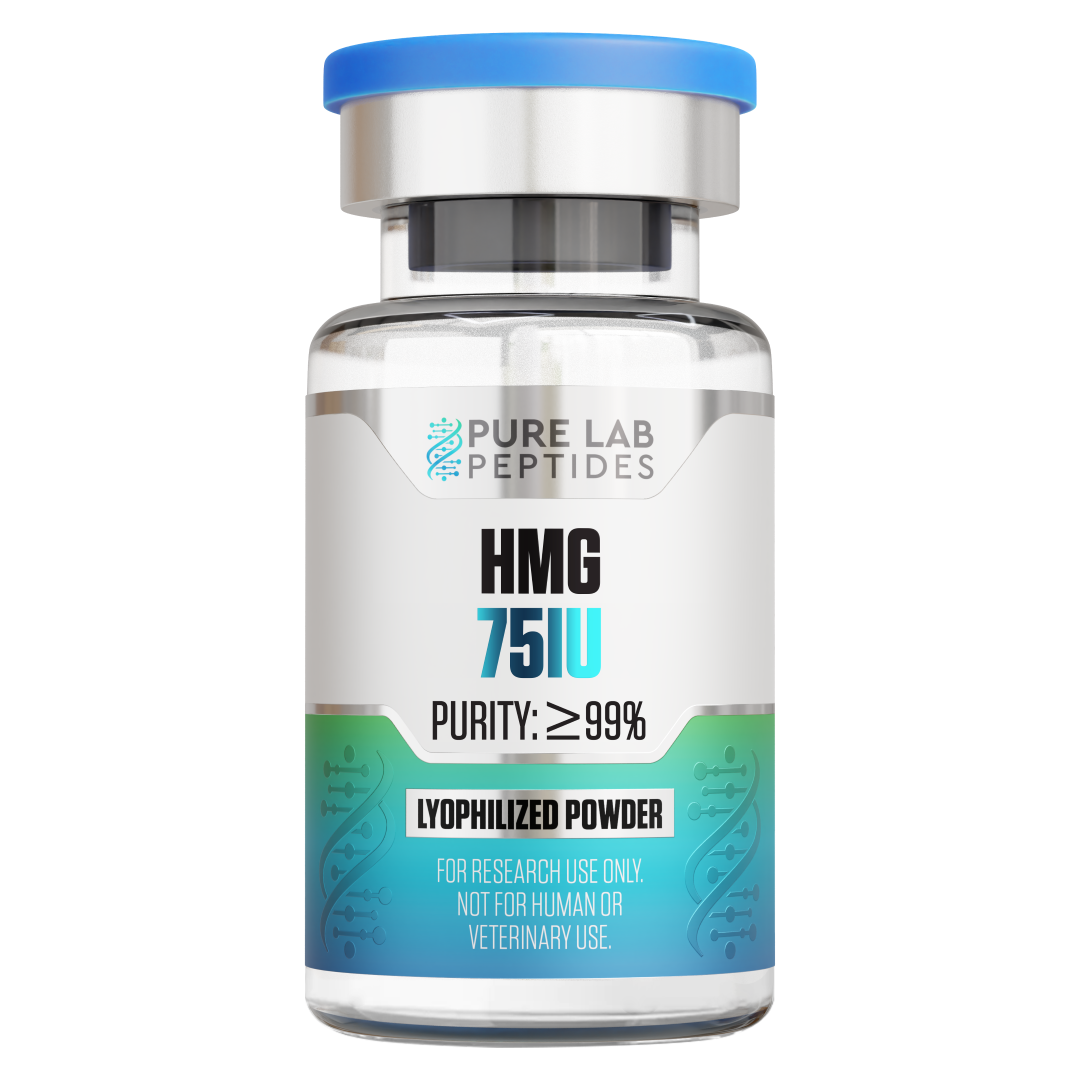
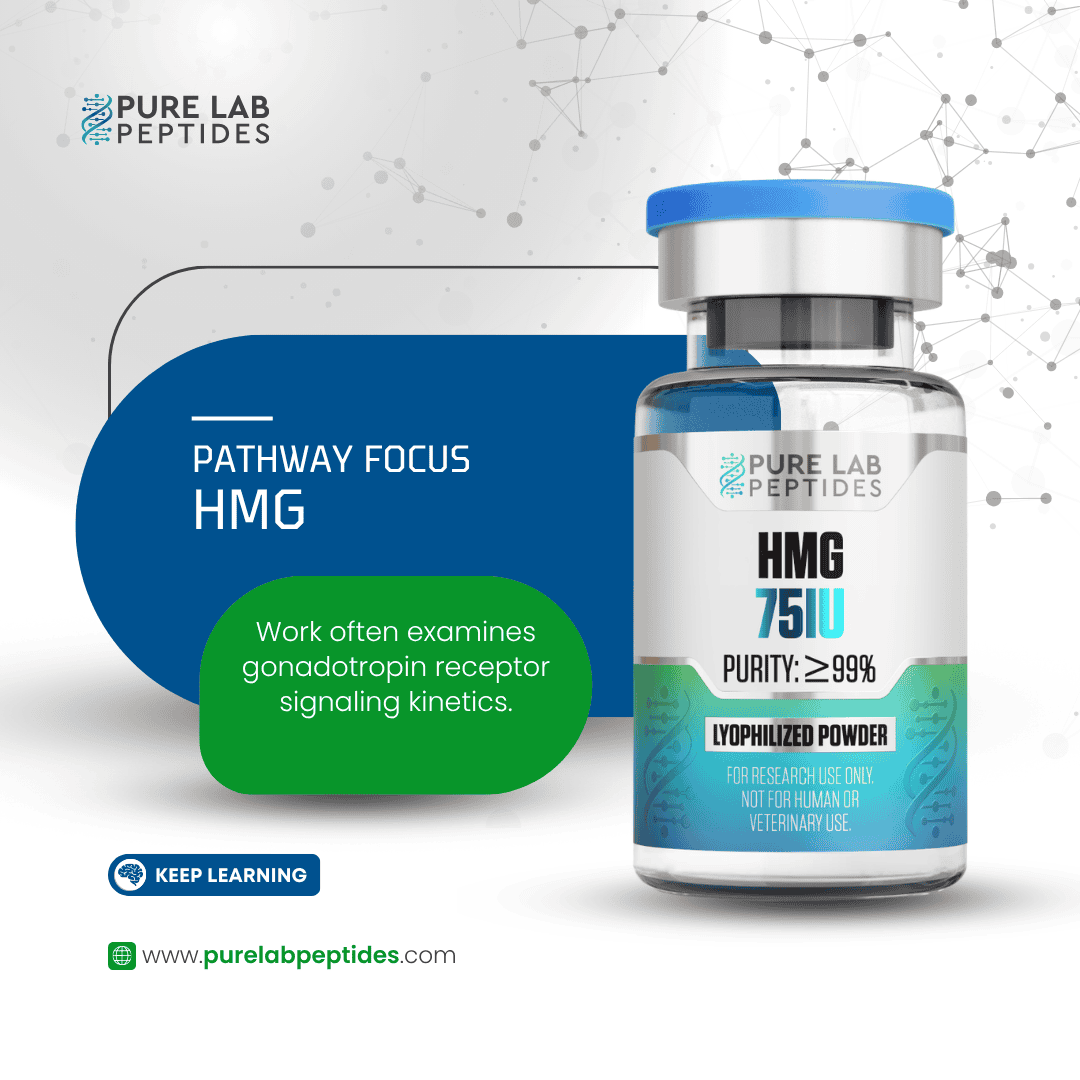
A product listing may also include catalog activity notation such as HMG 75 IU or 75iu. In an RUO product-page context, that should be treated as a catalog specification, not as a product-use instruction.
RUO labeling helps separate laboratory research materials from consumer, diagnostic, therapeutic, clinical, or veterinary positioning. FDA guidance for RUO-labeled IVD products explains that RUO labeling is tied to research-phase products and should not be used to support clinical diagnostic positioning [6]. Although HMG research materials are not being presented here as IVD products, the same editorial principle is useful: RUO language should keep product pages focused on research documentation.
For HMG, RUO clarity matters because some public databases and literature sources include clinical indexing terms. Those terms can create boundary risk if they are copied into product claims. A research page should instead focus on compound identity, analytical verification, COA review, and batch documentation.
HMG laboratory research content should be written for qualified research teams, technical procurement groups, and controlled laboratory environments. The article should not instruct personal use or frame the product as a medical, wellness, cosmetic, or household item.
HMG is a gonadotrophin research topic with overlap across peptide, protein, hormone, and glycoprotein hormone terminology. NIH LiverTox describes human gonadotropins such as follicle stimulating hormone, luteinizing hormone, and chorionic gonadotropin as heterodimeric peptide-hormone proteins made of two peptide chains, with a shared alpha chain and hormone-specific beta chains [4]. That makes molecular identity review more complex than a single small synthetic peptide.
Research use labeling should make the intended context unmistakable. It should identify the product as a laboratory research material and avoid claims about consumer outcomes, product effects, or clinical-use language.
The label should also connect to documents that a research team can archive. That includes product information, lot number, batch-specific certificate of analysis, analytical testing method, and storage documentation. If the label and COA do not match, procurement teams should pause the review.
Laboratory research use stays separate from product claims because published literature and product documentation serve different roles. Literature may describe a compound class, receptor system, analytical method, or model-specific finding. Product documentation should describe the material being supplied, the lot being reviewed, and the testing record attached to that lot.
Some public literature categories, including infertility and other clinical indexing terms, belong only in evidence-boundary context for this page. They should not become product positioning for an RUO HMG research material.
Controlled laboratory records give procurement teams a way to track what was reviewed, when it was reviewed, and which batch the review covered. Useful records include the product information page, lot number, COA, test method, chromatographic file when available, storage note, and internal receiving log.
This is especially relevant for research materials such as HMG because the broader menotropin category can involve multiple glycoprotein components and variable purity across preparations. NCBI MeSH notes that the FSH:LH ratio and degree of purity can vary across menotropin preparations [2].
HMG stands for human menopausal gonadotropin or human menopausal gonadotrophin in many research and database contexts. It is commonly associated with menotropin or menotropins, which PubChem describes as containing FSH and LH purified from postmenopausal urine [1].
For an RUO product page, the key point is classification. HMG should be treated as a gonadotrophin and glycoprotein hormone research material, not as a simple single-chain peptide with one sequence and one molecular weight.

Compound identity review should start with the canonical name, synonyms, database identifiers, and CAS documentation where available. FDA’s Global Substance Registration System lists menotropins with synonyms that include human menopausal gonadotrophin and related names [3]. NCBI MeSH lists menotropins as a controlled vocabulary term introduced in 1973 [2].
For procurement review, CAS information should not stand alone. CAS, synonym, and product-name alignment should be compared against COA identity data and supplier documentation.
Human menopausal gonadotropin, human menopausal gonadotrophin, menotrophin, menotropin, and menotropins may appear across scientific and regulatory sources. This naming variation can matter during supplier evaluation because different records may use different naming conventions for the same broader HMG category.
The safe editorial approach is to define the naming cluster once, then use HMG as the canonical product-page target. That avoids keyword stuffing and keeps the research material listing clear.
Glycoprotein hormone classification matters because gonadotropins are not simple small molecules. Academic reviews describe gonadotropins as glycoprotein hormones with common alpha subunit architecture and hormone-specific beta subunits [5] [7]. This structure supports the need for careful identity documentation, source review, and analytical method context.
It also affects how researchers read literature. A paper discussing FSH, LH, hCG, or receptor signaling may provide useful background, but it does not automatically describe a specific HMG research material.
A Pure Lab Peptides HMG product-page article should serve research procurement, not consumer buying. The safest content architecture is documentation-first: identity, COA, analytical testing, lot traceability, RUO labeling, and supplier records.
This also helps SEO without unsafe claims. The page can rank for buy HMG for research while staying aligned with laboratory research intent.
Product information supports technical review when it gives research buyers the basic facts needed to compare the listing against documentation. For HMG, relevant product information may include compound name, synonym set, research category, catalog activity notation, lab peptides category context, and COA availability.
Product information should not replace batch-specific documents. It is the starting point, not the whole review.
A research material listing should clarify the canonical name, RUO status, lot-level documentation availability, and analytical testing basis. It should also keep catalog specifications separate from product-use language.
For HMG, a listing might reference 75 IU as an activity designation if that is how the catalog identifies the material. Official menotropin label descriptions also use IU activity terminology for FSH and LH activity per vial, but an RUO product page should treat that as identity and catalog context only [8].
Vial details are catalog information. They should help identify the product listing, match the COA, and support inventory records.
They should not become instructions, product-use guidance, or outcome framing. For HMG 75 IU or buy hmg 75iu search intent, the safe product-page answer is documentation review: check the label, lot number, COA, activity notation, and RUO statement.
Gonadotrophin research connects HMG with FSH, LH, hCG, glycoprotein hormone structure, and receptor signaling. NIH LiverTox describes FSH and LH as pituitary gonadotropins and hCG as a chorionic gonadotropin, all within the human gonadotropin group [4].
For RUO writing, this scientific background should remain academic. The goal is to explain how researchers classify the material, not to suggest product applications.
Follicle-stimulating hormone context fits into HMG identity because menotropins are associated with FSH activity. The FSH receptor gene, FSHR, encodes a G protein-coupled receptor for follicle stimulating hormone according to NCBI Gene [9]. UniProt also identifies human FSHR as the follicle-stimulating hormone receptor [10].
For the product page, this receptor context should support literature understanding only. It should not imply a product claim.
Luteinizing hormone references support identity review because HMG materials are commonly described in relation to FSH and LH activity. NCBI Gene identifies LHCGR as the luteinizing hormone/choriogonadotropin receptor and describes it as a G protein-coupled receptor whose activity is mediated through G proteins that activate adenylate cyclase [11]. UniProt identifies LHCGR as a receptor for lutropin-choriogonadotropic hormone [12].
In an HMG article, this gives the reader a same-lane receptor map. It does not create product positioning.
Chorionic gonadotropin references belong in the literature context because some HMG and highly purified human menopausal gonadotrophin preparations have been studied for hCG abundance and glycan profiles. A 2024 analytical investigation used liquid chromatography–tandem mass spectrometry to examine FSH, LH, hCG, glycopeptides, oxidation, and impurity patterns in highly purified HMG preparations [13].
This is useful for research interpretation because it shows why analytical documentation can matter for complex glycoprotein hormone materials. It should not be converted into a claim about any specific RUO lot unless that lot has matching batch-specific documentation.
HMG research sits at the intersection of molecular identity, glycoprotein hormone biology, and receptor-pathway literature. Gonadotropin reviews describe FSH, LH, and hCG as related glycoprotein hormones with receptor-specific signaling features [5] [14].
That molecular context is relevant for documentation. It helps explain why HMG review should look beyond a single name field and include source, purity, method, and lot-specific records.
Receptor literature frames HMG research through FSHR and LHCGR context. FSHR is the receptor for FSH, while LHCGR is the receptor for luteinizing hormone and chorionic gonadotropin [9] [11]. Reviews of gonadotropin receptors describe these systems as G protein-coupled receptor pathways with complex regulation and signaling outputs [15].
For RUO content, receptor context should help researchers understand the literature lane. It should never imply an expected product outcome.
Follicular signaling models can clarify how FSH and LH literature is organized. They may discuss receptor engagement, second messenger pathways, steroidogenesis models, or cell signaling systems. Reviews of gonadotropin signaling discuss cAMP/PKA, ERK, AKT, and beta-arrestin-related pathway concepts in research settings [5] [14].
Those models are evidence context. Product-page language should stop before it becomes a claim about an RUO material.
Pathway context should not become product claims because a pathway discussed in academic literature is not the same thing as a verified statement about a supplied research material. The correct product-page evidence chain is narrower: identity, batch, method, COA, lot number, and RUO labeling.
This is the claim boundary framework for HMG: literature describes research areas; documentation describes the material.
Published literature on HMG and related gonadotropins includes database descriptions, compositional studies, glycoprotein hormone reviews, receptor papers, and analytical characterization work. A compositional analysis of a urinary-derived HMG preparation examined composition and impurities, highlighting the value of analytical review for complex gonadotrophin materials [16]. The 2024 HP-hMG analysis further shows how LC-MS/MS can be used to examine glycopeptide mapping and impurity profiles [13].
The safest interpretation is evidence-ladder thinking.
| Research Area | What Literature Examines | Evidence Type | RUO Interpretation |
|---|---|---|---|
| Compound identity | Menotropins as FSH and LH-containing gonadotrophin preparations [1] [2] | Official database | Useful for naming, synonyms, and classification review. |
| Glycoprotein hormone biology | Shared alpha subunits and hormone-specific beta subunits [4] [7] | Review and official NIH source | Supports same-lane scientific context, not product claims. |
| Receptor context | FSHR and LHCGR as receptor systems for gonadotropin signaling [9] [11] | Official gene database | Helps map literature terminology. |
| Analytical characterization | HMG composition, glycopeptide mapping, and impurity review [13] [16] | Peer-reviewed analytical literature | Shows why method-specific documentation matters. |
| RUO boundary | RUO labeling should stay distinct from clinical interpretive positioning [6] | Official guidance | Keeps the page focused on laboratory research documentation. |
Published literature can show how researchers describe HMG, menotropins, gonadotropins, receptor systems, glycoprotein hormone structure, and analytical characterization. It can also show how study authors evaluate impurities, glycosylation, receptor signaling, or method performance.
Published literature cannot replace a batch-specific COA. It also cannot confirm the identity, purity, or documentation status of a specific HMG research material unless the material and lot under review are directly tied to the evidence.
In vitro research fits the evidence map as model-specific scientific context. For example, LH and hCG receptor literature discusses ligand-receptor signaling and pathway differences in in vitro models [14]. Gonadotropin signaling reviews also discuss biased signaling and receptor pathway complexity [5].
For product-page content, in vitro findings should be described as literature context only. They should not become product claims, consumer outcomes, or research material guarantees.
Source quality matters most when a term has both scientific and commercial search demand. For HMG, researchers should prefer official databases, PubMed-indexed literature, analytical chemistry sources, and standards organizations over vendor summaries or unsourced marketing content.
A strong source-quality filter is:

The claim boundary for HMG is straightforward: literature context is not product positioning. Some published literature outside the scope of RUO product use has examined this compound class in human study settings. That literature should not be interpreted as a use claim for research-use-only materials.
For this product-page guide, the safe interpretation is documentation-centered. Product-performance language and consumer outcomes should remain outside the article’s positioning.
Study findings differ from product claims because studies evaluate defined models, materials, methods, and endpoints. Product claims imply something about the supplied material.
In HMG research, a paper on gonadotropin signaling can explain receptor pathways. A COA can document analytical results for a batch. The product page should not merge those two evidence types into a claim.
Search intent can drift into claims when commercial keywords are paired with clinical, consumer, or outcome language. That is why buy HMG becomes buy HMG for research on this page.
The phrase buy HMG for research keeps the commercial query aligned with technical procurement. It points researchers toward COA review, supplier documentation, analytical testing, and RUO labeling.
Research pages should emphasize verifiable documentation. For HMG, the highest-value topics are identity, naming, CAS records, COA fields, method transparency, purity reporting, lot traceability, storage records, and claim boundaries.
This approach improves both compliance and usefulness. It answers the commercial research query without turning the article into a consumer guide.

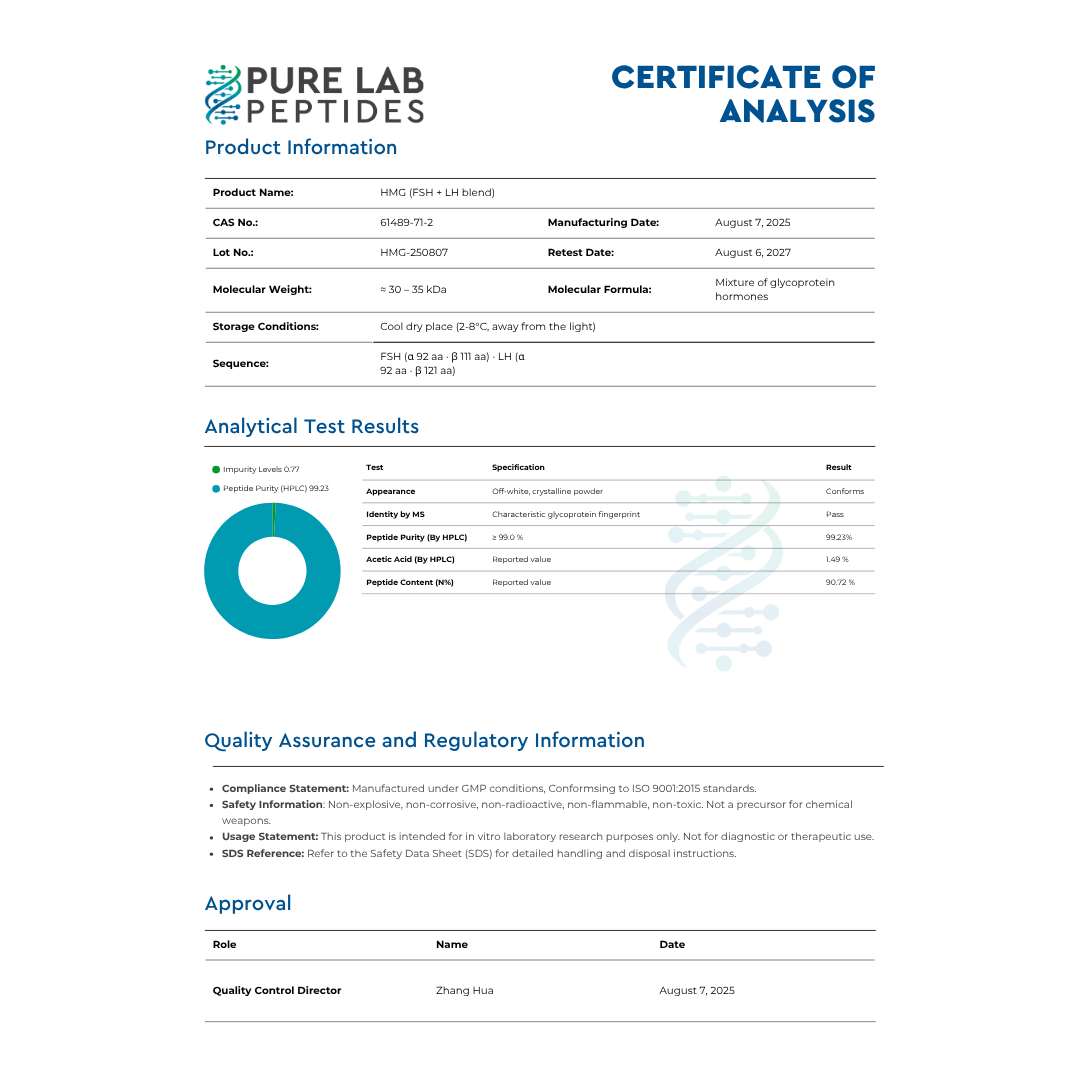
COA documentation is central to HMG research procurement. A certificate of analysis should be batch-specific and should connect the compound name, lot number, testing method, purity data, identity data, and document date.
NIST reference material guidance explains that certified properties are backed by a certificate of analysis and that traceability connects values and properties to a higher-order reference system when applicable [17]. Although an HMG supplier COA is not the same as a NIST certificate, the documentation principle is useful: values should be stated clearly, and the record should identify what was measured.
Certificate of analysis review matters because a product listing is general, while a COA should be batch-specific. The COA gives the procurement team a document to compare against the label and product information.
For HMG, the COA should support research material review by showing which analytical method was used and which lot the data describes. It should not be treated as a substitute for all quality review.
Batch-specific documentation should include the compound name, lot number, COA date, analytical method, purity or identity result where available, and storage documentation. It may also include lab source, third-party testing status, chromatogram record, or mass data.
For complex glycoprotein hormone research materials, method context matters. Studies of highly purified HMG preparations have used LC-MS/MS and glycopeptide mapping to examine molecular composition and impurity patterns [13].
COA dates support traceability by showing when the batch record was generated or released. They also help procurement teams match records to receiving logs and supplier communications.
A COA without a date, lot number, or method field is weaker than a batch-specific record with aligned documentation.

Purity and identity testing answer related but different questions. Purity review asks what proportion of detected signal or measured material aligns with the target under the stated method. Identity review asks whether the material corresponds to the expected compound or component profile.
ICH Q2(R2) identifies analytical procedure validation concepts for assay, purity, impurity, identity, and other qualitative or quantitative measurements [18]. For research procurement, this supports the idea that method purpose should be clear.
HPLC supports purity review by separating sample components and producing chromatographic data that can show relative peak patterns under specified conditions. A peptide analysis review describes HPLC as a major tool for peptide analysis and purification across modes such as reversed-phase, ion-exchange, and size-exclusion chromatography [19].
For HMG, HPLC data should be interpreted with method notes. A chromatogram is more useful when it is tied to a lot number, method, detector, and COA date.
LC-MS supports identity verification by combining chromatographic separation with mass spectrometry data. LC-MS methods are widely used to analyze peptides and proteins on chromatographic timescales, and LC-MS/MS can support peptide or glycopeptide mapping [20] [21].
For HMG materials, LC-MS or LC-MS/MS documentation may be especially relevant because the research category can involve glycoprotein hormone components rather than a single short peptide.
Chromatography data needs method context because retention time, peak shape, detector type, and sample conditions affect interpretation. ICH Q2(R2) lists separation techniques such as HPLC in the context of analytical validation examples [18].
A chromatogram without method context is only partial evidence. A stronger documentation package links the chromatogram to a COA, lot number, and method summary.
Analytical verification for research procurement should be written as a documentation workflow, not as material-handling guidance. The goal is to verify records, not to describe product preparation.
Mass spectrometry can support molecular identity review by measuring mass-related signals and, in tandem methods, fragmentation patterns. LC-MS/MS peptide mapping has been used in protein characterization workflows, including sequence-dependent digestion maps and peptide identification [21]. A 2023 study also evaluated LC-MS identification challenges for short homologous peptides, showing that identity assignment can require careful method design [22].
For HMG, mass spectrometry should be interpreted within the method and sample context. It is one part of the documentation package.
Reference standards support method review by giving laboratories a defined comparison point when available. USP authors have described reference standards as important tools for peptide quality attributes such as identity and purity in regulated peptide contexts [23]. NIST also explains that reference materials can support accurate measurements, method validation, and quality assurance [17].
For RUO procurement, the practical takeaway is not to assume. Review whether the documentation explains the method basis and any reference material used.
Supplier documentation should connect the product page, label, COA, and storage record. ISO describes ISO/IEC 17025 as a standard that helps testing and calibration laboratories demonstrate competence and generate valid results [24]. NIST’s own measurement-services quality system references ISO/IEC 17025 as part of its measurement-service framework [25].
A supplier does not need to turn a product page into a standards manual. But the supplier documentation should be clear enough for research buyers to evaluate the material.
Lot numbers connect labels and COAs by tying a physical catalog item to a batch-specific record. If the lot number on the label does not match the COA, the documentation chain is incomplete.
For HMG research materials, this match is especially important because a product name alone does not confirm lot-level purity, identity, or analytical data.
Storage documentation supports research material review by showing how the supplier expects the laboratory to maintain the material record. Storage records may include temperature language, light exposure notes, document dates, or receiving-log fields.
If a product is described as lyophilized or freeze-dry in supplier documentation, the product page should still avoid preparation guidance. The safe research focus is storage recordkeeping, documentation consistency, and controlled laboratory handling policies.
Use this checklist before researchers buy HMG for research:
Compare the product listing, label, COA, test report, lot number, storage note, supplier contact record, and receiving log. These documents should reinforce one another.
For HMG, the documentation review should also compare naming conventions. HMG, human menopausal gonadotropin, human menopausal gonadotrophin, menotropin, menotropins, and menotrophin may appear in different sources.
Final review keeps HMG research pages focused by asking four questions:
Pure Lab Peptides supplies compounds for laboratory research use only. Products are not intended for human or animal consumption, diagnostic use, therapeutic use, clinical use, veterinary use, or as food, drugs, cosmetics, dietary supplements, or household products. Researchers are responsible for ensuring lawful, appropriate handling and use in accordance with applicable regulations and institutional guidelines.
Published literature does not equal product-use guidance. A paper can explain gonadotropin signaling, HMG composition, or analytical methods, but it cannot replace a batch-specific COA for a research material.
A purity percentage does not prove complete compound identity. HPLC may support purity review, while LC-MS or LC-MS/MS may support identity review depending on the method and sample context [19] [20].
A COA should be batch-specific. General product information is useful, but lot-level documentation is what connects the material to the record.
Pathway relevance does not equal a product claim. FSHR and LHCGR receptor literature helps define the research lane, but it should not be used to imply product outcomes [9] [11].
Catalog specifications are not product-use guidance. Terms such as HMG 75 IU or 75iu belong in listing and identity context only.
Review the product-page documentation, COA details, analytical testing notes, and RUO labeling before evaluating HMG for laboratory research. For research teams comparing peptide suppliers, prioritize COA availability, transparent labeling, lot-level documentation, and clear separation between published literature and product positioning.
Research use only means HMG is intended solely for controlled laboratory research and documentation review. In this context, researchers evaluate product information, COA records, lot traceability, analytical testing, and supplier documentation. RUO language keeps the page focused on laboratory use, research purposes, and quality standards rather than product claims or non-research positioning.
Researchers should consider documentation first before they buy HMG for research. A research-focused review should include RUO labeling, compound identity, batch-specific COA records, lot number consistency, purity data, identity testing, and storage documentation. The strongest procurement review compares the product listing, supplier documentation, and laboratory records before any research material is accepted into inventory.
HMG and menotropin are closely related naming terms in research literature. HMG commonly refers to human menopausal gonadotropin, while menotropin or menotropins may describe gonadotropin preparations associated with FSH and LH activity [1]. Researchers should compare names, synonyms, CAS or database records, and COA documentation rather than relying on one label alone.
A COA matters for HMG research materials because it provides batch-specific documentation for technical review. Researchers use it to check the compound name, lot number, COA date, purity method, identity method, and supplier record alignment. A COA should support research documentation, but it should also be compared with the label and product information.
Published literature about HMG should be interpreted as research context, not product positioning. Literature may describe gonadotropin preparations, biological activity, analytical characterization, or model-specific findings. Those findings should stay separate from RUO product claims, and researchers should rely on batch-specific documentation for the material being evaluated.
Documentation that supports HMG identity review includes the product listing, synonym records, CAS or database references, COA documentation, lot number, analytical testing notes, and supplier documentation. For materials described as extracted from urine or aligned with gonadotropin preparations, identity review should be especially careful. HPLC and LC-MS records can support purity and identity review when properly documented [19] [20].
The following authors are recognized for published research that helped shape the scientific context discussed in this article.
Author profile: LE STUDIUM Profile
Livio Casarini’s published work is relevant to the HMG research page because it addresses gonadotropin signaling, receptor pathway interpretation, and model-specific analysis of human menopausal gonadotrophin materials. His articles help frame how literature on FSH, LH, hCG, and receptor signaling can be read as scientific context for an RUO product page. This is especially useful for separating pathway-focused research from supplier documentation, COA review, and analytical testing for laboratory research materials. His publications also support careful discussion of composition, immunoassay, and early signaling data while keeping product-page language centered on compound identity and batch records.
Selected publications:
Author profile: Wichita State University Profile
George R. Bousfield’s published work is relevant because it examines glycoprotein hormone structure, FSH glycosylation, mass spectrometry, and macro- and microheterogeneity in pituitary and urinary follicle-stimulating hormone materials. His work helps support the article’s explanation that HMG and related gonadotrophin materials require careful identity and analytical context rather than a single generic label. His glycoprotein-hormone research also informs how qualified professionals can read composition, glycan, and receptor-related literature alongside COA and lot-level documentation. That background is useful for a documentation-focused research lane because HMG discussions often involve FSH-related source context and glycan characterization rather than a simple single-component identity record.
Selected publications:
This research disclaimer clarifies how this page handles published literature and search language around HMG. In gonadotrophin and glycoprotein hormone research content, terms such as fertility, IVF, assisted reproductive technologies, ovarian stimulation, controlled ovarian stimulation, ovulation induction, follicular development, maturation, medication, fertility medication, Food and Drug Administration, and investigational can drift into clinical-use, consumer-facing, regulatory, or product-claim language when framed incorrectly.
Here, those phrases are treated only as research-language examples and literature-context signals, not product uses, outcomes, instructions, or recommendations. HMG product-page interpretation should remain centered on compound identity, COA review, analytical testing, peptide purity, lot traceability, RUO labeling, product documentation, model-specific research context, and published literature boundaries.
Discount Applied Successfully!
Your savings have been added to the cart.


There are no reviews yet.