





$39.99
Research Studies:


FREE Shipping on
orders over $200
ALL ARTICLES AND PRODUCT INFORMATION PROVIDED ON THIS WEBSITE ARE FOR INFORMATIONAL AND EDUCATIONAL PURPOSES ONLY. The products offered on this website are intended solely for research and laboratory use. These products are not intended for human or animal consumption. They are not medicines or drugs and have not been evaluated or approved by the FDA to diagnose, treat, cure, or prevent any disease or medical condition. Any form of bodily introduction is strictly prohibited by law.
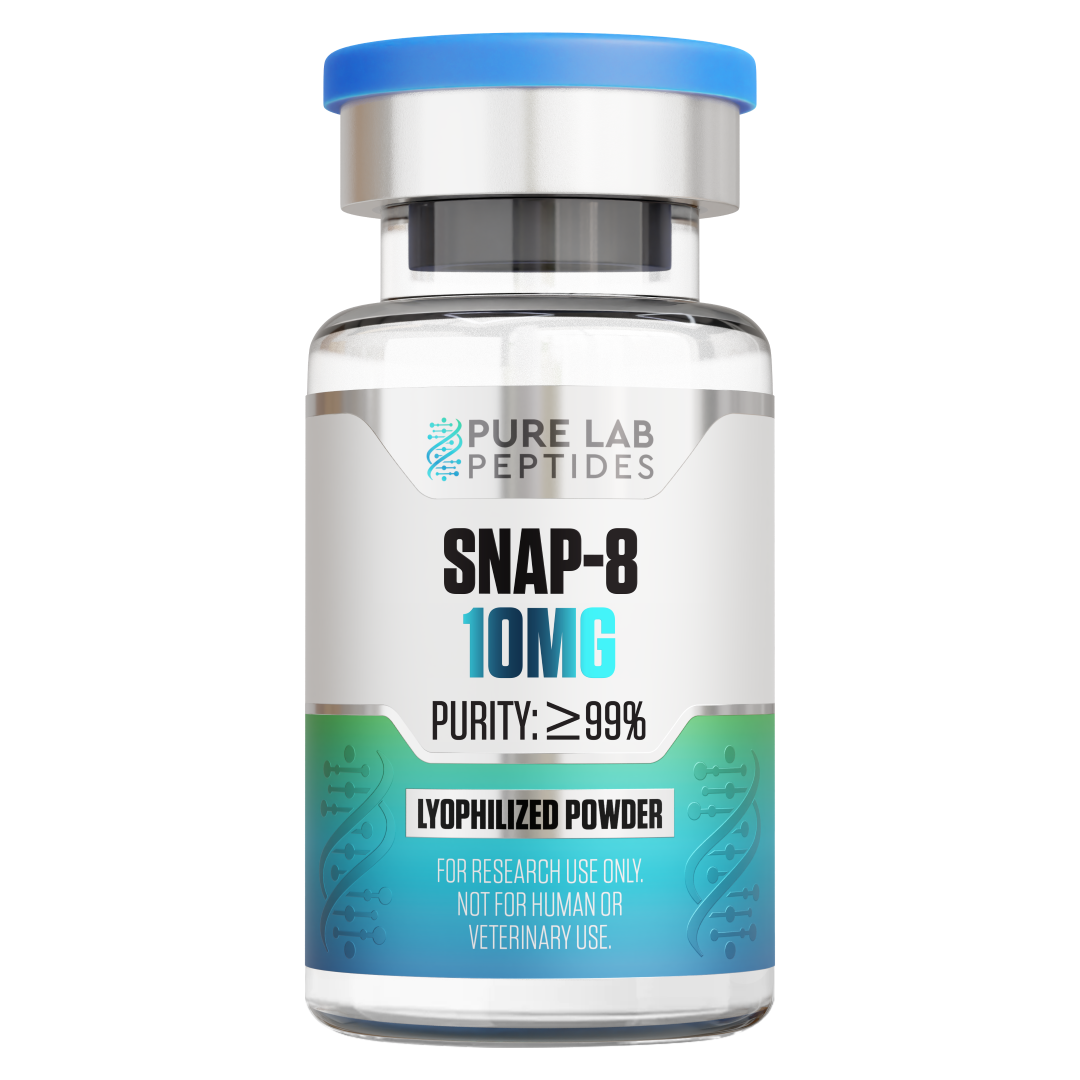
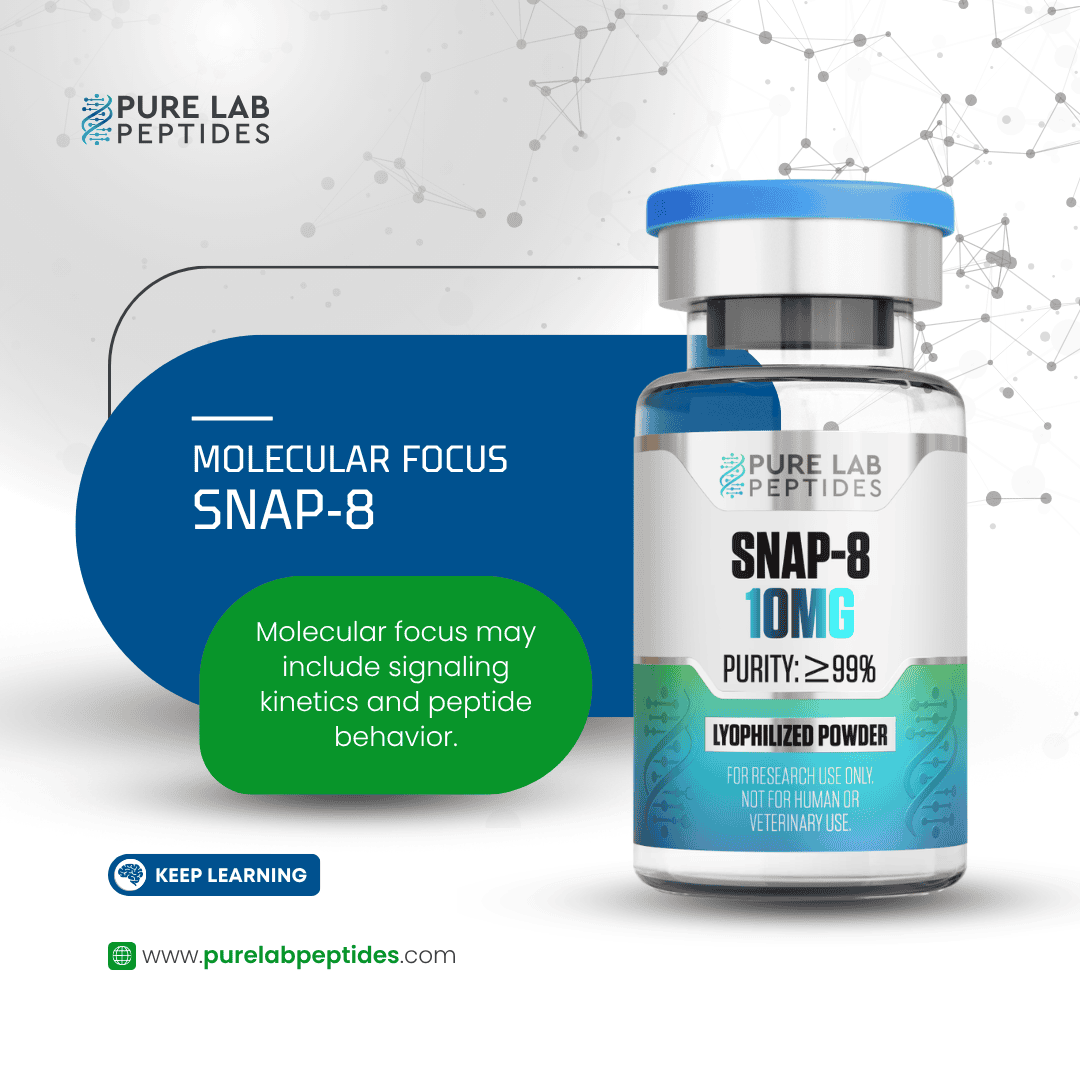
SNAP-8 10mg is a research-use-only laboratory material supplied for controlled research workflows, compound characterization, and analytical documentation review. It is manufactured under rigorous quality standards to support consistency, traceability, and batch-specific verification for qualified laboratory settings.
SNAP-8 10mg is intended strictly for laboratory research use only. This product is not intended for human or animal consumption, therapeutic use, diagnostic use, clinical use, veterinary use, or as a food, drug, cosmetic, dietary supplement, or household product.
| CAS No. | 868844-74-0 |
|---|---|
| Molecular Formula | C41H70N16O16S |
| Molecular Weight | 1075.2 g/mol |
| Purity | ≥99% |
| Sequence | Acetyl-Glu-Glu-Met-Gln-Arg-Arg-Ala-Asp-NH2 |
| Synthesis Method | Solid-phase synthesis |
| Format | Lyophilized powder |
| Solubility | Water/Sterile Diluent |
| Stability & Storage | Up to 24 months at -20°C. Avoid repeated freeze-thaw cycles. |
| Applications | Cosmetic peptide research, neuromodulation studies, anti-aging skincare development |
| Appearance | White to off-white powder |
| Regulatory/Compliance | Not for human consumption. For research use only. |
| Safety Information | MSDS available upon request |
Consider these supplementary peptides for a comprehensive research approach.
Researchers searching for buy SNAP-8 online should evaluate SNAP-8 as a research-use-only laboratory material, not a consumer product. For laboratory buyers, the key considerations are compound identity, SNAP-8 COA documentation, purity documentation, identity testing, lot traceability, product labeling, and supplier evaluation. This guide explains how to evaluate SNAP-8 research material for controlled research procurement through Pure Lab Peptides.
Researchers can buy SNAP-8 online for laboratory research by reviewing RUO labeling, batch-specific COA documentation, purity data, identity information, storage guidance, and supplier transparency before selecting a source. Products discussed in this article are intended for laboratory research use only and are not intended for human or animal consumption.
The phrase “buy SNAP-8 online” is addressed here as laboratory research procurement intent, not personal-use intent. In a qualified laboratory setting, the search is not about outcomes, self-use, protocols, or consumer positioning. It is about whether the supplier provides enough documentation for a technical procurement team to evaluate the material before purchase.
For SNAP-8 research-use-only procurement, researchers should confirm that the product is clearly labeled for research use only, that a batch-specific certificate of analysis is available, and that supplier documentation supports identity, purity, lot traceability, product form, and storage conditions. FDA guidance on RUO labeling in the in vitro diagnostic context distinguishes research-use positioning from clinical diagnostic use, which is a useful boundary concept for documentation review even though SNAP-8 is not being discussed here as an IVD product [1].
SNAP-8 is commonly associated with acetyl octapeptide-3, an acetylated peptide name found in chemical and substance databases. PubChem identifies acetyl octapeptide-3 and lists SNAP-8 among associated names, while NCATS Inxight Drugs records acetyl octapeptide-3 with UNII 8K14HJF88S and CAS 868844-74-0 [2] [3]. The NCI Dictionary defines peptides as molecules containing two or more amino acids, a useful general definition for classifying SNAP-8 as a peptide research material [4].
NCATS records the common sequence descriptor “Ac-Glu-Glu-Met-Gln-Arg-Arg-Ala-Asp-NH2” for acetyl octapeptide-3 [3]. Researchers should treat sequence, molecular formula, molecular weight, and synonym fields as identity documentation elements that must match the product page, label, and COA. If database records, supplier fields, or internal purchasing records use different naming conventions, procurement teams should resolve those differences before logging the material into a laboratory inventory system.
SNAP-8 appears in published literature related to peptide-derivative and SNAP-25/SNARE-context research, but those references should be used as background only. Published research context should not be interpreted as cosmetic, therapeutic, wellness, cognitive, or product-use guidance for RUO materials.
Researchers search this phrase to locate RUO product availability and compare supplier documentation. A qualified team looking to buy SNAP-8 should review whether the material is supplied with RUO labeling, SNAP-8 purity documentation, SNAP-8 identity testing, lot-level documentation, storage information, and batch-specific COA access.
Commercial search intent can be satisfied without consumer-style language. The research procurement question is whether the supplier gives enough information to support purchasing records, receiving records, inventory controls, and analytical review. It is not a prompt for dosing, preparation, administration, or product-use instructions.
Researchers evaluating where to buy SNAP-8 online for laboratory research should focus on documentation quality, not promotional language. Analytical-method guidance from FDA and ICH emphasizes that identity, purity, and quality-related documentation should be supported by appropriate analytical procedures and validation principles [5] [6] [7].
| Evaluation Area | What Researchers Should Review | Why It Matters for RUO Procurement |
| RUO labeling | Confirm the product is clearly labeled for research use only | Helps separate research procurement from human-use positioning |
| COA availability | Review the batch-specific certificate of analysis | Supports lot-level documentation and quality review |
| Purity data | Look for analytical support for the stated purity | Helps evaluate material consistency |
| Identity testing | Review HPLC, LC-MS, mass spectrometry, or related identity data | Helps confirm the material matches the listed compound |
| Lot traceability | Match lot numbers across product and documentation | Supports research recordkeeping |
| Product form | Confirm whether the material is supplied as lyophilized powder or another documented form | Supports laboratory planning |
| Storage information | Review storage and handling documentation | Helps maintain material integrity in laboratory settings |
| Supplier language | Confirm the supplier avoids dosing, therapeutic, or personal-use claims | Supports research-use-only positioning |
SNAP-8 supplier documentation should be reviewed as a complete package. Researchers should look for compound name, synonym alignment, lot number, test date, stated purity, testing method, identity confirmation, molecular weight or sequence information, product form, storage guidance, and batch-specific documentation. A SNAP-8 COA is strongest when the lot number on the COA matches the product label and receiving record.
A purity percentage alone does not establish complete compound identity; researchers should evaluate purity, identity, method, lot number, and documentation together. Published analytical work has specifically described LC-MS/MS method development for acetyl octapeptide-3 analysis, illustrating how targeted mass-spectrometric methods can support peptide identification and quantification in a defined analytical context [8]. Broader peptide analysis literature also supports the role of HPLC and mass spectrometry in peptide analysis and characterization [9] [10].
For laboratory recordkeeping, testing-laboratory context also matters. ISO/IEC 17025 describes competence, impartiality, and consistent operation expectations for testing and calibration laboratories, while NIST describes quality-system alignment with ISO/IEC 17025 for measurement services [11] [12].
SNAP-8 should be discussed as a research-use-only peptide material. Database records identify acetyl octapeptide-3 names, identifiers, and sequence descriptors; those records support identity review rather than product-use claims [2] [3].
The SNAP-8 name is often discussed in relation to SNAP-25 and SNARE literature. UniProt identifies SNAP-25 as a t-SNARE involved in molecular regulation of neurotransmitter release, and structural literature describes SNARE-complex formation involving synaptobrevin/VAMP, syntaxin, and SNAP-25 [13] [14]. Additional reviews and experimental papers discuss SNARE and Munc18 roles in synaptic vesicle fusion, assembly interactions involving syntaxin and SNAP-25, and binding of SNAP-25 with syntaxin and synaptobrevin [15] [16] [17].
Some review articles classify acetyl octapeptide-3/SNAP-8 within cosmetic peptide literature, but this article does not convert those discussions into product claims, consumer guidance, or laboratory-use instructions [18] [19]. Published clinical literature should not be interpreted as use guidance for RUO materials. Published literature related to SNAP-25, SNARE complexes, peptide derivatives, or cosmetic ingredient contexts should not be converted into product-use claims for RUO materials.
| Research Area | What Literature Examines | Evidence Type | RUO Interpretation |
| Compound identity | Molecular structure, sequence, formula, names, identifiers, or classification | Database / analytical | Supports identification, not product-use claims |
| Pathway or category context | SNAP-25, SNARE complex, peptide derivative, or model-specific research area | Review / in vitro / structural | Useful for research context, not therapeutic claims |
| Analytical testing | Purity, identity, and batch verification | HPLC / LC-MS / mass spectrometry / COA | Supports documentation review |
| Storage and stability | Material form and handling considerations | Laboratory documentation / stability literature | Supports research workflow planning |
Peptide stability literature emphasizes that peptide materials can be affected by chemical and physical stressors, so storage documentation should be treated as part of procurement review rather than an afterthought [20] [21].
| Research-Safe Statement | Why It Is Acceptable | Non-Compliant Version to Avoid |
| “SNAP-8 is discussed in published research related to peptide-derivative and SNAP-25/SNARE literature.” | Describes literature context without making a product claim | “SNAP-8 helps with a human outcome.” |
| “Researchers should review COA and identity data before procurement.” | Focuses on documentation and quality review | “Users should buy SNAP-8 for results.” |
| “Pure Lab Peptides supplies SNAP-8 as a research-use-only material.” | Clarifies intended use | “Pure Lab Peptides supplies SNAP-8 for therapy.” |
| “The phrase buy SNAP-8 online is addressed as research procurement intent.” | Qualifies commercial search intent | “Buy SNAP-8 online for personal use.” |
| “SNAP-8 supplier documentation should include purity and identity review.” | Centers the procurement decision on analytical documentation | “Supplier claims can replace analytical documentation.” |
Pure Lab Peptides presents SNAP-8 10mg as a research-use-only material. The product is positioned for laboratory research, with a ≥99% purity claim, lyophilized powder form, batch-specific COA availability, product page documentation, storage and handling information, lot-level traceability, and supplier transparency.
Review the Pure Lab Peptides SNAP-8 research-use-only product details for RUO labeling, product details, purity information, and batch-specific documentation. Researchers comparing SNAP-8 supplier documentation may also review the broader Pure Lab Peptides research peptide collection, educational resources at Pure Lab Peptides blogs, and fulfillment information at shipping and returns.
Buy SNAP-8 online should not be interpreted as personal-use guidance on this page. The phrase is addressed as laboratory procurement intent for qualified researchers reviewing RUO labeling, documentation, purity data, identity information, and supplier transparency.
Published literature can provide background on peptide identity, analytical methods, SNAP-25 terminology, or SNARE-related research. It does not provide permission to convert RUO material into consumer, clinical, veterinary, therapeutic, or diagnostic guidance.
SNAP-8 purity documentation is important, but purity alone is incomplete. Researchers should review identity testing, method information, lot number, product name, sequence or molecular identity fields, and COA consistency together.
For research procurement, batch-specific documentation is central. A general example COA may be useful for previewing format, but purchasing and receiving records should be supported by documentation linked to the actual lot.
Supplier language cannot replace analytical documentation. Researchers should prioritize batch-specific SNAP-8 COA records, identity testing, purity documentation, lot traceability, storage information, and RUO labeling over promotional descriptions.
Researchers can buy SNAP-8 online for laboratory research by selecting an RUO supplier that provides product labeling, batch-specific COA access, purity documentation, identity information, storage guidance, and lot-level traceability. Pure Lab Peptides provides a SNAP-8 product page for reviewing RUO product details and documentation.
Before buying SNAP-8 online, researchers should check RUO labeling, SNAP-8 COA availability, lot number alignment, identity testing, purity documentation, product form, storage information, and supplier language. The supplier should not position the material for personal, clinical, veterinary, diagnostic, or therapeutic use.
A SNAP-8 COA matters because it gives researchers batch-specific documentation for procurement review. A useful COA should support the product name, lot number, purity, analytical method, identity information, and documentation consistency. It should be reviewed with the label and product page, not in isolation.
SNAP-8 discussed on this page is not intended for human or animal consumption. It is discussed only as a research-use-only laboratory material. This article does not provide dosing, preparation, administration, clinical, veterinary, wellness, or consumer guidance.
Research use only means SNAP-8 is positioned as a laboratory research material for qualified research settings. RUO positioning requires careful supplier language, documentation review, and procurement controls. It does not support consumer use, medical use, diagnostic use, veterinary use, or outcome-based product claims.
Published literature about SNAP-8 should be interpreted as scientific context, not as product-use guidance. Database, analytical, SNAP-25/SNARE, and peptide-formulation references may support identity or background review, but they should not be converted into claims about RUO material outcomes.
Qualified researchers evaluating SNAP-8 should review product labeling, COA status, identity documentation, purity information, storage information, and supplier transparency before selecting any research-use-only material. Review the SNAP-8 product page for RUO labeling, purity information, and available batch-specific documentation.
Our team is ready to assist you with any inquiries regarding our catalogue of peptides and their applications.
Discount Applied Successfully!
Your savings have been added to the cart.
Pure Lab Peptides
You must be at least 21 years of age to enter this site. By entering, you confirm that you are of legal age and agree to our terms.
For research use only.

There are no reviews yet.