


Researchers who want to buy Cartalax for research need more than a catalog listing; they need compound identity, RUO labeling, COA data, purity evidence, and lot-level documentation. Cartalax is listed in PubChem as alanyl-glutamyl-aspartic acid, also known as Ala-Glu-Asp, with the sequence AED and a molecular weight of 333.29 g/mol [1]. This guide frames Cartalax peptide review for laboratory research only, separating published literature from product claims and practical documentation review.
To buy Cartalax for research, evaluate RUO labeling, batch-specific COA documentation, peptide identity, purity testing, and lot traceability before any supplier decision. Products discussed in this article are intended for laboratory research use only and are not intended for human or animal consumption. Cartalax review should stay focused on research documentation, analytical verification, and published literature boundaries.
The phrase buy Cartalax can look commercial by itself. For a research-use-only product page, the safer and more accurate framing is buy Cartalax for research, where the intent is supplier documentation review, not personal-use guidance.
That reframing matters because product-page copy should answer research procurement questions. The useful questions are: Does the label identify the compound clearly? Does the COA match the lot? Are purity and identity methods visible? Is the page limited to laboratory research use?
The first layer is compound identity. Cartalax should align with the AED peptide identity shown in authoritative chemical records, including the Ala-Glu-Asp sequence, molecular formula C12H19N3O8, and molecular weight 333.29 g/mol [1].
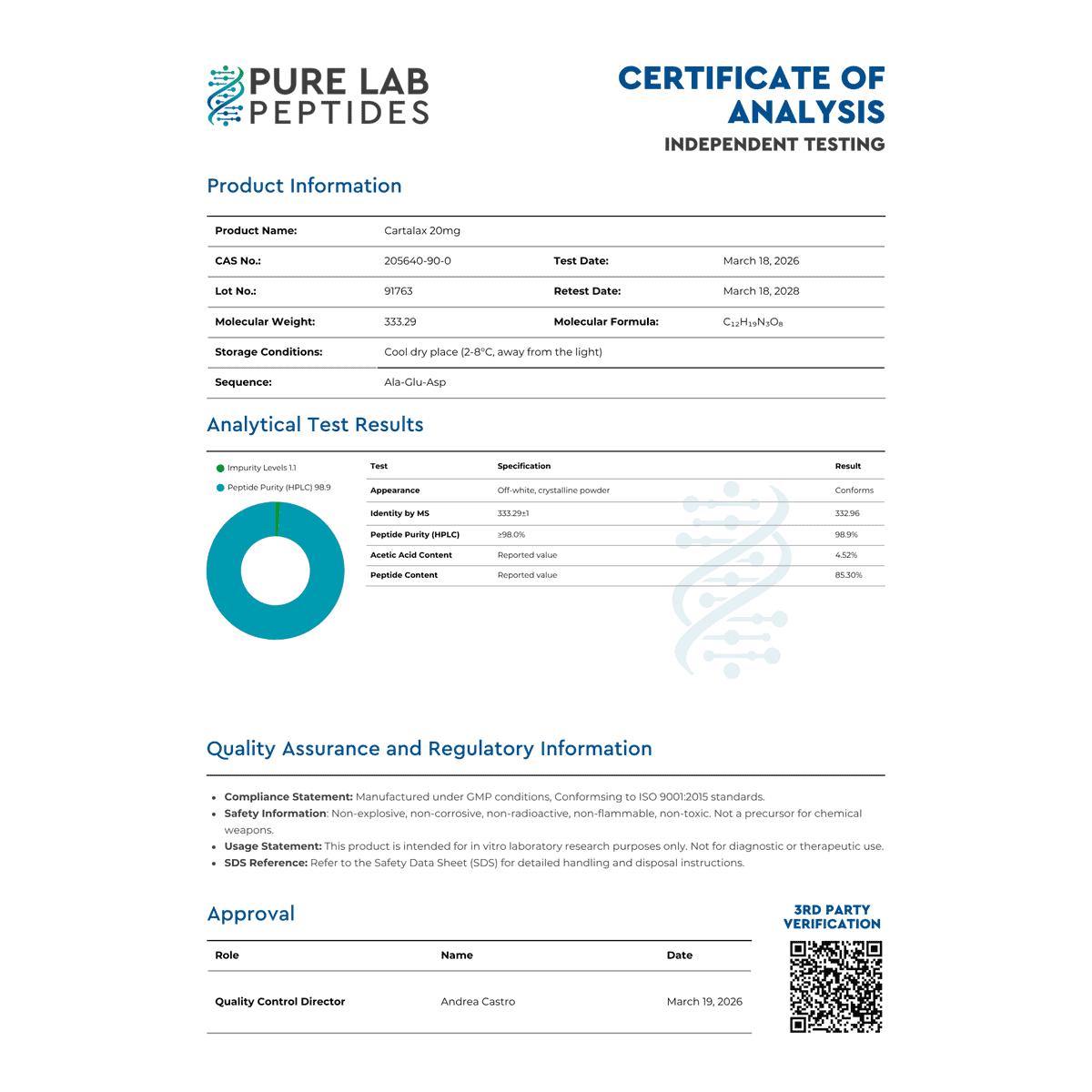
The next layer is batch documentation. A research buyer should review the certificate of analysis, test date, purity method, identity method, lot number, and product label together rather than treating any single document as complete evidence.
RUO labeling should appear before any commercial review. A Cartalax research material listing should make clear that the compound is intended for research purposes and sold for laboratory research use.
The practical rule is simple: if the page shifts toward consumer outcomes, product effects, or product performance, it leaves the documentation lane. RUO product pages should stay centered on compound identity, analytical testing, and literature interpretation.
Cartalax is a short synthetic peptide associated with the sequence Ala-Glu-Asp, often abbreviated AED [1]. In peptide bioregulator literature, short peptides have been studied as signal molecules in model systems, including publications that discuss DNA-peptide interactions, gene expression, and cellular regulatory context [6] [7].
The research context is narrow. Cartalax is not positioned here as a clinical-use material, wellness product, or consumer compound; it is discussed as a research peptide requiring documentation review.

Cartalax is a synthetic tripeptide because it contains three amino acid residues: alanine, glutamic acid, and aspartic acid [1]. PubChem lists the IUPAC condensed form as H-Ala-Glu-Asp-OH and the sequence as AED [1].
For product-page documentation, that identity should be consistent across the product label, COA, analytical report, and peptide catalog entry. A mismatch between compound name, sequence, formula, or lot details should be resolved before a research procurement decision.
AED belongs to the short peptide category because it contains only three residues. Khavinson, Linkova, and coauthors have published model-based work proposing that some short peptides can interact with DNA sequence motifs, including a report that modeled AED binding to an ACCT DNA sequence [6].
That literature is mechanistic and model-specific. It can inform research context, but it should not be converted into a product claim for a research material.
The sequence Ala-Glu-Asp contains glutamic acid and aspartic acid as its second and third residues [1]. Those residues are part of the compound identity, so they belong in sequence verification and supplier documentation.
For technical procurement teams, the key point is consistency. The label, COA, and analytical documentation should point to the same peptide identity rather than using vague naming alone.
Cartalax research use should be framed around laboratory documentation, peptide identity, and literature context. The page should not suggest Cartalax as a wellness, cosmetic, clinical, fitness, or personal-use product.
A canonical product page can still serve commercial research intent. It does that by answering documentation questions that qualified researchers and technical buyers need before evaluating a research-use-only peptide.
A clear research material listing names the compound, identifies the research category, describes available documentation, and avoids unsupported biological claims. For Cartalax, that means aligning the product-page language with the AED peptide identity and keeping scientific discussion separate from product positioning [1].
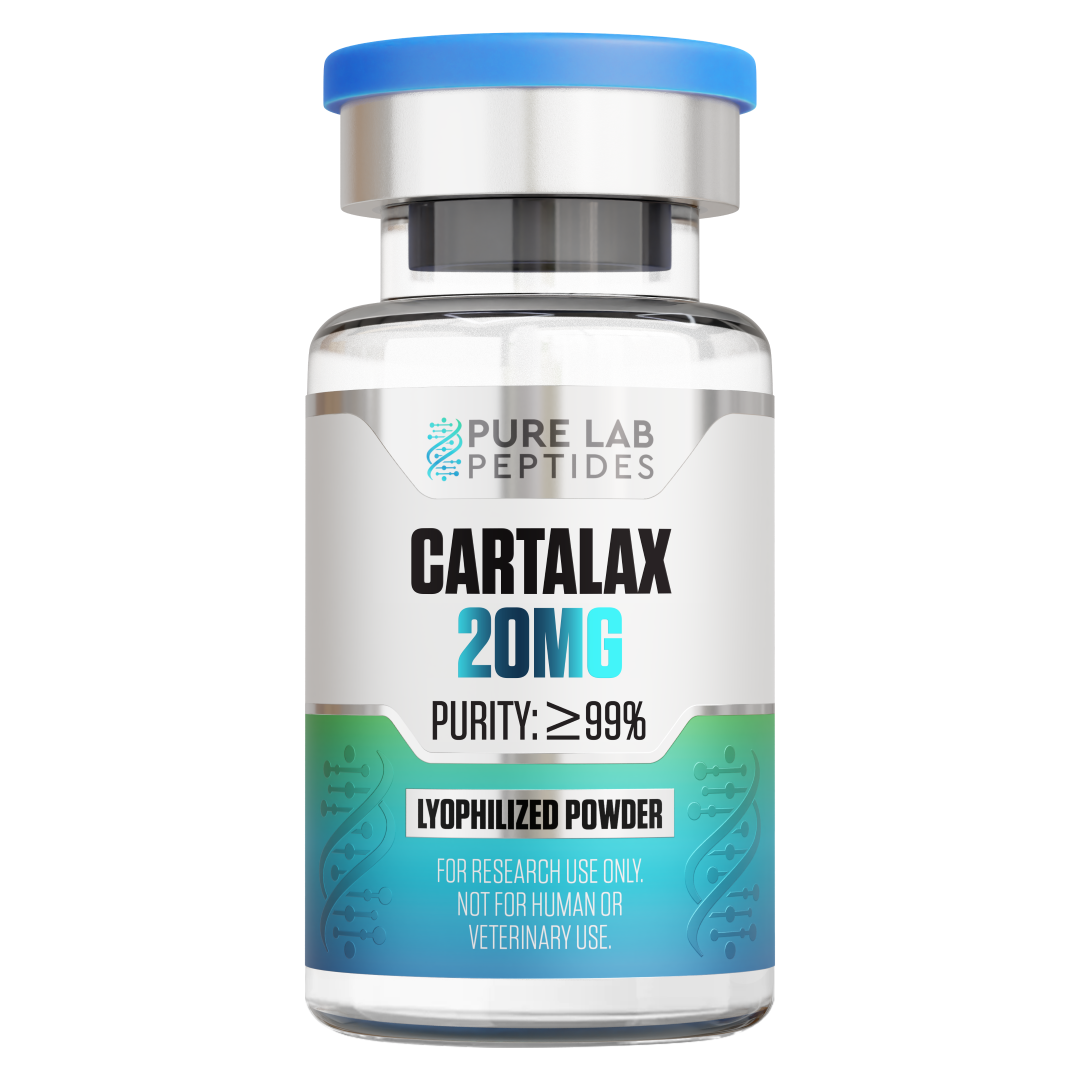
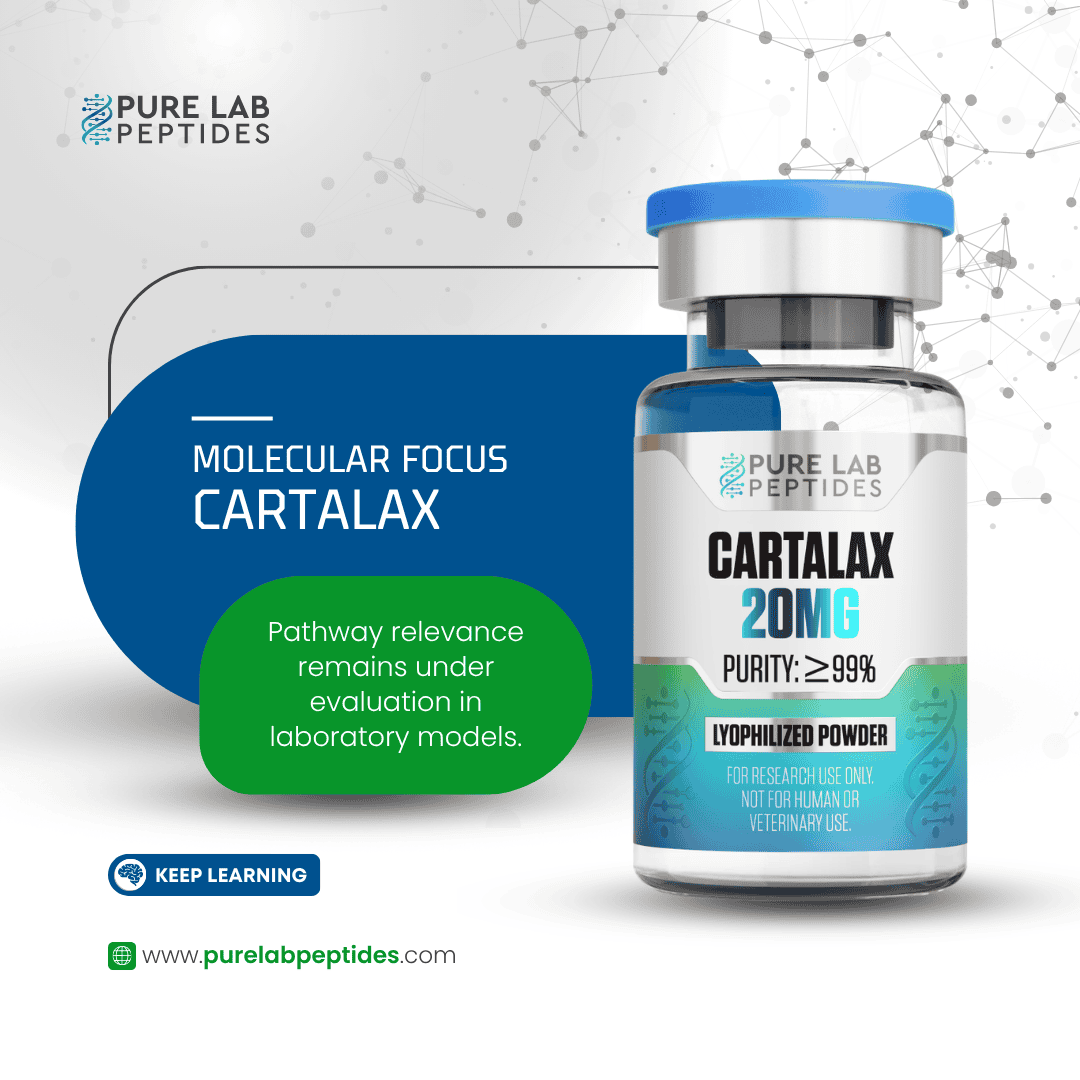
The listing can also note catalog-level details such as a peptide vial or a listing amount like 20mg. Those details should remain catalog specifications only, not separate SEO targets or research claims.
Pure Lab Peptides should frame Cartalax as a research-use-only peptide compound with documentation-centered product information. That positioning supports laboratory research, procurement review, COA checking, and lot-level recordkeeping.
The page should also keep published literature in its own lane. Literature can explain what researchers have examined, while product copy should describe what documentation is available for the research material.
Published literature around Cartalax overlaps with broader peptide bioregulator research, short peptides, cellular aging models, and chondrogenic differentiation models [2] [4] [7]. Much of this literature comes from a concentrated research network, so source quality and independent corroboration are important.
The safest product-page approach is to summarize the literature neutrally. Say what researchers examined, what model was used, and why the finding remains limited to that research context.
Khavinson, Linkova, and coauthors have published several papers and reviews on short peptides, peptide bioregulation, and gene expression models [6] [7]. Their systematic review describes peptides as molecules studied across several biological systems and discusses gene expression regulation as a central theme [7].
For a Cartalax product page, that background should be treated as literature context. It should not imply that every supplier material has the same properties as a compound used in a specific study.
One PubMed-indexed study examined Ala-Glu-Asp and other short peptides in mesenchymal stem cell aging cultures and reported changes in genes including IGF1, FOXO1, TERT, TNKS2, and NF-κB in model-specific conditions [4]. Another in vitro paper reported marker changes in fibroblast aging models, including MMP-9, Ki-67, CD98hc, and caspase-dependent apoptosis markers [5].
Those findings are research observations. They should not be presented as Cartalax product claims.
In vitro research is useful because it allows researchers to examine cell behavior, gene expression, protein synthesis, and pathway markers under controlled model conditions. A 2023 PubMed-indexed paper examined AED peptide and a cartilage polypeptide complex in mesenchymal stem cell chondrogenic differentiation models during replicative aging [3].
The important limitation is that in vitro findings are not product-use guidance. They describe model conditions, not buyer outcomes.
Cartilage and connective tissue research can provide context for Cartalax because AED appears in studies that discuss chondrogenic differentiation, extracellular matrix markers, and cartilage-related protein synthesis [2] [3]. The research application is the study model, not a product promise.
In a product-page guide, the safest wording is “cartilage research context” or “connective tissue research model.” Avoid language that turns a model finding into a supplier claim.
Cartilage cells, chondrocyte biology, and chondrogenic differentiation models help researchers study extracellular matrix formation and cartilage-specific markers. The 2023 Cartalax-related paper examined SOX9, aggrecan, type II collagen, and COMP in mesenchymal stem cell culture conditions [3].
These markers are part of research interpretation. They should be discussed as literature variables, not product outcomes.
Cartilage extracellular matrix is commonly described as a network rich in type II collagen, proteoglycans, hyaluronan, and related structural components [8] [10]. Chondrocyte behavior is shaped by cell-matrix interactions, mechanical cues, and signaling pathways within that matrix environment [8] [9].
This helps explain why literature around Cartalax peptide bioregulator research often sits near extracellular matrix, collagen, and chondrocyte terminology. It does not justify unsupported claims for a product listing.
Cartalax research is often described through cellular pathways and gene expression. Published short-peptide literature has examined DNA-peptide interaction models, gene expression markers, and cellular signaling context [6] [7].
A research page should keep this technical. Pathway relevance means a topic belongs in the literature review; it does not mean the product page can claim a biological outcome.
Gene expression terms belong in the article when they are tied to specific study models. For example, a mesenchymal stem cell aging culture paper examined IGF1, FOXO1, TERT, TNKS2, and NF-κB expression in relation to short peptides including AED [4].
A separate chondrogenic differentiation paper examined SOX9, aggrecan, type II collagen, and COMP in model conditions [3]. The product-page summary should identify those markers as research variables.
Cartilage pathway discussion can include extracellular matrix signaling, chondrogenic differentiation markers, collagen context, aggrecan context, and chondrocyte-related signaling. Reviews of cartilage extracellular matrix describe integrin-mediated cell-matrix interactions and pathways involved in chondrogenesis [8].
For Cartalax research, those pathways provide a map for interpreting literature. They are not claims about a Pure Lab Peptides product.
A pathway is a research framework. It helps researchers organize questions about cell signaling, gene expression, protein synthesis, and model-specific changes.
The claim boundary is simple. A paper may examine a pathway under defined study conditions, but a research-use-only product page should not convert that pathway discussion into consumer-facing claims, clinical-use language, or supplier performance promises.
The word regeneration can be used safely when it refers to a biological research field or model-specific literature. It should not be used as a product claim for Cartalax, nor should it imply a real-world outcome.
In Cartalax research, safer wording includes “cartilage regeneration literature,” “chondrogenic differentiation model,” and “connective tissue research context.” These phrases keep the discussion in the research lane.
In biological research, regeneration refers to a study area involving tissue models, cell differentiation, extracellular matrix formation, and related biological processes. In cartilage-focused literature, researchers may examine markers such as aggrecan, collagen, COMP, and SOX9 when studying chondrogenic differentiation [2] [3].
For RUO product-page writing, regeneration remains a literature category. It should not be written as a product promise.
Common misunderstandings should be addressed clearly:
Some published literature outside the scope of RUO product use has examined this compound class in human study settings. That literature should not be interpreted as a use claim for research-use-only materials.

Evidence interpretation starts with source type. A PubChem record supports identity data, a cell culture paper supports model-specific findings, a review summarizes a field, and analytical-method literature supports testing interpretation [1] [7] [11] [12].
| Research Area | What Literature Examines | Evidence Type | RUO Interpretation |
|---|---|---|---|
| Compound identity | PubChem lists Ala-Glu-Asp, AED, Cartalax, formula C12H19N3O8, and molecular weight 333.29 g/mol [1] | Official database | Useful for identity documentation; not a biological claim |
| Short-peptide literature | Reviews and model papers discuss short peptides, DNA-peptide interactions, and gene expression context [6] [7] | Review and modeling literature | Supports literature context; not product positioning |
| Chondrogenic models | AED-related work has examined SOX9, aggrecan, type II collagen, and COMP in mesenchymal stem cell cultures [3] | In vitro research | Model-specific findings only |
| Cellular aging models | Short-peptide papers have examined cellular aging markers in cell culture systems [4] [5] | In vitro research | Supports research discussion, not consumer outcomes |
| Analytical verification | HPLC is widely used for peptide separation and purity review; MS and LC-MS are used for synthetic peptide identity work [11] [12] [13] | Analytical literature | Supports COA and documentation review |
This evidence ladder is a practical way to avoid overstatement. Each source type answers a different question.
Tissue cultures differ by cell type, passage state, medium, exposure conditions, marker panel, and analytical endpoint. A mesenchymal stem cell model cannot be treated as the same evidence category as a fibroblast model, even when both involve short peptides [3] [5].
That distinction matters for Cartalax research. Study findings should be organized by model, not bundled into broad product language.
A source quality filter should start with peer-reviewed papers, PubMed-indexed abstracts, official databases, and method references. Vendor pages, forum posts, and unsourced summaries should not be used as scientific evidence.
For Cartalax, especially, source quality matters because much of the peptide bioregulator literature comes from a concentrated author network. A careful review should separate primary data, review claims, database identity records, and supplier documentation.
Reproducibility depends on clear compound identity, defined study conditions, transparent methods, and repeatable analytical endpoints. Analytical validation frameworks also emphasize method characteristics such as specificity, accuracy, precision, range, and robustness for procedure evaluation [14].
For procurement teams, reproducibility begins before the experiment. It starts with making sure the research material and documentation tell the same story.
A certificate of analysis is a core document for research material review. NIST describes certificates of analysis in reference material contexts as documents that state certified properties for measured materials, which helps explain why COA structure and traceability matter in scientific documentation [16].
For Cartalax peptide review, the COA should be batch-specific when possible. It should not be treated as interchangeable across unrelated lots.

A useful COA should identify the compound name, lot number, test date, testing method, purity result, identity result, and lab source. The COA should be compared against the product label and supplier documentation.
The COA is not the whole quality story. It is one document in a chain that also includes label consistency, analytical methods, storage notes, and lot traceability.
Batch-specific data ties the document to the research material under review. If a COA lacks a lot number or refers to a different batch, it may not support the material being evaluated.
NIST reference material documentation emphasizes traceability and certified property values in measurement contexts [16]. For research peptide procurement, the same general principle applies: documents are most useful when they connect clearly to the specific material.
Purity and identity answer different questions. HPLC can support chromatographic purity review by separating peptide-related species, while mass spectrometry can help confirm whether the observed mass aligns with the expected synthetic peptide identity [11] [12].
A strong documentation package should not rely on a purity number alone. It should pair purity data with identity evidence, method notes, and lot-level consistency.
For a documentation-focused laboratory verification workflow:
HPLC is widely used for peptide separation, analysis, and purification, including reversed-phase methods that separate peptides based on chromatographic behavior [12]. In a COA context, HPLC can help show whether a main chromatographic peak dominates under the stated method.
That does not mean HPLC alone proves full identity. Purity review should be paired with identity testing when the research material will be used in sensitive laboratory work.

Mass spectrometry is well suited for synthetic peptide identity and purity analysis, and LC-MS is commonly used when the peptide sequence is already known and the goal is confirmation [11]. LC-MS can compare observed mass data with the calculated molecular weight expected from the peptide sequence [11] [13].
For Cartalax, the expected molecular weight can be checked against the PubChem identity record for Ala-Glu-Asp [1]. Matching mass evidence strengthens identity review when it is tied to the correct lot.
Mass spectrometry documentation may include calculated mass, observed mass, ion information, and method notes. LC-MS literature also highlights that synthetic peptides can show structural modifications or impurities related to starting materials, manufacturing, or storage conditions [13].
For technical procurement, the best practice is to read mass data with the COA, label, and HPLC result together. No single field should be isolated from the documentation package.
Peptide vial labeling should support clarity, not marketing. The label should identify the compound, lot, catalog specification, and research-use-only status.
If a product listing includes 20mg, treat that amount as a catalog specification that should match the label and documentation. It should not become a separate product-page target or imply research instructions.
Research buyers should compare compound name, sequence, lot number, catalog specification, storage notes, and RUO language. The goal is consistency across documents.
A mismatch does not always prove a material is unsuitable, but it does create a documentation question. That question should be resolved before procurement approval.
Lot numbers connect product pages, COAs, labels, and internal research records. Without lot traceability, it becomes harder to interpret experimental variability or reproduce research conditions.
ISO/IEC 17025 describes competence and valid results for testing and calibration laboratories, which is relevant when procurement teams evaluate external laboratory documentation [15]. Lab identity and method clarity matter because a COA is only as useful as the documentation behind it.
Storage and handling documentation should be written for laboratory recordkeeping. It should describe conditions such as temperature range, light exposure, moisture control, and package integrity when supplied by the vendor.
Freeze-drying, also called lyophilization, is a common stability approach for biological and peptide-related materials, but solid-state materials can still undergo chemical change during storage [17] [18]. That is why documentation matters beyond the day of receipt.
Storage notes should be recorded as documentation requirements, not personal-use directions. A laboratory record can include received condition, label statement, storage condition, date received, and internal chain-of-custody notes.
This is especially relevant for research peptides because environmental exposure can affect material integrity. Published stability literature shows that solid-state peptide and protein materials can still undergo degradation pathways during storage [17].
Freeze-drying details can help a lab understand the physical form of the research material. Lyophilized solids are often used to support stability, but analytical characterization remains important because dried materials can still change under storage stress [17] [18].
A product page does not need to over-explain formulation science. It needs to make documentation available and keep the language focused on research material handling.
RUO-focused handling documentation should avoid consumer instructions and stay with laboratory records. Useful fields include product receipt date, label review, lot match, COA review, storage condition, and internal custodian.
For Cartalax research, this keeps the product page practical. The buyer sees what to verify without receiving any personal-use guidance.
Before researchers buy Cartalax for research, supplier documentation should be reviewed as a package. The package should include RUO labeling, batch-specific COA, analytical testing details, lot traceability, storage documentation, and a clear product-page description.
A stronger product page does not need hype. It needs verifiable documentation and careful literature framing.
Research buyers can compare supplier documentation with a simple checklist:
A peptide catalog should use consistent naming, category language, and documentation labels. For Cartalax, safe catalog language includes Cartalax peptide, Cartalax peptide bioregulator, AED peptide, and peptide bioregulator research when the identity is clear [1].
Catalog consistency also helps avoid variant creep. A peptide vial listing can include a catalog amount, but the page should still target the canonical compound: Cartalax.
Before ordering Cartalax for research, a technical buyer should review the product page, COA, lot information, identity data, purity method, labeling, and storage documentation. The final question is not whether the page makes strong claims; it is whether the documentation is strong enough for research procurement review.
Pure Lab Peptides supplies compounds for laboratory research use only. Products are not intended for human or animal consumption, diagnostic use, therapeutic use, clinical use, veterinary use, or as food, drugs, cosmetics, dietary supplements, or household products. Researchers are responsible for ensuring lawful, appropriate handling and use in accordance with applicable regulations and institutional guidelines.
The final procurement checklist should confirm five items: RUO labeling, compound identity, batch-specific COA, analytical method visibility, and lot traceability. It should also confirm that the product page stays separate from consumer-facing or clinical-use language.
For research teams comparing peptide suppliers, prioritize COA availability, transparent labeling, and lot-level documentation. Review the product-page documentation, COA details, and RUO labeling before evaluating this compound for laboratory research.

Claim boundaries keep the page focused on what can be documented. Literature may examine cellular aging, gene expression, cartilage regeneration models, and peptide bioregulation, but product pages should not turn those topics into product claims [3] [4] [7].
The safest final standard is documentation first. Explore Pure Lab Peptides for RUO peptide compounds with research-focused product information and available documentation.
Cartalax peptide is described in research documentation as Ala-Glu-Asp, a short tripeptide also abbreviated as AED [1]. In RUO product-page context, this identity supports compound characterization, peptide identity review, and documentation checks. Researchers should compare the name, sequence, and molecular weight across supplier documentation before they buy Cartalax for research.
Cartalax and cartilage tissue models should be interpreted as research context only. Published literature has examined AED-related peptide work in chondrogenic differentiation and extracellular matrix marker studies [3]. These models may include cartilage-related markers, but the findings should remain separate from product claims and should be reviewed alongside COA data and batch-specific documentation.
Cellular senescence is discussed as a model-specific research topic, not as a product outcome. Cartalax-related literature has examined aging in vitro, gene expression in human mesenchymal research models, and marker panels linked to cellular differentiation [4]. These findings should be read as experimental observations within defined laboratory conditions.
Fibroblast models can help researchers understand how short peptides have been examined in cell-culture systems. Literature on fibroblast functions during their aging has reported marker changes involving cell proliferation, programmed cell death, and caspase 3 in controlled research settings [5]. That context supports literature review, not product positioning or consumer-facing interpretation.
Researchers should review batch-specific documentation for Cartalax because it connects the product label, COA, lot traceability, and analytical testing record. A useful documentation package should support compound characterization through matching identity fields, visible purity data, and clear supplier documentation. HPLC and LC-MS may help support purity and identity review when included in the documentation package [11].
Cartalax product pages should stay research-use-only by focusing on peptide identity, COA review, analytical testing, lot traceability, and published literature boundaries. Boundary-sensitive phrases should not be framed as product claims. RUO content should describe what researchers can verify in documentation, not suggest clinical, wellness, cosmetic, or consumer-facing outcomes.
The following authors are recognized for published research that helped shape the scientific context discussed in this article.
Author profile: RUDN Journal of Medicine Profile
Vladimir Khatskelevich Khavinson authored and coauthored peer-reviewed work on short peptides, gene expression, and peptide bioregulator research. His publications are relevant to the Cartalax research context because they address short-peptide sequence concepts, peptide-DNA interaction models, and gene-expression frameworks that help explain how this research category is discussed in published literature. His work provides background for interpreting peptide bioregulation as a literature topic while keeping product-page discussion focused on research context and documentation.
Selected publications:
Author profile: ORCID
Natalia Sergeevna Linkova’s published work is closely related to the Bioregulator Peptide Research lane discussed in this article. Her publications include chondrogenic differentiation, short-peptide literature, and cell-model research that help frame Cartalax within cartilage, connective tissue, and gene-expression research contexts. Her work is useful for understanding how model-specific peptide findings should be reviewed as published literature rather than product claims.
Selected publications:
This research disclaimer clarifies how this page handles published literature and search language around Cartalax. In bioregulator peptide research content, phrases such as research and clinical studies, tissue repair, tissue health, connective tissue health, effects on cellular aging, direct effects, absorption, bioavailability, clinical outcomes, and regenerative medicine can drift into consumer-facing, administration-focused language, therapeutic language, or product-claim language when framed incorrectly.
Here, those phrases are handled only as research-language examples, not product applications, outcomes, recommendations, or product positioning. The focus remains on Cartalax identity, COA review, analytical testing, peptide purity, lot traceability, RUO labeling, product documentation, and published literature boundaries, including careful separation between model-specific research interpretation and commercial research procurement content.
Discount Applied Successfully!
Your savings have been added to the cart.





There are no reviews yet.