



Tesamorelin Research: Peptide Mechanism and Clinical Trial Results

TL;DR · The short version
Tesamorelin research includes visceral adipose tissue, liver fat and endocrine measurements. They describe different changes, so keep each number with its tissue, participants, follow-up and comparator. A visceral-fat percentage isn’t a percentage change in total body weight.
A headline may keep the percentage while dropping what it measures. With tesamorelin, look for the missing words first: visceral adipose tissue, imaging and the selected participants. Those details tell you what the result can actually answer.
Start with the peptide the experiment used
Quick take: Tesamorelin is a modified GHRH analog. Its structural modification belongs in the study-material description.
The original nonclinical TH9507 study described an analog of human growth hormone-releasing factor, GHRH(1–44)-NH2, with a trans-3-hexenoyl group added at its N-terminal Tyr1. The researchers compared degradation in plasma and biological responses across specific experimental models. The modification slowed degradation relative to the natural peptide under the tested conditions.
The design asks how modifying GHRH changes exposure and activity. The same study reported endocrine and toxicity findings in animals, so improved stability isn’t its whole story. Read the original pharmacology and safety evaluation gives the models and responses behind that description.
Use the paper’s construct and terminal chemistry when comparing its material with your record. A literature description doesn’t certify another vial. The peptide sequence guide explains why those notation details matter.
The mechanism starts with a signal to the pituitary gland, rather than supplying growth hormone directly. GHRH receptors on its somatotropic cells connect peptide recognition to pathways that regulate growth hormone secretion. The original GHRH receptor structure study examines that interaction at the molecular level. A receptor mechanism explains a research question; it does not, by itself, establish a change in body composition.
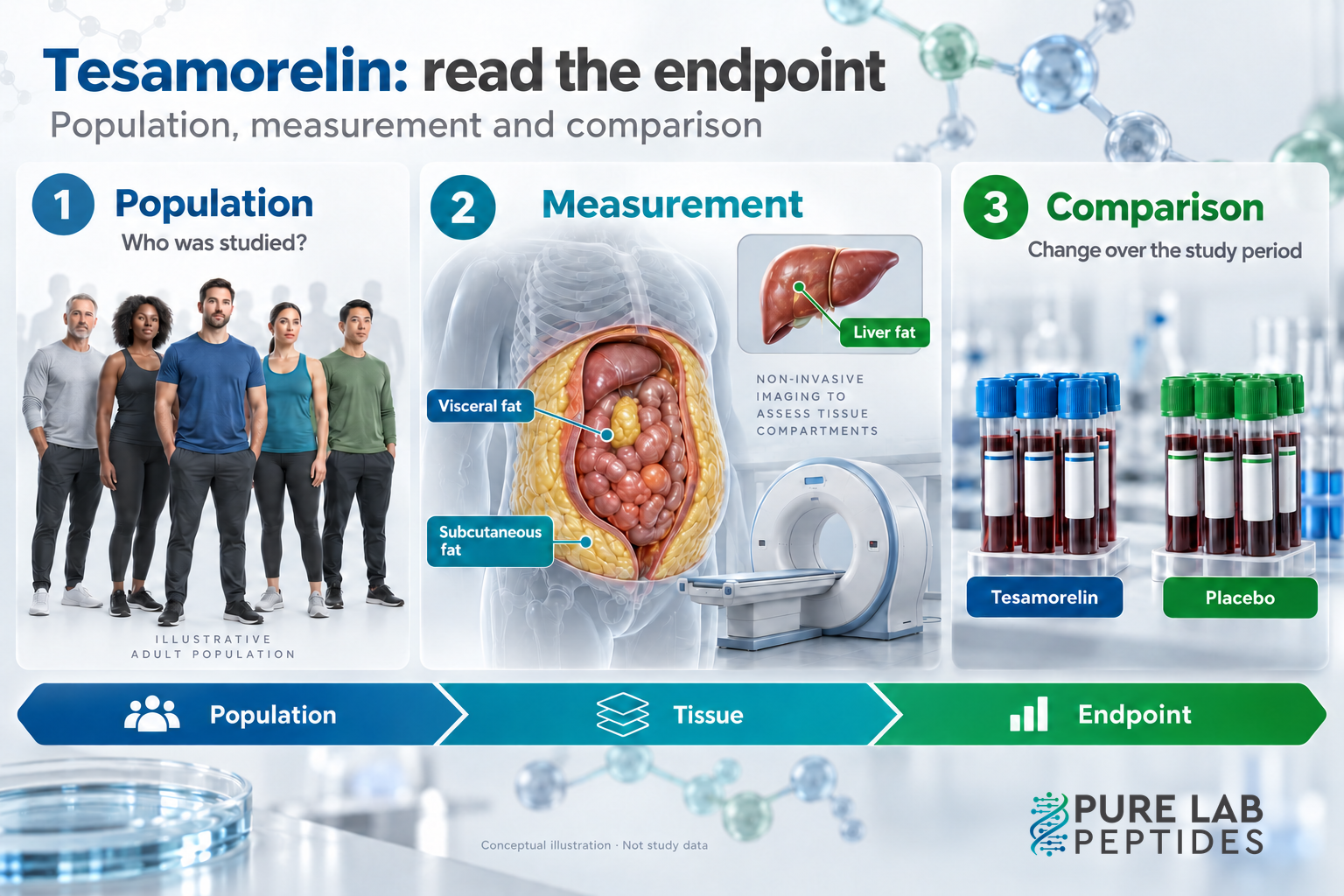
Tesamorelin clinical trials: what did the results measure?
Quick take: Visceral, subcutaneous and liver-fat measurements cannot be exchanged for one another.
The 2010 pooled analysis of two phase-3 trials included 806 antiretroviral-treated people with HIV and excess abdominal fat. Its primary measurement was percentage change in visceral adipose tissue, or VAT, assessed by computed tomography at week 26. The reported treatment effect was −15.4%. The between-group change in abdominal subcutaneous adipose tissue was not statistically significant.
This finding concerns visceral fat, not body weight. Even two measurements from one abdominal image may describe different tissue compartments. Keep the endpoint in the sentence summarizing the Original pooled findings.
The same analysis found an increase in mean IGF-I, also written IGF-1, relative to placebo. That is a separate endocrine result. A review of the effects of tesamorelin should keep the hormone measurement alongside the tissue measurements, rather than treating all changes as one benefit. Reported endocrine findings.
| Reported measurement | What the number describes | What to keep beside it |
|---|---|---|
| Visceral adipose tissue area | An imaging measurement of the internal abdominal fat compartment | Imaging method, units, time point and study population |
| Subcutaneous adipose tissue | A separate compartment beneath the skin | Its own measured change and statistical comparison |
| Liver lipid-to-water percentage | A spectroscopy measurement used in the liver-fat study | The method and percentage-point change, not kilograms |
| GH or IGF-I | An endocrine response | Sampling conditions, baseline and assay |
| Body weight | The mass of the person | Whether the study actually measured and reported that outcome |
Check what a longer follow-up is compared with
Quick take: A comparison with placebo and a comparison with the original baseline are different calculations.
The trials’ 26-week primary phase was followed by an extension involving changed treatment assignments. At week 52, continued-treatment results were compared with the original baseline. That is a different reference from the week-26 placebo comparison. Study design and extension results.
Suppose a summary pairs a six-month placebo comparison with a twelve-month baseline comparison and calls the later number a bigger effect. Check the reference value and participants before accepting that conclusion. A changed comparison isn’t simply a longer observation.
Combining trials in a pooled analysis doesn’t create an independent set of participants. Use the research-paper reading guide to trace the study designs before counting evidence.
The liver-fat study adds another endpoint
Quick take: Keep the liver measurement and the VAT measurement in their original units.
In a 2014 randomized, placebo-controlled trial, 50 antiretroviral-treated adults with HIV and abdominal fat accumulation were enrolled; 48 received study drug. Over six months, the authors reported reductions in VAT area and liver lipid-to-water percentage. The net treatment effects were −42 cm² for VAT and −2.9 percentage points for the liver measurement. Neither is a change in kilograms.
Glucose findings also depended on the time point. Fasting glucose increased at two weeks in the tesamorelin group relative to placebo, while the between-group fasting-glucose change at six months was not statistically significant. Both observations belong in the reading, rather than choosing whichever supports a simpler headline. The authors described the work as preliminary and called for further study of clinical importance and long-term consequences. Original results and conclusions.
A different population needs its own description
Quick take: “Adults with obesity” can still hide important selection criteria.
A 2012 randomized trial studied 60 abdominally obese subjects selected for reduced GH secretion over twelve months. It reported a between-group VAT treatment effect of −35 cm² and changes in several metabolic measurements, including carotid intima-media thickness. No significant effect on abdominal subcutaneous fat was found.
Selection for reduced GH secretion limits the population the result describes. A change in carotid intima-media thickness also isn’t evidence of fewer cardiovascular events. The mechanism of action versus efficacy explains what additional outcome evidence would be needed.
Questions worth resolving before you summarize
Quick take: Name the population and endpoint in the sentence containing the result.
Does a VAT result describe total weight loss?
No. VAT is a specific tissue measurement. Use the endpoint named in the paper, its units and its actual comparator.
Can the largest percentage from several studies stand for the whole literature?
Not without checking populations, methods and reference values. An absolute area change, a percentage change from baseline and a placebo-adjusted effect are not interchangeable.
What makes a useful tesamorelin research note?
Write down the construct, participants, method, duration and comparator, then summarize the finding with its source. That gives the reader more than a list of benefits, even when the summary is shorter.