



Fibroblast Peptide Research: Reading Collagen and Cell Results

TL;DR · The short version
Fibroblast peptide research begins with the readout. Collagen output, cell number and gene expression can change independently. Keep cell source, serum and matrix conditions with each measurement before comparing papers. A positive culture result doesn’t establish a clinical benefit.
“Increased fibroblast activity” leaves the reader with a question: which activity?
Matrix-protein production, division, movement and gene expression aren’t interchangeable. Naming the response lets a reader find the assay that supports it rather than infer a broad effect from the summary.
We’ll use original experiments to separate those findings. This is a way to read fibroblast evidence, rather than a treatment recommendation or dosing routine.
What are fibroblasts measuring in peptide research?
Quick take: Name the response before deciding what a study supports.
Fibroblasts produce connective-tissue components, including collagen in the extracellular matrix. Cultures let researchers examine protein output, growth, signaling and responses to surroundings. Keep “dermal fibroblast” attached to its model rather than extending it to every cell source.
The distinction is visible in a study of human neutrophil peptides. Researchers used neonatal human dermal fibroblasts in two-dimensional cultures and three-dimensional spheroids. They measured proliferation-related markers, COL1A1 expression and type I collagen protein. Those are several lines of evidence, not several names for the same test.
COL1A1 refers to a gene involved in type I collagen production. Measuring its RNA provides information about gene expression. A protein assay or staining result addresses another layer. Keeping both in the record makes the finding easier to evaluate.
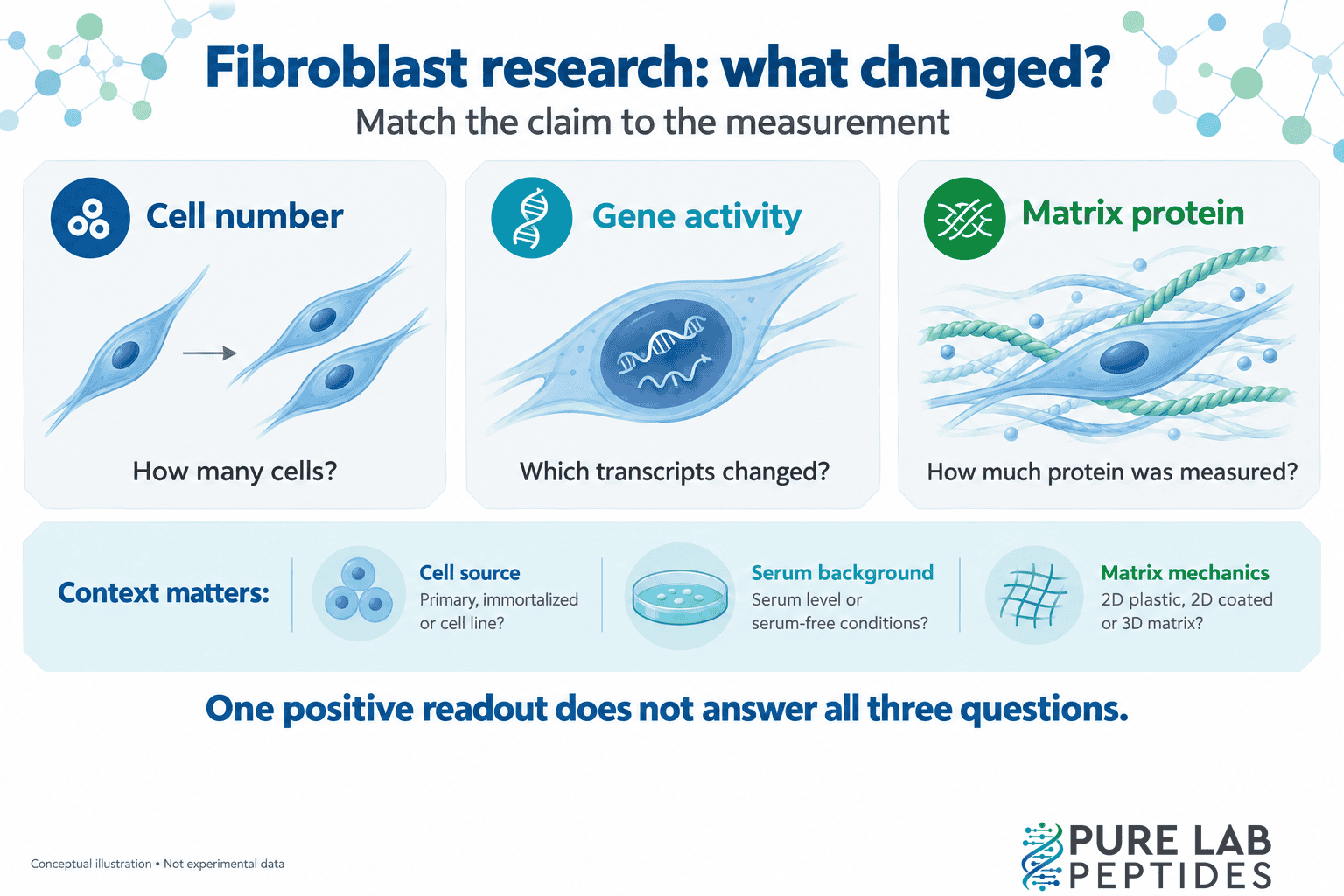
More collagen does not automatically mean more cells
Quick take: Protein output and cell number can change independently.
Maquart and colleagues’ GHK-Cu experiment is a helpful example. They reported increased collagen synthesis in fibroblast cultures independently of a change in cell number. Calling that result “more fibroblasts” would miss what the study found.
When a protein signal rises, ask whether output per cell changed or the sample contained more cells. The measurement and normalization determine which explanation is supported. A peptide’s reputation can’t fill that gap.
For copper-complex background, the copper peptide laboratory guide explains the chemistry and why the tested material’s identity matters. This article focuses on reading the fibroblast response.
| Reported measurement | Question it helps address | What still needs checking |
|---|---|---|
| Cell number or proliferation marker | Did the population or growth-related activity change? | Whether the assay directly counts cells and how survival was assessed. |
| COL1A1 RNA | Did expression of a collagen-associated gene change? | Whether protein was also measured and at what time. |
| Collagen protein or staining | Did the measured collagen signal change? | Normalization, sampling and the assay’s specific target. |
| MTT metabolic signal | Did the culture’s assay signal change? | Whether an independent measurement supports a cell-number claim. |
| Movement or gap closure | Did the spatial measurement change? | How proliferation and survival were separated from migration. |
Bring those questions to the actual methods and results. For a movement endpoint, the cell migration model guide examines the assay choices in more detail.
Read the results section, not only the headline
Quick take: A higher test concentration does not guarantee a larger or statistically supported response.
A 2024 collagen-peptide study used neonatal human dermal fibroblasts and measured matrix-related gene expression and collagen fluorescence. Its detailed results make a useful reading exercise: the lower of two selected concentrations produced a statistically significant increase in the collagen fluorescence measurement; the higher concentration’s increase did not meet that threshold.
The gene-expression results also need their individual assay and statistical context. They don’t establish that increasing peptide concentration keeps increasing collagen output. Keep the commercial hydrolyzed mixture and supplier funding visible when discussing this experiment.
The same paper describes MTT as a metabolic reduction assay. An MTT result therefore needs its assay context when it is discussed as viability or proliferation. A darker signal is not a stand-alone explanation of why it changed.
Read the figure legend before borrowing the conclusion. Locate the measured response, comparator and statistical finding. Those details give “fibroblast activation” a meaning that can be checked.
Serum background can hide a peptide response
Quick take: The medium can contain relevant background activity before the added peptide arrives.
Asai and colleagues examined hydroxyprolyl peptides in primary mouse skin fibroblasts grown in collagen gels. Different serum lots changed the response to added Pro-Hyp and Hyp-Gly. Removing the low-molecular-weight serum fraction restored a detectable growth response in the tested system.
That serum finding doesn’t prescribe serum-free culture for every experiment. It shows why the background condition needs checking before a weak supplemental response is treated as a universal peptide failure.
In a hypothetical comparison, the same cells and added peptide encounter different serum lots. A response in only one condition leaves a background explanation to investigate. Calling the peptide effective or ineffective without that context would decide more than the comparison resolves.
The matrix is another part of the experiment
Quick take: A change in the culture’s mechanical setting can affect cells even without a peptide comparison.
In Grinnell and colleagues’ human fibroblast collagen-matrix experiment, releasing mechanical tension triggered apoptosis under the conditions studied. This was not a head-to-head peptide study. Its relevance here is the matrix itself: a changed culture environment can contribute to the response being measured.
Record whether the cells grew on a flat plate, coated surface or three-dimensional matrix. Also distinguish a substrate-bound peptide from one added to medium. These describe the exposure more usefully than “fibroblasts plus peptide.”
A culture can answer a cellular question without settling the complete wound-repair process. Retain that boundary even when the paper discusses the broader research motivation.
What to save when you compare fibroblast papers
Quick take: Keep the material, model, conditions and result together. Do not save only the abstract’s conclusion.
- Cell identity: Species, tissue source, donor information where reported, and primary culture or cell line.
- Material: Exact peptide, copper complex or mixture, with relevant identity details.
- Culture context: Serum conditions, substrate or matrix and the comparison control.
- Readout: RNA, protein, cell number, metabolic signal or movement, with the measured time point.
- Limits: Which findings were supported and what the model did not test.
Material documentation is a separate record. The public COA results library contains the available lot-specific reports. Read the tests actually performed; a published cell study does not certify a supplied batch, and a sample report does not demonstrate a fibroblast effect.
Common questions about fibroblast peptide research
Is increased collagen synthesis the same as fibroblast proliferation?
No. One concerns a matrix-protein response; the other concerns cell growth or division. An experiment needs the appropriate measurements to support either claim.
Can dermal fibroblast results be applied to every fibroblast model?
Keep the cell source attached to the finding. Different tissues, donors and culture systems are reasons to examine whether the comparison actually transfers.
Do these culture studies establish a treatment benefit?
They establish the findings measured in their experimental models. Human outcomes require evidence that directly addresses those outcomes.