



Epitalon Research: Telomere Measurements and Evidence Limits

TL;DR · The short version
Epitalon research has examined telomere-related measurements in cultured cells. Gene expression, enzyme activity, telomere length and ALT are different readouts. Results depend on the model, and none of these measurements alone demonstrates longer human life.
A telomere became longer. That sounds straightforward, until the next question: in which cells, measured how, and through which process?
Those details are central to Epitalon research. Epitalon, also spelled Epithalon, is the synthetic tetrapeptide Ala-Glu-Asp-Gly, or AEDG. It is distinct from Epithalamin, a tissue-derived peptide preparation. This guide looks at cell-study findings and the measurements behind them, including a published figure correction.
The early fibroblast finding
TL;DR: The early finding concerned cultured fetal fibroblasts, not measured human lifespan.
In a 2003 study by Khavinson and colleagues, exposure of telomerase-negative human fetal fibroblast cultures to Epithalon was associated with expression of the enzyme’s catalytic subunit, telomerase activity and telomere elongation. These were findings in cultured cells. The authors’ suggestion of possible effects on organism lifespan went beyond the experiment’s measured outcomes.
What the later cell-line study adds
TL;DR: The later study found model-dependent differences and has a published figure correction that belongs in the evidence review.
Al-dulaimi and colleagues’ 2025 study compared normal fibroblast and epithelial models, IBR.3 and HMEC, with breast-cancer lines 21NT and BT474. It measured telomere length, hTERT expression, telomerase activity and alternative lengthening of telomeres (ALT).
Higher hTERT expression did not mean higher enzyme activity in every model. The normal-cell experiments showed increased telomerase activity, whereas the cancer-cell experiments showed increased ALT-related readouts without a significant increase in telomerase activity. The normal-cell and cancer-cell experiments also used different exposure durations, so they are not a matched head-to-head comparison of cellular sensitivity.
The authors reported model-dependent telomere-length changes. These findings do not establish clinical safety, quantify a person’s cancer risk or show that increasing telomere length has a net health benefit.
Read the corrected figures: the publisher’s November 2025 correction replaces incorrect versions of Figures 1–3 and states that the original article was corrected. Consult that record alongside any earlier downloaded copy.
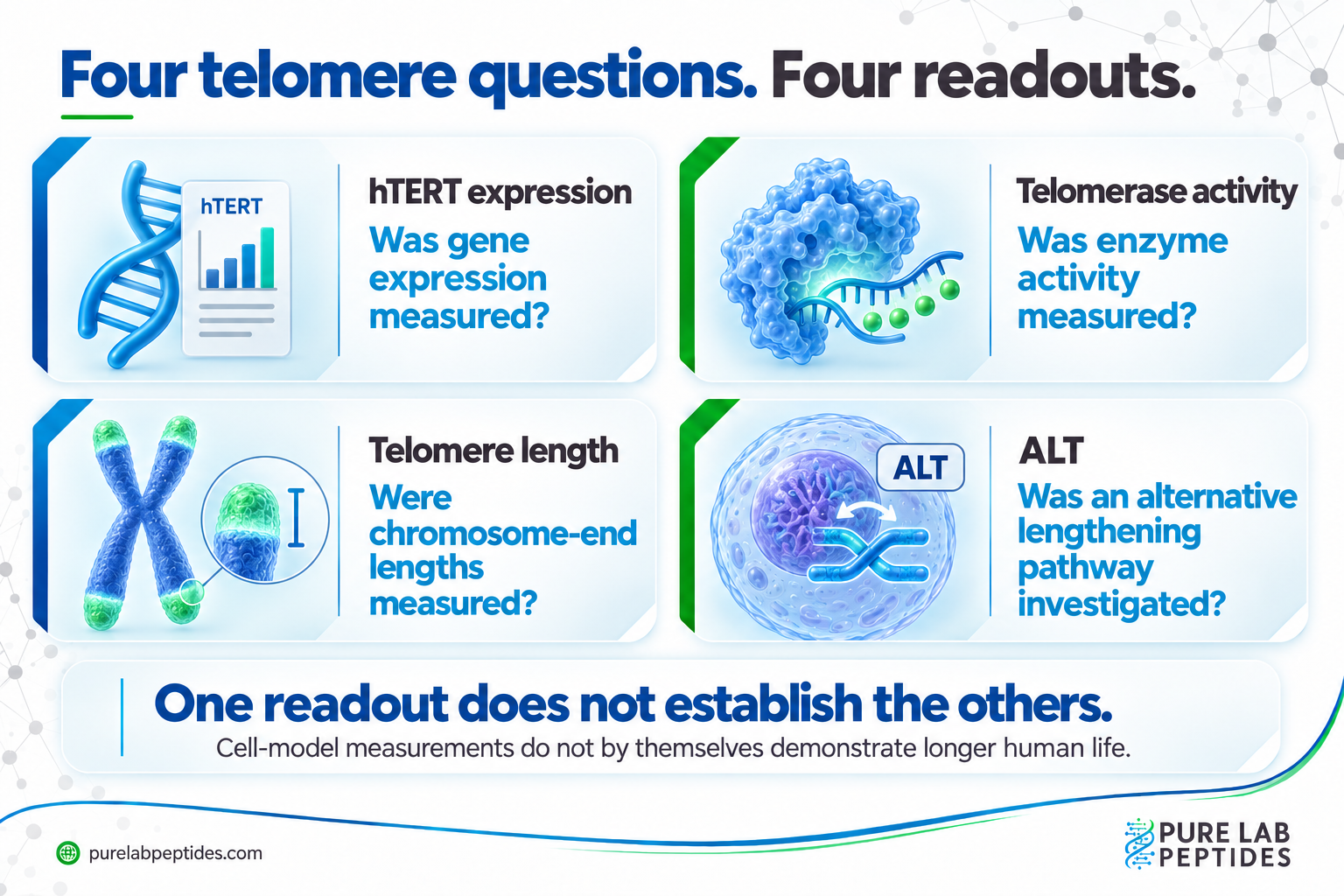
Four readouts, four different questions
TL;DR: hTERT expression, enzyme activity, telomere length and ALT answer different questions.
| Readout | Question it helps answer |
|---|---|
| hTERT expression | Did expression of the telomerase catalytic-subunit gene change? |
| Telomerase activity | Did the assay detect a change in enzyme function? |
| Telomere length | Did the measured length change in the sampled cell population? |
| ALT-related readouts | Was there evidence consistent with an alternative telomere-maintenance pathway? |
A useful evidence table keeps these outcomes in separate columns. It avoids turning an expression result into an enzyme-activity claim or treating a change in one marker as a complete explanation. The 2025 study illustrates why those distinctions matter.
How to compare Epitalon research papers
TL;DR: Compare the tested material, cell source, control, exposure interval and measurement method.
Start with the material, cell source, starting state and control group. Then record the observation period and analytical method. A comparison between different cell types can be informative while still leaving the reason for a difference unresolved.
- Separate observation from hypothesis. Note whether a pathway was measured directly or proposed in the discussion.
- Track the experimental unit. Repeated readings of one sample do not replace independent biological experiments.
- Check the version. Include corrections and supplementary files when reviewing a central figure.
- Match the conclusion to the endpoint. A molecular measurement, a cell-population outcome and a participant-level outcome answer different questions.
For a worked approach to that distinction, see mechanism of action versus efficacy. The research-paper reading guide provides a broader methods checklist.
What remains a separate verification task
TL;DR: Biological findings and supplied-lot quality require separate evidence.
Published cell responses do not establish the identity or quality of a supplied lot. Its analytical documentation must be evaluated separately. A certificate of analysis also cannot establish that a material produces a published biological response.
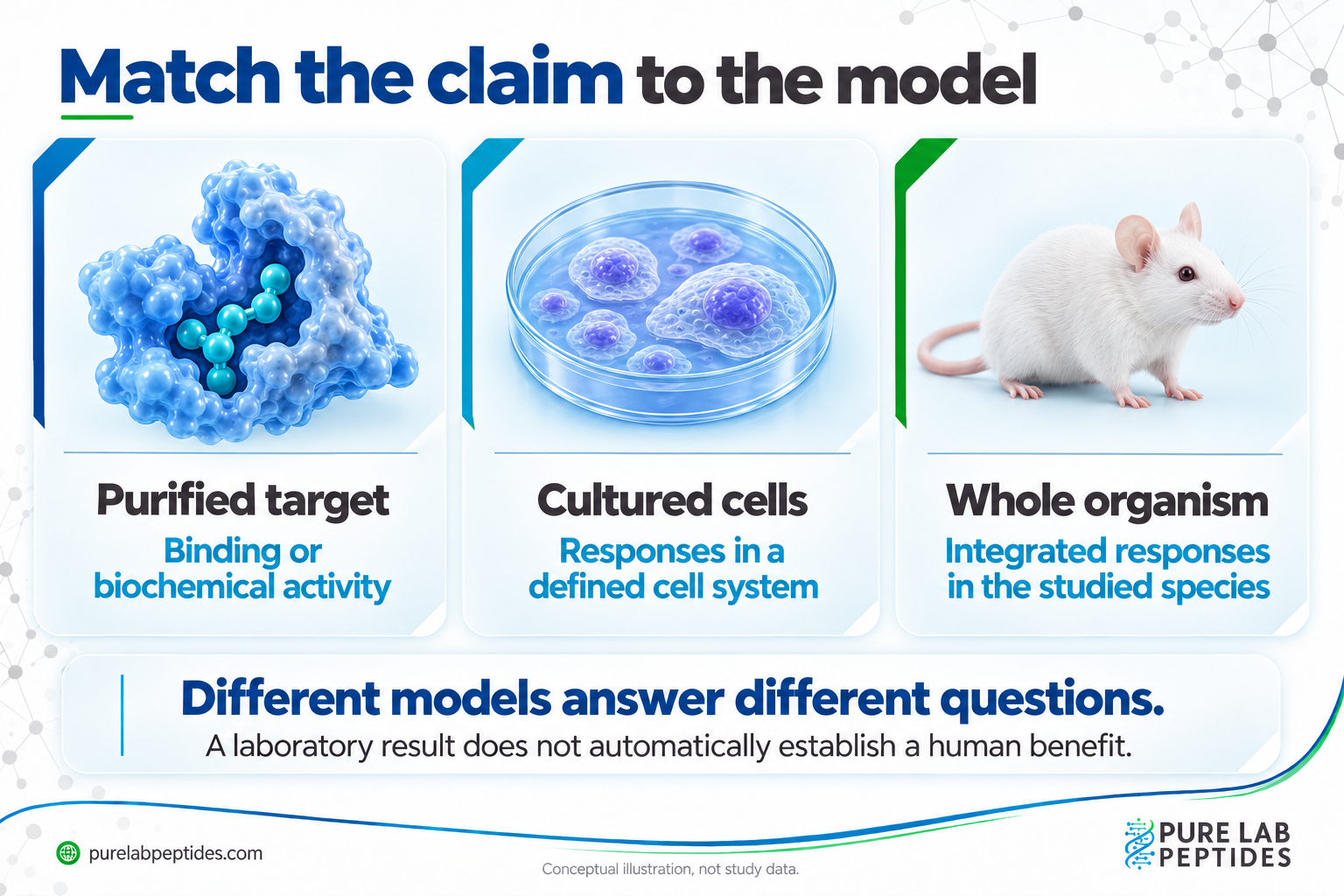
Read this evidence as an account of specific laboratory models and measurements. It does not supply a human dosing schedule or resolve clinical effectiveness and safety. The research-model comparison guide explains why evidence changes as the experimental system changes.