



Copper Peptide Complexes: Characterization Methods

TL;DR · The short version
Characterizing copper peptide complexes means separating peptide identity, total copper and coordination state. Each needs suitable evidence. Keep crystal or solution state and measurement conditions with the structural assignment; a single result doesn’t establish all of them.
Detecting the peptide and copper leaves another question: how are they associated in this solution?
Copper peptide complexes need an identity record, a copper measurement and evidence of the metal’s ligand environment. The methods below address different parts of that record. Decide which question a result answers before using it to describe the whole complex.
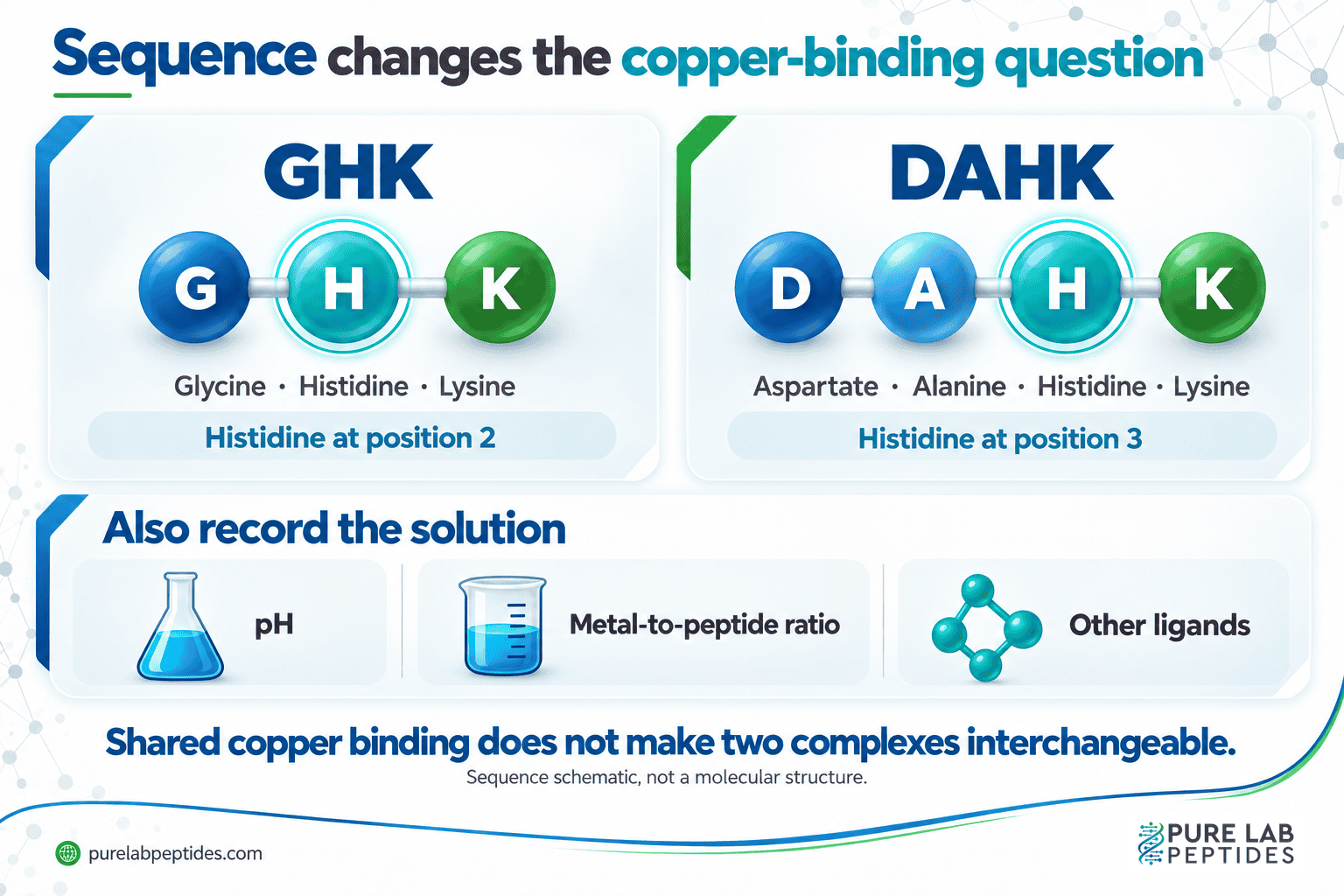
A structural example: GHK and DAHK
TL;DR: GHK and DAHK provide specific examples of different coordination, and crystal findings need not describe solution species.
In Hureau and colleagues’ comparison, GHK–copper had a dimeric crystal structure but formed a monomeric complex in solution. DAHK–copper showed a different coordination arrangement. These are specific structural findings, not interchangeable descriptions of every copper-binding peptide.
Write down the material state beside the assignment. A crystal and a solution may support different observations, as may another medium. Sequence, modifications and solution conditions explain what was examined.
What the methods contribute
TL;DR: Peptide identity, total copper and metal environment need measurements suited to each question.
| Method or measurement | Main question | Important limitation |
|---|---|---|
| Peptide identity analysis | Is the intended peptide present? | Does not independently quantify copper or prove the solution coordination state. |
| Elemental copper measurement | How much copper is in the sample? | Does not identify which ligand binds it. |
| EPR or other coordination-sensitive spectroscopy | What does the metal environment reveal? | Interpretation depends on the species and conditions accessible to the method. |
| X-ray crystallography | What structure is present in the crystal? | A crystal does not automatically describe all species in solution. |
| Chromatographic separation | Which components can the method resolve? | Mobile-phase conditions may differ from the experiment’s original medium. |
Infrared methods add another view. A 2024 infrared spectroscopy study compared Cu(II) complexes of short peptides including His-Gly and Gly-His. Their distinct spectral features supported different coordination assignments. The point is specific: even reversing two residues can change the interpretation. The study does not supply one universal structure for every copper peptide.
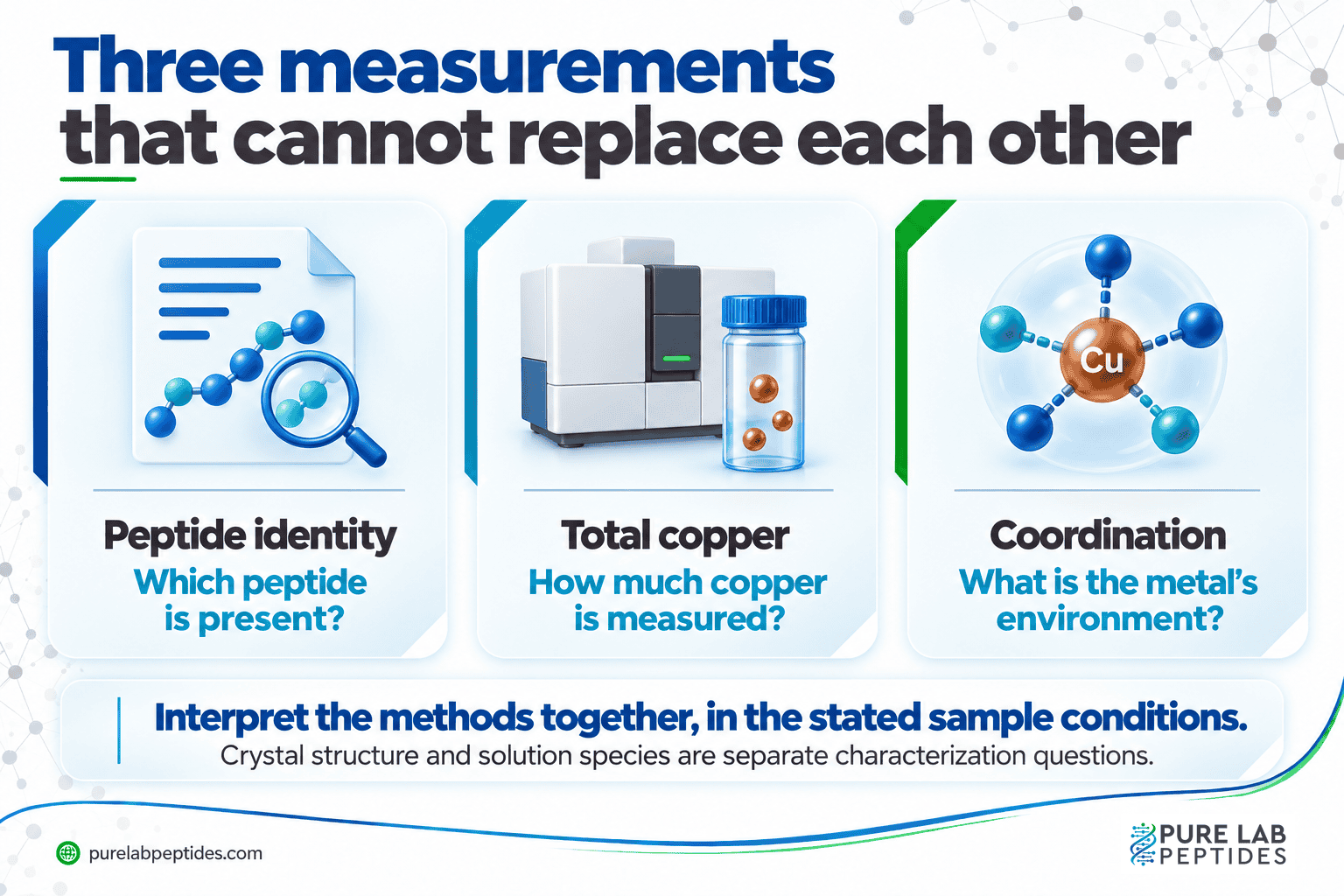
Complementary methods can expose misleading shortcuts
TL;DR: The strongest signal in one technique need not represent the most abundant solution species.
NMR and EPR work on GHK–copper examined species and exchange behavior. A strong signal can reflect how the technique observes that system, rather than identify its most abundant solution species. That distinction is a reason to compare evidence from appropriate methods.
Using coordination as a crystallography tool
TL;DR: An engineered GHK protein tag is a crystallography application, not evidence about a free research vial’s biological effects.
In Mehr and colleagues’ crystallography study, researchers fused GHK to the N-terminus of a GFP variant and an MBP fusion construct. Copper binding helped form crystals and provided an anomalous signal for structure determination.
The construct is an engineered tag attached to a protein. Its crystallization result isn’t a cell-response finding for a free GHK-Cu vial. Keep the attachment and experimental purpose with the conclusion.
Reporting a result clearly
TL;DR: Report the exact entity, conditions and observable, and investigate disagreements between methods.
Report material identity, established copper oxidation state, composition, pH, temperature and the method’s observable. Total copper, nominal peptide concentration and inferred concentration of an individual complex describe different quantities.
When methods disagree, compare sample states and assumptions before selecting an interpretation. The more favorable result doesn’t resolve the discrepancy. Document which evidence supports the assignment and under which conditions.
For the biological research questions that follow characterization, see our copper peptide research overview. For differences between an ion’s reported m/z and neutral molecular mass, use the mass-to-charge guide.