
...

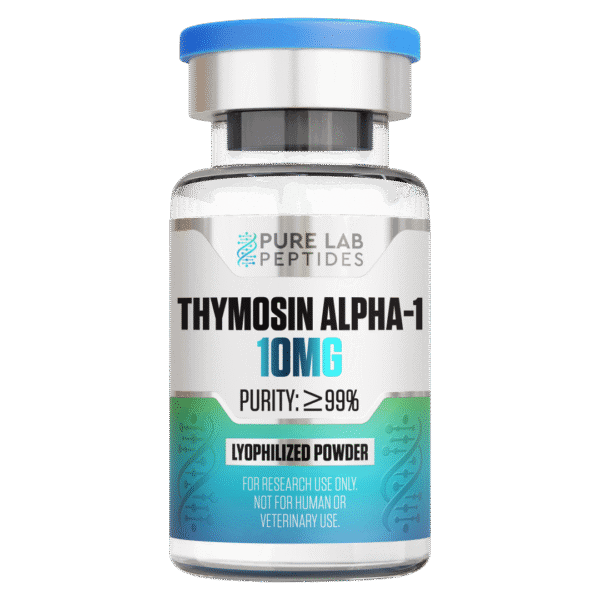
Thymosin Alpha-1 5mg

$79.99

(5.0) (20 customer reviews)

Research Studies:

  • Potent TLR9 and TLR2 agonist for investigating innate immune receptor signaling
  • Supports analysis of T-lymphocyte maturation and Th1-type cytokine expression in assays
  • Enables research on major histocompatibility complex class I molecule upregulation pathways
  • Useful for evaluating NF-κB and MAPK-mediated modulation of lymphocyte-specific responses

Quantity:

Free Shipping

Out of stock

Buy Peptides with confidence: Stripe-powered secure checkout and major cards accepted.
Secure payment methods for buying peptides: Visa, MasterCard, AMEX, and more.
Buy Peptides with confidence: Stripe-powered secure checkout and major cards accepted.
Secure payment methods for buying peptides: Visa, MasterCard, AMEX, and more.

FREE Shipping on 

orders over $200

ALL ARTICLES AND PRODUCT INFORMATION PROVIDED ON THIS WEBSITE ARE FOR INFORMATIONAL AND EDUCATIONAL PURPOSES ONLY. The products offered on this website are intended solely for research and laboratory use. These products are not intended for human or animal consumption. They are not medicines or drugs and have not been evaluated or approved by the FDA to diagnose, treat, cure, or prevent any disease or medical condition. Any form of bodily introduction is strictly prohibited by law.

Description

Thymosin Alpha-1 5mg is a research-use-only laboratory material supplied for controlled research workflows, compound characterization, and analytical documentation review. It is manufactured under rigorous quality standards to support consistency, traceability, and batch-specific verification for qualified laboratory settings.

Key Product Details

  • Manufactured in accordance with rigorous quality standards to support ≥99% purity, as reflected in batch-specific documentation where available.
  • Every batch is third-party analyzed for identity, assay/potency, and sterility documentation where applicable.
  • Supplied in lyophilized powder form to help preserve stability throughout transport and storage.
  • Produced with lot-level traceability to support research documentation and laboratory recordkeeping.

Research Documentation Context

  • Supports compound characterization in controlled laboratory settings.
  • Provides batch-specific identity and purity documentation for research review.
  • Allows lot-level traceability across laboratory documentation workflows.
  • Supports comparison of product labeling, analytical documentation, and storage information during research planning.
  • Supports analytical review of short peptide research materials within a strictly laboratory-focused context.

Specifications and Documentation

  • Certificate of Analysis: Available with batch-specific documentation where applicable.
  • Material Safety Data Sheet: Coming Soon.
  • Handling and Storage Instructions: Coming Soon.
  • Product Form: Lyophilized powder.
  • Purity Specification: ≥99% purity.
  • Intended Use: Laboratory research use only.

Thymosin Alpha-1 5mg is intended strictly for laboratory research use only. This product is not intended for human or animal consumption, therapeutic use, diagnostic use, clinical use, veterinary use, or as a food, drug, cosmetic, dietary supplement, or household product.

Additional information

CAS No.

62304-98-7

Purity

≥99%

Sequence

Ac-Ser-Asp-Ala-Ala-Val-Asp-Thr-Ser-Ser-Glu-Ile-Thr-Thr-Lys-Asp-Leu-Lys-Glu-Lys-Lys-Glu-Val-Val-Glu-Glu-Ala-Glu-Asn

Molecular Formula

C129H215N33O55

Molecular Weight

3108.3 g/mol

Applications

Immune modulation, antiviral research, immunotherapy studies

Synthesis

Solid-phase synthesis

Solubility

Soluble in water or 1% acetic acid

Stability & Storage

Stable for up to 24 months at -20°C. After reconstitution, may be stored at 4°C for up to 4 weeks or at -20°C for up to 6 months.

Appearance

White lyophilized powder

Shipping Conditions

Shipped at ambient temperature; once received, store at -20°C

Regulatory/Compliance

Manufactured in a facility that adheres to cGMP guidelines

Safety Information

Refer to provided MSDS

There are no reviews yet.

We value your feedback. Please leave a review below:

Research Procurement Information

Buy Thymosin Alpha-1 Online for Research | COA Guide

Researchers searching for buy Thymosin Alpha-1 online should evaluate Thymosin Alpha-1 as a research-use-only laboratory material, not a consumer product. For laboratory buyers, the key considerations are compound identity, purity documentation, batch-specific COAs, lot traceability, product labeling, and storage information. This guide explains how to evaluate Thymosin Alpha-1 for controlled research procurement through Pure Lab Peptides, with emphasis on supplier documentation, analytical transparency, and RUO boundaries.

Fast Answer: buy Thymosin Alpha-1 online for Laboratory Research

Researchers can buy Thymosin Alpha-1 online for laboratory research by reviewing RUO labeling, batch-specific COA documentation, purity data, identity information, storage guidance, and supplier transparency before selecting a source. Products discussed in this article are intended for laboratory research use only and are not intended for human or animal consumption. The evaluation should center on documents, labels, and lot records rather than any use outcome.

What Does “Buy Thymosin Alpha-1 Online” Mean in a Research Context?

The phrase “buy Thymosin Alpha-1 online” is addressed here as laboratory research procurement intent, not personal-use intent. In this context, the searcher is a qualified researcher, laboratory buyer, research institution, or technical procurement team comparing RUO materials for controlled laboratory settings.

Research procurement is a documentation-first process. A laboratory buyer should verify that a supplier’s presentation is consistent with research-use-only positioning, that the product page avoids personal-use claims, and that batch-specific quality documentation is available for review. FDA guidance for RUO-labeled in vitro diagnostic products emphasizes the relationship between RUO labeling and intended use, and federal labeling language provides a useful compliance reference for research-only positioning even when a peptide material is not being presented as an IVD product [1] [2].

For Thymosin Alpha-1 research-use-only procurement, the buyer’s review should include the product name, fill size, product form, lot number, COA status, testing method, purity result, identity documentation, storage information, and supplier transparency. The goal is not to infer product effects. The goal is to confirm that the Thymosin Alpha-1 research material is labeled, documented, and traceable enough for laboratory recordkeeping.

Thymosin Alpha-1 Research Material Overview

Thymosin Alpha-1 is commonly discussed in scientific databases under the name thymalfasin. PubChem identifies thymalfasin as an acetylated polypeptide with molecular formula C129H215N33O55, and ChEMBL maintains a compound record for thymalfasin under CHEMBL2103979 [3] [4]. Researchers evaluating Thymosin Alpha-1 identity testing should compare supplier documentation against the compound name, molecular identity, and analytical data presented for the relevant lot.

The compound has a long literature history. A 1977 PNAS paper reported isolation and sequence analysis of thymosin alpha1 as a 28-amino-acid thymic polypeptide, while a later Journal of Biological Chemistry paper described detailed amino acid sequence analysis and N-terminal acetylation [5] [6]. In laboratory documentation, this kind of identity context is relevant because peptide materials are typically characterized through a combination of name, sequence or molecular description, molecular mass, chromatographic profile, and mass-based confirmation.

Thymosin Alpha-1 also appears in prothymosin alpha literature. Prothymosin alpha was isolated as an immunoreactive form related to thymosin alpha1, and later research described processing of prothymosin alpha to thymosin alpha1 and thymosin alpha11 by an asparaginyl endopeptidase [7] [8]. NCBI Gene and UniProt records identify PTMA as the human gene/protein entry for prothymosin alpha, which is useful for scientific context but should not be converted into a product-use claim for any RUO material [9] [10].

For category purposes, Thymosin Alpha-1 is best treated as a thymosin-related research peptide with immunology and peptide-characterization literature. Because the supplied category rules do not provide a dedicated Thymosin Alpha-1 category, this guide applies conservative general RUO boundaries: compound identity, analytical documentation, COA review, lot traceability, and supplier transparency. Published thymosin-related literature should be discussed as scientific context, not as product-use guidance for RUO materials.

Why Researchers Search “Buy Thymosin Alpha-1 Online”

Researchers search “buy Thymosin Alpha-1 online” when they need to evaluate research-use-only product availability and supplier documentation before procurement. This is a technical purchasing task, not a consumer decision. The most relevant questions are whether the material is labeled for research use only, whether the supplier makes a batch-specific Thymosin Alpha-1 COA available, and whether the product page clearly identifies the material as a laboratory research compound.

Teams that buy Thymosin Alpha-1 for laboratory research should also check whether documentation connects the product name, amount, lot number, product form, and analytical method. A Thymosin Alpha-1 COA should be reviewed with the label and product page so discrepancies can be detected before the material enters laboratory records.

Search intent is also practical. Procurement teams may need a Thymosin Alpha-1 research-use-only source with transparent Thymosin Alpha-1 purity documentation, Thymosin Alpha-1 identity testing, and Thymosin Alpha-1 supplier documentation. These terms point to traceability, not personal-use outcomes. Buying intent is appropriate only when it is qualified as buy Thymosin Alpha-1 online for laboratory research.

Research Procurement Checklist for Thymosin Alpha-1

  • Verify that Thymosin Alpha-1 is labeled for research use only.
  • Review the batch-specific certificate of analysis before procurement.
  • Confirm that the COA includes identity and purity documentation.
  • Check whether HPLC, LC-MS, mass spectrometry, or another analytical method is listed.
  • Compare the product name, amount, lot number, and documentation for consistency.
  • Assess whether the supplier avoids dosing, injection, therapeutic, diagnostic, human-use, or animal-use claims.
  • Document storage and handling information in laboratory records.
  • Evaluate whether the lyophilized powder form matches the needs of the research workflow.
  • Confirm that the product is not marketed for human or animal consumption.

Thymosin Alpha-1 Quality Signals to Review Before Buying Online

Researchers evaluating where to buy Thymosin Alpha-1 online should look for quality signals that support laboratory recordkeeping. The strongest procurement signals are not marketing claims. They are specific, reviewable documents that connect a product page, label, lot number, and COA.

Quality signal What researchers should review Why it matters for RUO procurement
RUO labeling Research-use-only language on product presentation and supporting documentation Clarifies that the material is positioned for laboratory research, not personal use
Batch-specific COA COA tied to the product lot rather than a generic sample document Supports lot-level traceability and laboratory documentation
Purity documentation Purity result, testing method, and chromatographic or analytical basis Helps researchers evaluate whether the reported purity is supported by data
Identity testing Molecular identity, mass data, sequence context, or equivalent method Reduces reliance on product name alone
Lot consistency Matching lot number across product label, COA, and internal receiving records Links documentation to the exact research material received
Product form Lyophilized powder form and storage information Supports controlled inventory and handling records

COA, Purity, and Identity Documentation

Thymosin Alpha-1 purity documentation should be reviewed as one part of a broader identity and traceability file. A strong review looks for the compound name, lot number, test date, purity percentage, analytical method, identity confirmation, molecular weight where relevant, product form, and storage documentation. A purity percentage alone does not establish complete compound identity; researchers should evaluate purity, identity, method, lot number, and documentation together.

Analytical documentation practices are supported by broader method-validation and laboratory-quality sources. FDA guidance discusses analytical procedures and validation data for documenting identity, strength, quality, purity, and related attributes; ICH Q2(R2) addresses validation of analytical procedures; ICH Q14 addresses analytical procedure development; and ISO/IEC 17025 addresses competent testing and calibration laboratory operation [11] [12] [13] [14]. USP reference-standard guidance and NIST reference-material resources also illustrate why assigned values, certificates, and traceable measurement records matter in laboratory documentation [15] [16].

For peptide materials, HPLC is widely used in peptide analysis and purification, while mass spectrometry is a core method for peptide and protein analysis because it can support molecular-mass and identification workflows [17] [18]. Thymosin Alpha-1 has also appeared in analytical literature using LC-MS/MS, which shows the relevance of mass-based analytical methods to this compound’s scientific record without implying any RUO product-use guidance [19].

flowchart TD A[Receive product and COA] --> B{RUO labeling present?} B -- No --> C[Flag procurement gap] B -- Yes --> D{Lot number matches across label and COA?} D -- No --> E[Request batch-specific documentation] D -- Yes --> F{Identity supported by analytical method?} F -- No --> G[Request HPLC, LC-MS, or equivalent] F -- Yes --> H[Proceed to laboratory documentation and storage]

This workflow is a documentation review model. It does not describe preparation, administration, dosing, or any use protocol. The purpose is to help laboratory teams decide whether Thymosin Alpha-1 supplier documentation is complete enough for controlled research procurement records.

Research Literature Context

Published literature has examined Thymosin Alpha-1 across biochemical, immunology-related, analytical, preclinical, review-based, and clinical study settings. Reviews have summarized the compound’s historical development, biological research context, and laboratory models involving thymosin-related pathways [20] [21] [22]. This literature can help researchers understand why the compound appears in scientific databases and published model systems, but it should not be treated as a claim about any RUO product.

Some research literature discusses immunology-related signaling, dendritic-cell models, cytokine-model observations, and thymosin-related history [23] [24]. Other reviews discuss infectious-disease research areas or in vitro experimental systems involving Thymosin Alpha-1 [25] [26]. These citations provide research context only. They do not establish that a research-use-only Thymosin Alpha-1 material is appropriate for human use, animal use, diagnostic use, therapeutic use, or any clinical purpose.

Published clinical literature should not be interpreted as use guidance for RUO materials. Regulated clinical products, study protocols, and RUO laboratory materials are not interchangeable. This article discusses research-use-only sourcing and documentation, not clinical use.

Evidence Landscape

Evidence type What it can support What it cannot support for RUO procurement
Database records Compound name, identifiers, formula, and database classification context They do not replace a batch-specific Thymosin Alpha-1 COA
Historical sequence literature Scientific background on peptide identity and sequence characterization It does not verify the identity of a supplier’s current lot
Analytical-method literature General relevance of HPLC, LC-MS, and mass spectrometry to peptide characterization It does not prove that a supplier performed a specific method unless documented
Review literature Broad scientific context and limitations across published studies It does not convert published findings into RUO product-use guidance
In vitro and preclinical literature Model-based context under defined experimental conditions It does not justify personal-use, animal-use, clinical, or diagnostic claims
Clinical literature outside RUO scope Historical context for regulated research and study design It does not apply to research-use-only materials sold for laboratory procurement

Claim Boundary Table

Acceptable research phrasing Unsafe product claim to avoid
“Thymosin Alpha-1 appears in thymosin-related research literature.” “Thymosin Alpha-1 produces personal health results.”
“Researchers should review Thymosin Alpha-1 COA and identity testing before procurement.” “A purity percentage alone proves the product’s full identity.”
“Published literature provides scientific context for controlled laboratory research.” “Published studies are instructions for using an RUO material.”
“Thymosin Alpha-1 research-use-only material should be documented by lot.” “RUO labeling supports human, animal, clinical, or diagnostic use.”
“Supplier transparency includes labeling, COA availability, and lot-level traceability.” “Supplier claims can replace analytical documentation.”

How Pure Lab Peptides Presents Thymosin Alpha-1

Pure Lab Peptides presents Thymosin Alpha-1 5mg as a research-use-only laboratory material. The product is listed in lyophilized powder form with an ≥99% purity claim, and a batch-specific COA is available for documentation review. Laboratory buyers should review the product page, COA, product labeling, storage and handling documentation, and lot-level traceability before adding the material to internal procurement records.

Review the Pure Lab Peptides Thymosin Alpha-1 research-use-only product page for RUO labeling, product details, purity information, and batch-specific documentation. Researchers comparing available peptide materials can also review the broader Pure Lab Peptides research peptide collection for supplier presentation, documentation consistency, and research-only positioning.

Common Misunderstandings About Buying Thymosin Alpha-1 Online

Misunderstanding 1: “Buy Thymosin Alpha-1 online” means personal use

In this article, “buy Thymosin Alpha-1 online” means laboratory research procurement. The phrase does not refer to personal-use intent, consumer decision-making, wellness use, therapeutic use, or any form of self-directed use. Qualified laboratory buyers should evaluate RUO labeling, COA availability, identity documentation, and supplier transparency.

Misunderstanding 2: Published literature equals product-use guidance

Published thymosin-related literature is scientific context. It is not a protocol, instructions, or product-use guidance for an RUO material. Research model findings are bound to their study design, materials, controls, and regulatory context. They should not be transferred to a commercial research material as a product claim.

Misunderstanding 3: Purity percentage alone proves identity

Purity is important, but it is not the same as full identity confirmation. Researchers should review the Thymosin Alpha-1 COA with the product name, lot number, analytical method, identity testing, molecular information, and product form. A purity value without method and identity context is incomplete for research procurement review.

Misunderstanding 4: COA documentation does not need to be batch-specific

A generic COA is weaker than batch-specific documentation because it may not correspond to the actual lot received by the laboratory. For Thymosin Alpha-1 supplier documentation, the lot number on the COA should match the product label and internal receiving records.

Misunderstanding 5: RUO labeling supports clinical or diagnostic use

RUO labeling does not support clinical, diagnostic, veterinary, personal, or consumer positioning. A research-use-only label is a boundary for controlled laboratory research. Laboratory teams should reject supplier content that mixes RUO materials with personal-use claims, protocols, or outcome language.

FAQs About Buying Thymosin Alpha-1 Online for Research

Where can researchers buy Thymosin Alpha-1 online for laboratory research?

Researchers can buy Thymosin Alpha-1 online for laboratory research from an RUO supplier that provides clear product labeling, batch-specific COA access, purity documentation, identity information, storage guidance, and lot-level traceability. Pure Lab Peptides provides a Thymosin Alpha-1 5mg product page for research-use-only procurement review.

What should researchers check before buying Thymosin Alpha-1 online?

Before buying Thymosin Alpha-1 online, researchers should check RUO labeling, product name consistency, lot number matching, COA availability, purity documentation, identity testing, product form, storage information, and supplier transparency. The review should focus on documentation quality, not personal-use expectations.

Why does a COA matter when buying Thymosin Alpha-1?

A COA matters when buying Thymosin Alpha-1 because it gives laboratory buyers a lot-specific record to compare against the product label and internal receiving records. Researchers should review the Thymosin Alpha-1 COA for compound name, lot number, purity data, analytical method, identity support, and documentation consistency.

Is Thymosin Alpha-1 intended for human or animal consumption?

No. Thymosin Alpha-1 research-use-only material discussed here is not intended for human or animal consumption. RUO procurement language means the material is positioned for controlled laboratory research. It should not be described as a consumer product, clinical product, diagnostic product, veterinary material, or therapeutic material.

What does research use only mean for Thymosin Alpha-1?

Research use only means Thymosin Alpha-1 is presented as a laboratory research material for qualified research settings. The phrase defines procurement and labeling boundaries. Researchers should evaluate documentation, COA status, identity testing, purity records, and lot traceability, while avoiding any interpretation connected to personal or clinical use.

How should published literature about Thymosin Alpha-1 be interpreted?

Published literature about Thymosin Alpha-1 should be interpreted as scientific background for researchers, not as instructions or claims for an RUO product. Study findings depend on the materials, controls, endpoints, and regulatory context of each publication. Published clinical literature should not be interpreted as use guidance for RUO materials.

Next Steps

For research teams comparing Thymosin Alpha-1 suppliers, prioritize COA availability, transparent labeling, purity documentation, identity testing, storage information, and lot-level traceability. Review the Thymosin Alpha-1 product page for RUO labeling, product details, purity information, and available batch-specific documentation.

References

  1. U.S. Food and Drug Administration. “Distribution of In Vitro Diagnostic Products Labeled for Research Use Only or Investigational Use Only.” FDA Guidance for Industry and FDA Staff. 2013. https://www.fda.gov/regulatory-information/search-fda-guidance-documents/distribution-in-vitro-diagnostic-products-labeled-research-use-only-or-investigational-use-only
  2. Electronic Code of Federal Regulations. “21 CFR 809.10 – Labeling for in vitro diagnostic products.” eCFR. Current. https://www.ecfr.gov/current/title-21/chapter-I/subchapter-H/part-809/subpart-B/section-809.10
  3. National Center for Biotechnology Information. “Thymalfasin.” PubChem Compound Summary. Current database record. https://pubchem.ncbi.nlm.nih.gov/compound/Thymalfasin
  4. European Bioinformatics Institute. “Thymalfasin CHEMBL2103979.” ChEMBL. Current database record. https://www.ebi.ac.uk/chembl/explore/compound/CHEMBL2103979
  5. Goldstein AL, Low TL, McAdoo M, McClure J, Thurman GB, Rossio J, Lai CY, Chang D, Wang SS, Harvey C, Ramel AH, Meienhofer J. “Thymosin alpha1: isolation and sequence analysis of an immunologically active thymic polypeptide.” Proceedings of the National Academy of Sciences of the United States of America. 1977. https://www.pnas.org/doi/10.1073/pnas.74.2.725
  6. Low TL, Goldstein AL. “The chemistry and biology of thymosin. II. Amino acid sequence analysis of thymosin alpha1 and polypeptide beta1.” Journal of Biological Chemistry. 1979. https://www.jbc.org/article/S0021-9258(17)37901-2/fulltext
  7. Haritos AA, Goodall GJ, Horecker BL. “Prothymosin alpha: isolation and properties of the major immunoreactive form of thymosin alpha 1 in rat thymus.” Proceedings of the National Academy of Sciences of the United States of America. 1984. https://www.pnas.org/doi/10.1073/pnas.81.4.1008
  8. Sarandeses CS, Covelo G, Diaz-Jullien C, Freire M. “Prothymosin alpha is processed to thymosin alpha 1 and thymosin alpha 11 by a lysosomal asparaginyl endopeptidase.” Journal of Biological Chemistry. 2003. https://doi.org/10.1074/jbc.M213005200
  9. National Center for Biotechnology Information. “PTMA prothymosin alpha [Homo sapiens].” NCBI Gene. Current database record. https://www.ncbi.nlm.nih.gov/gene/5757
  10. UniProt Consortium. “PTMA – Prothymosin alpha – Homo sapiens.” UniProtKB. Current database record. https://www.uniprot.org/uniprotkb/P06454/entry
  11. U.S. Food and Drug Administration. “Analytical Procedures and Methods Validation for Drugs and Biologics.” FDA Guidance for Industry. 2015. https://www.fda.gov/regulatory-information/search-fda-guidance-documents/analytical-procedures-and-methods-validation-drugs-and-biologics
  12. International Council for Harmonisation. “ICH Q2(R2): Validation of Analytical Procedures.” ICH Harmonised Guideline. 2023. https://database.ich.org/sites/default/files/ICH_Q2%28R2%29_Guideline_2023_1130.pdf
  13. International Council for Harmonisation. “ICH Q14: Analytical Procedure Development.” ICH Harmonised Guideline. 2023. https://database.ich.org/sites/default/files/ICH_Q14_Guideline_2023_1116.pdf
  14. International Organization for Standardization. “ISO/IEC 17025 – Testing and calibration laboratories.” ISO. 2017. https://www.iso.org/ISO-IEC-17025-testing-and-calibration-laboratories.html
  15. United States Pharmacopeia. “FAQs: Reference Standards.” USP. Current resource. https://www.usp.org/frequently-asked-questions/reference-standards
  16. National Institute of Standards and Technology. “NIST Standard Reference Materials Catalog.” NIST. 2023. https://www.nist.gov/system/files/documents/2023/05/15/SRM%20Catalog.pdf
  17. Mant CT, Chen Y, Yan Z, Popa TV, Kovacs JM, Mills JB, Tripet B, Hodges RS. “HPLC Analysis and Purification of Peptides.” Methods in Molecular Biology. 2007. https://pmc.ncbi.nlm.nih.gov/articles/PMC7119934/
  18. Zhang G, Annan RS, Carr SA, Neubert TA. “Overview of Peptide and Protein Analysis by Mass Spectrometry.” Current Protocols in Protein Science. 2010. https://pubmed.ncbi.nlm.nih.gov/21104985/
  19. Tuthill CW, Rudolph A, Li Y, Tan B, Fitzgerald TJ, Beck SR, Li YX. “Quantitative analysis of thymosin alpha1 in human serum by LC-MS/MS.” AAPS PharmSciTech. 2000. https://pmc.ncbi.nlm.nih.gov/articles/PMC2784822/
  20. Li J, Liu CH, Wang FS. “Thymosin alpha 1: Biological activities, applications and genetic engineering production.” Peptides. 2010. https://pmc.ncbi.nlm.nih.gov/articles/PMC7115394/
  21. King R, Tuthill C. “Immune Modulation with Thymosin Alpha 1 Treatment.” Vitamins and Hormones. 2016. https://pubmed.ncbi.nlm.nih.gov/27450734/
  22. Dominari A, Hathaway D III, Pandav K, et al. “Thymosin alpha 1: A comprehensive review of the literature.” World Journal of Virology. 2020. https://pmc.ncbi.nlm.nih.gov/articles/PMC7747025/
  23. Romani L, Bistoni F, Montagnoli C, et al. “Thymosin alpha1: an endogenous regulator of inflammation, immunity, and tolerance.” Annals of the New York Academy of Sciences. 2007. https://pubmed.ncbi.nlm.nih.gov/17495242/
  24. Garaci E. “Thymosin alpha1: a historical overview.” Annals of the New York Academy of Sciences. 2007. https://pubmed.ncbi.nlm.nih.gov/17567941/
  25. Tao N, Wen H, Liu Y, et al. “Thymosin alpha1 and Its Role in Viral Infectious Diseases.” Molecules. 2023. https://www.mdpi.com/1420-3049/28/8/3539
  26. Espinar-Buitrago M de la Sierra, et al. “Enhanced Immunomodulatory Effects of Thymosin-alpha-1 in Combination With Polyanionic Carbosilane Dendrimers.” International Journal of Molecular Sciences. 2024. https://pmc.ncbi.nlm.nih.gov/articles/PMC10887890/

Have Questions?

Our team is ready to assist you with any inquiries regarding our catalogue of peptides and their applications.

0