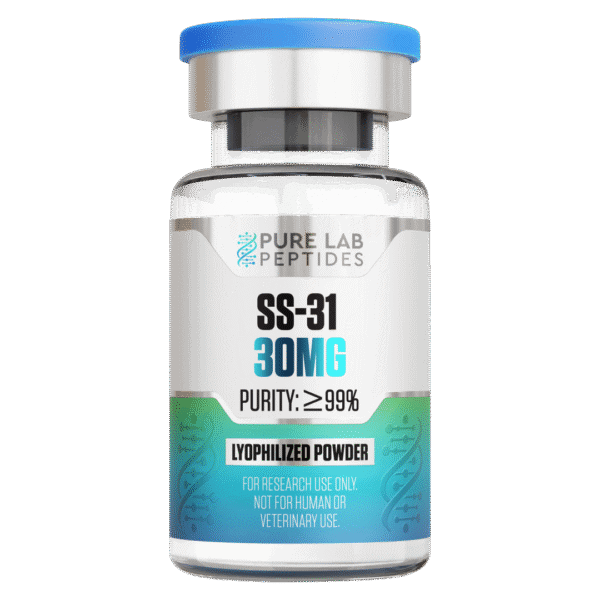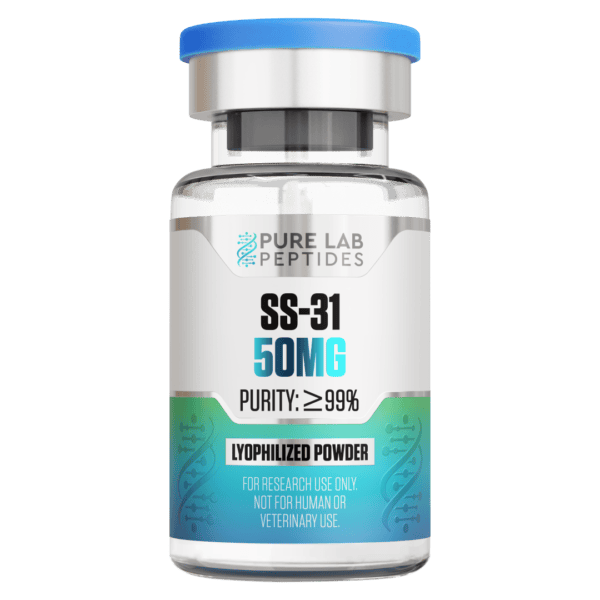

...

SS-31 10mg

$59.99

(5.0) (20 customer reviews)

Research Studies:

  • Enhances mitochondrial function and bioenergetics
  • Reduces oxidative stress and cellular damage
  • Promotes improved cardiovascular and cognitive health
  • Demonstrates potential in age-related disease models

Quantity:

Free Shipping

Out of stock

Buy Peptides with confidence: Stripe-powered secure checkout and major cards accepted.
Secure payment methods for buying peptides: Visa, MasterCard, AMEX, and more.
Buy Peptides with confidence: Stripe-powered secure checkout and major cards accepted.
Secure payment methods for buying peptides: Visa, MasterCard, AMEX, and more.

FREE Shipping on 

orders over $200

ALL ARTICLES AND PRODUCT INFORMATION PROVIDED ON THIS WEBSITE ARE FOR INFORMATIONAL AND EDUCATIONAL PURPOSES ONLY. The products offered on this website are intended solely for research and laboratory use. These products are not intended for human or animal consumption. They are not medicines or drugs and have not been evaluated or approved by the FDA to diagnose, treat, cure, or prevent any disease or medical condition. Any form of bodily introduction is strictly prohibited by law.

Description

SS-31 10mg is a research-use-only laboratory material supplied for controlled research workflows, compound characterization, and analytical documentation review. It is manufactured under rigorous quality standards to support consistency, traceability, and batch-specific verification for qualified laboratory settings.

Key Product Details

  • Manufactured in accordance with rigorous quality standards to support ≥99% purity, as reflected in batch-specific documentation where available.
  • Every batch is third-party analyzed for identity, assay/potency, and sterility documentation where applicable.
  • Supplied in lyophilized powder form to help preserve stability throughout transport and storage.
  • Produced with lot-level traceability to support research documentation and laboratory recordkeeping.

Research Documentation Context

  • Supports compound characterization in controlled laboratory settings.
  • Provides batch-specific identity and purity documentation for research review.
  • Allows lot-level traceability across laboratory documentation workflows.
  • Supports comparison of product labeling, analytical documentation, and storage information during research planning.
  • Supports analytical review of peptide research materials within a strictly laboratory-focused context.

Specifications and Documentation

  • Certificate of Analysis: Available with batch-specific documentation where applicable.
  • Material Safety Data Sheet: Coming Soon.
  • Handling and Storage Instructions: Coming Soon.
  • Product Form: Lyophilized powder.
  • Purity Specification: ≥99% purity.
  • Intended Use: Laboratory research use only.

SS-31 10mg is intended strictly for laboratory research use only. This product is not intended for human or animal consumption, therapeutic use, diagnostic use, clinical use, veterinary use, or as a food, drug, cosmetic, dietary supplement, or household product.

Additional information

CAS No.

897016-82-9

Molecular Formula

C22H38N8O5

Molecular Weight

494.59 g/mol

Purity

≥99%

Sequence

D-Arg-dimethylTyr-Lys-Phe-NH₂

Synthesis Method

Solid-phase synthesis

Format

Lyophilized powder

Solubility

Water/Sterile Diluent

Stability & Storage

Up to 24 months at -20°C. Avoid repeated freeze-thaw cycles.

Applications

Mitochondrial dysfunction research, oxidative stress studies, age-related disease models

Appearance

White to off-white powder

Regulatory/Compliance

Not for human consumption. For research use only.

Safety Information

MSDS available upon request

There are no reviews yet.

We value your feedback. Please leave a review below:

Research Procurement Information

Buy SS-31 Online for Laboratory Research | COA Guide

Researchers searching for buy SS-31 online should evaluate SS-31 as a research-use-only laboratory material, not a consumer product. For laboratory buyers, the key considerations are compound identity, SS-31 purity documentation, batch-specific COAs, lot traceability, product labeling, and storage information. Pure Lab Peptides presents SS-31 10mg for controlled research procurement where qualified teams can review RUO labeling, supplier documentation, and batch-specific quality records before selecting a laboratory research material.

Fast Answer: Buy SS-31 Online for Laboratory Research

Researchers can buy SS-31 online for laboratory research by reviewing RUO labeling, batch-specific COA documentation, purity data, identity information, storage guidance, and supplier transparency before selecting a source. Products discussed in this article are intended for laboratory research use only and are not intended for human or animal consumption.

What Does “Buy SS-31 Online” Mean in a Research Context?

The phrase “buy SS-31 online” is addressed here as laboratory research procurement intent, not personal-use intent. For qualified researchers, the query is best understood as a documentation and supplier-evaluation question: Is the material labeled for research use only? Is batch-specific COA documentation available? Does the documentation support the listed identity, purity, lot number, and product form?

Research-use-only sourcing also requires language discipline. A supplier page should separate laboratory procurement from therapeutic, diagnostic, consumer, veterinary, or personal-use positioning. FDA guidance for products labeled research use only or investigational use only in the in vitro diagnostic setting illustrates a broader documentation principle: research-only labeling should align with the intended research context and not be used to support non-research positioning [1].

For SS-31 research-use-only procurement, supplier transparency means clear product naming, RUO labeling, batch-specific documentation, storage and handling information, and traceable quality records. Laboratory buyers should review the SS-31 COA, compare lot identifiers across materials and documentation, and confirm that supplier language does not shift from research procurement into use guidance.

SS-31 Research Material Overview

SS-31 is commonly discussed in scientific literature under the name elamipretide and has also appeared in literature under related research names such as MTP-131 and Bendavia. PubChem identifies elamipretide as compound CID 11764719 with the molecular formula C32H49N9O5 [2]. DrugBank and the NCATS Global Substance Registration System provide additional identifier-based records for elamipretide, supporting database-level identity review for researchers comparing names, synonyms, and substance records [3] [4].

In published research, SS-31 is generally described as a synthetic mitochondria-targeted tetrapeptide. A recent review describes SS-31, or elamipretide, as a mitochondria-targeting tetrapeptide with the sequence D-Arg-Dmt-Lys-Phe-NH2 [5]. Early research on SS-family peptides described cell-permeable peptide antioxidants targeted to the inner mitochondrial membrane in experimental models [6]. Later mechanistic studies examined SS-31 interactions with cardiolipin and mitochondrial membrane environments [7].

Cardiolipin is a mitochondrial phospholipid that appears in bioenergetics and membrane-organization literature, and reviews have described its structural and functional complexity in health and disease research contexts [8]. SS-31 research literature has examined lipid bilayer interactions, surface electrostatics, protein interaction landscapes, and structure-activity relationships in laboratory and model systems [9] [10] [11]. These publications are useful scientific context for compound classification, but they are not product-use instructions.

Metabolic pathway literature should not be translated into weight-loss, performance, or wellness claims for RUO materials. For SS-31 research material procurement, the relevant commercial evaluation is documentation-focused: identity, purity, COA availability, analytical method review, product form, storage information, and lot-level traceability.

Why Researchers Search “Buy SS-31 Online”

Researchers may search “buy SS-31 online” when comparing RUO product availability, supplier documentation, product form, and quality signals across potential laboratory sources. In that context, the word “buy” does not imply personal use. It refers to institutional or laboratory procurement of a research compound where documentation can be reviewed before selection.

A qualified laboratory buyer looking to buy SS-31 should evaluate whether the supplier provides clear RUO positioning, a batch-specific certificate of analysis, purity documentation, identity testing information, and a traceable product page. Product naming should be consistent across the product listing, label, COA, and internal purchasing records. Documentation should also identify the product form so that the receiving laboratory can align handling records with its internal quality system.

Supplier language is part of the evaluation. A research-focused supplier should not rely on personal-use claims, outcome promises, or clinical positioning to market SS-31 research material. The strongest procurement signals are precise labeling, batch-specific SS-31 COA access, transparent SS-31 supplier documentation, and clear separation between published scientific literature and RUO product positioning.

Research Procurement Checklist for SS-31

  • Verify that SS-31 is labeled for research use only.
  • Review the batch-specific certificate of analysis before procurement.
  • Confirm that the COA includes SS-31 purity documentation and identity information.
  • Check whether HPLC, LC-MS, mass spectrometry, or another analytical method is listed.
  • Compare the product name, lot number, product page, and documentation for consistency.
  • Assess whether the supplier avoids dosing, therapeutic, diagnostic, veterinary, or personal-use claims.
  • Document storage and handling information in laboratory purchasing and receiving records.
  • Evaluate whether the lyophilized powder form matches the research workflow and internal documentation needs.
  • Confirm that the product is not marketed for human or animal consumption.
  • Retain SS-31 identity testing records and supplier documentation with lot-level research files.

SS-31 Quality Signals to Review Before Buying Online

Research teams using the query buy SS-31 online should prioritize documentation that can be reviewed, retained, and matched to a specific lot. The following quality signals help laboratory buyers evaluate SS-31 research-use-only procurement without converting scientific literature into use guidance.

Evaluation Area What Researchers Should Review Why It Matters for RUO Procurement
RUO labeling Confirm the product is clearly labeled for research use only Helps separate research procurement from human-use positioning
COA availability Review the batch-specific certificate of analysis Supports lot-level documentation and quality review
Purity data Look for analytical support for the stated purity Helps evaluate material consistency
Identity testing Review HPLC, LC-MS, mass spectrometry, or related identity data Helps confirm the material matches the listed compound
Lot traceability Match lot numbers across product and documentation Supports research recordkeeping
Product form Confirm that the material is supplied as lyophilized powder Supports laboratory planning
Storage information Review storage and handling documentation Helps maintain material integrity in laboratory settings
Supplier language Confirm the supplier avoids dosing, therapeutic, or personal-use claims Supports research-use-only positioning

COA, Purity, and Identity Documentation

For SS-31 procurement, the COA is a central record, but it should be interpreted as part of a complete documentation package. Researchers should look for the compound name, lot number, test date, purity percentage, testing method, identity confirmation, and product-form information. Where analytical records include chromatographic or mass data, the laboratory can evaluate whether the documentation supports the listed SS-31 identity and purity claim.

A purity percentage alone does not establish complete compound identity; researchers should evaluate purity, identity, method, lot number, and documentation together. ICH Q2(R2) describes analytical validation concepts such as specificity, accuracy, precision, and suitability for intended analytical purpose, which are relevant when reviewing identity, purity, and assay documentation [12]. ISO/IEC 17025 provides a laboratory competence framework for testing and calibration organizations, and it is often used as a reference point when evaluating the reliability of laboratory-generated results [13].

Peptide documentation frequently relies on chromatographic and mass-spectrometric methods. HPLC methods are widely used in peptide analysis and purification contexts [14]. Mass spectrometry is also used for synthetic peptide characterization, including identity and impurity-related review [15]. LC-HRMS literature further describes peptide quality-control approaches and structurally related impurity evaluation [16] [17]. Two-dimensional LC-MS approaches have also been discussed for peptide peak-purity assessment in pharmaceutical peptide methods [18].

For SS-31 identity testing, researchers should compare the product name, synonym records, molecular formula, sequence information, and analytical signals against the COA and supplier documentation. For procurement records, the strongest review process links the product page, label, batch-specific COA, lot number, and storage guidance into a single laboratory record.

flowchart TD A[Receive product and COA] --> B{RUO labeling present?} B -- No --> C[Flag procurement gap] B -- Yes --> D{Lot number matches across label and COA?} D -- No --> E[Request batch-specific documentation] D -- Yes --> F{Identity supported by analytical method?} F -- No --> G[Request HPLC, LC-MS, or equivalent] F -- Yes --> H[Proceed to laboratory documentation and storage]

Research Literature Context

SS-31 appears in research literature related to mitochondrial peptide chemistry, cardiolipin-associated models, lipid bilayer interactions, and mitochondrial protein-interaction mapping. The literature includes database records, mechanistic studies, review articles, preclinical model research, and regulated clinical literature outside the scope of RUO product use. These sources can help researchers understand compound identity and scientific context, but they should not be used as procurement shortcuts or product-use instructions.

Early work on SS-family peptides examined mitochondrial targeting concepts and experimental model systems [6]. Subsequent research investigated SS-31 interaction with cardiolipin and mitochondrial membrane features [7]. Additional studies examined SS-31 lipid-bilayer interaction, surface electrostatics, protein-interaction mapping, and structure-activity relationships [9] [10] [11]. A review article has also discussed elamipretide structure and mechanistic research context [5].

Published literature outside the scope of RUO product use has examined elamipretide in clinical study settings. For example, published clinical research has evaluated elamipretide in primary mitochondrial myopathy and Barth syndrome study contexts [19] [20]. In 2025, FDA announced accelerated approval of a regulated elamipretide product for Barth syndrome, which underscores the distinction between regulated medicines and RUO research materials [21]. Published clinical literature should not be interpreted as use guidance for RUO materials.

Regulated medicines and research-use-only materials are not interchangeable. This article discusses research-use-only sourcing and documentation, not clinical use. Metabolic pathway literature should not be translated into weight-loss, performance, or wellness claims for RUO materials.

Evidence Landscape

Research Area What Literature Examines Evidence Type RUO Interpretation
Compound identity Molecular structure, sequence, formula, synonyms, and identifier records Database / analytical Supports identification, not product-use claims
Pathway or category context Mitochondrial peptide literature, cardiolipin context, lipid bilayer interaction, and model-specific research areas Review / in vitro / preclinical Useful for research context, not therapeutic claims
Analytical testing Purity, identity, peak purity, impurity review, and batch verification HPLC / LC-MS / mass spectrometry / COA Supports documentation review
Storage and stability Material form and handling considerations documented by supplier records Laboratory documentation Supports research workflow planning

This evidence landscape separates scientific context from procurement requirements. Database records and literature help confirm naming and classification, while COA review, analytical methods, and lot matching support SS-31 research-use-only purchasing decisions [2] [15].

Claim Boundary Table

Research-Safe Statement Why It Is Acceptable Non-Compliant Version to Avoid
“SS-31 is discussed in published research related to mitochondrial peptide and cardiolipin research.” Describes literature context without making a product claim “SS-31 helps with human outcomes.”
“Researchers should review COA and identity data before procurement.” Focuses on documentation and quality review “Users should buy SS-31 for results.”
“Pure Lab Peptides supplies SS-31 as a research-use-only material.” Clarifies intended use “Pure Lab Peptides supplies SS-31 for therapy.”
“The phrase buy SS-31 online is addressed as research procurement intent.” Qualifies commercial search intent “Buy SS-31 online for personal use.”
“SS-31 supplier documentation should be reviewed with the batch-specific COA.” Emphasizes traceability and records “Supplier claims can replace analytical documentation.”

How Pure Lab Peptides Presents SS-31

Pure Lab Peptides presents SS-31 10mg as a research-use-only compound for qualified laboratory procurement. The product is supplied as lyophilized powder with a stated ≥99% purity claim, and a batch-specific COA is available for review. Researchers should review the product page, RUO labeling, product details, purity information, storage and handling documentation, and lot-level traceability before selecting any SS-31 research material.

Review the Pure Lab Peptides SS-31 research-use-only product details page for RUO labeling, product details, purity information, and batch-specific documentation. Researchers comparing related materials may also review the broader research peptide collection, the Pure Lab Peptides blog, and shipping and returns documentation as part of procurement recordkeeping.

The role of the supplier page is to support procurement review, not to provide application guidance. A research-focused product page should make the material identity, form, documentation status, and supplier positioning clear without relying on therapeutic, diagnostic, human-use, animal-use, or consumer claims.

Common Misunderstandings About Buying SS-31 Online

Misunderstanding: “Buy SS-31 online” means personal use

Buy SS-31 online should not be interpreted as personal-use guidance on this page. The phrase is addressed as laboratory procurement intent for qualified researchers reviewing RUO labeling, documentation, purity data, identity information, COA availability, and supplier transparency.

Misunderstanding: Published literature equals product-use guidance

Published SS-31 literature can provide scientific context about compound identity, mitochondrial peptide classification, cardiolipin-related research, and analytical characterization. It should not be converted into guidance for using RUO materials. Research publications and supplier documentation serve different purposes.

Misunderstanding: Purity percentage alone proves identity

SS-31 purity documentation is important, but purity alone does not establish complete identity. Researchers should evaluate purity percentage, identity testing, analytical method, lot number, product name consistency, and supporting records together before completing laboratory procurement review.

Misunderstanding: COA documentation does not need to be batch-specific

A general specification sheet is not the same as a batch-specific COA. For SS-31 research-use-only procurement, researchers should match the COA to the product lot, verify that the compound name is consistent, and retain the documentation with laboratory records.

Misunderstanding: Pathway relevance equals product claims

SS-31 is discussed in mitochondrial pathway and cardiolipin-related literature, but pathway relevance is not a product claim. RUO procurement should remain focused on compound identity, analytical documentation, lot traceability, storage information, and supplier transparency.

Misunderstanding: Supplier language can replace analytical documentation

Marketing descriptions cannot replace SS-31 identity testing, COA review, purity documentation, or lot-level traceability. Researchers should prioritize documentation that can be reviewed and retained rather than relying on unsupported claims or non-research positioning.

FAQs About Buying SS-31 Online for Research

Where can researchers buy SS-31 online for laboratory research?

Researchers can buy SS-31 online for laboratory research by selecting an RUO supplier that provides clear product labeling, batch-specific COA access, purity documentation, identity information, storage guidance, and lot-level traceability. Pure Lab Peptides presents SS-31 10mg as a research-use-only material with batch-specific documentation available for qualified laboratory review.

What should researchers check before buying SS-31 online?

Before buying SS-31 online, researchers should check RUO labeling, the SS-31 COA, purity documentation, identity testing information, lot number consistency, product form, storage documentation, and supplier language. The supplier should avoid therapeutic, diagnostic, animal-use, personal-use, or consumer positioning.

Why does an SS-31 COA matter when buying SS-31?

An SS-31 COA matters because it gives the laboratory a batch-specific record for procurement review. Researchers should evaluate the compound name, lot number, analytical method, purity data, identity information, and test-date details together. A COA supports documentation review; it does not create product-use guidance.

Is SS-31 intended for human or animal consumption?

SS-31 research-use-only material discussed on this page is not intended for human or animal consumption. The procurement context is limited to qualified laboratory research. Researchers should evaluate supplier documentation, product labeling, COA status, and storage information while maintaining a clear separation from clinical, veterinary, or consumer-use contexts.

What does research use only mean for SS-31?

Research use only means SS-31 is positioned as a laboratory research material rather than a consumer, clinical, diagnostic, therapeutic, or veterinary product. RUO review focuses on identity, purity, batch-specific documentation, lot traceability, storage information, and supplier transparency rather than application guidance or outcome claims.

How should published literature about SS-31 be interpreted?

Published literature about SS-31 should be interpreted as scientific context for compound identity, classification, analytical review, or model-specific research. It should not be interpreted as guidance for RUO materials. Published clinical literature should not be interpreted as use guidance for research-use-only materials.

Next Steps

Qualified researchers evaluating SS-31 should review product labeling, COA status, identity documentation, storage information, and supplier transparency. Review the SS-31 product page for RUO labeling, purity information, and available batch-specific documentation before selecting any research-use-only material.

References

  1. U.S. Food and Drug Administration. “Distribution of In Vitro Diagnostic Products Labeled for Research Use Only or Investigational Use Only.” FDA Guidance Document. 2013. https://www.fda.gov/regulatory-information/search-fda-guidance-documents/distribution-in-vitro-diagnostic-products-labeled-research-use-only-or-investigational-use-only
  2. National Center for Biotechnology Information. “Elamipretide.” PubChem Compound Summary. Accessed 2026. https://pubchem.ncbi.nlm.nih.gov/compound/Elamipretide
  3. DrugBank Online. “Elamipretide.” DrugBank. Accessed 2026. https://go.drugbank.com/drugs/DB11981
  4. National Center for Advancing Translational Sciences. “ELAMIPRETIDE.” Global Substance Registration System. Accessed 2026. https://gsrs.ncats.nih.gov/ginas/app/ui/substances/3a8a2740-697d-4ad3-9e42-89727f036fee
  5. Tung C, et al. “Elamipretide: A Review of Its Structure, Mechanism of Action, and Applications.” PubMed Central. 2025. https://pmc.ncbi.nlm.nih.gov/articles/PMC11816484/
  6. Zhao K, Zhao GM, Wu D, Soong Y, Birk AV, Schiller PW, Szeto HH. “Cell-Permeable Peptide Antioxidants Targeted to Inner Mitochondrial Membrane Inhibit Mitochondrial Swelling, Oxidative Cell Death, and Reperfusion Injury.” Journal of Biological Chemistry. 2004. https://doi.org/10.1074/jbc.M402999200
  7. Birk AV, Liu S, Soong Y, Mills W, Singh P, Warren JD, Seshan SV, Pardee JD, Szeto HH. “The Mitochondrial-Targeted Compound SS-31 Re-Energizes Ischemic Mitochondria by Interacting with Cardiolipin.” Journal of the American Society of Nephrology. 2013. https://doi.org/10.1681/ASN.2012121216
  8. Claypool SM, Koehler CM. “The Complexity of Cardiolipin in Health and Disease.” Trends in Biochemical Sciences. 2012. https://doi.org/10.1016/j.tibs.2011.09.003
  9. Mitchell W, Ng EA, Tamucci JD, Boyd KJ, Sathappa M, Coscia A, Pan M, Han X, Eddy NA, May ER, Szeto HH, Alder NN. “The Mitochondria-Targeted Peptide SS-31 Binds Lipid Bilayers and Modulates Surface Electrostatics as a Key Component of Its Mechanism of Action.” Journal of Biological Chemistry. 2020. https://doi.org/10.1074/jbc.RA119.012094
  10. Chavez JD, Tang X, Campbell MD, Reyes G, Kramer PA, Stuppard R, Keller A, Zhang H, Rabinovitch PS, Marcinek DJ, Bruce JE. “Mitochondrial Protein Interaction Landscape of SS-31.” Proceedings of the National Academy of Sciences of the United States of America. 2020. https://doi.org/10.1073/pnas.2002250117
  11. Mitchell W, et al. “Structure-Activity Relationships of Mitochondria-Targeted Tetrapeptide Pharmacological Compounds.” eLife. 2022. https://doi.org/10.7554/eLife.75531
  12. International Council for Harmonisation. “ICH Q2(R2) Guideline: Validation of Analytical Procedures.” ICH Harmonised Guideline. 2023. https://database.ich.org/sites/default/files/ICH_Q2%28R2%29_Guideline_2023_1130.pdf
  13. International Organization for Standardization. “ISO/IEC 17025: Testing and Calibration Laboratories.” ISO. Accessed 2026. https://www.iso.org/ISO-IEC-17025-testing-and-calibration-laboratories.html
  14. Mant CT, Chen Y, Yan Z, Popa TV, Kovacs JM, Mills JB, Tripet B, Hodges RS. “HPLC Analysis and Purification of Peptides.” Methods in Molecular Biology. 2007. https://doi.org/10.1007/978-1-59745-430-8_1
  15. Prabhala BK, Mirza O, Hojrup P, Hansen PR. “Characterization of Synthetic Peptides by Mass Spectrometry.” Methods in Molecular Biology. 2015. https://doi.org/10.1007/978-1-4939-2999-3_9
  16. Zeng K, Geerlof-Vidavisky I, Gucinski A, Jiang X, Boyne MT II. “Liquid Chromatography-High Resolution Mass Spectrometry for Peptide Drug Quality Control.” AAPS Journal. 2015. https://doi.org/10.1208/s12248-015-9730-z
  17. Li M, et al. “Identification and Accurate Quantification of Structurally Related Peptide Impurities.” PubMed. 2018. https://pubmed.ncbi.nlm.nih.gov/29862433/
  18. Petersson P, et al. “A Strategy for Assessing Peak Purity of Pharmaceutical Peptides in Reversed-Phase Chromatography Methods Using Two-Dimensional Liquid Chromatography Coupled to Mass Spectrometry. Part I: Selection of Columns and Mobile Phases.” Journal of Chromatography A. 2023. https://doi.org/10.1016/j.chroma.2023.463874
  19. Karaa A, Haas R, Goldstein A, Vockley J, Weaver WD, Cohen BH. “Efficacy and Safety of Elamipretide in Individuals With Primary Mitochondrial Myopathy: The MMPOWER-3 Randomized Clinical Trial.” Neurology. 2023. https://doi.org/10.1212/WNL.0000000000207402
  20. Thompson WR, et al. “Long-Term Efficacy and Safety of Elamipretide in Patients With Barth Syndrome: 168-Week Open-Label Extension Results of TAZPOWER.” Genetics in Medicine. 2024. https://doi.org/10.1016/j.gim.2024.101138
  21. U.S. Food and Drug Administration. “FDA Grants Accelerated Approval to First Treatment for Barth Syndrome.” FDA News Release. 2025. https://www.fda.gov/news-events/press-announcements/fda-grants-accelerated-approval-first-treatment-barth-syndrome

Have Questions?

Our team is ready to assist you with any inquiries regarding our catalogue of peptides and their applications.

0