
Researchers searching for buy Oxytocin online should evaluate Oxytocin as a research-use-only laboratory material, not a consumer product. For laboratory buyers, the key considerations are compound identity, purity documentation, batch-specific COAs, lot traceability, product labeling, and storage information. This guide explains how to evaluate Oxytocin 5mg for controlled research procurement through Pure Lab Peptides, with emphasis on RUO documentation, analytical testing, supplier transparency, and records suitable for qualified research teams.
Fast Answer: buy Oxytocin online for laboratory research
Researchers can buy Oxytocin online for laboratory research by reviewing RUO labeling, batch-specific COA documentation, purity data, identity information, storage guidance, and supplier transparency before selecting a source. Products discussed in this article are intended for laboratory research use only and are not intended for human or animal consumption.
What Does “Buy Oxytocin Online” Mean in a Research Context?
The phrase “buy Oxytocin online” is addressed here as laboratory research procurement intent, not personal-use intent. In this context, qualified researchers, laboratory buyers, research institutions, and technical procurement teams are evaluating whether an Oxytocin research material is documented clearly enough for controlled laboratory sourcing.
A research procurement review should focus on RUO labeling, product identity, purity documentation, the Oxytocin COA, lot-level traceability, product form, storage information, and supplier language. FDA guidance in the IVD context distinguishes research-use-only labeling from diagnostic positioning, and FDA labeling resources describe RUO statements as separate from diagnostic use claims; those regulatory materials are used here as conservative documentation context, not as a claim that Oxytocin 5mg is an IVD product [1] [2].
Oxytocin Research Material Overview
Oxytocin is identified in chemical and pharmacology databases as a cyclic peptide with the molecular formula C43H66N12O12S2 [3]. The IUPHAR/BPS Guide to Pharmacology lists the peptide sequence as CYIQNCPLG, with a disulfide bond between cysteine residues at positions 1 and 6 and amidation at the C-terminal glycine [4]. ChEMBL identifies oxytocin as CHEMBL395429, supporting database-level review of compound identity and literature-linked records [5].
In laboratory procurement language, Oxytocin should be treated as a neuropeptide signaling research compound. HMDB also lists Oxytocin as a peptide with the CYIQNCPLG sequence and a sulfur bridge between cysteine residues [6]. NCBI Gene describes OXT as the gene encoding an oxytocin/neurophysin I prepropeptide, which is relevant for biological literature context but not for product-use claims [7].
The receptor literature is relevant only as scientific context. UniProt identifies OXTR as the oxytocin receptor and describes it as a G protein-mediated receptor system [8]. NCBI Gene also identifies OXTR as the oxytocin receptor gene [9]. Review literature has examined oxytocin receptor structure, signaling, ligand binding, and related receptor-network questions [10] [11] [12]. Structural studies have also reported oxytocin receptor structures, including a crystal structure and an active receptor complex involving oxytocin [13] [14] [15].
Why Researchers Search “Buy Oxytocin Online”
Researchers search “buy Oxytocin online” to compare RUO product availability, identity documentation, purity data, COA access, lot number consistency, label clarity, product form, storage and handling information, and supplier transparency. The goal is not to evaluate Oxytocin for personal use. It is to determine whether a supplier provides documentation that supports research procurement and laboratory recordkeeping.
When laboratory buyers search buy Oxytocin, they should confirm that the supplier uses research-use-only language, avoids dosing or human-use positioning, and provides a batch-specific COA. Oxytocin supplier documentation should match the product name, amount, lot number, purity claim, and form stated on the product page.
Research Procurement Checklist for Oxytocin
- Verify that Oxytocin is labeled for research use only.
- Review the batch-specific certificate of analysis before procurement.
- Confirm that the Oxytocin COA includes identity and purity documentation.
- Check whether HPLC, LC-MS, mass spectrometry, or another analytical method is listed.
- Compare the product name, amount, lot number, and documentation for consistency.
- Assess whether the supplier avoids dosing, injection, therapeutic, diagnostic, or human-use claims.
- Document storage and handling information in laboratory records.
- Evaluate whether the lyophilized powder form matches the needs of the research workflow.
- Confirm that the product is not marketed for human or animal consumption.
Oxytocin Quality Signals to Review Before Buying Online
Researchers comparing sources to buy Oxytocin online should prioritize documentation over promotional language. Oxytocin purity documentation, Oxytocin identity testing, lot traceability, and RUO labeling are stronger procurement signals than unsupported claims.
| Evaluation Area | What Researchers Should Review | Why It Matters for RUO Procurement |
| RUO labeling | Confirm the product is clearly labeled for research use only | Helps separate research procurement from human-use positioning |
| COA availability | Review the batch-specific certificate of analysis | Supports lot-level documentation and quality review |
| Purity data | Look for analytical support for the stated purity | Helps evaluate material consistency |
| Identity testing | Review HPLC, LC-MS, mass spectrometry, or related identity data listed in documentation | Helps confirm the material matches the listed compound |
| Lot traceability | Match lot numbers across product and documentation | Supports research recordkeeping |
| Product form | Confirm whether the material is supplied as lyophilized powder or another documented form | Supports laboratory planning |
| Storage information | Review storage and handling documentation | Helps maintain material integrity in laboratory settings |
| Supplier language | Confirm the supplier avoids dosing, therapeutic, or personal-use claims | Supports research-use-only positioning |
COA, Purity, and Identity Documentation
A certificate of analysis should be reviewed as a batch-specific research record, not as marketing copy. For Oxytocin, researchers should review the compound name, lot number, test date, purity percentage, testing method, identity confirmation, molecular weight or sequence information when listed, chromatogram or mass data included in the documentation, product form, and storage information.
A purity percentage alone does not establish complete compound identity; researchers should evaluate purity, identity, method, lot number, and documentation together. FDA analytical-method guidance discusses analytical procedures as tools used to support documentation of identity, quality, purity, and related attributes [16]. FDA adoption pages for ICH Q2(R2) and Q14 describe validation principles and analytical procedure development frameworks, which are useful background for evaluating method language on COAs and supplier documentation [17] [18].
Laboratory buyers may also consider whether testing laboratories operate under recognized quality frameworks. ISO describes ISO/IEC 17025 as a standard that helps testing and calibration laboratories demonstrate competence and generate valid results [19]. ISO Guide 31 addresses certificates, labels, and accompanying documentation for reference materials, while NIST explains that certified reference materials may be accompanied by certificates of analysis that state certified property values [20] [21].
Peptide analytical literature also supports the need to use more than one documentation signal. HPLC is widely used in peptide analysis and purification, and peptide quantification studies involving oxytocin have compared methods such as HPLC, quantitative NMR, amino acid analysis, and related approaches [22] [23]. NMR-based peptide quality-control literature emphasizes identity and sequence confirmation, while peptide impurity studies show why structurally related impurities should be evaluated with appropriate analytical methods [24] [25]. Oxytocin-specific analytical publications have examined structurally related impurities and purity assignment for synthetic oxytocin, reinforcing the need for method-aware documentation review [26] [27].
flowchart TD
A[Receive product and COA] --> B{RUO labeling present?}
B -- No --> C[Flag procurement gap]
B -- Yes --> D{Lot number matches across label and COA?}
D -- No --> E[Request batch-specific documentation]
D -- Yes --> F{Identity supported by analytical method?}
F -- No --> G[Request HPLC, LC-MS, or equivalent]
F -- Yes --> H[Proceed to laboratory documentation and storage]
Research Literature Context
Published literature has examined Oxytocin in neuropeptide, receptor-signaling, analytical, and structural biology contexts. Database records identify Oxytocin by structure, sequence, molecular formula, and receptor-linked literature records. Review articles discuss the oxytocin receptor system, ligand binding, signaling network organization, and receptor-related models [10] [11] [12].
Structural literature has examined oxytocin receptor architecture and ligand recognition. These publications are useful for understanding why identity, sequence, and receptor terminology appear in research documentation, but they should not be converted into product-use claims for RUO materials [13] [14]. Published clinical literature should not be interpreted as use guidance for RUO materials. Research model findings should not be interpreted as human-use guidance for RUO materials.
Evidence Landscape
The Oxytocin evidence landscape is mixed: some sources are database records, some are receptor or structural reviews, and others are analytical-method publications. RUO procurement should use this literature only to understand compound characterization, not to infer product use.
| Research Area | What Literature Examines | Evidence Type | RUO Interpretation |
| Compound identity | Molecular structure, sequence, formula, and classification | Database / analytical | Supports identification, not product-use claims |
| Neuropeptide signaling context | Oxytocin receptor records, receptor reviews, and model-specific signaling literature | Review / in vitro / preclinical / structural | Useful for research context, not therapeutic claims |
| Analytical testing | Purity, identity, impurity profiling, and batch verification | HPLC / LC-MS / mass spectrometry / COA | Supports documentation review |
| Storage and stability | Material form and handling considerations | Laboratory documentation | Supports research workflow planning |
Claim Boundary Table
| Research-Safe Statement | Why It Is Acceptable | Non-Compliant Version to Avoid |
| “Oxytocin is discussed in published research related to neuropeptide receptor signaling.” | Describes literature context without making a product claim | “Oxytocin helps with human outcomes.” |
| “Researchers should review COA and identity data before procurement.” | Focuses on documentation and quality review | “Users should buy Oxytocin for results.” |
| “Pure Lab Peptides supplies Oxytocin as a research-use-only material.” | Clarifies intended use | “Pure Lab Peptides supplies Oxytocin for therapy.” |
| “The phrase buy Oxytocin online is addressed as research procurement intent.” | Qualifies commercial search intent | “Buy Oxytocin online for personal use.” |
| “Oxytocin purity documentation should be reviewed with identity data and lot traceability.” | Centers the review on analytical documentation | “A purity number alone proves everything researchers need to know.” |
How Pure Lab Peptides Presents Oxytocin
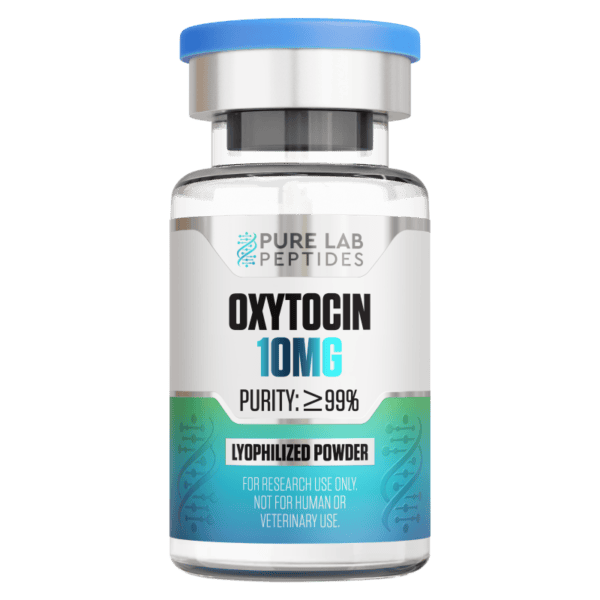
Pure Lab Peptides presents Oxytocin 5mg as a research-use-only material with a stated ≥99% purity claim, lyophilized powder form, and batch-specific COA availability. Researchers should review the product page and batch-specific documentation to confirm RUO labeling, product details, purity information, identity documentation, storage and handling information, and lot-level traceability.
Review the Pure Lab Peptides Oxytocin research-use-only product page for RUO labeling, product details, purity information, and batch-specific documentation. Research teams comparing related RUO materials can also review the Pure Lab Peptides research peptide collection, the Pure Lab Peptides blogs, and shipping and returns information for supplier-process context.
Common Misunderstandings About Buying Oxytocin Online
Misunderstanding: “Buy Oxytocin online” means personal use
Buy Oxytocin online should not be interpreted as personal-use guidance on this page. The phrase is addressed as laboratory procurement intent for qualified researchers reviewing RUO labeling, documentation, purity data, identity information, lot traceability, and supplier transparency.
Misunderstanding: Published literature equals product-use guidance
Published literature can provide context about compound identity, receptor terminology, structural biology, or analytical methods. It does not create use guidance for an Oxytocin research-use-only material. Research model findings should remain separate from procurement decisions and supplier documentation review.
Misunderstanding: Purity percentage alone proves identity
A purity percentage is only one documentation signal. Researchers should review Oxytocin purity documentation together with identity testing, analytical method, lot number, product name consistency, storage information, and COA details. A purity number without identity support is incomplete for research procurement.
Misunderstanding: COA documentation does not need to be batch-specific
Batch-specific COA review is central to RUO procurement. The lot number on the product label should match the lot number on the COA and internal laboratory records. Lot-level traceability helps research teams document exactly which material entered a controlled workflow.
Misunderstanding: RUO labeling supports human or animal use
RUO labeling does not support human or animal consumption. In this article, Oxytocin research material is discussed only for controlled laboratory procurement and documentation review. Supplier language should remain aligned with research-use-only positioning.
Misunderstanding: Supplier claims can replace analytical documentation
Supplier claims cannot replace batch-specific documentation. Researchers should review the Oxytocin COA, identity information, purity data, testing method, product form, storage guidance, and lot traceability before procurement. Transparent documentation is more useful than promotional wording.
FAQs About Buying Oxytocin Online for Research
Where can researchers buy Oxytocin online for laboratory research?
Researchers can buy Oxytocin online for laboratory research from an RUO supplier that provides clear labeling, a batch-specific COA, purity documentation, identity information, storage guidance, and lot-level traceability. Pure Lab Peptides presents Oxytocin 5mg as a research-use-only material with product documentation available for review.
What should researchers check before buying Oxytocin online?
Before buying Oxytocin online, researchers should check RUO labeling, the Oxytocin COA, purity data, identity testing, lot number consistency, product form, storage information, and supplier language. The supplier should avoid human-use positioning, dosing language, therapeutic claims, and personal-use guidance.
Why does a COA matter when buying Oxytocin?
A COA matters when buying Oxytocin because it gives researchers batch-specific documentation to compare against product labeling and internal records. The COA should be reviewed for compound name, lot number, purity percentage, test method, identity support, and documentation consistency.
Is Oxytocin intended for human or animal consumption?
Oxytocin discussed on this page is not intended for human or animal consumption. This article addresses research-use-only procurement, supplier documentation, purity review, and identity confirmation for qualified laboratory settings. It does not provide use instructions, medical advice, or product-use guidance.
What does research use only mean for Oxytocin?
Research use only means Oxytocin is positioned as a laboratory research material, not as a consumer product, medicine, supplement, diagnostic material, or veterinary material. For procurement teams, RUO review focuses on labeling, COA availability, identity documentation, purity support, and traceability.
How should published literature about Oxytocin be interpreted?
Published literature about Oxytocin should be interpreted as scientific context for compound identity, receptor terminology, analytical methods, and research models. It should not be interpreted as use guidance for RUO materials. Published clinical literature should remain separate from research-use-only procurement decisions.
Next Steps
Qualified researchers evaluating Oxytocin should review product labeling, COA status, identity documentation, storage information, and supplier transparency before selecting any research-use-only material. Review the Oxytocin product page for RUO labeling, purity information, and available batch-specific documentation.
References
- U.S. Food and Drug Administration. “Distribution of In Vitro Diagnostic Products Labeled for Research Use Only or Investigational Use Only.” FDA Guidance Document. 2018. https://www.fda.gov/regulatory-information/search-fda-guidance-documents/distribution-in-vitro-diagnostic-products-labeled-research-use-only-or-investigational-use-only
- U.S. Food and Drug Administration. “In Vitro Diagnostic Device Labeling Requirements.” FDA. 2023. https://www.fda.gov/medical-devices/device-labeling/in-vitro-diagnostic-device-labeling-requirements
- National Center for Biotechnology Information. “PubChem Compound Summary for CID 439302, Oxytocin.” PubChem. 2026. https://pubchem.ncbi.nlm.nih.gov/compound/Oxytocin
- IUPHAR/BPS Guide to Pharmacology. “Oxytocin ligand page.” Guide to Pharmacology. 2026. https://www.guidetopharmacology.org/GRAC/LigandDisplayForward?ligandId=2174&tab=structure
- European Bioinformatics Institute. “Compound: Oxytocin (CHEMBL395429).” ChEMBL. 2026. https://www.ebi.ac.uk/chembl/explore/compound/CHEMBL395429
- Human Metabolome Database. “Showing metabocard for Oxytocin (HMDB0002865).” HMDB. 2026. https://www.hmdb.ca/metabolites/HMDB0002865
- National Center for Biotechnology Information. “OXT oxytocin/neurophysin I prepropeptide.” NCBI Gene. 2026. https://www.ncbi.nlm.nih.gov/gene/5020
- UniProt Consortium. “OXTR – Oxytocin receptor – Homo sapiens.” UniProtKB P30559. 2026. https://www.uniprot.org/uniprotkb/P30559/entry
- National Center for Biotechnology Information. “OXTR oxytocin receptor.” NCBI Gene. 2026. https://www.ncbi.nlm.nih.gov/gene/5021
- Gimpl G, Fahrenholz F. “The oxytocin receptor system: structure, function, and regulation.” Physiological Reviews. 2001;81(2):629-683. https://pubmed.ncbi.nlm.nih.gov/11274341/
- Gimpl G, Reitz J, Brauer S, Trossen C. “Oxytocin receptors: ligand binding, signalling and cholesterol dependence.” Progress in Brain Research. 2008;170:193-204. https://pubmed.ncbi.nlm.nih.gov/18655883/
- Chatterjee O, Patil K, Sahu A, Gopalakrishnan L, Mol P, Advani J, et al. “An overview of the oxytocin-oxytocin receptor signaling network.” Journal of Cell Communication and Signaling. 2016;10(4):355-360. https://pubmed.ncbi.nlm.nih.gov/27624619/
- Waltenspühl Y, Schöppe J, Ehrenmann J, Kummer L, Plückthun A. “Crystal structure of the human oxytocin receptor.” Science Advances. 2020;6(29):eabb5419. https://pubmed.ncbi.nlm.nih.gov/32832646/
- Waltenspühl Y, Ehrenmann J, Vacca S, Thom C, Medalia O, Plückthun A. “Structural basis for the activation and ligand recognition of the human oxytocin receptor.” Nature Communications. 2022;13:4153. https://pubmed.ncbi.nlm.nih.gov/35851571/
- RCSB Protein Data Bank. “7QVM: Human Oxytocin receptor (OTR) oxytocin Gq chimera complex.” RCSB PDB. 2022. https://www.rcsb.org/structure/7QVM
- U.S. Food and Drug Administration. “Analytical Procedures and Methods Validation for Drugs and Biologics.” FDA Guidance Document. 2015. https://www.fda.gov/regulatory-information/search-fda-guidance-documents/analytical-procedures-and-methods-validation-drugs-and-biologics
- U.S. Food and Drug Administration. “Q2(R2) Validation of Analytical Procedures.” FDA Guidance Document. 2024. https://www.fda.gov/regulatory-information/search-fda-guidance-documents/q2r2-validation-analytical-procedures
- U.S. Food and Drug Administration. “Q14 Analytical Procedure Development.” FDA Guidance Document. 2024. https://www.fda.gov/regulatory-information/search-fda-guidance-documents/q14-analytical-procedure-development
- International Organization for Standardization. “ISO/IEC 17025 – Testing and calibration laboratories.” ISO. 2026. https://www.iso.org/ISO-IEC-17025-testing-and-calibration-laboratories.html
- International Organization for Standardization. “ISO Guide 31:2015 – Reference materials – Contents of certificates, labels and accompanying documentation.” ISO. 2015. https://www.iso.org/standard/52468.html
- National Institute of Standards and Technology. “Reference Materials.” NIST. 2026. https://www.nist.gov/reference-materials
- Mant CT, Chen Y, Yan Z, Popa TV, Kovacs JM, Mills JB, Tripet BP, Hodges RS. “HPLC analysis and purification of peptides.” Methods in Molecular Biology. 2007;386:3-55. https://pubmed.ncbi.nlm.nih.gov/18604941/
- Li C, Bhavaraju S, Thibeault MP, Melanson J, Blomgren A, Rundlöf T, et al. “Survey of peptide quantification methods and comparison of their reproducibility: A case study using oxytocin.” Journal of Pharmaceutical and Biomedical Analysis. 2019;166:105-112. https://pubmed.ncbi.nlm.nih.gov/30640042/
- Choules MP, Bisson J, Gao W, Lankin DC, McAlpine JB, Niemitz M, Jaki BU, Franzblau SG, Pauli GF. “Quality Control of Therapeutic Peptides by 1H NMR HiFSA Sequencing.” The Journal of Organic Chemistry. 2019;84(6):3055-3073. https://pubmed.ncbi.nlm.nih.gov/30793905/
- De Spiegeleer B, Vergote V, Pezeshki A, Peremans K, Burvenich CPG. “Impurity profiling quality control testing of synthetic peptides using liquid chromatography-photodiode array-fluorescence and liquid chromatography-electrospray ionization-mass spectrometry: The obestatin case.” Analytical Biochemistry. 2008;376(2):229-234. https://pubmed.ncbi.nlm.nih.gov/18342612/
- Li M, Josephs RD, Daireaux A, Choteau T, Westwood S, Martos G, Wielgosz RI, Li H. “Structurally related peptide impurity identification and accurate quantification for synthetic oxytocin by liquid chromatography-high-resolution mass spectrometry.” Analytical and Bioanalytical Chemistry. 2021;413(7):1861-1870. https://pubmed.ncbi.nlm.nih.gov/33479819/
- Wang S, Wu P, Li M, Huang T, Shi N, Feng L, Li H. “Mass balance method for SI-traceable purity assignment of synthetic oxytocin.” Journal of Pharmaceutical and Biomedical Analysis. 2022;207:114401. https://pubmed.ncbi.nlm.nih.gov/34656934/
There are no reviews yet.