

$199.99
Research Studies:


FREE Shipping on
orders over $200
ALL ARTICLES AND PRODUCT INFORMATION PROVIDED ON THIS WEBSITE ARE FOR INFORMATIONAL AND EDUCATIONAL PURPOSES ONLY. The products offered on this website are intended solely for research and laboratory use. These products are not intended for human or animal consumption. They are not medicines or drugs and have not been evaluated or approved by the FDA to diagnose, treat, cure, or prevent any disease or medical condition. Any form of bodily introduction is strictly prohibited by law.
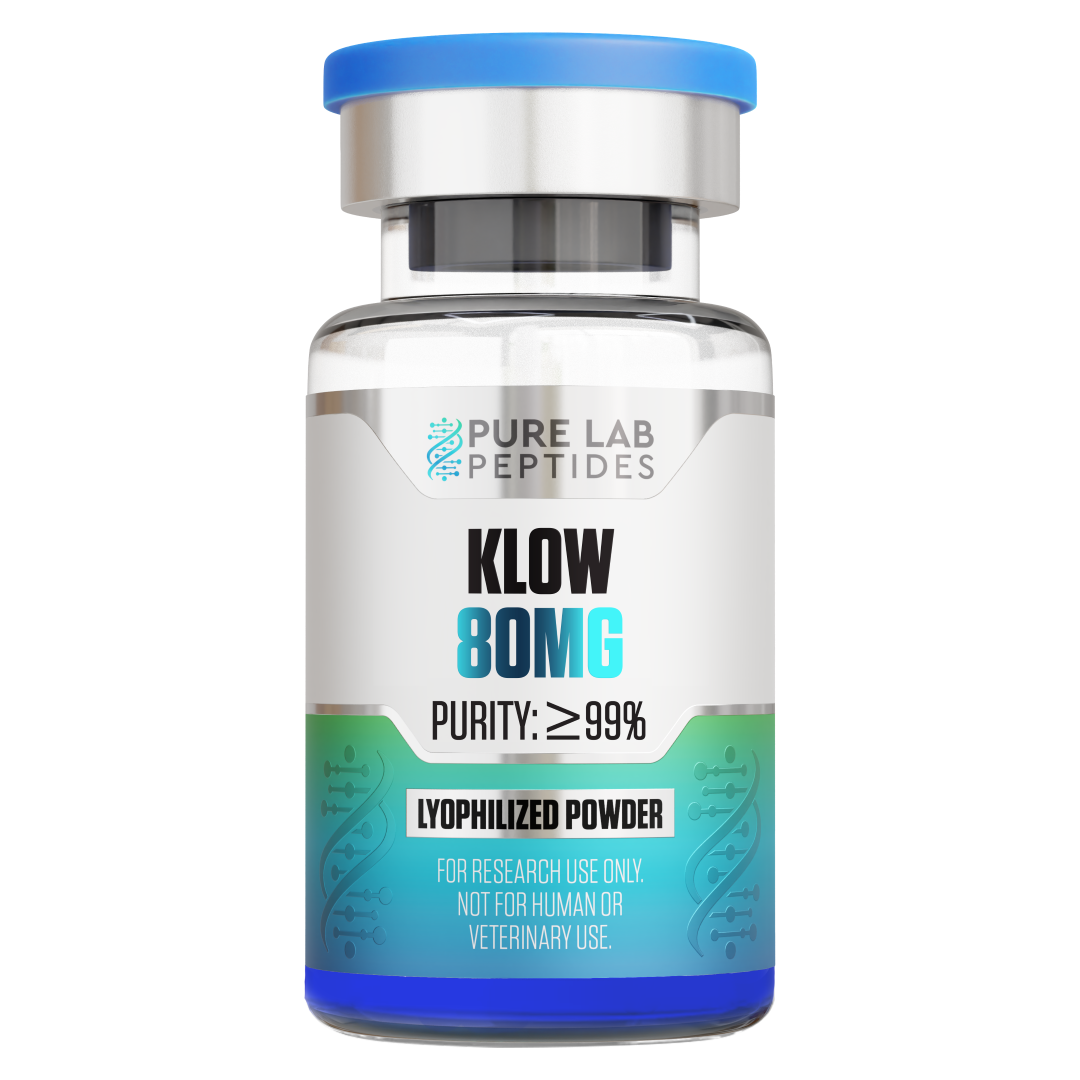
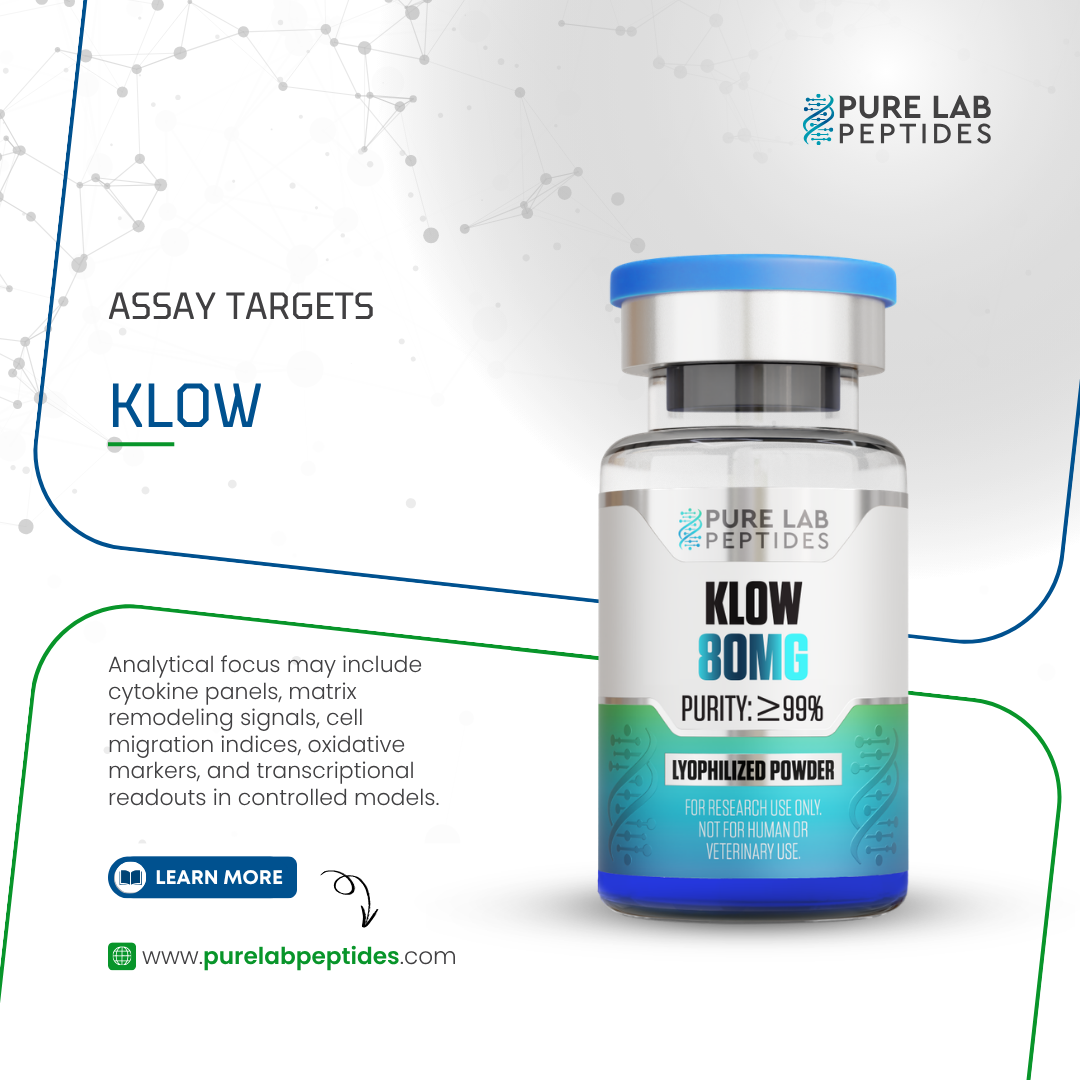
KLOW (TB-500 10mg + BPC-157 10mg + KPV 10mg + GHK-Cu 50mg) is a research-use-only peptide blend supplied for controlled laboratory workflows, multi-compound documentation review, and analytical characterization. This blend is manufactured under rigorous quality standards to support consistency, traceability, and batch-specific verification for qualified laboratory settings.
KLOW (TB-500 10mg + BPC-157 10mg + KPV 10mg + GHK-Cu 50mg) is intended strictly for laboratory research use only. This product is not intended for human or animal consumption, therapeutic use, diagnostic use, clinical use, veterinary use, or as a food, drug, cosmetic, dietary supplement, or household product.
| CAS No. | TB-500: 77591-33-4 BPC-157: 137525-51-0 KPV: 113274-56-9 GHK-Cu: 49557-75-7 |
|---|---|
| Purity | ≥99% |
| Sequence | TB-500: Ac-Ser-Asp-Lys-Pro-Asp-Met-Ala-Glu-Ile-Glu-Lys-Phe-Asp-Ile-Thr-His-Gly-Glu-Glu-Asn BPC-157: Gly-Glu-Pro-Pro-Pro-Gly-Lys-Pro-Ala-Asp-Asp-Ala-Gly-Leu-Val KPV: Lys-Pro-Val GHK-Cu: Gly-His-Lys + Cu(2+) |
| Molecular Formula | Blend of four peptides |
| Molecular Weight | Blend-dependent; TB-500 ≈ 4963 g/mol, BPC-157 ≈ 1419 g/mol, KPV ≈ 341 g/mol, GHK-Cu ≈ 340 g/mol (excluding copper ion weight adjustment) |
| Applications | Regenerative medicine research, wound healing, skin health, anti-inflammatory studies, gut and immune function research |
| Synthesis | Solid-phase synthesis |
| Solubility | Soluble in water or 1% acetic acid |
| Stability & Storage | Stable for up to 24 months at -20°C. After reconstitution, may be stored at 4°C for up to 4 weeks or at -20°C for up to 6 months. |
| Appearance | White lyophilized powder |
| Shipping Conditions | Shipped at ambient temperature; once received, store at -20°C |
| Regulatory/Compliance | Manufactured in a facility that adheres to cGMP guidelines |
| Safety Information | Refer to provided MSDS |
Consider these supplementary peptides for a comprehensive research approach.
Researchers looking to buy Klow Peptide Blend for research should evaluate the page as a laboratory material record, not as a product-use guide. Klow is framed here as a research peptide blend associated with KPV, BPC-157, TB500, and GHK-Cu component documentation rather than any consumer outcome. Pure Lab Peptides presents this page for RUO procurement review, with emphasis on compound identity, COA availability, analytical testing, and lot-level documentation.
To buy Klow Peptide Blend for research, research buyers should first confirm RUO labeling, batch-specific COA availability, HPLC purity data, LC-MS identity support, lot traceability, and supplier documentation. Products discussed in this article are intended for laboratory research use only and are not intended for human or animal consumption. Analytical records should be reviewed as documentation, not as product-performance proof [17] [20].
The phrase buy Klow Peptide Blend for research should lead to a documentation-first review. In an RUO context, commercial intent means checking whether the product page provides enough technical information for qualified research procurement, not whether the material is positioned for any non-laboratory outcome.
Start with the certificate of analysis, product label, lot number, testing method, and component naming. ICH Q2(R2) explains analytical validation around identity, purity, and quantitative or qualitative measurements, which makes method transparency useful for document review [17].
RUO labeling keeps the page aligned with laboratory research scope. FDA’s RUO/IUO guidance is written for in vitro diagnostic products, but it illustrates a broader documentation principle: labeling and surrounding communications should remain consistent with the stated research scope [26] [27].
A Klow blend product page should read like a technical material listing. The page should identify the research peptide blend, the component names, the testing documentation, and the records available for laboratory review.
The key research boundary is simple. The product page can discuss identity, published literature, analytical testing, and supplier documentation, but it should not translate research literature into product claims.
A peptide blend combines multiple peptide components into one research formulation. That makes documentation more important because each component name, naming variant, purity record, and analytical identity reference should be consistent across the product page, COA, label, and supplier records.
Product-page language should stay focused on research purposes, product identity, and documentation quality. It should describe what the listing is, what records researchers can review, and what the page does not claim.
Laboratory research use fits into supplier review at the documentation level. Research buyers should compare the label, COA, analytical methods, lot details, and storage documentation before selecting any research-use-only peptide.
Klow is treated here as a multi-peptide research product built around component documentation for KPV, BPC-157, TB500, and GHK-Cu. That blend context makes the page different from a single-compound overview because the buyer must review both the blend identity and the component identities.
Klow peptide documentation should identify the product as an RUO peptide blend. The classification should stay within multi-peptide research, cellular pathway context, and analytical documentation rather than consumer-facing language.
Consistent naming helps prevent documentation drift. Klow, Klow blend, Klow peptide, and Klow peptide blend should point to the same catalog entity, while component names should remain stable across the label and COA.
Many peptide research materials appear as lyophilized powder because freeze drying removes water through sublimation and desorption, a process widely discussed for preserving protein and peptide materials in solid form [28]. Storage documentation should be recorded separately from analytical identity, because stability and identity are related but not identical documentation questions [29].
The blend combines four peptides in a research formulation. The safest way to describe those components is to separate compound identity from literature interpretation and product-page positioning.
KPV is identified as MSH 11-13, Lys-Pro-Val, or L-lysyl-L-prolyl-L-valine in PubChem [1]. Published KPV literature has examined NF-kappaB and MAP kinase signaling in model systems, which should be presented as research context rather than a claim about a Klow product [2].
BPC-157 and BPC157 should be treated as naming variants that need consistency across supplier records. PubChem lists BPC-157 under CID 9941957, and GSRS includes BPC-157 with the sequence Gly-Glu-Pro-Pro-Pro-Gly-Lys-Pro-Ala-Asp-Asp-Ala-Gly-Leu-Val [4] [5].
GHK-Cu should be matched against copper peptide records such as Cu-GHK and glycyl-L-histidyl-L-lysine documentation [7] [8]. TB-500 and TB500 naming should be connected to thymosin beta-4 fragment context, with UniProt identifying thymosin beta-4 as the TMSB4X protein and analytical literature discussing N-acetylated LKKTETQ as an active-region marker [11] [14].
Published literature helps define research applications, but it does not define product intent. For an RUO page, literature should be interpreted as background for model design, pathway language, and documentation review.
| Research Area | What Literature Examines | Evidence Type | RUO Interpretation |
|---|---|---|---|
| KPV component context | KPV literature examines NF-kappaB and MAP kinase signaling in model systems [2]. | In vitro and preclinical literature | Useful for pathway context; not a product claim. |
| BPC-157 identity context | BPC-157 is documented as a pentadecapeptide in official and published records [5] [6]. | Database and review literature | Useful for naming and sequence review. |
| GHK-Cu component context | GHK-Cu literature discusses copper-peptide complex biology and cellular pathway models [9] [10]. | Structural and review literature | Useful for copper peptide classification. |
| TB500 component context | Analytical literature discusses TB-500 in relation to N-acetylated LKKTETQ and LC-MS detection [14]. | Analytical literature | Useful for identity terminology and method context. |
| Matrix-focused model context | ECM literature describes cell-matrix interaction, remodeling, and migration concepts [15] [16]. | Review literature | Useful for research vocabulary, not product positioning. |
Published literature can support careful discussion of compound class, peptide sequence, research models, receptor or pathway context, and analytical characterization. It cannot support claims that a research-use-only material provides product effects or clinical outcomes.
Study findings are tied to specific models, materials, methods, and endpoints. RUO product positioning should stay anchored to documentation: COA review, HPLC data, LC-MS identity support, lot traceability, and label consistency.
Preclinical and in vitro literature can help define the boundaries of a research question. For example, KPV literature has examined NF-kappaB and MAP kinase signaling, while ECM reviews discuss how cell-matrix interactions can shape cell migration models [2] [15].
Klow component literature intersects with cellular pathway research, copper peptide research, thymosin beta-4 fragment terminology, and extracellular matrix research. These areas belong on a research page only when they are described as literature context.
Extracellular matrix remodeling describes changes in the matrix environment around cells. Review literature connects ECM dynamics with cell migration and matrix metalloproteinase activity, but those concepts should remain model-specific rather than product-specific [15] [16].
Cell signaling language should be framed as pathway research. KPV literature may discuss NF-kappaB or MAP kinase signaling, and GHK-Cu literature may discuss gene-expression or copper-complex models, but neither should become a Klow performance claim [2] [10].
Angiogenesis and endothelial terminology can appear in same-lane literature for thymosin beta-4 and related pathway models. The safer product-page approach is to identify these as research terms and avoid presenting them as outcomes associated with the product [12] [13].
Claim boundaries separate what published literature examines from what a product page can safely say. A Klow product page should focus on the research material, not on promises, recommendations, or end-user outcomes.
Some published literature outside the scope of RUO product use has examined this compound class in human study settings. That literature should not be interpreted as a use claim for research-use-only materials.
Search phrases can drift when commercial intent is mixed with outcome-driven language. A safer page keeps the commercial query inside research procurement language: buy Klow Peptide Blend for research, review the COA, verify identity support, and compare batch documentation.
Pathway relevance means a topic appears in the literature. It does not mean a product produces a pathway outcome, and it does not replace batch-specific analytical documentation.
Product-page copy should keep literature context, supplier documentation, and purchasing language in separate lanes. Literature explains research background; documentation confirms the record; procurement language helps qualified professionals evaluate materials for laboratory research.
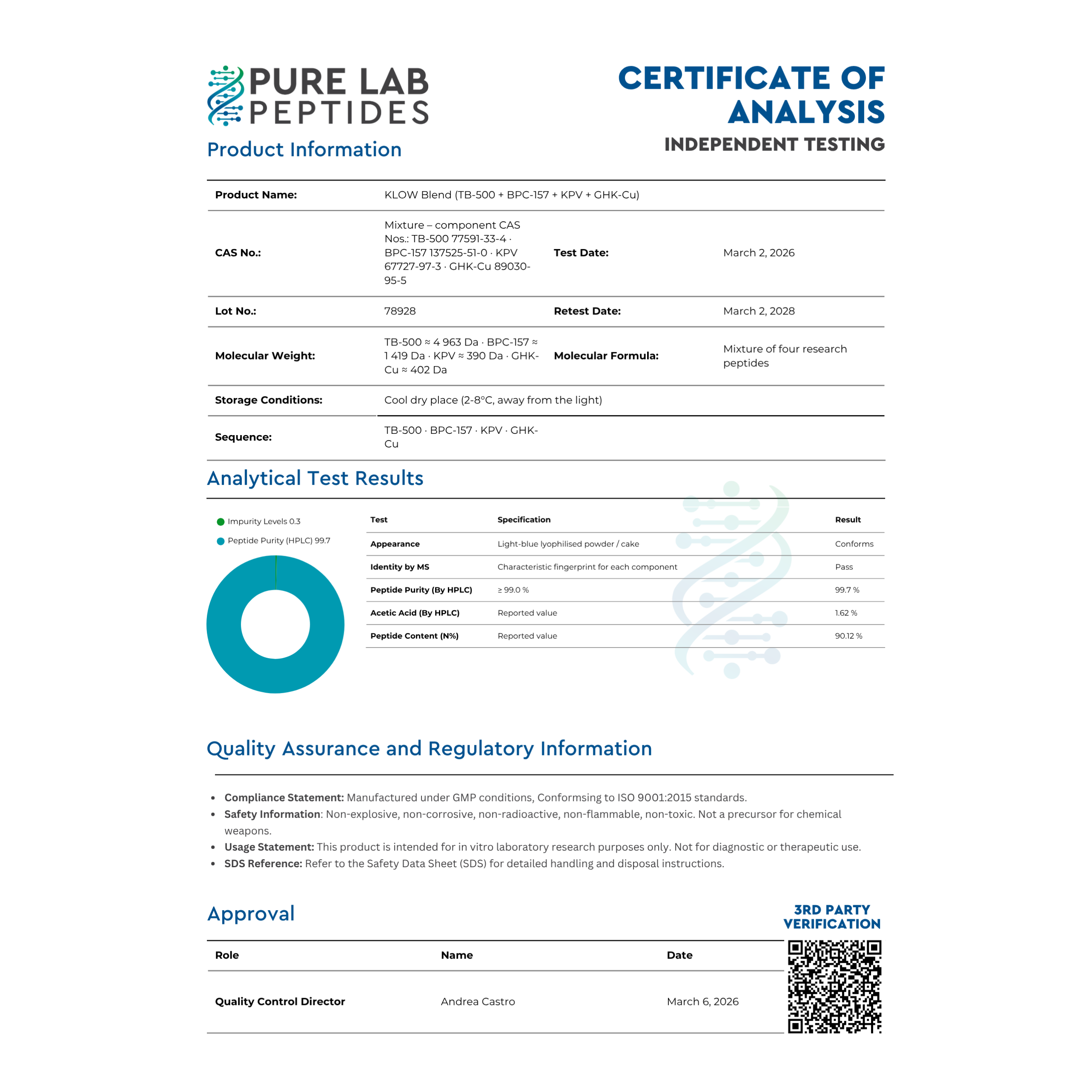
A certificate of analysis should make the research material easier to verify. It should not force the buyer to guess whether the tested lot matches the product listing.
A COA should confirm the product name, component naming, lot number, test date, testing method, purity result, and identity-supporting method. Analytical validation guidance emphasizes that identity and purity measurements require suitable procedures and appropriate validation considerations [17] [18].
COA dates and lot numbers help connect the laboratory result to the specific research material record. FDA data-integrity guidance emphasizes complete laboratory records, including graphs, charts, spectra, and other data associated with results [24].
Batch-specific documentation matters because a peptide blend can have several component identity points. The COA, label, product listing, and internal supplier record should tell the same story for Klow peptide and its listed components.
Analytical testing helps research buyers move from product description to technical review. For peptide materials, HPLC can support purity review, while LC-MS and mass spectrometry can support molecular identity assessment [20] [21] [22].
HPLC is widely used for peptide analysis and purification, including reversed-phase approaches that separate peptide-related components under controlled chromatographic conditions [20]. For procurement review, the important question is whether the COA states the method and ties it to the correct lot.
LC-MS can support synthetic peptide characterization by pairing chromatographic separation with mass-based information. Literature on synthetic peptide characterization describes LC-MS workflows for evaluating peptide impurities and identity-related information [21].
Chromatogram review may include retention time, peak shape, and method details, while mass spectrometry review may include mass-to-charge information and identity-supporting spectra. Two-dimensional LC-MS literature also shows why chromatographic separation can matter when closely related peptide forms are being assessed [23].
A documentation-only lab-test verification workflow can follow these steps:
High-purity language should be reviewed through the lens of testing records. A high-purity statement is strongest when the COA, method, chromatogram, and lot details are available together.
In analytical context, high-purity should point to a measured result, a method, and a batch record. ICH Q2(R2) places purity and identity among the common analytical measurement categories addressed by analytical procedure validation [17].
Third-party testing is most useful when it matches the product name, lot number, method, and date shown in the supplier documentation. ISO/IEC 17025 describes requirements for testing and calibration laboratories to demonstrate competent operation and valid results [25].
Reference standards can support quality review when their identity, purity, and traceability are documented. A peer-reviewed discussion of synthetic peptide reference standards describes chromatography, mass spectrometry, and related approaches used to support peptide quality assessment [30].
Lot traceability connects the product listing to the tested material. For a Klow peptide blend, this matters because the page must keep component identity, label language, and testing data aligned.
Research teams should compare product name, lot number, COA date, analytical method, test source, and label text. Complete laboratory records help preserve the context needed to review analytical findings [24].
Batch records create a chain between the product listing, the label, the COA, and any available analytical files. If one record uses Klow blend while another uses only a component name, the documentation should explain the relationship clearly.
A tested in the USA statement should not stand alone. Research buyers should look for the testing source, COA date, method, lot number, and whether the third-party documentation aligns with the supplier’s product record.
Labeling consistency helps prevent product-page ambiguity. It also helps research buyers distinguish catalog information from scientific claims.
Catalog quantities such as 10mg, KPV 10 mg, 50mg, 50 mg, or 80mg belong in listing and label documentation. They should be treated as catalog specifications, not as research instructions or separate SEO targets.
Amount labels can fragment a product page when they are treated as separate intent. A canonical product page should keep Klow Peptide Blend as the main entity and use amount language only for neutral catalog clarity.
Before buying Klow Peptide Blend for research, qualified professionals should check whether the product page provides enough documentation to support laboratory procurement review. The goal is not to answer consumer-use questions; the goal is to verify identity, purity support, lot traceability, RUO labeling, and supplier consistency.
Quality and documentation checklist:
Lab teams should compare the product listing, RUO label, COA, testing method, lot record, and storage documentation. The strongest supplier record is consistent across every document and avoids converting research literature into product claims.
Common misunderstandings to avoid:
Research-use-only notice:
“Pure Lab Peptides supplies compounds for laboratory research use only. Products are not intended for human or animal consumption, diagnostic use, therapeutic use, clinical use, veterinary use, or as food, drugs, cosmetics, dietary supplements, or household products. Researchers are responsible for ensuring lawful, appropriate handling and use in accordance with applicable regulations and institutional guidelines.”
Next step:
Review the product-page documentation, COA details, analytical testing context, and RUO labeling before evaluating Klow Peptide Blend for laboratory research procurement.
Research use only means Klow Peptide Blend is intended solely for laboratory research contexts. This designation indicates the material is not intended for human or animal consumption, clinical testing, or therapeutic purposes. Researchers should ensure all handling, storage, and experimental use comply with institutional guidelines and applicable regulations.
Researchers should interpret Klow literature as a reference for peptide identity, molecular characterization, and pathway evaluation rather than as a guide for human or animal use. Published studies provide mechanistic, in vitro, or preclinical data, which should not be translated into practical application claims. Proper COA review and analytical documentation are essential for safe laboratory evaluation.
Researchers should review batch-specific certificates of analysis, HPLC and LC-MS data, lot numbers, and purity documentation for Klow Peptide Blend. This ensures compound identity, consistency across production lots, and alignment with research-use-only labeling. Analytical testing information supports informed laboratory planning and compound verification.
Lot traceability is critical for Klow Peptide Blend because it links each vial to its batch-specific COA, production records, and analytical testing results. This traceability allows researchers to verify consistency, document experimental materials accurately, and maintain reproducibility in preclinical and in vitro studies.
Klow product pages should clearly separate literature language from potential consumer or therapeutic interpretations. Terms like nootropic, cognitive enhancement, or peptide therapy must be framed as boundary-sensitive examples and tied back to compound identity, COA review, analytical testing, lot traceability, and RUO labeling. This ensures the page remains compliant and scientifically focused.
Analytical methods such as HPLC and LC-MS are used to evaluate Klow Peptide Blend purity. HPLC verifies peptide composition and detects impurities, while LC-MS confirms molecular weight and sequence identity. These methods provide essential validation for laboratory research, supporting accurate compound characterization and documentation.
The following authors are recognized for published research that helped shape the scientific context discussed in this article.
Author profile: Nature Reviews Molecular Cell Biology author profile (Alexandra Naba)
Alexandra Naba is a research author whose work on the extracellular matrix (ECM) informs broader discussions of cellular environments, matrix composition, and structural frameworks that can intersect with laboratory peptide research contexts. Her publications explore mechanisms governing ECM assembly, diversity, and proteomic characterization, providing neutral background literature for researchers interested in complex protein and peptide environments and analytical characterization. These contributions help contextualize how peptides and matrix components are studied in advanced laboratory settings without implying any product-use claims.
Selected publications:
Author profile: Lingjun Li – Wikipedia
Lingjun Li is a research author whose work on mass spectrometry–based peptide and proteome analysis contributes to the understanding of analytical techniques used for peptide identification, characterization, and quantitation. Her research publications describe advances in mass spectrometric methods that are widely referenced in peptide analytical literature and support foundational knowledge for laboratory research, including analytical validation approaches relevant to peptide purity and identity. These studies provide a neutral research backdrop for interpreting laboratory peptide documentation and analytical verification discussions.
Selected publications:
This research disclaimer clarifies how language and terminology are presented in the context of this peptide product. In neuropeptide and peptide blend research content, terms such as nootropic, cognitive enhancement, mental clarity, peptide therapy, nasal, gastrointestinal tract, and clinical trial can drift into consumer-facing, administration-focused, wellness, therapeutic, or product-claim language when interpreted outside a research-use-only framework. These phrases are provided solely as examples of boundary-sensitive terminology observed in literature or research discussions.
Here, those terms are addressed only as research-language examples, not as product uses, outcomes, or instructions. The focus remains on compound identity, COA review, analytical testing, peptide purity, lot traceability, RUO labeling, product documentation, and published literature boundaries. Researchers and technical procurement teams should interpret references to wound healing, tissue repair, regeneration, antiinflammatory activity, soft-tissue models, and synergistic interactions strictly within model-specific research contexts, separate from any consumer, clinical, or performance claims.
Our team is ready to assist you with any inquiries regarding our catalogue of peptides and their applications.
Discount Applied Successfully!
Your savings have been added to the cart.
Pure Lab Peptides
You must be at least 21 years of age to enter this site. By entering, you confirm that you are of legal age and agree to our terms.
For research use only.
There are no reviews yet.