

Researchers evaluating where to buy Oxytocin for research need a documentation-led review, not a consumer-facing product narrative. Oxytocin is a cyclic nine-amino-acid peptide with the sequence CYIQNCPLG and a documented molecular identity in major pharmacology and chemistry databases [1] [2]. This Pure Lab Peptides guide keeps the focus on research-use-only positioning, COA review, analytical testing, lot traceability, and careful interpretation of published literature.
Researchers should evaluate the documentation, COA, identity testing, purity data, lot traceability, and RUO label before they buy Oxytocin for research. Products discussed in this article are intended for laboratory research use only and are not intended for human or animal consumption. The most useful commercial research review compares the product listing against batch-specific records and analytical method details.
The commercial phrase behind this page must be interpreted as research procurement intent. That means the article should help laboratory buyers decide whether the documentation is clear, not whether the compound produces any outcome.
A research-safe review asks better questions: Does the label match the COA? Is the lot number visible? Is the compound identity supported by analytical testing? Those questions keep the product page aligned with RUO expectations.

The first review point is the batch-specific COA. Analytical validation frameworks emphasize that procedures should be suitable for the attribute being measured, including identity, purity, and related quality characteristics in appropriate analytical contexts [7] [8].
For an Oxytocin research material, the COA should be read alongside the label, product listing, lot number, storage notation, and any available method records. No single document should carry the full review by itself.
RUO labeling tells the reader that the material belongs in a laboratory research context. U.S. labeling rules for certain laboratory research-phase products include a prominent research-use-only statement, and FDA guidance stresses that RUO labeling must align with how a product is represented [9] [10].
For a peptide product page, RUO positioning should be visible in the product copy, documentation language, and downstream research procurement review. The goal is clarity before any purchasing decision.
Oxytocin is a peptide hormone and neuropeptide that appears across endocrine, receptor-signaling, neurobiology, and analytical chemistry literature. The IUPHAR/BPS Guide to Pharmacology lists oxytocin as an endogenous peptide ligand, while ChEMBL reports its molecular formula and molecular weight for compound identity reference [1] [2].
In this article, Oxytocin is treated as the canonical compound entity. Product strengths, catalog amounts, and listing variants are not part of the SEO target.
Oxytocin is commonly described as a cyclic nonapeptide. IUPHAR lists the peptide sequence as CYIQNCPLG and notes a disulfide bond between cysteine residues at positions 1 and 6 with C-terminal amidation [1].
That structural identity is why sequence, molecular weight, and method records matter for research procurement. The page should help researchers verify documentation, not infer research outcomes.
Peptide hormone identity can be documented through compound database records, sequence references, COA data, and analytical method outputs. NCBI describes the OXT gene as encoding a precursor that is processed to oxytocin and neurophysin I [5].
For procurement teams, the practical task is to compare the compound name, sequence, molecular weight, and lot-specific documentation. If those records do not align, the material needs additional review before it enters a laboratory inventory.

Hypothalamus and pituitary context belongs in scientific background, not product positioning. NCBI’s OXT gene record describes oxytocin as associated with a precursor system connected to hypothalamic synthesis and posterior pituitary context [5].
Published reviews also discuss oxytocin in relation to parturition, lactation, receptor signaling, and central research models [11] [12]. A product page can summarize that literature as background while keeping the commercial page focused on documentation.
A strong Oxytocin product page should answer the procurement question with evidence of documentation. It should not lean on consumer vocabulary, broad claims, or unsupported interpretations of research literature.
The best research page is simple. It makes the identity, RUO status, testing records, and supplier documentation easy to review.
The most useful listing signals are the compound name, RUO status, lot number, COA availability, analytical method notation, purity record, identity record, and storage documentation. These signals help laboratory teams compare the product page with the supporting documents.
The listing should also avoid implying that published literature automatically applies to a supplied research material. That boundary protects both the reader and the product page.
A buy Oxytocin for research page should prioritize COA records, identity testing, lot traceability, and RUO labeling. This is the safest way to serve commercial research intent without creating consumer-facing claims.
The page should make procurement review easier. It should not become a wellness guide, medication comparison, or route-specific product page.
Catalog copy should avoid product claims because research materials are not positioned as finished products for consumer outcomes. Published studies may describe receptor activity, model findings, or physiological background, but product pages should not convert those findings into claims about supplied materials.
A safer approach is to say what can be verified: identity documentation, purity records, lot alignment, and RUO label clarity.
Scientific background helps researchers understand why Oxytocin appears in neuropeptide literature. The same background can become unsafe if it is written as a product claim.
For an RUO page, the key distinction is clear: literature context is not product positioning.
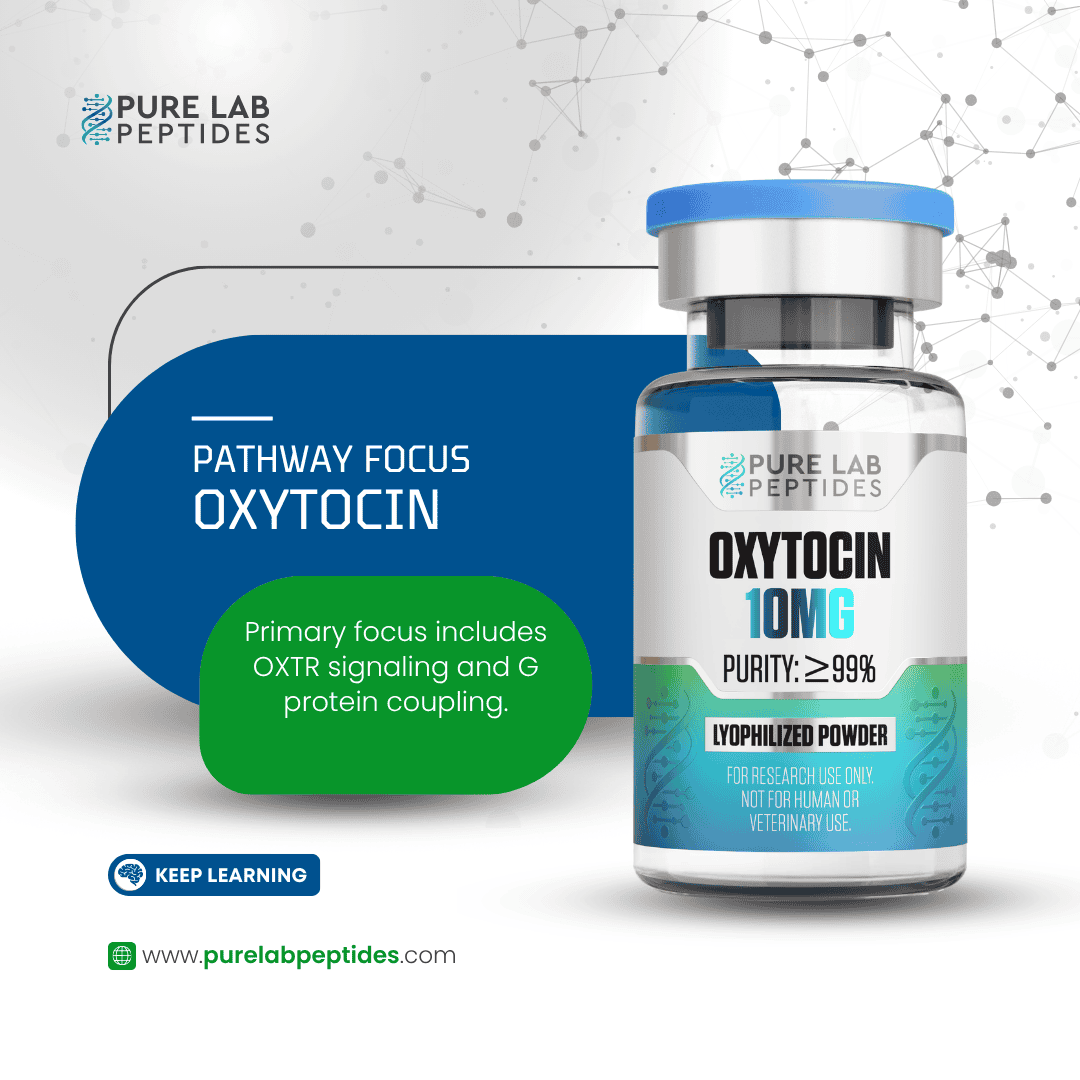
The oxytocin receptor is listed by IUPHAR as an OT receptor in the vasopressin and oxytocin receptor family, with human OXTR documented as a class A GPCR [3]. UniProt describes OXTR activity as G protein-mediated and linked to a phosphatidylinositol-calcium second-messenger system [4].
NCBI also describes OXTR as encoding a G protein-coupled receptor for oxytocin [6]. These records support receptor-pathway context, not product claims.
Neuropeptide research often examines how peptide signaling interacts with broader neural circuit models. Russo’s review notes that neuropeptides can modulate co-released neurotransmitter activity in the brain and periphery [13].
Oxytocin-specific reviews discuss receptor distribution, central signaling models, and circuit-level questions in academic contexts [14] [15]. Those discussions should be framed as model-specific literature, not product-page promises.
The literature describes oxytocin’s established physiological background in uterine contraction, childbirth-associated endocrine literature, lactation, and milk let-down contexts [11] [12]. Those topics help explain why the compound is widely studied, but they do not define any intended context for an RUO research material.
This page uses physiological background only to clarify the literature lane. It does not provide clinical, personal, or consumer-facing guidance.
Published Oxytocin literature spans compound identity, receptor biology, endocrine physiology, neurobiology, and model-specific signaling. Reviews by Gimpl and Fahrenholz, Jurek and Neumann, and Lee and colleagues each describe different aspects of the oxytocin system [11] [12] [16].
For an RUO product page, the safest interpretation is to treat the literature as a map of research context. It is not a substitute for batch documentation.
Preclinical literature can support questions about model design, receptor expression, signaling hypotheses, and pathway mapping. Jurek and Neumann review OXT expression, OXTR binding, and OXTR-coupled signaling across research contexts [16].
Other reviews discuss oxytocin pathways and sensory-system interactions in model-specific academic literature [17]. That evidence should stay tied to study design and model limitations.
In vitro models can help researchers examine receptor signaling, ligand interaction, and pathway readouts under controlled conditions. Chatterjee and colleagues compiled oxytocin-OXTR signaling reactions from literature to organize the receptor signaling network [18].
Cell-based receptor responsiveness studies can also examine signaling features such as phospholipase C activity and calcium-related readouts under defined assay conditions [19]. Those models are useful for research interpretation, not product positioning.
Study design determines what a paper can and cannot support. A receptor assay, a preclinical model, an analytical chemistry paper, and a literature review answer different questions.
For procurement teams, that distinction matters. Literature can explain why a compound is studied, while COA and analytical records explain what the supplied research material is documented to be.
An evidence interpretation framework helps prevent over-reading. It separates compound facts, receptor context, model-specific findings, analytical verification, and RUO labeling.
| Research Area | What Literature Examines | Evidence Type | RUO Interpretation |
|---|---|---|---|
| Compound identity | Sequence, formula, molecular weight, and peptide class [1] [2] | Database and chemistry records | Supports identity review, not outcome claims |
| Receptor context | OXTR classification and receptor signaling [3] [4] | Official receptor databases | Supports pathway context, not product positioning |
| Neuropeptide signaling | Central signaling and model-specific neural circuit questions [13] [14] | Review and research literature | Supports literature interpretation only |
| In vitro signaling | OXTR-linked reaction networks and receptor responsiveness [18] [19] | Cell and pathway models | Supports assay context, not procurement claims |
| Analytical testing | Peptide separation, identity review, and mass data interpretation [20] [21] | Analytical chemistry literature | Supports documentation review |
Source quality starts with official databases, peer-reviewed reviews, and primary analytical literature. Recent reviews can help summarize a large evidence base, but databases are often better for fixed identity details such as receptor names, sequence references, and molecular records [1] [2] [3] [22].
A strong product page should use literature to clarify context and documentation to support procurement review. Mixing those two roles creates avoidable risk.
Some published literature outside the scope of RUO product use has examined this compound class in human study settings. That literature should not be interpreted as a use claim for research-use-only materials.
A research buyer should ask what the study actually measured, what model it used, and whether the finding belongs in product copy at all. Most product-page decisions should return to COA records, identity testing, and lot-level documentation.
Neutral summaries keep verbs under control. Safer verbs include describes, reports, examines, evaluates, and characterizes.
That tone matters because Oxytocin has a broad literature base. The page should not imply that a Pure Lab Peptides material is the same thing as a compound used in any outside study.
Claim boundaries protect the product page from drifting away from laboratory research intent. The article can discuss Oxytocin as a compound, receptor ligand, and research topic, but it should not frame the product as a consumer or clinical item.
This is especially important for commercially motivated search. People may arrive through broad search terms, but the page must keep them inside an RUO documentation review.
Search intent can drift when broad commercial phrases are paired with consumer-facing expectations. A phrase such as oxytocin nasal spray belongs in a language-boundary review, not in product positioning for a laboratory material.
The same caution applies to pharmacy-style framing. If a page starts sounding like a healthcare channel, it is no longer serving a technical procurement purpose.
Research pages should emphasize product documentation, compound identity, COA availability, analytical testing, storage records, and supplier transparency. Those are the review points that matter for research procurement.
This approach still serves commercial research intent. It simply does so without promising product effects or converting literature into claims.

Literature context explains what researchers have examined. Product positioning explains what the supplier is offering.
For RUO pages, those roles must stay separate. Published literature can guide scientific background, while the product page should focus on documentation, purity, identity, label clarity, and lot traceability.
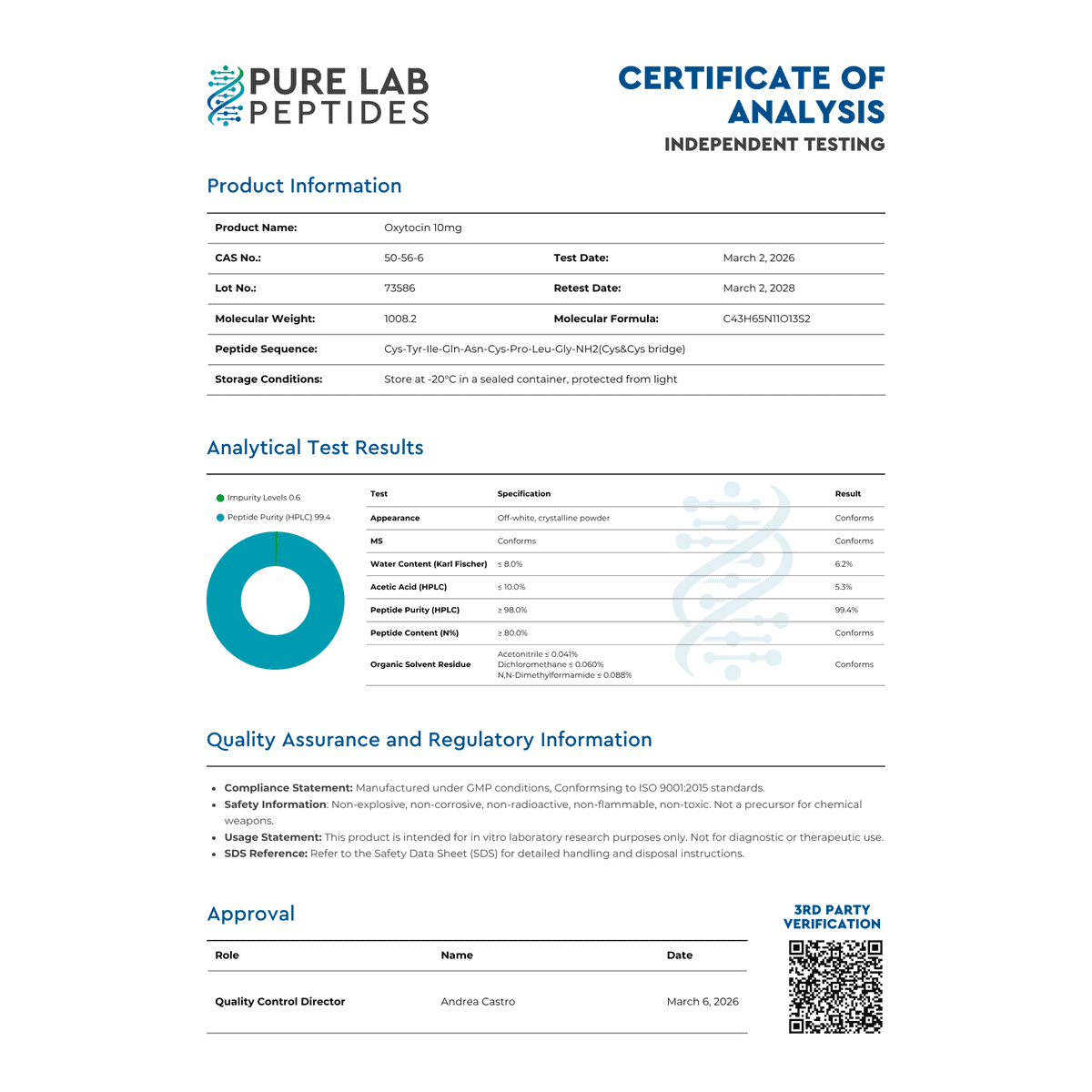
A COA is one of the most important documents for Oxytocin research procurement. It should help the reviewer connect a product listing to a specific batch and its supporting analytical records.
A useful COA does not stand alone. It should match the label, lot number, product page, and supporting supplier documentation.

A certificate of analysis should identify the material, lot number, test date or report date, reported purity, testing method, and supplier or laboratory record. FDA analytical-method guidance describes how method validation data can support documentation of identity, quality, purity, and related attributes in regulated analytical contexts [8].
ICH Q2(R2) also provides a framework for evaluating validation characteristics for analytical procedures [7]. For RUO procurement, those references help editors and lab teams understand why method detail is important.
COA dates and lot numbers help connect a report to a specific batch. Without that connection, a buyer cannot easily tell whether the analytical record belongs to the material under review.
Lot-level alignment is also a traceability practice. NIST describes metrological traceability as a documented connection between measurement results and specified references through an unbroken chain of comparisons [23].
Purity and identity are related, but they are not the same review point. A purity result can describe the proportion of a main chromatographic peak under a method, while identity testing asks whether the material corresponds to the expected compound.
For Oxytocin, a stronger documentation file includes both purity and identity support.
HPLC is widely used for peptide separation and purification because different modes can separate peptides by properties such as hydrophobicity, charge, or size [20]. USP <621> provides general chromatography terminology, definitions, calculations, and system suitability concepts for chromatographic procedures [24].
For procurement review, an HPLC chromatogram can support purity review when it is connected to the correct batch and method conditions. It should not be treated as complete identity proof by itself.
LC-MS combines chromatographic separation with mass spectrometric detection. LC-MS literature notes that high-resolution systems can identify peptides using accurate mass measurements and elution behavior [21].
Peptide-focused LC-HRMS work has also been used to characterize peptide materials and related impurities [25]. For short peptides, LC-MS identity work may require careful attention to homologous or closely related structures [26].

A documentation-focused verification sequence should stay with records, labels, and analytical outputs. It should never become product-preparation guidance.
A chromatogram can help reviewers assess separation behavior, peak profile, and method consistency. USP <621> discusses chromatographic definitions and system suitability concepts that help frame this type of review [24].
Retention-time consistency is most useful when the method, reference data, and batch record are available together. Without that context, a chromatogram is only a partial documentation signal.
Supplier evaluation should look at whether testing records are batch-specific, method-aware, and internally consistent. ICH Q14 describes science- and risk-based approaches for analytical procedure development, while ISO/IEC 17025 focuses on laboratory competence and the generation of valid testing and calibration results [27] [28].
For a research buyer, that means the documentation file should show more than a number. It should show how that number fits the material being reviewed.
Lot traceability connects the product listing, COA, label, and supplier file. It is a procurement control, not a product claim.
When traceability is weak, the buyer may not be able to confirm whether the documentation belongs to the material being evaluated.
Lot traceability adds continuity. It links the listed research material with the corresponding batch-specific record, date, and analytical data.
NIST’s traceability policy explains the value of documented measurement connections, while ISO/IEC 17025 emphasizes competent laboratory operation and valid results [23] [28]. Those principles support careful review of lot-level documentation.
Batch records help laboratory teams organize future procurement decisions. They also support internal notes on which documents were available at the time of purchase.
For Oxytocin research materials, batch records should be saved with the COA, chromatogram, identity file, storage notes, and product-page snapshot. This keeps the procurement file coherent.
Storage, handling, and labeling documentation help laboratory teams maintain a clear chain of records after procurement. These notes should stay practical and research-focused.
The product page should not turn storage language into claims. It should describe documentation expectations and point researchers back to the supplier file.
Storage notes support material integrity by giving laboratory teams a documented condition to record and follow within their institutional system. The key point is consistency between the product page, label, COA, and any supplemental supplier record.
Storage information should be treated as a documentation item. It should not be written as a performance promise.
Handling notes should describe labeling, recordkeeping, storage condition review, and chain-of-custody documentation. They should not explain personal, clinical, or consumer contexts.
A good supplier file keeps these boundaries clean. The documentation helps the lab manage a research material without drifting into non-research language.
For buy Oxytocin for research decisions, a practical checklist helps buyers compare suppliers without relying on marketing language.
Researchers should compare the listing, label, COA, lot number, method notation, and storage notes. The documents should tell the same story.
If the name, lot number, or method details are inconsistent, the file should be reviewed before procurement. A research buyer should not rely on isolated claims.
Labeling consistency helps reduce confusion across product pages, invoices, COA files, and stored records. The compound name, RUO status, and lot information should remain consistent.
This is especially important on canonical product pages. Variant language should not become a separate SEO target or imply a product-purpose difference.
Several misunderstandings can make an RUO page less precise than it should be.
A final documentation review should happen before the purchase decision. This review is not about product outcomes; it is about whether the research material has a coherent file.
The strongest procurement file includes the product listing, RUO label, COA, lot number, method details, purity record, identity record, storage notes, and supplier documentation.
Before researchers buy Oxytocin for research, they should save the product-page record, batch-specific COA, lot number, analytical testing files, and storage documentation. This gives the lab a consistent procurement file.
The saved file should also include the date of review. That makes later recordkeeping easier if product documentation changes.
Lab purchasing teams should look for transparent labeling, batch-specific records, method clarity, and clear separation between literature context and product positioning. These signals are more useful than broad claims.
A careful review also checks what the page avoids. Clean RUO pages avoid wellness framing, consumer outcomes, clinical positioning, and unsupported claims.
Review the product-page documentation, COA details, analytical testing records, and RUO labeling before evaluating this compound for laboratory research. For research teams comparing peptide suppliers, prioritize transparent labeling, batch-specific documentation, and lot-level traceability.
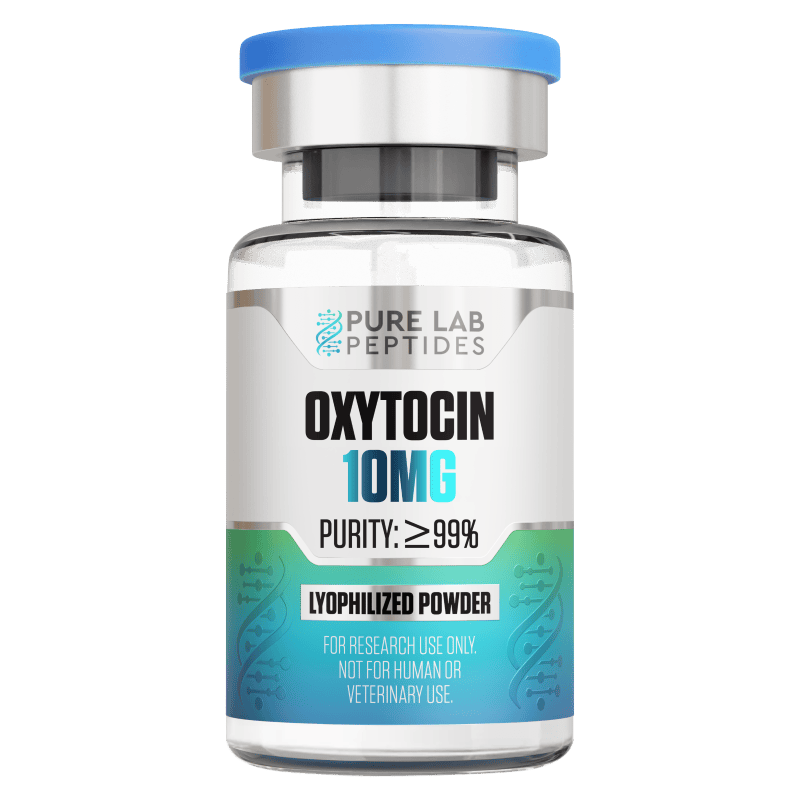
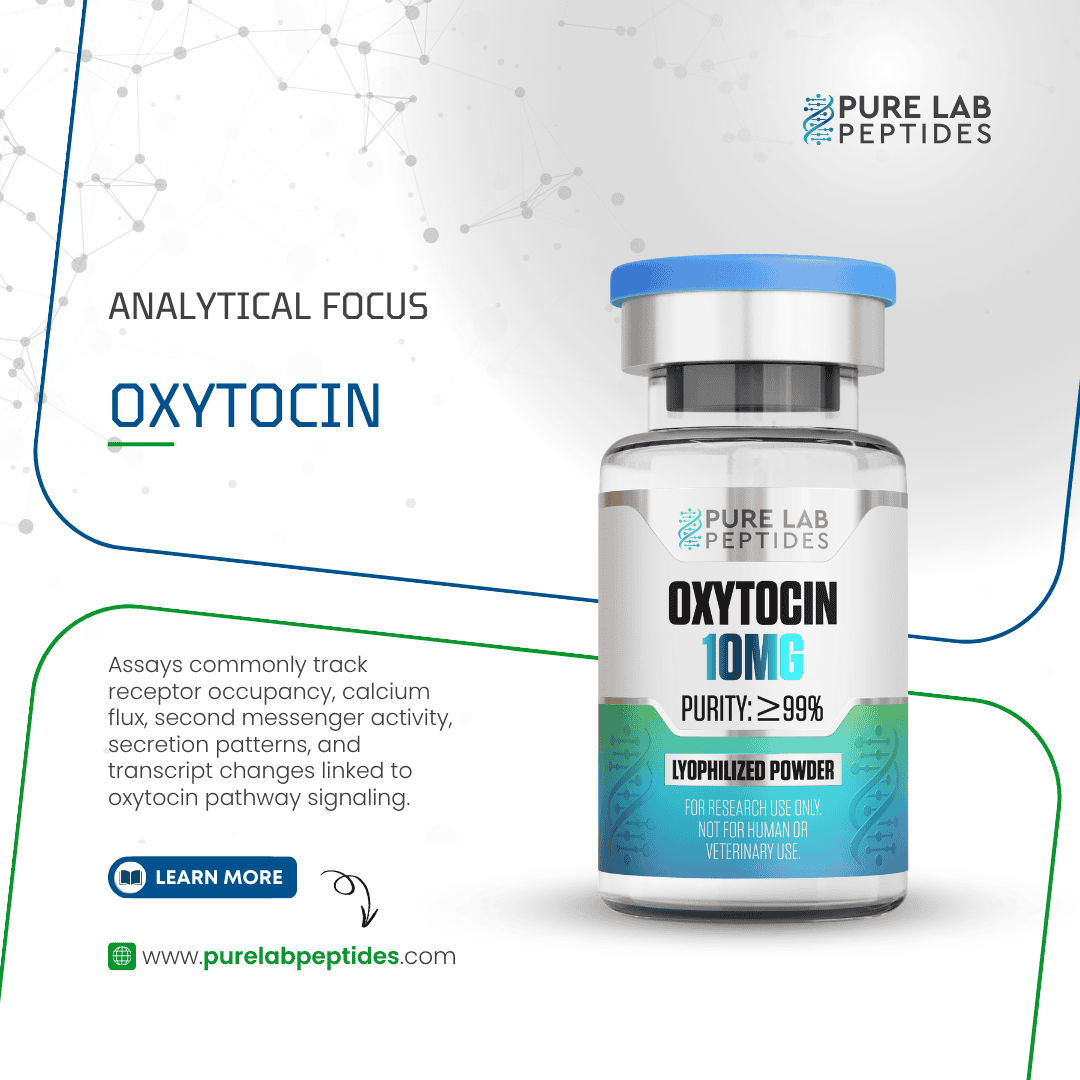
Research use only means Oxytocin is positioned solely as a laboratory research material. It is not intended for human or animal consumption or any consumer-facing purpose. In a product-page context, RUO framing keeps the focus on compound identity, research documentation, COA review, analytical testing, lot traceability, and supplier documentation.
Researchers should consider documentation first before they buy Oxytocin for research. The key review points include RUO labeling, a batch-specific COA, lot traceability, analytical testing records, and consistency between the product listing and supplier documentation. Commercial research intent should stay tied to procurement review rather than product claims.
Oxytocin is described in research literature as a cyclic peptide hormone and neuropeptide with a documented compound identity [1] [2]. For product-page research context, that identity should be reviewed through sequence references, molecular records, COA documentation, and analytical testing. Literature background should not be converted into product-purpose language.
Mass spectrometry supports peptide identity review by helping researchers compare mass-related analytical data against the expected compound record. In Oxytocin documentation review, mass spectrometry is most useful when paired with batch-specific records, LC-MS data, lot traceability, and supplier documentation. It should be treated as part of compound characterization, not as a standalone claim.
Research documentation matters because it connects the product listing to the batch-specific file. A stronger documentation set includes the COA, lot number, identity testing, purity review, storage notes, and supplier documentation. These records help qualified researchers evaluate consistency before procurement without relying on broad or claim-heavy language.
Researchers should interpret boundary-sensitive literature language as context, not product positioning. Terms such as oxytocin levels can appear in published studies, but they should not become claims for a research-use-only material. Product-page language should return to peptide identity, compound characterization, COA review, analytical testing, lot traceability, and RUO labeling.
The following authors are recognized for published research that helped shape the scientific context discussed in this article.
Author profile: Google Scholar
Inga D. Neumann is a scientific author whose published work is closely connected to Oxytocin, neuropeptide research, receptor pathway research, and literature interpretation. Her publications are especially relevant to the article’s discussion of Oxytocin as a peptide hormone, the oxytocin receptor system, and model-specific signaling literature. Her work also supports the article’s emphasis on keeping published literature separate from product-page claims, since receptor and pathway findings must be interpreted as research context rather than product positioning. The publications highlighted below are useful background for understanding Oxytocin receptor signaling and neuropeptide research models.
Selected publications:
Author profile: Central Institute of Mental Health Profile
Valery Grinevich is a published researcher whose work is relevant to Oxytocin pathway mapping, neuropeptide research, central signaling models, and receptor-focused literature context. His publications helped inform the article’s discussion of how Oxytocin research is organized across pathway-level and model-specific literature. This is useful for a research-use-only product page because it helps place Oxytocin within a scientific research lane without turning literature findings into product claims. His selected publications below provide context for pathway-focused Oxytocin research and broader neuropeptide signaling interpretation.
Selected publications:
This research disclaimer clarifies how this page handles published literature and search language around oxytocin. In neuropeptide research content, terms such as nootropic, cognitive enhancement, nasal spray, peptide therapy, and intranasal oxytocin can drift into consumer-facing, administration-focused, clinical-use, wellness, or product-claim language if framed incorrectly. These phrases appear in literature discussions only and are not linked to product uses or outcomes.
Here, those terms are used strictly as research-language examples. The focus remains on oxytocin identity, COA review, analytical testing, peptide purity, lot traceability, RUO labeling, product documentation, and published literature boundaries. Researchers and technical procurement teams should interpret model-specific findings and terminology within a laboratory context, ensuring that terminology does not imply human-use, therapeutic, or consumer-facing applications.
Discount Applied Successfully!
Your savings have been added to the cart.


There are no reviews yet.