



Peptide Molecular Weight: Formula, Mass and Identity

TL;DR · The short version
Compare peptide molecular weight values only after matching the entity and convention. Average mass, monoisotopic mass, molar mass and m/z aren’t interchangeable. Terminal chemistry and the declared form matter too; matching mass doesn’t resolve every identity question.
A listing and report give different weights. Before correcting either, find out what each number describes. A typo is possible, but so is a different calculation basis.
Peptide molecular weight can accompany a neutral formula, salt specification or mass-spectrometry assignment. Average and monoisotopic conventions add another distinction. Put those descriptions beside the numbers before treating the difference as an error.
Four terms that often share one spreadsheet column
TL;DR: Molecular mass, molar mass, relative molecular mass and m/z are related but distinct quantities.
- Molecular mass describes the mass of a molecule, commonly expressed in daltons.
- Molar mass describes mass per amount of substance, commonly in grams per mole.
- Relative molecular mass, often called molecular weight, is a dimensionless relative quantity.
- Mass-to-charge ratio, written m/z, describes the reported ion signal in mass spectrometry, not directly the neutral molecule.
The IUPAC definition of relative molecular mass is useful when cleaning up inconsistent units in a specification. Numerical similarity does not make different quantities identical.
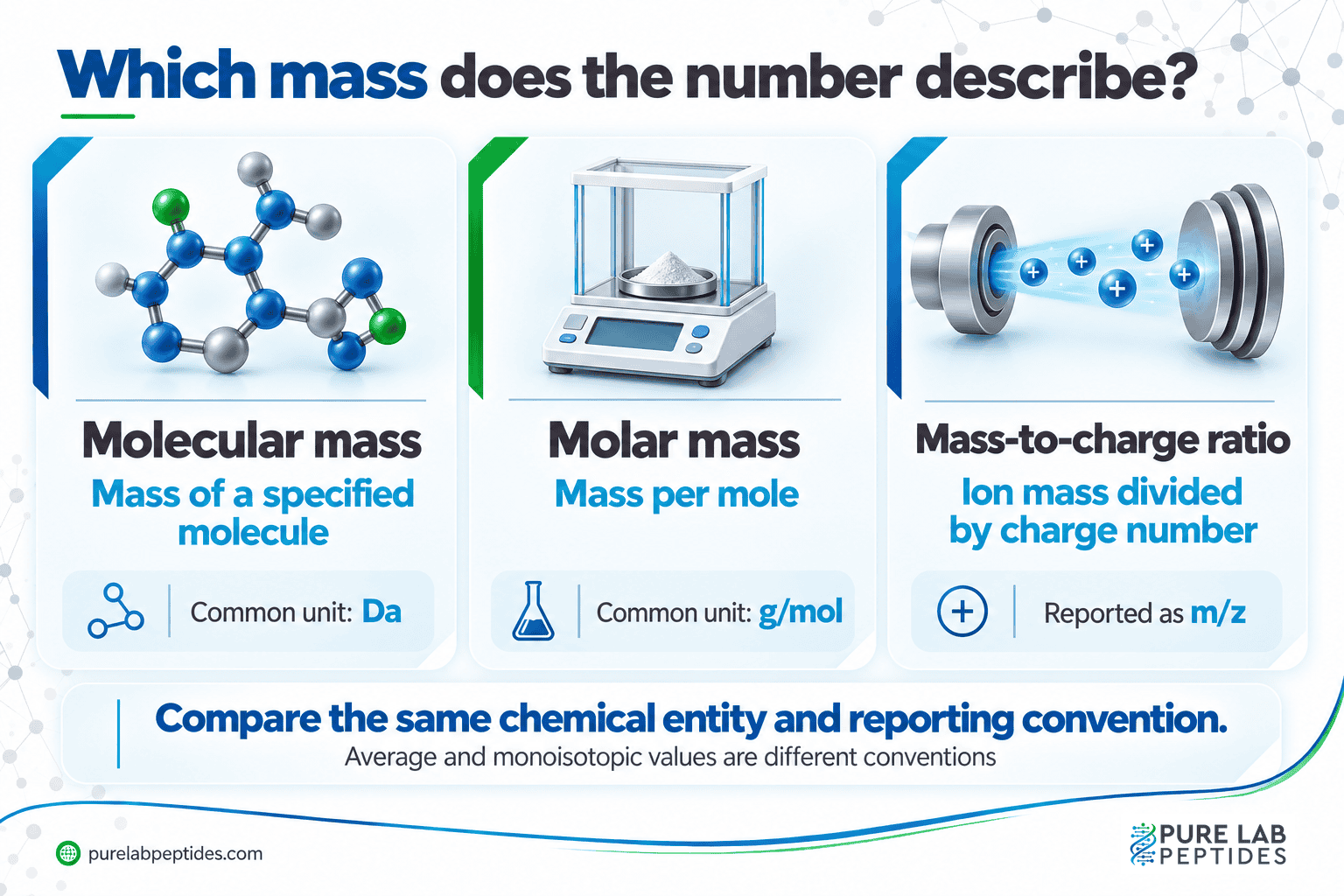
Average and monoisotopic values use different conventions
TL;DR: Check average versus monoisotopic convention, precision and rounding before comparing numbers.
Average mass uses isotopic abundances; monoisotopic mass uses specified individual isotopes. The same formula can therefore have different valid values. Check convention, precision and rounding together.
Do not decide the convention solely from the instrument’s brand or family. Inspect the actual reported assignment. Waters’ mass-accuracy primer illustrates how isotope resolution and the mass definition affect interpretation.
The sequence is not the complete formula calculation
TL;DR: Residue incorporation, terminal chemistry and other modifications belong in the calculation.
Free amino-acid masses can’t simply be added to obtain a peptide’s formula. Incorporation into the chain, terminal groups and modifications alter the accounting. For a specific molecule, cyclization, amidation, acetylation, lipid attachment or disulfides may need to be included too.
A salt, hydrate or metal-complex description adds a reporting-basis question. An assumed counterion or water content shouldn’t be added just to bring the result closer to a catalogue number.
For an ordinary unmodified linear tripeptide with free ends, start with the masses of the three free amino acids and subtract the mass of two water molecules for the two peptide bonds. A calculator that already uses residue masses handles that accounting differently. Check which inputs it expects so you do not subtract the water twice. Bachem’s calculator documentation describes its residue and terminal-group approach.
Work through an apparent mismatch
TL;DR: Align the molecular entity and reporting basis before applying a method-specific tolerance.
| What differs? | First check |
|---|---|
| A small numerical difference | Average versus monoisotopic convention, displayed precision and rounding. |
| An ion value near a fraction of the expected mass | Charge state, adduct assignment and whether the laboratory supplied a deconvoluted neutral result. |
| The formula or terminal group | Whether the two documents actually describe the same molecular entity. |
| Only a commercial name is shared | The structure or specification associated with the tested sample. |
Once the entities and quantities match, apply the method’s tolerance. A close percentage doesn’t rescue a mismatched comparison. Correct a verified transcription error from the controlling record; changing the number alone won’t resolve uncertain identity.
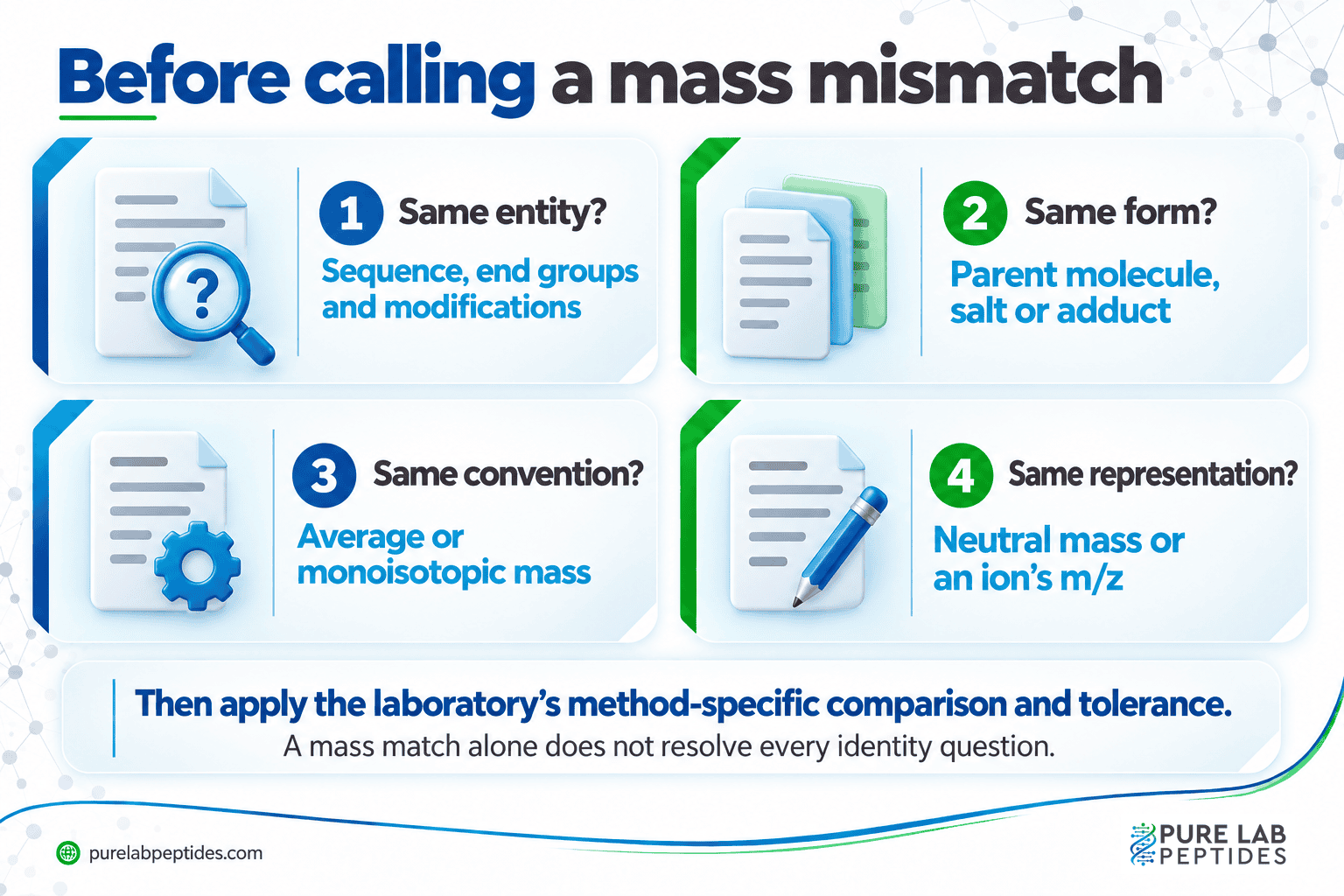
What a mass match can establish
TL;DR: A mass match supports an assignment within the method’s limits; it does not resolve every sequence or stereochemical possibility.
A matching observed and calculated mass supports an assignment within the method’s limits. It does not automatically distinguish every sequence arrangement, isobaric residue or stereochemical alternative. Sequence-sensitive and other complementary measurements may be necessary for the intended identity claim.
Record the entity, formula or sequence source, terminal chemistry, convention, ion assignment and observation together. Leave missing details open. A tidy internet value can’t clarify a different entity or ambiguous assignment.
If the confusing number comes from a spectrum, continue with mass-to-charge ratio in LC-MS. For the written identity, the sequence guide covers order, termini and modifications.