



Mitochondrial-Derived Peptides: Humanin, MOTS-c and SHLPs

TL;DR · The short version
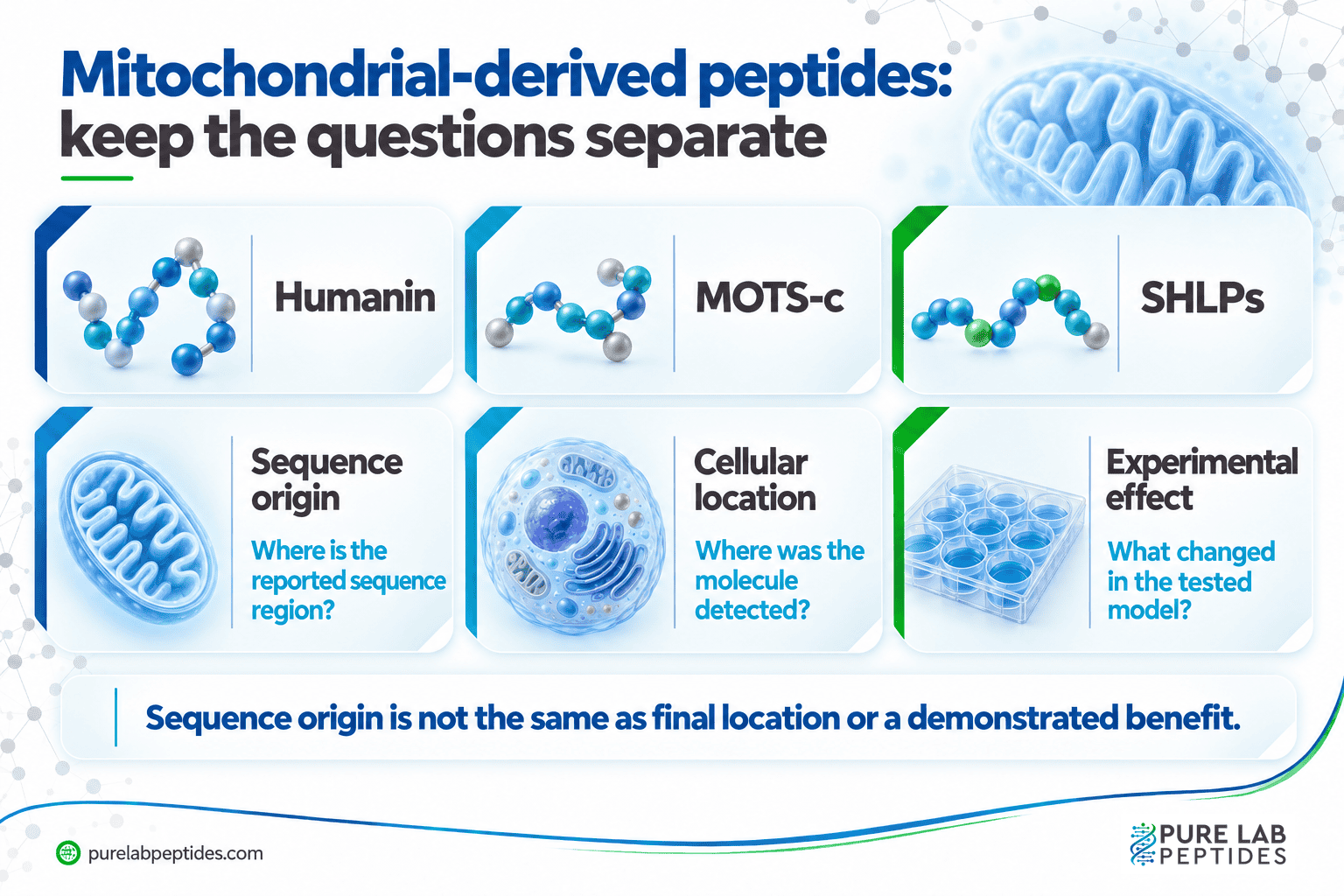
Humanin, MOTS-c and SHLPs belong to the mitochondrial-derived peptides category by sequence origin. That label doesn’t place every step inside mitochondria. Detection, location and biological response remain different findings for distinct family members.
“Mitochondrial” can refer to where a sequence originates, where a molecule goes or what an experiment measures. Work out which meaning the paper uses before following its conclusion.
Mitochondrial-derived peptides are small signaling molecules studied in relation to open reading frames in mitochondrial sequence regions. Humanin, MOTS-c and small humanin-like peptides share that category, but have different research histories. We’ll keep those histories distinct rather than grouping every mitochondria-related compound together.
What does mitochondrial-derived mean?
TL;DR: Sequence origin, the place of synthesis and eventual location are different questions.
The term refers to short peptide sequences associated with small open reading frames in mitochondrial DNA. An open reading frame is a sequence that can potentially encode a peptide; identifying one is a starting point for testing whether the corresponding product is made and what it does. Sequence origin, the place of protein synthesis and the peptide’s eventual location are separate questions.
For example, the MOTS-c discovery paper described a 16-amino-acid sequence within the mitochondrial 12S ribosomal RNA region. The authors noted that its coding sequence is compatible with the cytoplasmic genetic code rather than the mitochondrial code. “Mitochondrial-derived” should therefore not be read as proof that every step occurs inside a mitochondrion.
The main families in the published literature
TL;DR: Humanin, MOTS-c and SHLPs have distinct reported sequence regions and research histories.
| Example | Reported sequence region | Research context |
|---|---|---|
| Humanin | Mitochondrial 16S ribosomal RNA region | Cell survival and stress-response experiments. |
| MOTS-c | Mitochondrial 12S ribosomal RNA region | Metabolic regulation and stress-associated nuclear responses. |
| SHLP1–6 | Additional open reading frames in the 16S region | Studies comparing distinct small humanin-like peptides. |
Humanin: a discovery defined by its experimental models
TL;DR: The Humanin discovery finding depended on the cell model and the specific insult tested.
Hashimoto and colleagues’ 2001 paper reported protection in neuronal cell models exposed to selected familial Alzheimer’s disease gene products or amyloid-beta. The same protection was not observed for the Q79 or mutant superoxide dismutase-1 insults tested. This specificity matters: the finding was not a universal prevention of cell death or a demonstrated treatment effect in people.
MOTS-c: metabolism and communication between compartments
TL;DR: MOTS-c studies examined defined metabolic and stress responses; nuclear localization adds a separate mechanistic question.
The initial MOTS-c publication linked changes in the folate cycle and de novo purine synthesis to accumulation of the intermediate AICAR and activation of AMP-activated protein kinase (AMPK). In mice, the authors reported effects on insulin resistance in the age-related and high-fat-diet models they tested. Those are defined cellular and animal findings, not a general human metabolic claim.
A 2018 follow-up study examined a different question: communication with the nucleus. In cultured cells, metabolic stress prompted transient nuclear localization of MOTS-c. Interventions against AMPK reduced that movement. The researchers also investigated interactions with stress-responsive transcription factors and changes in nuclear gene expression. This adds mechanistic detail beyond simply calling the peptide an “energy booster.”
SHLPs are related names, not interchangeable compounds
TL;DR: The six SHLPs did not show identical responses. Keep each finding attached to the named member.
Cobb and colleagues described six additional small humanin-like peptides and compared biological responses. In the cell systems examined, SHLP2 and SHLP3 reduced apoptosis and reactive oxygen species and altered mitochondrial metabolism. The six peptides did not show identical activity. A result attributed to one member should therefore retain that member’s name rather than being generalized to the entire group.
Mitochondrial origin is different from mitochondrial targeting
TL;DR: Mitochondrial origin and mitochondrial targeting are different classifications.
Sequence origin and mitochondrial targeting are different classifications. A synthetic material designed to interact with mitochondrial components doesn’t acquire a mitochondrial genetic origin just because it shares an endpoint with another peptide.
An assay using added synthetic peptide also leaves endogenous production, processing and transport unresolved. Those questions need suitable detection and mechanistic experiments.
How to compare studies without flattening the differences
TL;DR: Compare exact material, model, stressor, time and endpoint before combining conclusions.
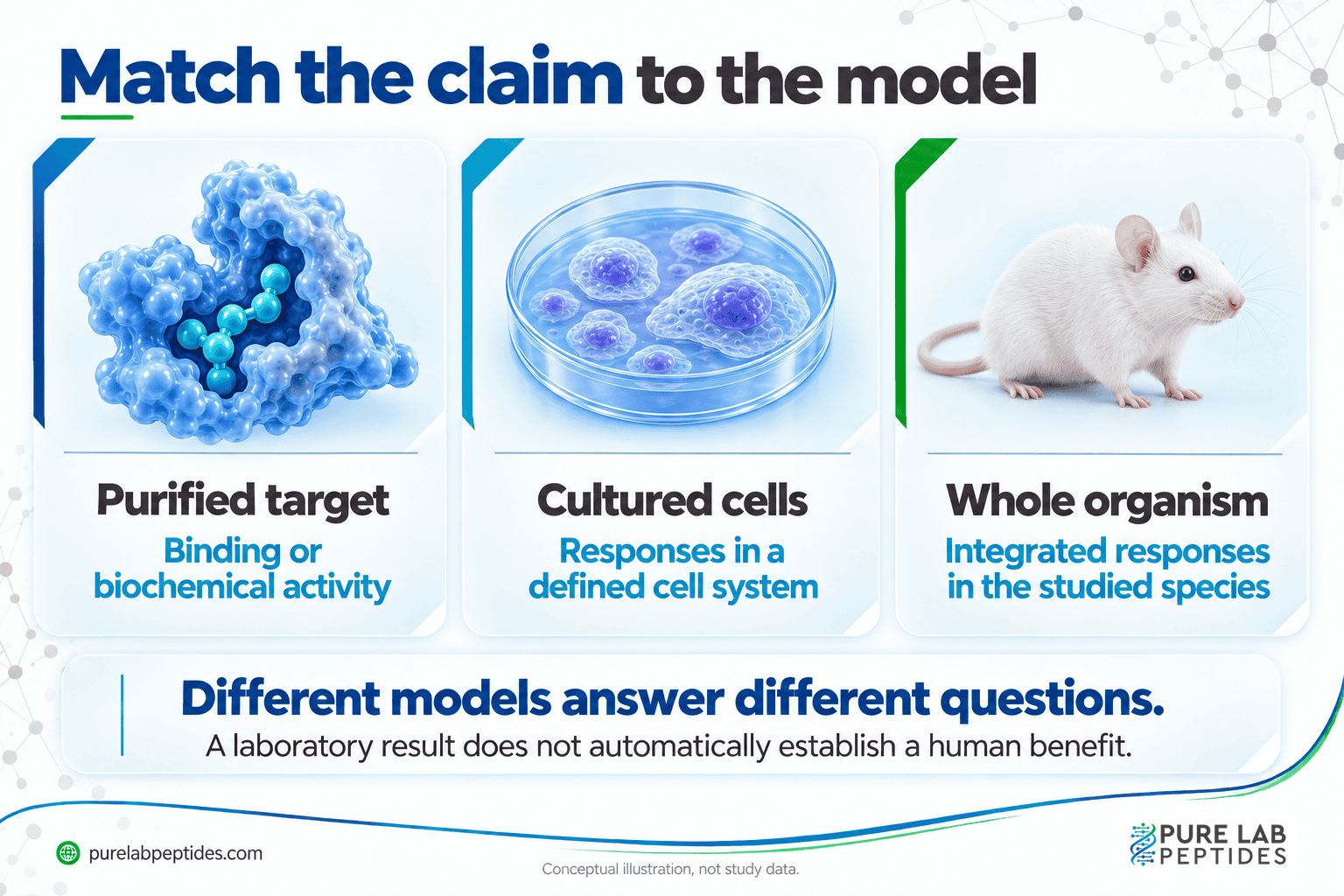
Start your notes with the exact sequence or analogue. Was the material detected in the system or added as a synthetic preparation? Follow that with the model, stressor, time and endpoint. You’ll then be less likely to confuse abundance with activity.
Production, detection, direct interactions and transfer between models remain experimental questions in this field. A primary paper may establish a specific observation without establishing class-wide anti-aging effects or human treatment instructions.
What should a useful research summary include?
TL;DR: Detection, location and effects of experimental intervention belong in separate columns.
Keep detection, location and response to an intervention in separate columns. A circulating concentration change doesn’t establish a cause. A response to added peptide doesn’t settle what the endogenous peptide does either.
Our comparison of in vitro and in vivo models explains why the experimental setting belongs alongside every reported result.