



Peptide Photostability: Light Exposure and Handling

TL;DR · The short version
Peptide photostability concerns changes during a defined light exposure. Record material state, container, wavelength, intensity, time and temperature. Appearance isn’t a complete chemical measurement, and another sequence’s study doesn’t set a universal exposure allowance.
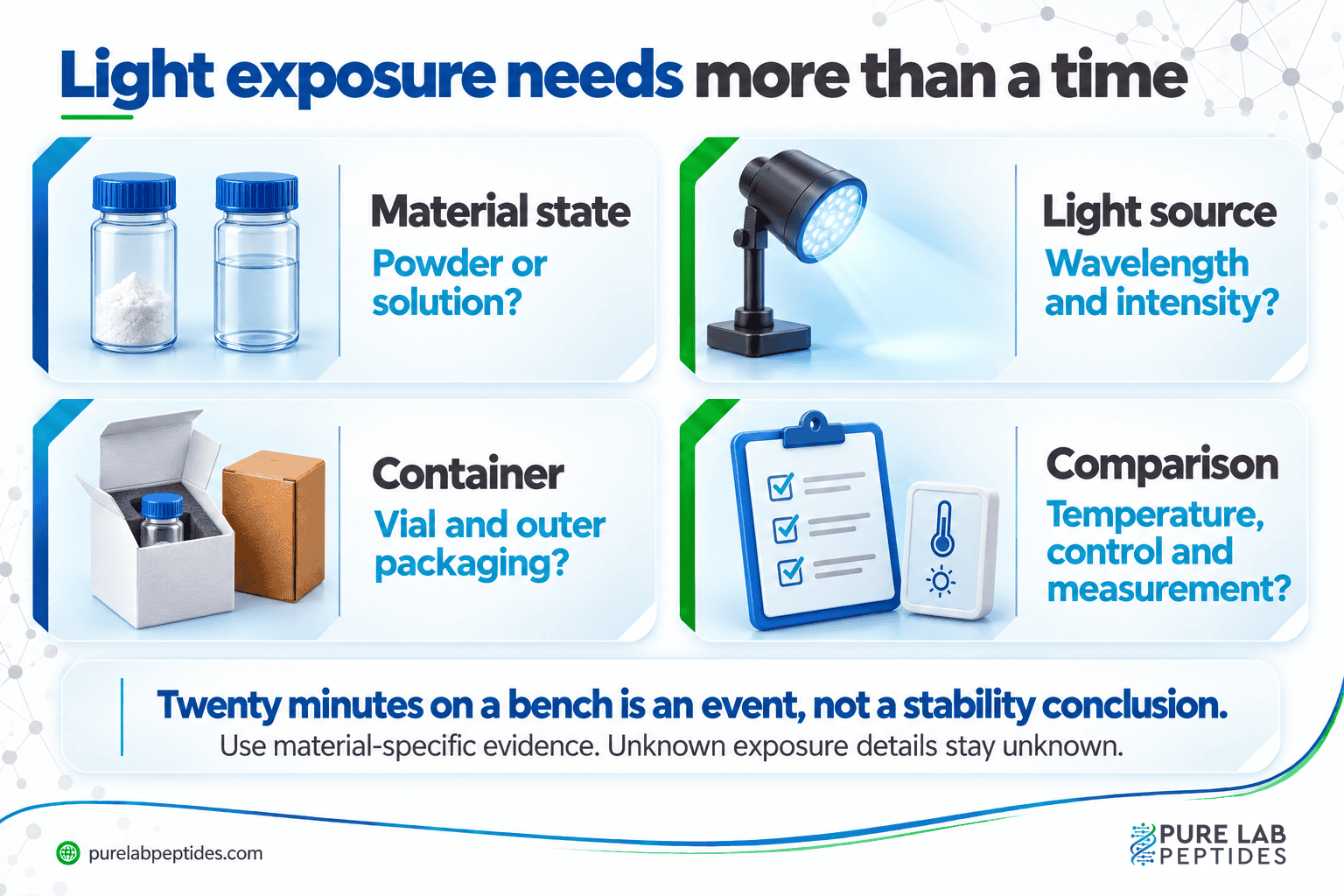
Twenty minutes on a bench is a duration, but not a complete exposure record. A box, an uncovered vial and direct sunlight describe different circumstances.
Peptide photostability needs that material and exposure context. Powder inside a box isn’t the same case as solution beside a sunny window. Compare the actual situation with applicable evidence before assigning a safe time.
What can light change?
TL;DR: Different methods can detect different changes. Unchanged appearance does not prove unchanged chemistry.
Light can produce oxidation and changes in molecular species. Interpretation depends on the preparation and measurements. A dissolved-protein study can’t establish an unrelated dry peptide’s shelf life.
In a somatropin photostability study by Pritts and colleagues, researchers compared lyophilized, reconstituted and diluted presentations under controlled light stress. They found increased methionine oxidation by LC-MS/MS peptide mapping and increased high-molecular-weight species by size-exclusion chromatography. The liquid presentations showed larger increases in those high-molecular-weight species than the powder.
Yet microfluidic imaging did not show a corresponding increase in particles. This is a useful distinction: different analytical methods measured different quality attributes. It was not evidence that every exposed sample becomes visibly cloudy, or that a clear sample has unchanged chemistry. The findings belong to the studied formulation and exposure conditions.
Wavelength and formulation change the comparison
TL;DR: Light source, wavelength and formulation can change the result, including how mixtures behave.
“Left in the light” leaves the source unspecified. Visible light, ultraviolet and simulated daylight aren’t equivalent. Matching duration alone won’t establish matching exposure.
A 2021 study of Garvicin KS peptides compared individual peptides and mixtures under simulated direct sunlight and window-glass-filtered daylight. The three-peptide mixture showed less photodegradation under the filtered conditions but more under the direct-sunlight conditions, relative to the individual peptides. The researchers also examined photostabilizing additives and antimicrobial activity.
The mixture study measured behavior that component names couldn’t predict alone. Its conditions aren’t instructions to add antioxidants or a generic bench-time limit for research vials.
What a photostability study should document
TL;DR: Separate light effects from heat and compare material, container and packaging conditions.
ICH Q1B, the pharmaceutical photostability guideline, distinguishes forced degradation used to investigate change from confirmatory testing under defined conditions. It describes temperature control or an appropriate dark control so heat is not mistaken for a light effect. It also considers the exposed material, immediate container and outer packaging separately.
The guideline supplies experimental context, not proof that a research product passed pharmaceutical testing. Physical observations and suitable chemical measurements belong together; exposure or a later photograph isn’t the complete result.
Make an exposure record useful
TL;DR: Record known exposure details and label unknowns; duration alone is not a measured light dose.
| Record | Why it matters |
|---|---|
| Sample and lot | Connect the event and any follow-up analysis to the affected material. |
| Powder or solution | Identify the actual presentation, including solvent and concentration if applicable. |
| Vial and outer packaging | Describe what was between the material and the light. |
| Source, duration and temperature | Keep measured exposure information separate from estimates and unknowns. |
| Comparison and measurement | State what the test can detect and what reference or control was used. |
For the twenty-minute event, note the box, sunlight and any measured temperature. Leave unmeasured source or intensity unknown. That records an event to assess without turning it into a calculated light dose.
What to do when handling instructions are unclear
TL;DR: Use instructions for the actual material and state, and seek clarification when they are incomplete.
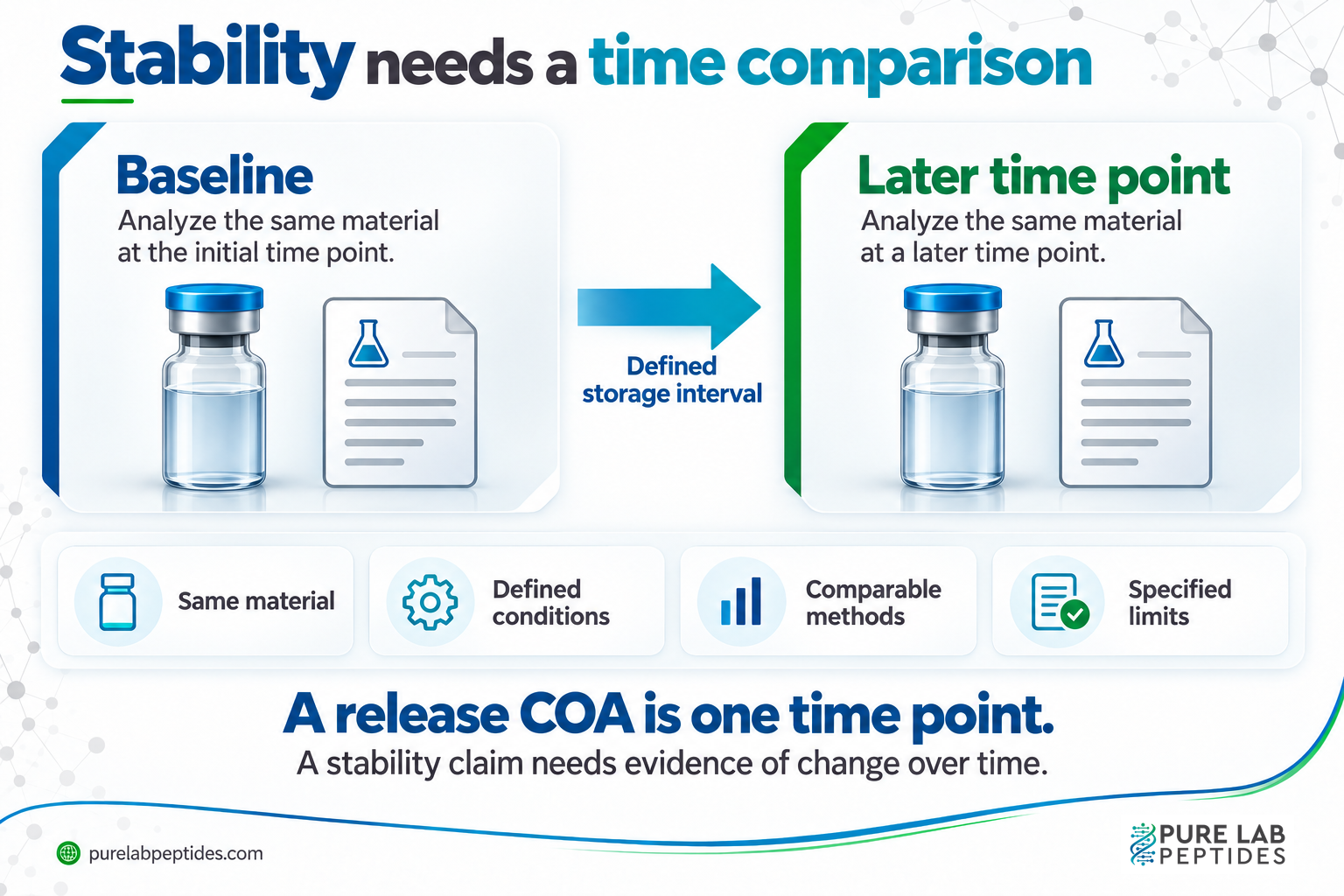
Use the material-specific documentation and the laboratory’s approved procedure. Keep the original packaging when it forms part of the stated storage presentation. If powder and solution instructions differ, apply the instructions for the actual state being handled.
Resolve conflicting or missing records before setting exposure allowances or expiry. Clarity doesn’t settle chemistry, and another sequence’s findings don’t guarantee this product’s stability. The The peptide stability guide connects the other handling variables.