



Amino Acid Abbreviations: Codes and Sequence Examples

TL;DR · The short version
Amino acid abbreviations describe residues in order: GHK is Gly-His-Lys. D means aspartic acid in an ordinary sequence, but D-Phe uses a stereochemical prefix. Keep those annotations and any ambiguity labels when copying a sequence.
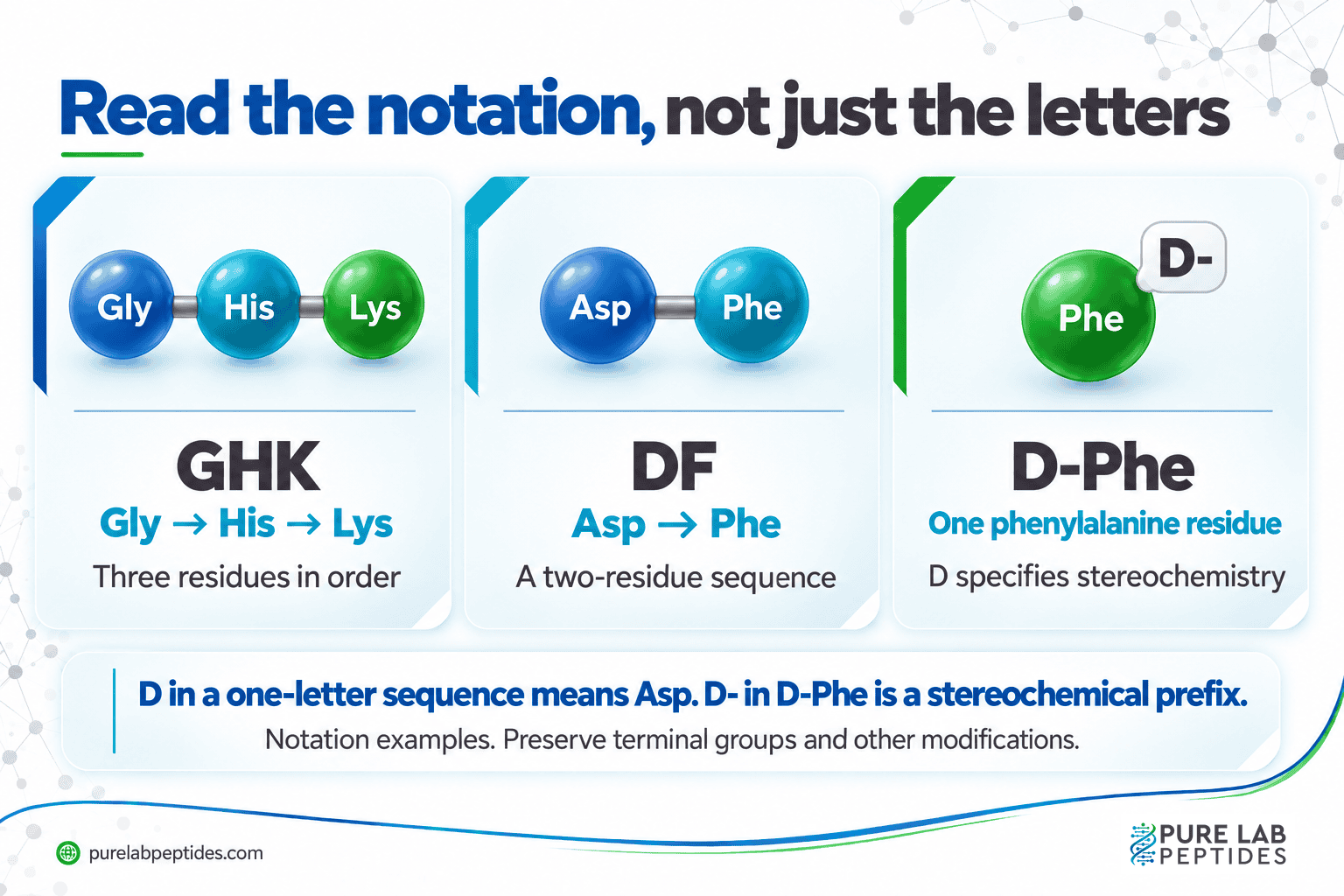
On a small label, D-Phe and DF are easy to skim as the same thing. The first names one stereochemically specified residue; the second names two residues. That is an identity difference, not a spelling preference.
Amino acid abbreviations compress a lot of chemistry into little space. Use the reference table, then check the examples for order, stereochemistry and annotations before transcribing the record.
The 20 common amino acid codes
TL;DR: Use the standard twenty codes as a starting reference, not a complete list of all possible residues.
The following reference follows the IUPAC one-letter recommendations. These are the usual twenty residue codes; they are not a complete catalogue of every amino acid or modified residue used in peptide chemistry.
| One letter | Three letters | Amino acid |
|---|---|---|
| A | Ala | Alanine |
| R | Arg | Arginine |
| N | Asn | Asparagine |
| D | Asp | Aspartic acid |
| C | Cys | Cysteine |
| Q | Gln | Glutamine |
| E | Glu | Glutamic acid |
| G | Gly | Glycine |
| H | His | Histidine |
| I | Ile | Isoleucine |
| L | Leu | Leucine |
| K | Lys | Lysine |
| M | Met | Methionine |
| F | Phe | Phenylalanine |
| P | Pro | Proline |
| S | Ser | Serine |
| T | Thr | Threonine |
| W | Trp | Tryptophan |
| Y | Tyr | Tyrosine |
| V | Val | Valine |
Converting one-letter and three-letter sequences
TL;DR: Translate each residue in order. Several one-letter codes are not the first letter of the full name.
Translate each ordinary code in sequence. GHK gives Gly-His-Lys, and AGS gives Ala-Gly-Ser. The three-letter version is easier to check visually; the one-letter version is shorter. Neither changes the residue order.
Some letters won’t follow the first-letter shortcut. N is asparagine and D is aspartic acid; Q is glutamine and E is glutamic acid. K identifies lysine because leucine already uses L. Keep the table nearby instead of decoding from names alone.
Read a sequence from the N-terminus to the C-terminus
TL;DR: The usual direction is N-terminus to C-terminus; reversing the order changes the sequence.
Unless the source defines another convention, read amino end to carboxyl end. Gly-His-Lys and Lys-His-Gly contain the same residues but specify different sequences. Their order is part of their identity.
For a simple illustration, GHK expands to glycine, histidine and lysine in that order. Adding “Cu” to GHK-Cu refers to a copper complex; it is not another amino acid code. The sequence alone does not fully specify a metal complex, counterion or hydration state.
The letter D and the prefix D- mean different things
TL;DR: D in an ordinary one-letter sequence means Asp. D- in D-Phe specifies stereochemistry.
Within an ordinary one-letter sequence, D means aspartic acid. In a notation such as D-Phe, the prefix identifies the D stereochemical form of phenylalanine. It does not mean an extra aspartic acid followed by phenylalanine. Likewise, a lowercase letter may be a source-specific convention for a D residue, so read that source’s notation key rather than assuming a universal lowercase rule.
The IUPAC’s three-letter notation guidance explains stereochemical qualifications alongside residue symbols. Retain them when transcribing the supplier’s notation; simplifying them away can change the specified material.
What B, Z and X tell you
TL;DR: B, Z and X express ambiguity; U and O identify specific additional residues.
B can represent Asp or Asn, and Z can represent Glu or Gln. X denotes an unknown or otherwise unspecified residue in the relevant convention. These ambiguity symbols are not a fully resolved identity. Nonstandard residues and synthetic modifications should be defined in the document that uses them.
Two additional residue codes appear in broader sequence references: U (Sec) for selenocysteine and O (Pyl) for pyrrolysine. Both are listed in the University of Washington Proteomics Resource amino-acid table. They are specific residues, unlike the ambiguity symbol X.
A sequence may omit important chemistry
TL;DR: Terminal groups, bond connectivity and attachments can change the entity beyond its core sequence.
N-terminal acetylation, C-terminal amidation, disulfide connectivity, cyclization and attached groups can change the chemical entity while leaving the core residue sequence recognizable. A salt designation is different again: it describes associated counterions rather than a new residue in the chain.
After decoding the letters, check the full specification for the chemistry they don’t show. Matching a record to a paper requires both the sequence and its stated modifications, supported by appropriate identity evidence.
Check a transcribed sequence before using it
TL;DR: Count residues, preserve annotations and flag unknowns rather than guessing.
- Count the residue symbols, not the characters in a three-letter name.
- Preserve their order and retain the source’s notation key.
- Keep any D/L prefixes, terminal groups and bond annotations.
- Flag ambiguous codes instead of guessing a residue.
For example, D-Phe is one stereochemically specified residue. The ordinary one-letter sequence DF contains two residues: aspartic acid followed by phenylalanine. Treating those expressions as interchangeable changes the identity being described.
For the next step, see how to read a peptide sequence. The molecular-weight guide explains why the final chemical specification matters when calculating mass.