


$79.99
Research Studies:


FREE Shipping on
orders over $200
ALL ARTICLES AND PRODUCT INFORMATION PROVIDED ON THIS WEBSITE ARE FOR INFORMATIONAL AND EDUCATIONAL PURPOSES ONLY. The products offered on this website are intended solely for research and laboratory use. These products are not intended for human or animal consumption. They are not medicines or drugs and have not been evaluated or approved by the FDA to diagnose, treat, cure, or prevent any disease or medical condition. Any form of bodily introduction is strictly prohibited by law.
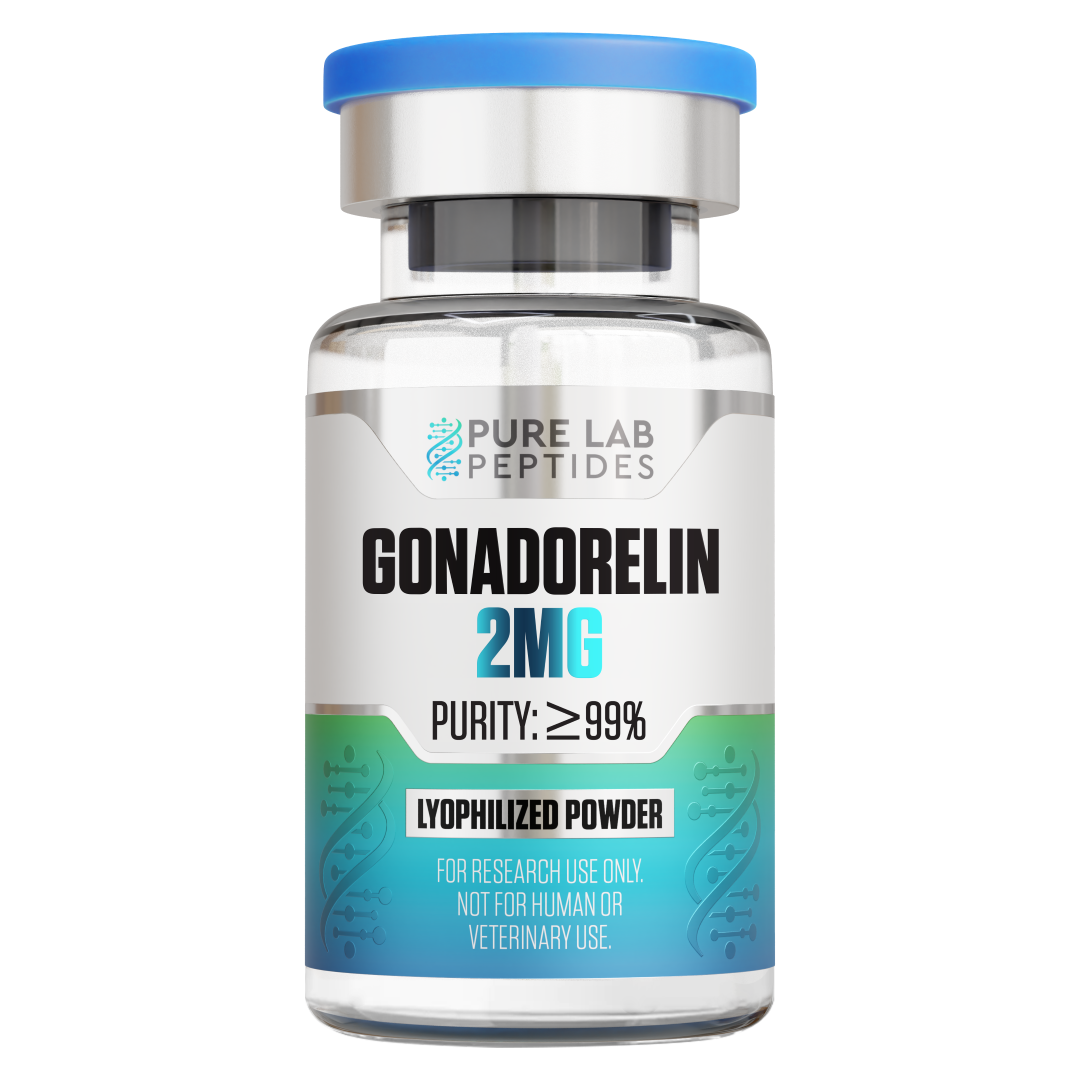
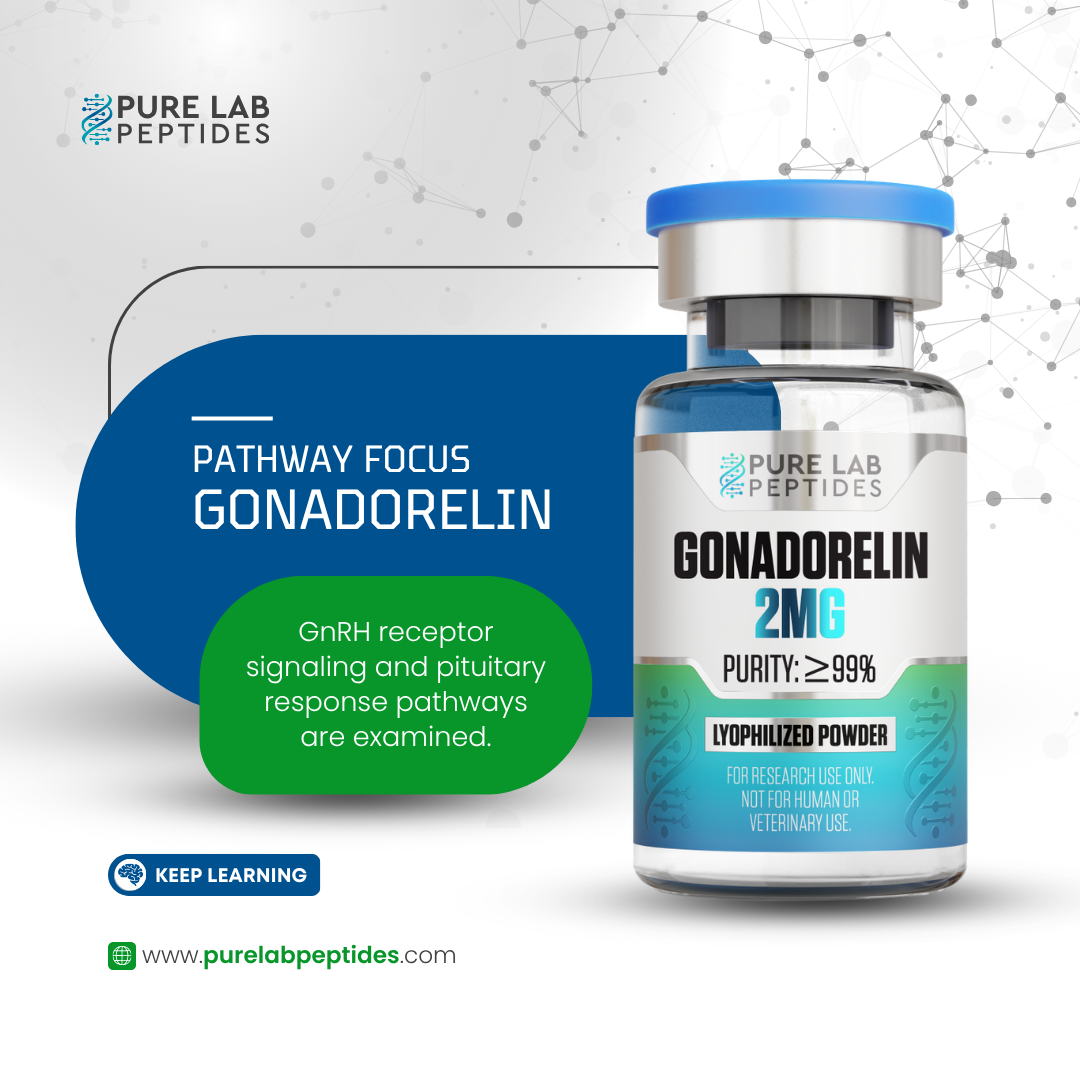
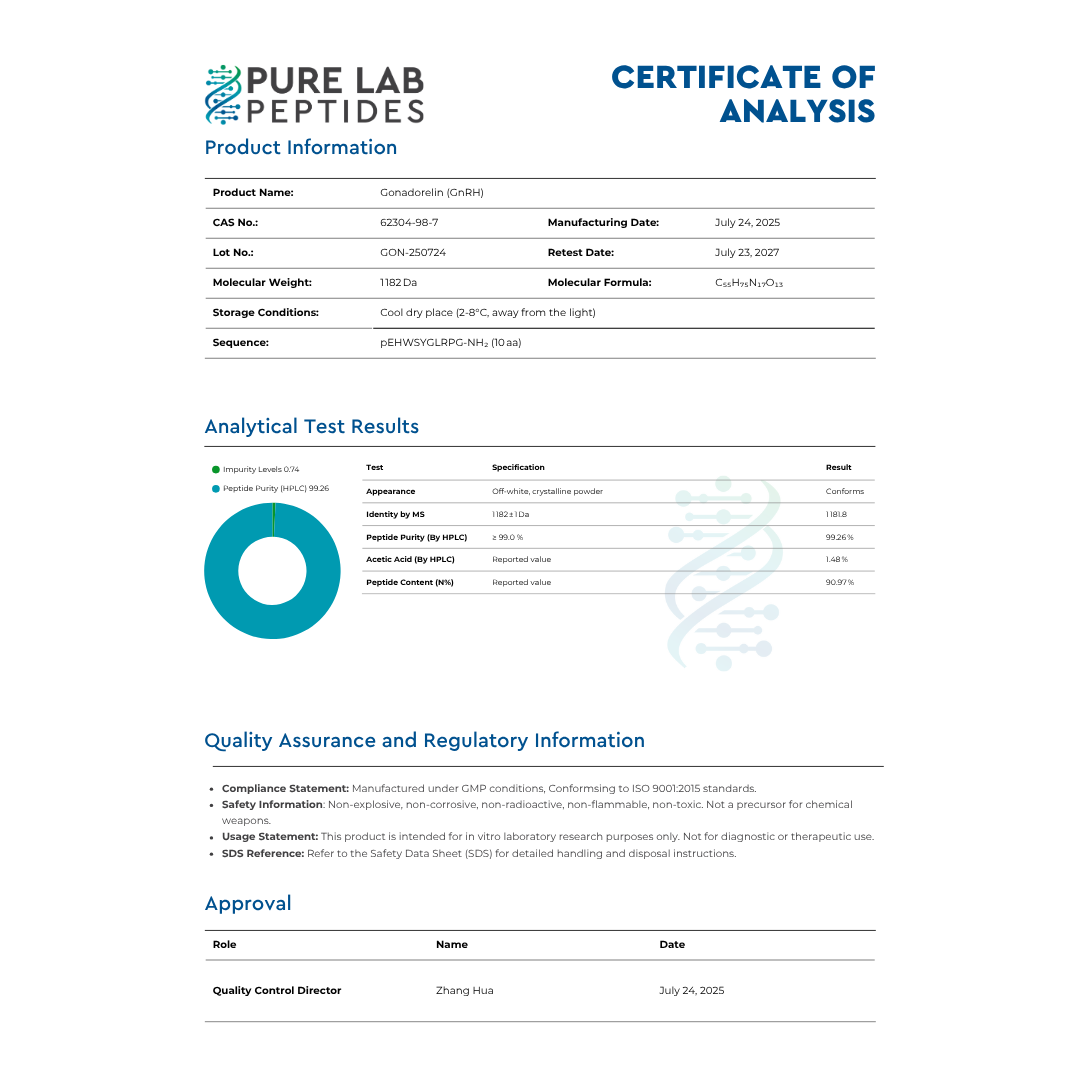
Gonadorelin 2mg is a research-use-only laboratory material supplied for controlled research workflows, compound characterization, and analytical documentation review. It is manufactured under rigorous quality standards to support consistency, traceability, and batch-specific verification for qualified laboratory settings.
Gonadorelin 2mg is intended strictly for laboratory research use only. This product is not intended for human or animal consumption, therapeutic use, diagnostic use, clinical use, veterinary use, or as a food, drug, cosmetic, dietary supplement, or household product.
| CAS No. | 33515-09-2 |
|---|---|
| Purity | ≥99% |
| Sequence | pGlu-His-Trp-Ser-Tyr-Gly-Leu-Arg-Pro-Gly-NH2 |
| Molecular Formula | C55H75N17O13 |
| Molecular Weight | 1182.31 g/mol |
| Applications | Reproductive hormone studies, pituitary function tests, fertility research |
| Synthesis | Solid-phase synthesis |
| Solubility | Soluble in water or 1% acetic acid |
| Stability & Storage | Stable for up to 24 months at -20°C. After reconstitution, may be stored at 4°C for up to 4 weeks or at -20°C for up to 6 months. |
| Appearance | White lyophilized powder |
| Shipping Conditions | Shipped at ambient temperature; once received, store at -20°C |
| Regulatory/Compliance | Manufactured in a facility that adheres to cGMP guidelines |
| Safety Information | Refer to provided MSDS |
Consider these supplementary peptides for a comprehensive research approach.
Researchers evaluating where to buy KPV for research should treat the product page as a documentation checkpoint, not a consumer guide. KPV is commonly described in databases and literature as MSH(11-13), the lysine-proline-valine tripeptide associated with the C-terminal portion of alpha-melanocyte-stimulating hormone [1][2]. This guide frames KPV as a research peptide for laboratory documentation review, literature interpretation, melanocortin receptor context, COA assessment, and RUO procurement.
To buy KPV for research responsibly, researchers should first review the compound identity, RUO label, batch-specific certificate of analysis, HPLC purity data, LC-MS identity support, lot number, storage notes, and supplier documentation. Products discussed in this article are intended for laboratory research use only and are not intended for human or animal consumption. Literature context should not be converted into product-use claims.
The phrase buy KPV for research has commercial intent, but the safe frame is technical procurement. The focus is not what KPV is for in a consumer setting. The focus is whether the product-page documentation allows a laboratory team to verify identity, purity, traceability, and research-use-only positioning.
This distinction matters because KPV appears in both compound databases and experimental literature. PubChem lists MSH(11-13) with KPV-related synonyms, molecular formula, and molecular weight fields, while academic papers examine pathway-level questions in specific models [1][14]. A product page should connect those facts to documentation review, not to outcome language.
Start with the label, certificate of analysis, and lot-specific records. A certificate of analysis should make it possible to connect the product listing, batch identity, purity measurement, and analytical method in one review trail. FDA analytical-method guidance describes analytical procedures as tools for documenting identity, quality, purity, and related measurements in regulated-material contexts, which is useful as a general quality framework for documentation review [25].
The safest procurement order is simple: label first, COA second, analytical data third, traceability fourth. If the product name, lot number, and COA do not align, the page is not documentation-ready.
RUO labeling sets the scope for the page. FDA’s RUO/IUO guidance is written for in vitro diagnostic products, but it is still a useful example of how research labeling and intended scope should be aligned with presentation [28]. Federal IVD labeling rules also show that research labeling is tied to restricted research positioning rather than broad product claims [29].
For a KPV peptide product page, RUO clarity should appear before any scientific background. The scientific discussion should explain what literature examines, not what a product is claimed to do.
A KPV product page should be a technical reference point for qualified research buyers. It should identify the compound, show documentation availability, explain relevant literature categories, and keep the page within laboratory and research purposes.
The commercial question is still valid. A laboratory buyer may be comparing verified peptides, COAs, lot records, and supplier notes. The RUO boundary keeps that comparison focused on documentation rather than consumer interpretation.
Research use means the material is positioned for laboratory research use, not as a food, cosmetic, household item, dietary supplement, or clinical product. For KPV, that positioning should be paired with compound identity, peptide purity, and analytical testing information.
This page also treats regulatory references carefully. FDA, EMA, USP, and ICH documents are cited only as analytical-quality or documentation frameworks, not as claims that any RUO peptide is approved, standardized, or suitable for another category [24][27].
A documentation-first product listing gives researchers a way to check facts. The compound name should match the COA. The lot number should match the batch record. The analytical method should be listed clearly enough for a technical reader to understand what was tested.
The same principle applies to KPV peptide online research listings. A page that emphasizes claims without documentation creates risk. A page that foregrounds identity, COA, HPLC, LC-MS, and lot traceability better serves research procurement.
KPV is the lysine-proline-valine tripeptide associated with MSH(11-13), a short C-terminal peptide fragment linked to alpha-MSH literature [1][2]. PubChem lists MSH(11-13) with molecular formula C16H30N4O4 and molecular weight 342.43 g/mol [1].
In research writing, that identity should come before pathway interpretation. KPV is not just a keyword; it is a defined short peptide entity that should be evaluated through sequence, molecular identity, source documentation, and analytical records.
A tripeptide contains three amino acid residues. For KPV, those residues are lysine, proline, and valine, which explains the common Lys-Pro-Val shorthand [1]. PubChem also identifies MSH(11-13) with KPV-related names, giving research buyers a database-backed identity checkpoint [1].
The phrase KPV peptide is useful when it signals compound identity. It becomes less useful when it is separated from RUO labeling, COA review, or analytical verification.
Lysine-proline-valine defines the KPV sequence in plain language. Lysine supplies the “K,” proline supplies the “P,” and valine supplies the “V.” PubChem’s MSH(11-13) entry supports that sequence-level identity [1].
Sequence matters because many peptide documentation errors start with naming mismatches. A product page should align the common name, synonym set, and sequence shorthand wherever those details are provided.
KPV is commonly discussed as a C-terminal alpha-MSH fragment. Alpha-melanocyte-stimulating hormone is listed by PubChem as a thirteen amino acid peptide hormone, and UniProt identifies melanocyte-stimulating hormone alpha as part of the pro-opiomelanocortin system [2][3].
That same-lane context explains why KPV literature often intersects with melanocortin peptides, receptor signaling, and inflammatory pathway models. It does not turn the product page into a claim page.
Alpha-MSH is a melanocortin peptide derived from POMC processing, and UniProt describes alpha-MSH as a ligand for melanocortin receptors including MC1R, MC3R, MC4R, and MC5R [3]. KPV is linked to the final portion of alpha-MSH, which is why it appears in alpha-MSH fragment research [1][2].
This context helps researchers interpret the literature. It also gives the product page a safe semantic lane: melanocortin receptor research and peptide documentation.
The melanocortin receptor system includes five closely related G-protein-coupled receptors, commonly described as MC1R through MC5R [7][8]. Reviews describe melanocortin peptides as ligands that interact with this receptor family across different cell and signaling contexts [7][9].
For KPV, same-lane research should stay narrow. Relevant context includes alpha-MSH fragment literature, melanocortin receptor signaling, NF-κB model discussion, cytokine measurements, and peptide identity testing.
Mechanism of action language must be handled carefully. In a research article, it can summarize what papers investigated. On a product page, it should not become a claim about a product.
KPV literature includes several mechanistic themes, including melanocortin-related context, PepT1-mediated uptake in intestinal epithelial and immune cells, and NF-κB signaling models [12][14][16].
Mechanistic papers can show how a model was designed, what pathway markers were measured, and what observations were reported. For example, one KPV study examined whether the peptide’s activity in intestinal epithelial cells and immune cells was associated with the peptide transporter PepT1 [14]. Another paper investigated KPV and alpha-MSH-related signaling in airway epithelial cell models, including NF-κB-linked measurements [16].
Those findings are research context. They do not establish product positioning for RUO materials.
Melanocortin receptors are class A GPCRs, and reviews describe the receptor family as MC1R, MC2R, MC3R, MC4R, and MC5R [7][8]. NCBI Gene describes MC1R as encoding a seven-pass transmembrane G-protein-coupled receptor for melanocyte-stimulating hormone [4]. UniProt similarly identifies MC1R as a receptor that binds melanocyte-stimulating hormones and ACTH [5].
For KPV, receptor discussion should be presented as literature context. Some papers have explored whether KPV-related observations are MC1R or cyclic-AMP dependent, while later work also examined alternate cellular mechanisms [12][16].
A signal pathway can be relevant to a research model without becoming a product claim. NF-κB, cytokine, and inflammatory gene expression markers are common in mechanistic literature, but a product page should present them as study endpoints or model features [16][17].
The safer rule is simple: pathway relevance explains what the literature examined. It does not say what a product does.
KPV appears in a research lane that overlaps melanocortin receptor biology and cell signaling models. MC1R, MC3R, and related melanocortin receptor contexts appear in the broader alpha-MSH literature [6][7][9].
Research buyers do not need a product page to overstate those links. They need enough context to understand why KPV is placed in melanocortin receptor research and why documentation must remain separate from literature interpretation.
MC1R is the most common receptor entity connected to alpha-MSH identity and melanocortin receptor discussion, and the Guide to Pharmacology lists MC1 receptor nomenclature and database links for the receptor target [6]. Broader reviews explain that melanocortin receptors differ by subtype, ligand interaction, tissue expression, and downstream signaling features [7][8].
KPV-specific literature is more cautious. Elliott and colleagues examined KPV and related C-terminal tripeptides while noting that the exact dependence on MC1R or cyclic AMP required clarification [12].
KPV papers have used cytokine and gene-expression-related markers as model readouts. In the PepT1 study, researchers examined KPV in intestinal epithelial and immune cells, including inflammatory signaling readouts [14]. In airway epithelial research, KPV was examined alongside NF-κB reporter activity and chemokine measurements [16].
These are model-specific measurements. They are not product performance claims and should not be presented as such.
KPV literature often uses inflammatory pathway language because alpha-MSH and related peptides have been examined in inflammation-related research models [9][10][11]. This language requires careful framing on a product page.
The safe version is “inflammatory pathway research context.” The unsafe version is a product claim that implies an outcome.
Antiinflammatory research language should stay tied to specific papers, models, markers, and limitations. Reviews of alpha-MSH-related peptides discuss antiinflammatory activity in model systems, while KPV studies investigate defined experimental questions within that literature lane [10][11][14].
For RUO copy, the word should never function as a claim for a product. It should describe the category of literature being reviewed.
In vitro research is useful because it lets investigators examine defined cell systems and pathway markers under controlled conditions. The PepT1 KPV paper examined intestinal epithelial cells and immune cells, connecting KPV uptake to transporter expression in that model context [14]. A separate review describes PepT1 as a membrane transporter relevant to epithelial peptide transport biology [19].
This is why intestinal epithelium appears in KPV literature. It should be discussed as a model context, not as a product-use statement.
Published literature should be interpreted by source type, model type, endpoint, and limitation. A database entry can support compound identity. A review can summarize a field. A mechanistic study can report pathway observations. None of these automatically becomes a product claim.
| Research Area | What Literature Examines | Evidence Type | RUO Interpretation |
|---|---|---|---|
| Compound identity | MSH(11-13), Lys-Pro-Val, molecular formula, and molecular weight [1] | Official database | Supports identity review, not product claims |
| Alpha-MSH context | POMC-derived melanocortin peptide context [2][3] | Official database | Helps place KPV in same-lane literature |
| Receptor signaling | MC1R and melanocortin receptor family classification [4][7][8] | Official database and reviews | Supports pathway context only |
| PepT1 model research | KPV uptake in intestinal epithelial and immune-cell models [14][19] | Mechanistic and review literature | Supports model interpretation, not product positioning |
| NF-κB model research | KPV and alpha-MSH-related signaling markers [16][17][18] | Mechanistic literature | Supports literature discussion only |
| Analytical review | HPLC, LC-MS, purity, identity, and peptide characterization [21][22][23] | Analytical chemistry and standards literature | Supports COA and documentation review |
Research buyers should identify whether a source is a database entry, review, in vitro paper, preclinical paper, analytical chemistry article, or official documentation standard. Each source type answers a different question.
For KPV, PubChem answers identity questions [1]. Melanocortin reviews answer receptor-family and pathway-context questions [7][9]. Analytical sources answer documentation and testing questions [21][23][24].
Preclinical findings require careful limits because they depend on model design, assay conditions, endpoints, and interpretation boundaries. KPV has been examined in preclinical inflammatory pathway models and reviews, but those papers should be read as research literature, not as product-page permission to make claims [15][20].
The page should keep the evidence ladder visible: database identity, in vitro model, preclinical model, review synthesis, analytical documentation, RUO boundary.
Good evidence signals include a peer-reviewed source, clear model description, defined endpoints, analytical methods, and cautious interpretation. Strong product-page documentation also includes COA availability, method naming, batch match, lot date, and storage notes.
Weak signals include uncited claims, vague purity statements, missing lot numbers, and product copy that converts study findings into commercial claims.
A safer KPV product page separates three things: what the compound is, what literature examines, and what the product page may claim. These categories should not blur.
Phrases about product effects, product performance, or clinical-use language can drift into claim territory if they are disconnected from model-specific literature. RUO positioning keeps the page focused on compound identity, analytical testing, lot traceability, COA review, and supplier documentation.
Study findings are tied to the conditions of the study. A paper may examine cytokine markers, NF-κB signaling, receptor context, or intestinal epithelium models [14][16]. That does not mean the product page should promise the same findings for the material being sold for laboratory research.
This is the core claim boundary. Literature can inform research context, but product pages should not turn literature into claims.
Claim boundaries protect clarity. They help readers understand that KPV is being discussed as a research peptide and laboratory material, not as a consumer product.
A strong RUO page should say what researchers can review: identity, sequence, purity method, LC-MS support, certificate of analysis, lot traceability, and supplier documentation. It should not imply an out-of-scope purpose.
A certificate of analysis matters because it connects the product listing to batch-specific analytical information. FDA analytical-method guidance identifies analytical procedures as part of documentation for identity, quality, purity, and related measurements in regulated contexts [25]. USP discussion of reference-standard certificates also emphasizes lot-specific certificate access and assigned-value documentation for reference standards [30].
For RUO KPV, the COA should be reviewed as a documentation record. It is not a guarantee of every possible quality attribute.
A useful COA should identify the compound name, batch or lot number, test date, reported purity, analytical method, and supplier or laboratory source. If identity testing is listed, the method should be clear enough for technical review.
For a peptide, documentation is stronger when purity and identity are supported by complementary methods. Synthetic peptide guidance and reference-standard literature often emphasize multiple quality attributes, including identity, purity, impurities, and method suitability [22][27].
Batch-specific documentation reduces ambiguity. A COA that does not match the product lot creates a gap between the listing and the record.
Researchers should compare the KPV name, lot number, COA date, and analytical method across the product page and supplier documentation. A match does not replace scientific review, but it gives the procurement record a traceable structure.
COA dates and lot numbers help researchers understand which material the record describes. USP certificate policy for reference standards discusses current and previous lots, which illustrates why lot status and certificate timing matter in technical documentation [30].
For KPV research procurement, the key question is whether the label, COA, and supplier notes describe the same batch.
Peptide purity and peptide identity are related, but they are not identical. HPLC can support purity review by separating peptide-related peaks, while mass spectrometry can support identity review by measuring mass-related information [21][23].
The strongest documentation uses method detail. A simple purity percentage without method context is not enough for a complete technical review.
HPLC is widely used for peptide analysis and purification because chromatographic separation can show the relative presence of a main peak and related peaks under defined conditions [21]. In synthetic peptide reference-standard work, RP-HPLC has been used to assess lot homogeneity, stability, identity-related attributes, content, and purity [22].
For a KPV product page, HPLC data should be treated as purity documentation. It should not be treated as a stand-alone identity conclusion.
LC-MS can support identity verification because it combines liquid chromatography with mass spectrometry, allowing mass-related information to be reviewed with separation behavior [23]. ICH Q2(R2) also describes analytical-procedure validation concepts for identity, purity, impurity, assay, and other quantitative or qualitative measurements [24].
A safe lab-test verification workflow can follow this order:
Lot traceability lets researchers connect the physical research material to a documentation trail. In peptide procurement, traceability is practical: it helps organize the product listing, COA, testing data, label, and storage notes.
It also supports internal review. A lab team can confirm whether the record set is complete before adding the material to its laboratory inventory.
Lot traceability adds continuity. It lets the research buyer ask whether the product page, COA, HPLC record, LC-MS record, and label all refer to the same batch.
That continuity is especially important for short peptides like KPV because small naming variations can create confusion. PubChem lists MSH(11-13), Lys-Pro-Val, and related synonyms, which makes name matching a real documentation task [1].
Storage and handling documentation should be treated as a laboratory record issue. The product page should provide clear conditions where available, and the internal research file should preserve those conditions alongside the COA.
Good documentation does not only say what the product is. It also says how the supplier expects the research material to be maintained before evaluation in laboratory workflows.
Verified peptides should be reviewed through documentation rather than slogans. The strongest pages provide RUO labeling, compound identity, certificate of analysis access, purity method details, identity testing support, and lot-level traceability.
Official quality frameworks also emphasize method suitability and documentation. FDA and ICH documents describe analytical-method validation principles, while EMA’s synthetic peptide guideline addresses characterization, specifications, and analytical control for synthetic peptides [24][25][27].
Research buyers should compare the same categories across suppliers: RUO label clarity, KPV identity, COA availability, lot number match, HPLC data, LC-MS support, storage documentation, and supplier transparency.
Price alone is not a documentation metric. The better question is whether the listing gives enough technical information to support a defensible laboratory procurement record.
KPV peptide online research listings should be evaluated through a documentation filter. The listing should clearly identify KPV, avoid consumer-purpose framing, and present a research-focused path to COA and analytical review.
A safe search journey can include commercial research language, such as buy KPV peptide for research, while still keeping the page focused on laboratory and research purposes.
KPV research pages often become unclear when scientific literature, commercial language, and product documentation are mixed together. The page should separate them.
Common misunderstandings include:
Catalog format language should stay neutral. Product-page copy can identify a listing format, package category, or documentation field, but it should not imply a particular research design or out-of-scope purpose.
For KPV, the canonical entity is the compound itself. The page should not create separate SEO targeting around formats or variants.
Search terms can be broader than safe product-page language. A phrase may start as commercial research intent and then drift into consumer-facing expectations if the page answers the wrong question.
That is why the safe primary phrase is buy KPV for research. It preserves procurement intent while keeping the page anchored in RUO documentation.
A research procurement checklist should be direct. It should also be narrow. The goal is to verify the documentation trail before selecting any RUO peptide for laboratory research.
Before researchers buy KPV peptide for research, the product page should answer four basic questions. What is the compound? What batch does the COA describe? Which analytical methods support the record? Does the page maintain RUO scope?
If those questions are answered clearly, the procurement review is stronger. If they are not, the page needs closer scrutiny.
COAs and supplier notes should form one documentation set. The COA provides analytical data. Supplier notes provide label, storage, and handling context. The product listing connects both to the research material.
For KPV, the best documentation record is consistent across all three: product page, COA, and supplier notes.
KPV belongs on a research page that prioritizes peptide identity, literature context, COA review, analytical testing, lot traceability, and supplier documentation. Review the product-page documentation, COA details, and RUO labeling before evaluating this compound for laboratory research.
Research use only means KPV is intended solely for laboratory research contexts. This designation ensures that the compound is handled under controlled experimental conditions, with documentation such as COA, lot traceability, and analytical testing confirming identity and purity. It is not intended for human or animal consumption, and all interpretations must remain within preclinical and in vitro research boundaries.
Researchers review a Certificate of Analysis (COA) for KPV because it provides batch-specific documentation, including purity, peptide identity, and analytical testing methods such as HPLC or LC-MS. Evaluating COAs ensures that the laboratory material aligns with the labeled compound and supports reproducible research results without extrapolating to human or animal use.
Published literature should be interpreted as research context, not as guidance for product use. For KPV, studies often examine receptor pathways, peptide signaling, or in vitro models. Researchers should distinguish between experimental findings and product claims, focusing on compound characterization, pathway analysis, and peer-reviewed methodology.
Analytical methods for KPV include high-performance liquid chromatography (HPLC) and liquid chromatography–mass spectrometry (LC-MS). These techniques confirm peptide identity, verify purity, and match the experimental batch to documentation. Proper application of these methods ensures reliable research-use-only verification without implying human or animal administration.
Lot traceability is critical for KPV because it connects the product to specific COAs, analytical testing, and documentation records. Maintaining traceability allows researchers to confirm that experimental results are reproducible and attributable to a verified peptide batch, supporting laboratory and research integrity.
KPV product pages stay research-use-only by separating boundary-sensitive language from compound documentation. Terms such as nootropic, cognitive enhancement, nasal spray, or peptide therapy must be distinguished from research context. Focus remains on COA review, analytical testing, lot traceability, RUO labeling, and published literature interpretation to ensure compliance and avoid consumer-use claims.
The following authors are recognized for published research that helped shape the scientific context discussed in this article.
Author profile: Georgia State University Profile
Didier Merlin’s published work is directly relevant to the KPV, PepT1, intestinal epithelium, and peptide transport literature discussed in this article. His coauthored studies help connect KPV research models with transporter-focused questions, including how peptide materials are characterized within cell and pathway research. That work supports the article’s emphasis on compound identity, in vitro research context, and careful literature interpretation. It also complements the documentation-focused portions of the page, where analytical verification and batch records are discussed separately from mechanistic findings. For an RUO page, his research is best recognized as model-specific literature context, not product guidance.
Selected publications:
Author profile: University of Münster Research Portal
Thomas A. Luger’s publications are relevant to the alpha-MSH and melanocortin receptor pathway context discussed in this KPV research page. His work appears in reviews that connect alpha-MSH-derived tripeptides, receptor pathway research, cytokine-model interpretation, and literature boundaries. That background is useful for understanding why KPV is evaluated as part of melanocortin peptide literature rather than as a consumer-facing product topic. Within an RUO product-page article, this literature helps frame peptide identity, receptor pathway context, and model-specific findings without converting scientific observations into product claims.
Selected publications:
This research disclaimer clarifies how this page handles published literature and search language around KPV. In Melanocortin Receptor Research content, terms such as cognitive, mental clarity, brain health, nasal, injectable, KPV administration, effects of KPV, bioavailability, clinical outcomes, wellness language, and therapeutic language can drift into consumer-facing, administration-focused, clinical-use, wellness, or product-claim language when framed incorrectly.
Here, those phrases are handled only as research-language examples, not product purposes, outcomes, instructions, or recommendations. The focus remains on KPV identity, COA review, analytical testing, peptide purity, lot traceability, RUO labeling, product documentation, and published literature boundaries, with model-specific research interpretation kept separate from product positioning.
Our team is ready to assist you with any inquiries regarding our catalogue of peptides and their applications.
Discount Applied Successfully!
Your savings have been added to the cart.
Pure Lab Peptides
You must be at least 21 years of age to enter this site. By entering, you confirm that you are of legal age and agree to our terms.
For research use only.
There are no reviews yet.