

$79.99
Research Studies:


FREE Shipping on
orders over $200
ALL ARTICLES AND PRODUCT INFORMATION PROVIDED ON THIS WEBSITE ARE FOR INFORMATIONAL AND EDUCATIONAL PURPOSES ONLY. The products offered on this website are intended solely for research and laboratory use. These products are not intended for human or animal consumption. They are not medicines or drugs and have not been evaluated or approved by the FDA to diagnose, treat, cure, or prevent any disease or medical condition. Any form of bodily introduction is strictly prohibited by law.
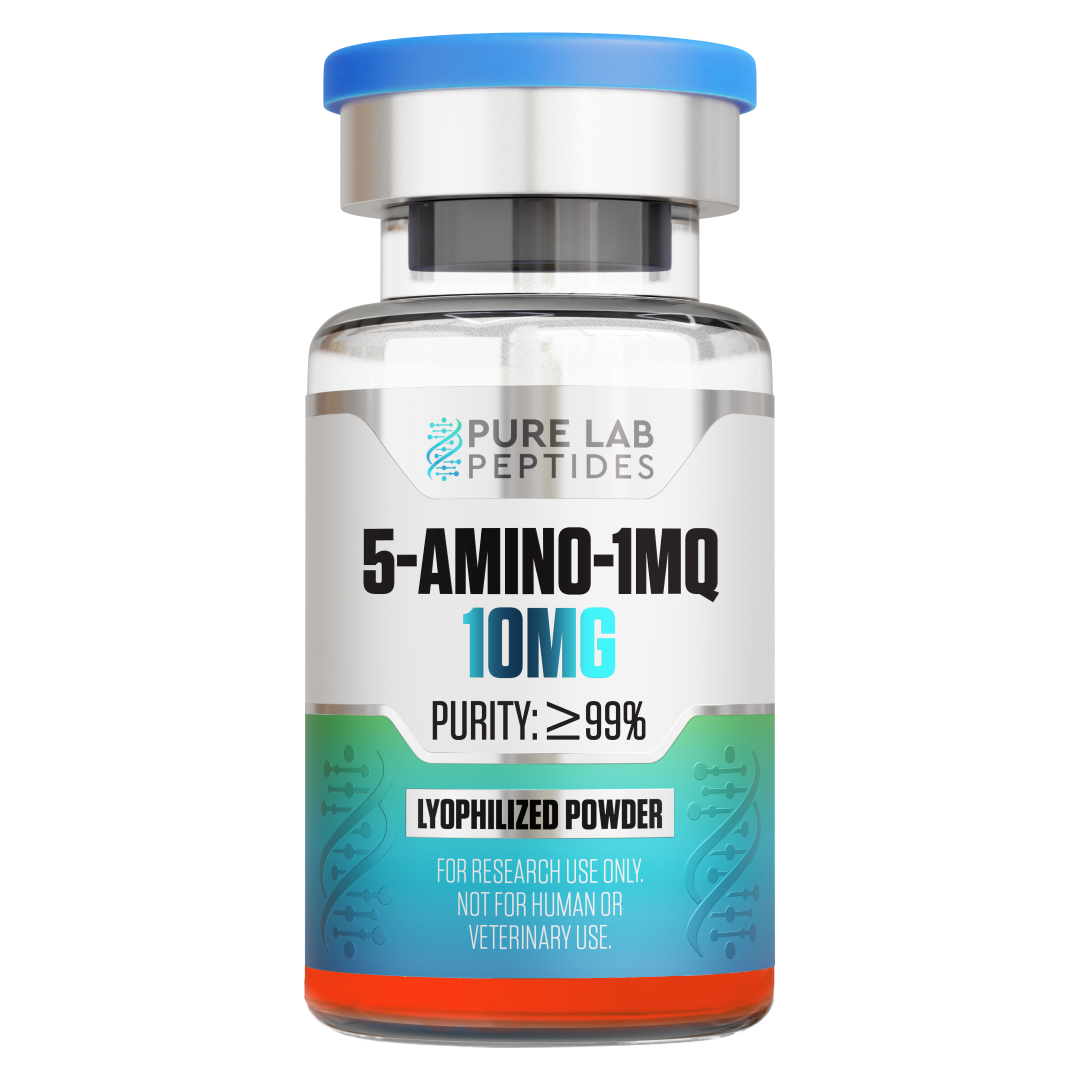
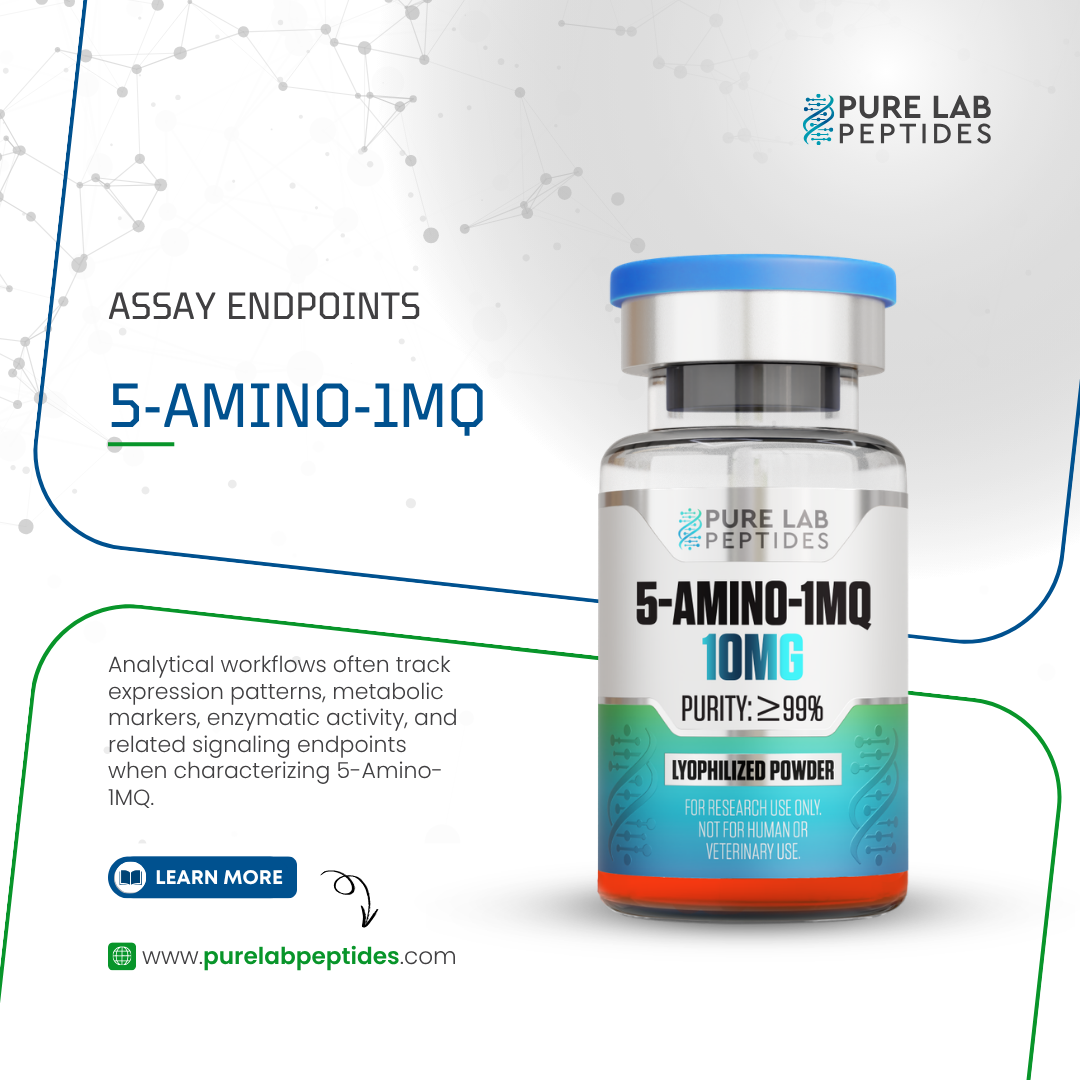
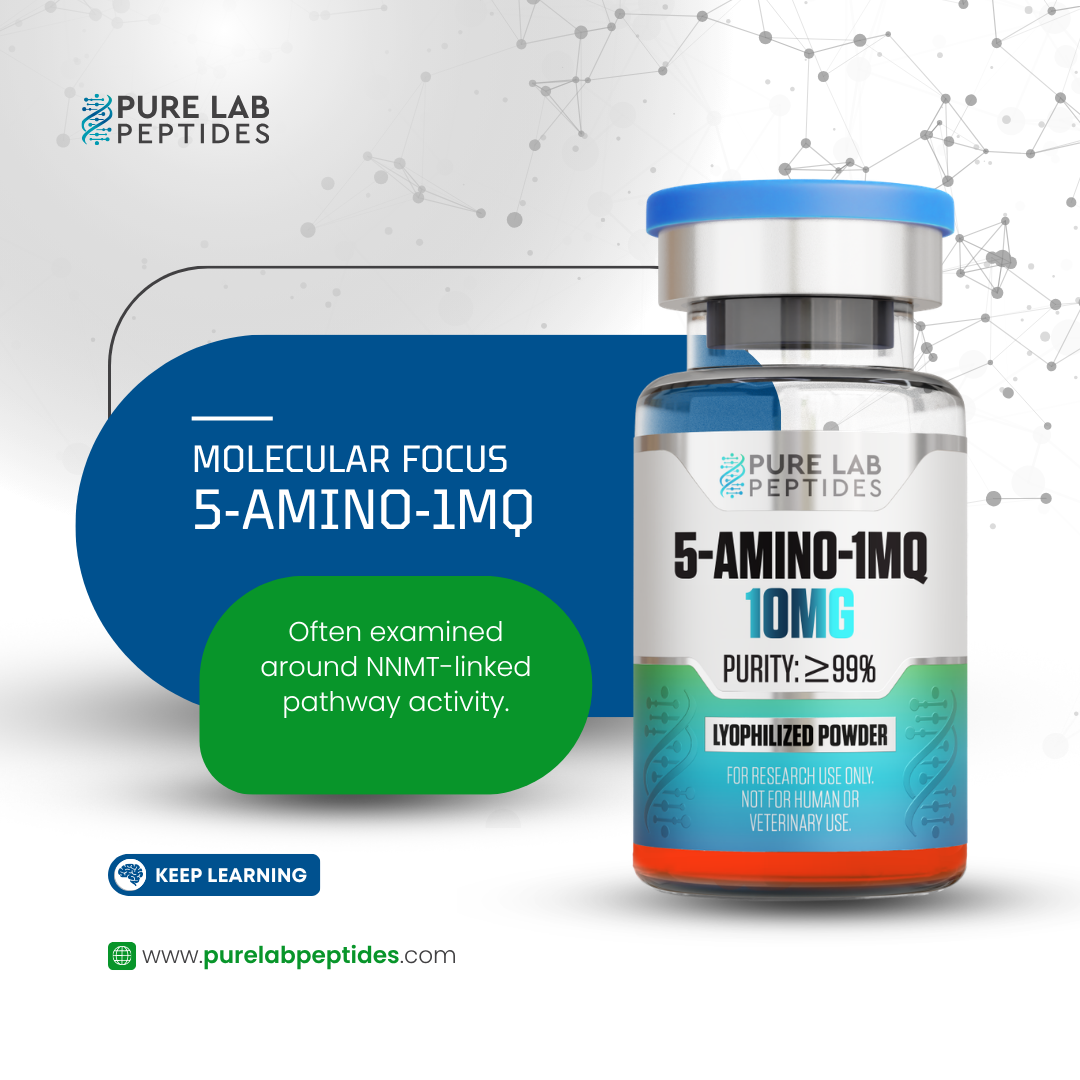
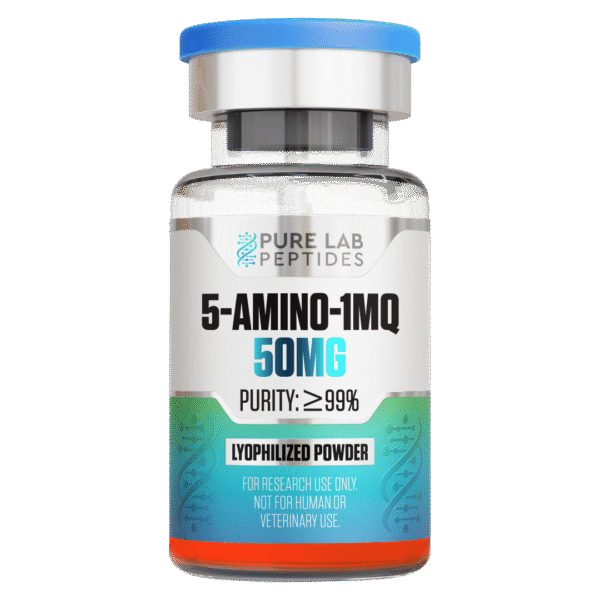
5-Amino-1MQ 10mg is a research-use-only laboratory material supplied for controlled research workflows, compound characterization, and analytical documentation review. It is manufactured under rigorous quality standards to support consistency, traceability, and batch-specific verification for qualified laboratory settings.
5-Amino-1MQ 10mg is intended strictly for laboratory research use only. This product is not intended for human or animal consumption, therapeutic use, diagnostic use, clinical use, veterinary use, or as a food, drug, cosmetic, dietary supplement, or household product.
| CAS No. | 42464-96-0 |
|---|---|
| Purity | ≥99% |
| Sequence | N/A |
| Molecular Formula | C₁₀H₁₁N₂⁺ |
| Molecular Weight | 159.21 g/mol |
| Applications | Metabolic studies, NNMT inhibition research, adipocyte biology, muscle regeneration investigations |
| Synthesis | Solid-phase synthesis |
| Solubility | Soluble in water or 1% acetic acid |
| Stability & Storage | Stable for up to 24 months at -20°C. After reconstitution, may be stored at 4°C for up to 4 weeks or at -20°C for up to 6 months. |
| Appearance | White lyophilized powder |
| Shipping Conditions | Shipped at ambient temperature; once received, store at -20°C |
| Regulatory/Compliance | Manufactured in a facility that adheres to cGMP guidelines |
| Safety Information | Refer to provided MSDS |
Consider these supplementary peptides for a comprehensive research approach.
Researchers who want to buy 5-Amino-1MQ for research should evaluate the compound through RUO labeling, batch-specific documentation, and analytical testing rather than consumer-facing claims. 5-Amino-1MQ is listed by PubChem as 5-amino-1-methylquinolinium, a small molecule with the formula C10H11N2+ and a computed molecular weight of 159.21 g/mol [1]. Published NNMT literature describes nicotinamide N-methyltransferase as an enzyme involved in nicotinamide methylation and broader metabolic pathway research, which makes documentation and claim boundaries essential for a research-use-only product page [2].
5-Amino-1MQ is best framed as a research compound in metabolic pathway research, even when it appears in peptide-category catalogs for navigation.
PubChem identifies the parent cation as 5-amino-1-methylquinolinium and separately lists an iodide salt entry, so compound identity review should distinguish the listed form from any catalog specification [1], [3].
NNMT is the accepted symbol for nicotinamide N-methyltransferase; UniProt describes the enzyme as catalyzing the N-methylation of nicotinamide using S-adenosyl-L-methionine [2].
Published literature has examined 5-Amino-1MQ and related quinolinium analogues in NNMT inhibitor research, including enzyme selectivity, cellular models, and preclinical model design [4], [5].
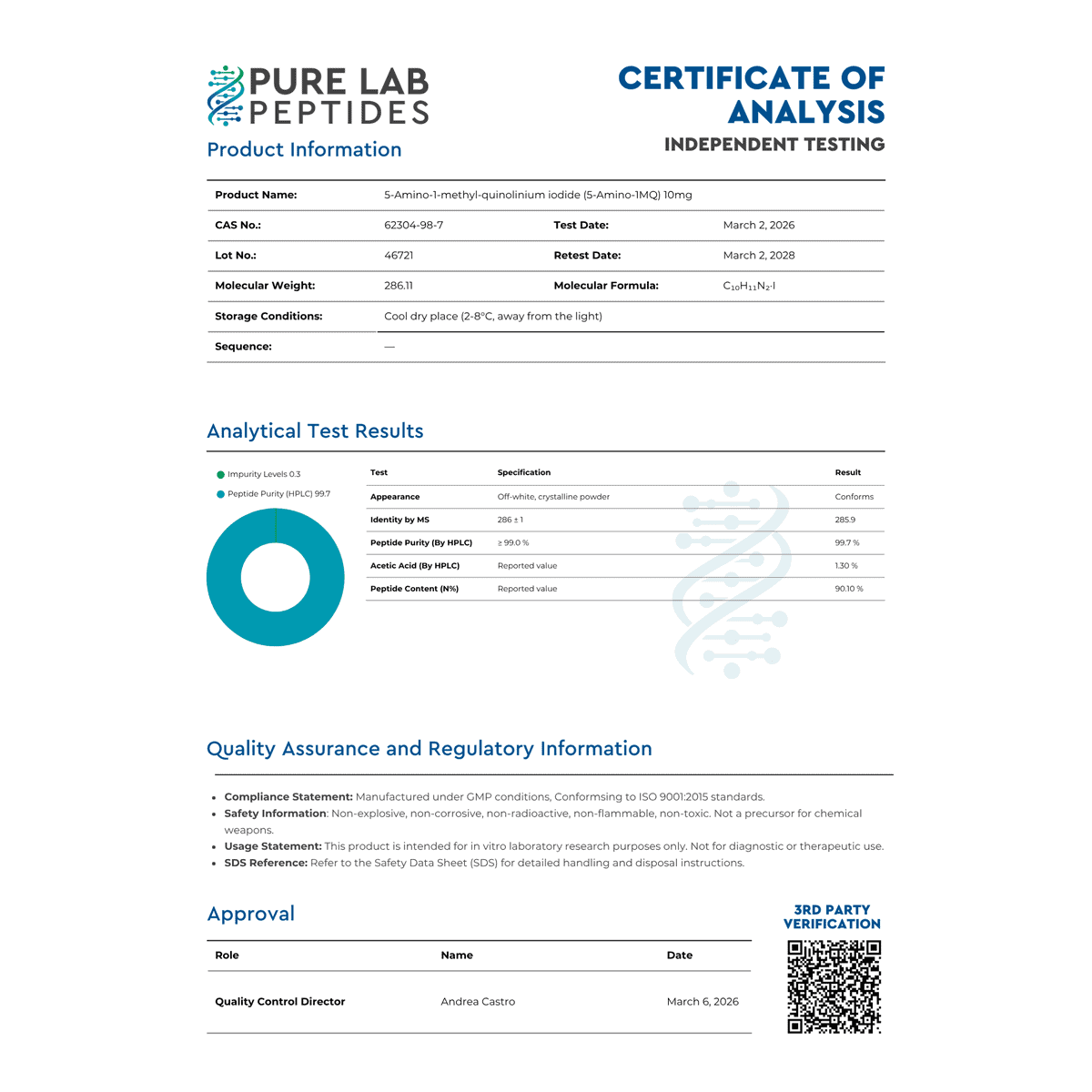
COA review should focus on compound name, lot number, purity method, identity method, date, and lab source.
HPLC can support purity review, while LC-MS or related mass spectrometry methods can support identity verification when matched with documented reference data [6], [7].
RUO product-page language should keep published research findings separate from product effects, product performance, or any consumer-facing interpretation.
To buy 5-Amino-1MQ for research, qualified research buyers should first review RUO labeling, compound identity, batch-specific COA documentation, purity testing, identity verification, lot traceability, and supplier documentation. Products discussed in this article are intended for laboratory research use only and are not intended for human or animal consumption. Literature context should support research interpretation, not product claims.
The first review layer is the product documentation set: label, COA, lot record, analytical method summary, and any supporting storage or handling record. NIST describes certificates for reference materials as documents that provide property values, uncertainty where applicable, and traceability statements, which is a useful model for thinking about why documented values matter in analytical review [8].
For a 5-Amino-1MQ research material listing, the COA should match the product name and lot number shown on the label. A mismatch between the listing, label, and batch file should be resolved before the material is selected for laboratory research.
Commercial research intent is not the same as consumer intent. A product page can serve researchers evaluating where to buy 5-Amino-1MQ for research while still keeping every claim tied to documentation, analytical review, and literature interpretation.
That framing matters because search phrases can drift toward product effects or product performance if the page is not carefully controlled. RUO positioning keeps the page focused on compound identity, COA review, analytical testing, and lawful laboratory research.
RUO labeling should be visible, consistent, and aligned across the product page, label, and supporting documentation. USP notes that its reference standards are intended for test and assay applications, not direct-use contexts, which illustrates the broader distinction between analytical materials and end-use products [9].
Research procurement teams should treat RUO statements as part of the documentation package. They do not replace COA review, but they help define the page’s intended lane.
5-Amino-1MQ is a shorthand name for 5-amino-1-methylquinolinium. PubChem lists the cation under CID 950107, while the iodide salt appears separately as NNMTi under CID 66522933, so product documentation should clearly identify the listed chemical form [1], [3].
Although the selected product-page title uses the word peptide, 5-Amino-1MQ is more accurately described as a small molecule research compound. The peptide-category context should be treated as a catalog navigation lane, not a chemical-class claim.
5-amino-1-methylquinolinium has the IUPAC name 1-methylquinolin-1-ium-5-amine and a computed exact mass of 159.092223359 Da for the cationic structure listed by PubChem [1]. The iodide salt listing has a different molecular formula and molecular weight because it includes the counterion [3].
That distinction matters for COA review. The compound name, form, molecular weight, and analytical method should all point to the same material identity.
The “1MQ” portion refers to the 1-methylquinolinium scaffold. The “5-amino” descriptor indicates an amino substitution at the 5-position of the quinolinium ring, and the resulting compound is part of the quinolinium NNMT inhibitor research lane described in medicinal chemistry literature [4].
Because shorthand names can vary across suppliers and literature, researchers should compare the full compound name against PubChem, the COA, and any analytical report. This reduces ambiguity between 5-Amino-1MQ, 5 amino 1mq, and other 1MQ-related naming variants.
Catalog amounts such as 50mg are product-listing specifications, not the canonical research entity. The canonical entity for this page is 5-Amino-1MQ, and amount-specific language should not become separate SEO targeting.
A listing format such as 1MQ capsules may appear in search data, but that phrase should be handled only as catalog-format context. The product page should still prioritize compound identity, COA review, and RUO documentation.
5-Amino-1MQ fits the metabolic pathway research lane because published work has examined NNMT inhibition, nicotinamide metabolism, NAD-related cellular models, and methyl donor pathways [5], [10]. NNMT literature links nicotinamide methylation to metabolic and methylation-pathway questions, but RUO product pages should not convert those studies into claims about a product.
UniProt describes NNMT as catalyzing the N-methylation of nicotinamide using S-adenosyl-L-methionine, producing N1-methylnicotinamide and S-adenosyl-L-homocysteine [2]. NCBI identifies NNMT as a protein-coding gene and lists nicotinamide N-methyltransferase as the official full name [11].
This makes NNMT a relevant molecular target for research documentation. It does not make a product-use claim.
Nicotinamide adenine dinucleotide, or NAD, is central to redox biology and cellular metabolism; NAD reviews describe salvage pathways that recycle nicotinamide into NAD through NAMPT and NMNAT enzymes [12]. NNMT literature is relevant because methylation of nicotinamide can intersect with how researchers model nicotinamide utilization and methyl donor balance [10].
That literature is mechanistic context. It should be interpreted as research background, not as a claim about a specific RUO material.
Researchers should separate three layers: NNMT enzyme biology, NNMT inhibitor literature, and the documentation for the specific 5-Amino-1MQ research material under review. The first two layers inform context; the third determines whether a product-page listing is adequately documented.
Medicinal chemistry work reported quinolinium analogues with low-micromolar NNMT inhibition and used structure-activity relationships to understand compound features linked with enzyme interaction [4]. A later preclinical characterization study reported that 5-amino-1MQ was evaluated for permeability, selectivity, cellular metabolite changes, and model-specific metabolic endpoints [5].
Those findings remain study-context findings. They should not be rewritten as human-use, wellness, or clinical-use language on an RUO product page.
NAD reviews describe NAD+ and NADH as redox cofactors involved in cellular energy metabolism, mitochondrial energy transduction, and multiple enzymatic processes [12], [13]. NNMT review literature discusses nicotinamide methylation as a pathway that can interact with methyl donor availability and NAD-related biology [10].
These terms belong in the article as research vocabulary. They should not become promises, outcomes, or product-positioning claims.
In vitro models can help clarify enzyme selectivity, cellular metabolite changes, and assay-specific pathway responses under controlled conditions. The 2018 5-amino-1MQ study included cell-based evaluation of intracellular 1-methylnicotinamide, NAD+, and related metabolites, which helps define research context without establishing product-use claims [5].
In vitro research is useful because it narrows the question. It does not answer every question about a compound, and it does not replace batch-specific identity testing.
Published literature frames 5-Amino-1MQ mainly around NNMT inhibitor chemistry, enzyme selectivity, cellular metabolism, and preclinical model interpretation [4], [5]. A safer product-page approach is to summarize the evidence level and the model type, then state what cannot be concluded from that evidence.
| Research Area | What Literature Examines | Evidence Type | RUO Interpretation |
|---|---|---|---|
| Compound identity | 5-amino-1-methylquinolinium structure, formula, and molecular weight [1] | Official database | Supports identity review, not product claims |
| Chemical form | Iodide salt listing and parent cation distinction [3] | Official database | Helps compare label, COA, and catalog records |
| NNMT enzyme context | Nicotinamide methylation and enzyme function [2], [10] | Database and review | Supports pathway context |
| NNMT inhibitor chemistry | Quinolinium scaffold structure-activity work [4] | Peer-reviewed medicinal chemistry | Supports compound-class interpretation |
| Cellular model findings | Metabolite and selectivity observations in controlled models [5] | Peer-reviewed preclinical research | Supports literature context only |
| Documentation review | Analytical validation and data reliability principles [6], [14] | Official guidance | Supports COA and record review |
Source-quality evidence starts with official databases, peer-reviewed literature, and recognized analytical guidance. PubChem and UniProt can support identity and enzyme context, while peer-reviewed studies can support model-specific statements [1], [2], [4], [5].
Vendor copy, forum posts, and anecdotal claims should not be treated as scientific evidence. For an RUO product page, those sources should not drive compound positioning.
Literature gaps should stay visible wherever a finding is model-specific, early-stage, or dependent on assay conditions. The 2018 paper and related NNMT literature provide useful research context, but product pages should avoid extending those findings beyond the studied models [5], [10].
A practical editorial rule is simple: state what the literature examined, identify the evidence type, and avoid turning the finding into a product claim.
A 5-Amino-1MQ product-page article should serve technical procurement teams, lab managers, and qualified researchers. The page should answer documentation-first questions before it discusses mechanism or literature context.
A search for buy 5-Amino-1MQ for research should be interpreted as a research procurement query. The page should not suggest personal evaluation, consumer outcomes, or clinical-use language.
The safest commercial answer is documentation-first. That means COA availability, purity method, identity method, lot traceability, storage documentation, and RUO labeling.
Product copy should prioritize documentation because analytical records are the bridge between a catalog listing and a research material. FDA’s analytical validation guidance describes validation as a framework for assessing analytical procedures, including performance characteristics relevant to test methods [6].
That does not mean every RUO material is governed by the same framework. It does mean researchers should expect method transparency, batch records, and data consistency.
Safe research applications include NNMT enzyme research, nicotinamide methylation models, cellular metabolism studies, NAD-related pathway interpretation, and analytical compound characterization. These topics are supported by NNMT literature and NAD metabolism reviews [5], [10], [12].
Unsafe framing begins when research applications are rewritten as product outcomes. The page should stay with models, methods, and documentation.
The key research boundary is that literature does not equal product positioning. A paper can examine a pathway, enzyme, or model-specific endpoint without giving an RUO product page permission to claim an outcome.
Study findings should stay separate from product claims because model design, assay conditions, and analytical endpoints define the scope of each result. FDA data-integrity guidance emphasizes that records should be reliable and accurate, which supports the broader principle that data should remain traceable to the conditions under which it was generated [14].
For product-page writing, that means a study finding should be summarized as a study finding. It should not be converted into consumer-facing language.
Claim boundaries keep RUO product pages focused on research documentation. Boundary-sensitive phrases such as product effects or product performance can become claims if separated from model-specific literature context.
A safer structure is to discuss compound identity, literature scope, COA review, and analytical testing. That structure supports commercial research intent without implying non-RUO purposes.
Product-page copy should keep literature summaries separate from procurement checks. Literature context explains why researchers may study NNMT; procurement checks explain how researchers evaluate the material before laboratory research.
This separation also protects the reader experience. It helps the page answer commercial research questions without drifting into wellness language or clinical-use language.
COA documentation matters because it ties a product listing to a specific batch record. NIST describes certified reference material documentation as including property values, uncertainty where applicable, and traceability information, which underscores why documentation must be specific rather than generic [8].
Researchers should review compound name, lot number, reported purity, analytical method, date, laboratory source, and whether the COA matches the product label. NIST explains that a chemical Certificate of Analysis can include material description, intended purpose, certified property values, methods, validity period, and technical information [8].
A COA without a matching lot number is incomplete for procurement review. A purity number without method context is also limited.
Batch-specific documentation supports material review by connecting the tested sample to the material being evaluated. NIST notes that Standard Reference Materials are supplied with a Certificate of Analysis and related documentation when applicable, which shows the value of connecting material identity with documented measurement records [15].
For 5-Amino-1MQ, the same logic applies at the product-page level. The lot number on the label, COA, and supplier record should tell the same story.
Research use statements should be clear and consistent across product documentation. They should not be hidden in fine print or contradicted by copy that implies non-RUO purposes.
A strong documentation set should align the product page, label, COA, and storage record around the same intended research lane. If one document suggests a different lane, the product listing needs editorial or documentation review.
Analytical testing supports compound identity by adding method-based evidence to the product record. It cannot make unsupported claims, but it can help researchers evaluate whether the listed compound, label, and batch documentation are consistent.
Analytical review workflow:
Verify that the compound name, chemical form, and lot number match across the label, product page, and COA.
Review the batch-specific COA before comparing literature context.
Check whether the purity testing method is listed.
Confirm whether identity testing is supported by LC-MS, mass spectrometry, or another suitable analytical method.
Review chromatogram or mass data when available.
Check the COA date, laboratory source, and record consistency.
Document storage and handling requirements in a laboratory record.
HPLC supports purity review by separating components under a defined chromatographic method and reporting a purity-related result based on the method conditions. FDA’s Q2(R2) guidance describes analytical procedure validation principles that can apply to methods using chromatographic and spectroscopic data [6].
For procurement review, HPLC is strongest when the COA includes method context, chromatogram information, and batch matching. A standalone purity percentage is less informative without those details.
LC-MS can support identity verification by combining chromatographic separation with mass-based information. Reviews of small-molecule mass spectrometry note that identification often depends on reference spectra, molecular formula interpretation, fragmentation data, and database matching [7], [16].
For 5-Amino-1MQ, LC-MS documentation should be interpreted with the listed chemical form in mind. The parent cation and salt form have different formula records in PubChem [1], [3].
Mass spectrometry adds mass-based evidence that can support compound identity review. Small-molecule MS literature emphasizes that structural identification can require accurate mass, isotopic patterns, fragment interpretation, and reference data rather than a single number alone [7], [16], [17].
This is why a COA should ideally show both purity and identity support. Purity and identity are related, but they are not the same question.
Lot traceability helps research buyers connect the material received with the records reviewed. The more specific the documentation, the easier it is to evaluate consistency across product page, label, COA, and lab file.
Research buyers should review lot numbers because a COA is only useful when it corresponds to the material being evaluated. NIST SRM definitions note that lot or issue identifiers can appear on certificates and help identify batch-produced or individually certified units [8].
For RUO procurement, the lot number should be checked before any literature interpretation. The literature does not verify the specific batch.
Labeling consistency adds confidence that the product page, label, and COA refer to the same material. FDA data-integrity guidance emphasizes reliable, accurate records, which supports the broader documentation principle that records should remain complete, consistent, and attributable [14].
A label should not create a different impression from the COA. If the label says one compound form and the COA reports another, that gap should be resolved.
Researchers should evaluate 1MQ research material listings by looking beyond shorthand names. The review should confirm full compound name, chemical form, PubChem identity, COA fields, purity method, identity method, lot number, and RUO language.
Listing language should stay focused on research use, compound identity, analytical testing, and documentation. It should avoid consumer-facing phrases, outcome language, and claims that go beyond published model-specific evidence.
Safe listing language can mention NNMT research, cellular metabolism models, nicotinamide methylation, and analytical documentation when supported by sources. It should not position the material as a consumer product.
Catalog specifications describe inventory details. Article targeting describes the canonical research entity.
For this page, the canonical entity is 5-Amino-1MQ. Catalog format, amount, and packaging language should not become a separate article theme or a substitute for COA review.
Research buyers should confirm RUO labeling, compound identity, full product name, chemical form, batch-specific COA, HPLC purity review, LC-MS or mass-based identity support, lot traceability, and storage documentation. PubChem identity records and peer-reviewed NNMT literature can support the scientific background, but batch records support procurement review [1], [3], [5].
Same-lane research entities can help readers understand how 5-Amino-1MQ fits metabolic pathway research. They should be used only when they clarify pathways, methods, or documentation—not to stack unrelated keywords.
SLU-PP-332 belongs in a different but nearby metabolic research lane because published literature describes it as an ERR signaling chemical probe rather than an NNMT inhibitor [18]. It should not be treated as a synonym, substitute, or direct comparator for 5-Amino-1MQ.
The useful editorial point is classification. 5-Amino-1MQ belongs in NNMT and nicotinamide methylation research, while SLU-PP-332 belongs in ERR signaling literature.
Common misunderstandings usually come from mixing catalog language, literature findings, and product claims. A product page should separate those layers before it explains mechanism or procurement.
Peptide labeling requires careful review because 5-Amino-1MQ may appear on peptide supplier websites even though PubChem identifies it as a small molecule cation rather than a peptide sequence [1]. The product-category label may help store navigation, but it should not override chemical identity.
The safest wording is “research compound” or “small molecule research compound.” If the page uses peptide-category language, it should be clear that the category is catalog-based.
Small molecule classification affects documentation because identity review relies on chemical name, formula, exact mass, salt form, and analytical data rather than peptide sequence confirmation. PubChem lists both parent and salt-related records, which makes chemical-form consistency especially important [1], [3].
Misunderstandings to avoid:
Published literature does not equal product-use guidance.
Preclinical findings should not be converted into claims for RUO materials.
A purity percentage does not prove complete compound identity.
A COA should be batch-specific.
Product amount specifications are catalog details, not article targets.
A practical research procurement review should be documentation-led. Use the checklist below before evaluating a 5-Amino-1MQ research material listing.
Verify that the compound is labeled for research use only.
Review the batch-specific certificate of analysis.
Confirm that purity data are supported by analytical testing.
Check that the lot number on the COA matches the product documentation.
Compare compound name, chemical form, molecular weight, and PubChem identity across documentation.
Assess whether the product page avoids non-RUO claims.
Document storage and handling conditions in a laboratory record.
Lab teams should compare the product name, synonym list, chemical form, lot number, purity result, analytical method, COA date, laboratory source, and RUO label language. FDA’s data-integrity guidance emphasizes reliable and accurate records, which supports this kind of consistency review [14].
If the supplier provides a chromatogram or mass data, the lab file should keep it with the COA. That record helps later reviewers understand how the procurement decision was made.
Buy 5-Amino-1MQ for research fits at the end of the review, not the beginning. The commercial decision should follow identity review, COA review, lot traceability, analytical testing review, RUO labeling review, and documentation consistency checks.
Pure Lab Peptides supplies compounds for laboratory research use only. Products are not intended for human or animal consumption, diagnostic use, therapeutic use, clinical use, veterinary use, or as food, drugs, cosmetics, dietary supplements, or household products. Researchers are responsible for ensuring lawful, appropriate handling and use in accordance with applicable regulations and institutional guidelines.
Review the product-page documentation, COA details, and RUO labeling before evaluating this compound for laboratory research.
Research use only means 5-Amino-1MQ is intended for research purposes in controlled laboratory contexts. Product-page information should focus on compound identity, COA review, analytical testing, lot traceability, supplier documentation, and published literature boundaries. It should not be framed as guidance for non-research settings.
Researchers should consider documentation before they buy 5-Amino-1MQ for research. Key review points include RUO labeling, batch-specific COA records, HPLC purity review, LC-MS identity support, lot traceability, and consistency between the product listing and supporting files. Procurement review should come before broader literature interpretation.
5-Amino-1MQ research focuses on NNMT because published literature has examined the compound in relation to inhibiting NNMT and the inhibition of nicotinamide N-methyltransferase in model-specific settings [5]. FAQ content should treat that as pathway research context, not as a product claim or non-RUO positioning.
The amino group at the 5-position helps describe the chemical naming of 5-Amino-1MQ. In documentation review, researchers should compare the full compound name, shorthand naming, chemical form, and COA details against identity records. This supports compound characterization without turning naming details into product claims.
Mechanism of action language should be interpreted as literature context for research models. For 5-Amino-1MQ, that context may include NNMT, nicotinamide methylation, NAD-related biology, nucleotide salvage, cofactor systems, energy production, and mitochondrial function. These topics should remain tied to published research and documentation review.
Language boundaries matter because terms such as lipid metabolism can drift into product-positioning language if separated from model-specific literature. A research-use-only page should keep those terms connected to compound identity, COA review, analytical testing, lot traceability, RUO labeling, and published literature boundaries rather than non-RUO claims.
The following authors are recognized for published research that helped shape the scientific context discussed in this article.
Author profile: ASPET Profile
Harshini Neelakantan, PhD, is a published author in NNMT-focused research relevant to 5-Amino-1MQ. Her work is especially useful for this product-page research context because it connects small-molecule NNMT inhibitor characterization with enzyme assays, compound characterization, and model-specific literature interpretation. The article’s discussion of 5-Amino-1MQ identity, nicotinamide N-methyltransferase context, and RUO claim boundaries draws on this type of published literature. Her publications help frame how researchers can distinguish pathway-focused research findings from product-page claims while keeping attention on compound identity, analytical documentation, and research-use-only positioning.
Selected publications:
A peer-reviewed 5-Amino-1MQ NNMT research model study — Biochemical Pharmacology, 2018. DOI: 10.1016/j.bcp.2017.11.007. PMID: [29155147].
Structure–Activity Relationship for Small Molecule Inhibitors of Nicotinamide N-Methyltransferase — Journal of Medicinal Chemistry, 2017. DOI: 10.1021/acs.jmedchem.7b00389. PMID: [28548833].
Author profile: UTMB Faculty Profile
Stanley J. Watowich, PhD, is a published researcher whose work appears across NNMT enzyme assay development, small-molecule inhibitor structure-activity research, and broader biochemical model design. His publications are relevant to the analytical and mechanistic portions of the article because they connect enzyme activity measurement, ligand-enzyme interaction models, and compound-level interpretation. This background supports the article’s emphasis on published literature, biochemistry, and documentation-focused research review. For a research-use-only product page, his work helps provide context for discussing 5-Amino-1MQ as a research compound while staying within pathway-focused literature.
Selected publications:
Noncoupled Fluorescent Assay for Direct Real-Time Monitoring of Nicotinamide N-Methyltransferase Activity — Biochemistry, 2017. DOI: 10.1021/acs.biochem.6b01215. PMID: [28121423].
Structure–Activity Relationship for Small Molecule Inhibitors of Nicotinamide N-Methyltransferase — Journal of Medicinal Chemistry, 2017. DOI: 10.1021/acs.jmedchem.7b00389. PMID: [28548833].
National Center for Biotechnology Information. PubChem Compound Summary: 5-Amino-1-methylquinolinium. PubChem. Updated 2026.
UniProt Consortium. NNMT_HUMAN Nicotinamide N-methyltransferase. UniProtKB/Swiss-Prot. Accessed 2026.
National Center for Biotechnology Information. PubChem Compound Summary: NNMTi, 5-amino-1-methylquinolinium iodide. PubChem. Updated 2026.
Neelakantan H, Wang H-Y, Vance V, Hommel JD, McHardy SF, Watowich SJ. Small-molecule NNMT inhibitor structure-activity research. Journal of Medicinal Chemistry. 2017. DOI: 10.1021/acs.jmedchem.7b00389. PMID: 28548833.
Neelakantan H, et al. Preclinical 5-amino-1MQ NNMT inhibitor characterization study. Biochemical Pharmacology. 2018. PMID: 29155147.
U.S. Food and Drug Administration. Q2(R2) Validation of Analytical Procedures. FDA Guidance Document. 2024.
Scheubert K, Hufsky F, Böcker S. Computational mass spectrometry for small molecules. Journal of Cheminformatics. 2013. DOI: 10.1186/1758-2946-5-12.
National Institute of Standards and Technology. SRM Definitions. NIST. Updated 2026.
United States Pharmacopeia. Reference Standards FAQs. USP. Accessed 2026.
Pissios P. Nicotinamide N-methyltransferase review. Trends in Endocrinology & Metabolism. 2017. DOI: 10.1016/j.tem.2017.02.004. PMID: 28291578.
National Center for Biotechnology Information. NNMT nicotinamide N-methyltransferase gene record. NCBI Gene. Updated 2026.
Covarrubias AJ, Perrone R, Grozio A, Verdin E. NAD+ metabolism and cellular processes review. Nature Reviews Molecular Cell Biology. 2021.
Ralto KM, Rhee EP, Parikh SM. NAD(H) in mitochondrial energy transduction. Nature Reviews Nephrology. 2020.
U.S. Food and Drug Administration. Data Integrity and Compliance With Drug CGMP: Questions and Answers. FDA Guidance Document. 2018.
National Institute of Standards and Technology. Reference Materials. NIST. Accessed 2026.
Kind T, Fiehn O. Small-molecule structure elucidation using mass spectrometry. Bioanalytical Reviews. 2010. DOI: 10.1007/s12566-010-0015-9.
Neumann S, Böcker S. Identification of metabolites and small molecules from mass spectrometry data. Analytical and Bioanalytical Chemistry. 2010. DOI: 10.1007/s00216-010-4142-5.
Okda HE, Zhao P, Hayes M, et al. SLU-PP-332 ERR signaling structure-activity research. International Journal of Biological Macromolecules. 2026. DOI: 10.1016/j.ijbiomac.2026.151450.
This research disclaimer clarifies how this page handles published literature and search language around 5-Amino-1MQ. In metabolic pathway research content, phrases such as 5-amino-1mq capsules, 5 amino 1mq capsules, 5-amino-1mq 50mg, 1MQ 50mg, 30 capsules, 60 capsules, and 1MQ capsules for sale can drift from catalog description into product-positioning language when framed incorrectly. Related phrases such as obesity, type ii diabetes, metabolic health, cellular health, fat metabolism, and SLU-PP-332 capsules also require careful separation from product claims and model-specific research context.
Here, those phrases are handled only as research-language examples, not outcomes, instructions, recommendations, or product-positioning statements. This page remains focused on 5-Amino-1MQ identity, COA review, analytical testing, peptide purity, lot traceability, RUO labeling, product documentation, published literature boundaries, and laboratory use. Terms such as intended for research use and blocking NNMT should be interpreted within documentation and pathway research context, not as consumer-facing language.
Our team is ready to assist you with any inquiries regarding our catalogue of peptides and their applications.
Discount Applied Successfully!
Your savings have been added to the cart.
Pure Lab Peptides
You must be at least 21 years of age to enter this site. By entering, you confirm that you are of legal age and agree to our terms.
For research use only.
There are no reviews yet.