



What Are Peptides? Bonds, Structure and Laboratory Research

TL;DR · The short version
What are peptides? Their structures contain amino-acid residues connected by peptide bonds. Length, sequence and chemical modifications describe the molecule, but experiments on that particular molecule tell you about its behavior. Once you separate those two questions, the basic terminology becomes much easier to use in research reading.
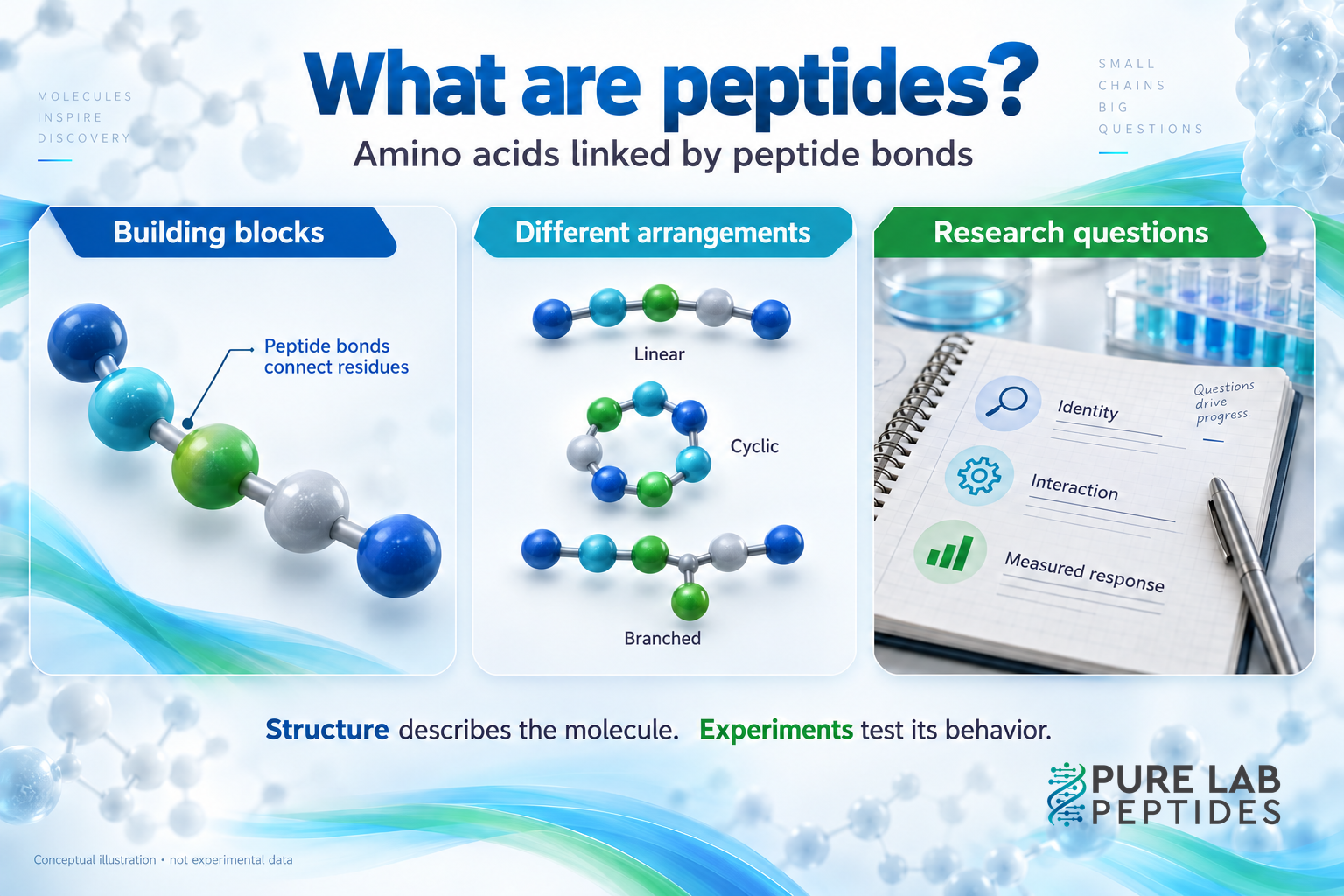
A bead-chain diagram gives you a way into a complicated paper. The beads stand for building blocks; their arrangement points to the molecule being studied. The next question is what the experiment measured for that arrangement. The picture and the paper are doing different jobs.
I’d start with the terms that let you follow that connection, rather than a list of names to memorize. What is an amino-acid residue? What joins the residues, and what was the study set up to learn? Those questions give the details somewhere to fit.
What makes a molecule a peptide?
At a glance: A peptide contains at least two amino-acid residues connected through peptide bonds. A single free amino acid is a building block, rather than a peptide chain.
A peptide bond is an amide linkage between the carbonyl carbon of one amino-acid unit and the nitrogen of another. The IUPAC definition of peptides describes this connection as formally involving loss of water. That’s a chemical description of the linkage, not a claim that every laboratory synthesis follows one simple mixing step.
After an amino acid is incorporated into the chain, we call that unit a residue. A chain with four residues contains four amino-acid units. The peptide bond describes their connection; the sequence gives their order. Keep both ideas in mind when moving from a definition to a named molecule.
Linear chains are familiar, but they aren’t the only arrangement. The National Library of Medicine’s peptide vocabulary also includes branched and cyclic structures. In the illustration below, the beads are a reading aid. They don’t show an experimental three-dimensional structure or a precise chemical formula.
Peptides, polypeptides and proteins: where does the name change?
The useful distinction: These names overlap. A residue-count convention helps classify a molecule, but it does not establish its function.
You may see a beginner’s definition saying peptides usually have 2 to 50 residues. The NHGRI glossary uses that convention and calls a longer chain a polypeptide. Other scientific vocabularies draw the line differently: IUPAC’s polypeptide entry uses ten or more residues.
Two vocabularies can use different cutoffs without describing two different molecules. “Peptide” and “polypeptide” serve classification purposes; neither label creates a biological boundary by itself. For research comparisons, write down the sequence and construct so the comparison doesn’t depend on a naming convention alone.
| Term | What it describes | What it does not establish |
|---|---|---|
| Amino acid | A building block that can become a residue in a chain | The identity of a complete peptide |
| Peptide bond | The amide linkage joining amino-acid units | A particular biological effect |
| Peptide sequence | The order of residues | Every modification or the full experimental context |
| Polypeptide | A longer peptide chain under the source’s naming convention | A universal length-based boundary for function |
| Protein | A molecule built from one or more polypeptide chains | Equivalence to a shorter fragment from that protein |
Why researchers study particular peptide structures
The research question comes first: Peptides can be studied as binding partners, engineered analogues or precisely defined experimental molecules. Those are different uses.
One example is thymosin beta-4. In a 1992 biochemical study, Weber and colleagues examined its interaction with actin. Under the tested conditions, thymosin beta-4 formed a one-to-one complex with actin monomers, and that complex did not elongate actin filaments. The result describes a molecular interaction in an assay. It doesn’t, by itself, establish a recovery outcome in people.
Another example is peptide engineering. Lau and colleagues’ original semaglutide design paper examined modifications to a GLP-1 analogue alongside receptor activity, albumin affinity and exposure in an animal model. Here, the question was how design choices changed the compound’s properties. A name ending in “peptide” would tell you very little about that balance.
The actin study asks how a peptide interacts with another molecule. The engineering study asks how changes to an analogue affect its behavior. Those are useful, concrete research questions. Their answers don’t automatically cover every peptide, related fragment or preparation carrying a similar name.
How peptide synthesis made defined chains easier to study
A little history: Solid-phase synthesis gave researchers a practical way to build a defined sequence step by step.
In Merrifield’s 1963 paper, the growing peptide remained attached to a solid support while protected amino acids were added in successive steps. Washing and filtration removed excess reagents and byproducts between steps. The paper demonstrated the approach with the tetrapeptide leucyl-alanyl-glycyl-valine.
Picture the growing chain staying on the support while the surrounding reagents change. That makes the historical synthesis approach easier to follow. It explains construction of a specified chain, not proof of a finished vial’s identity or a synthesized analogue’s equivalence to a natural molecule.
A simple way to read your first peptide paper
Start with three questions: Which molecule? Which experimental system? Which measured result?
For a hypothetical comparison, take two abstracts using the same peptide name. One examines the full sequence with a purified binding partner; the other examines a short fragment in cultured cells. First check the construct. Then check what was measured. A shared name doesn’t make those findings interchangeable.
A headline asking whether a peptide “works” skips those distinctions. A binding measurement, gene-expression change and animal-study outcome are different observations. Reading what each experiment actually asked gives you a better starting point for judging the finding.
For the next step, use our peptide sequence notation guide to interpret residue letters and modifications. Our guide to reading peptide research literature explains study comparisons in more detail, while in vitro and in vivo research covers the differences between experimental systems.
Common questions about peptides
Keep these separate: A structural definition is not a statement about safety, effectiveness or an individual product.
Are all peptides hormones?
No. The word “Peptide” describes molecular structure, while a hormone is named for a biological role. The actin-binding example shows why those categories aren’t interchangeable: peptide molecules can be investigated for different interactions.
Does a shorter chain necessarily mean a weaker effect?
You can’t infer that result from residue count. Define the molecule, outcome and experimental conditions before comparing findings. The classification table helps with names; it doesn’t predict what an experiment will show.
Does published research verify a particular research vial?
No. A publication reports the material and experiments in its own study, not the identity of an unrelated supplied batch. Also keep a molecular mechanism separate from a measured outcome. The mechanisms and outcome claims guide develops that distinction.