 Skip to content
Peptide Formulation Research: Documentation Basics and Best Practices

Peptide formulation research depends on rigorous documentation to verify each peptide batch used in the lab. Key documentation basics include a lot-specific Certificate of Analysis (COA) that reports the peptide’s identity, purity, and composition, along with a Safety Data Sheet (SDS) for hazards and handling. These records ensure researchers know exactly what peptide they have and how to handle it. All information here applies strictly to research-use-only materials, not for clinical or animal applications.
Fast Answer
Batch-specific analytical documents—primarily the Certificate of Analysis (COA) and Safety Data Sheet (SDS)—provide essential information in peptide formulation research. A COA confirms that a peptide lot has been tested and meets defined specifications. It typically lists the lot number, identity test results (e.g. MS or chromatography data), purity percentage, and other attributes. Products discussed in this article are intended for laboratory research use only and are not intended for human or animal consumption. Researchers use these documents to verify that each peptide meets the required quality criteria before proceeding with in vitro experiments.
Key Documents: Certificate of Analysis and Safety Data Sheet
A Certificate of Analysis (COA) is a quality-control document issued for each peptide batch. It states what tests were performed and whether results met the pre-established criteria. In effect, a COA “confirms the product has been tested according to specific standards”. For peptides, the COA should clearly identify the batch (name, sequence, lot number, salt form) and report results of each analytical method used. Common entries include identity confirmation (often via mass spectrometry or NMR), purity percentage (by HPLC), assay/content (by calibrated HPLC), and any impurities or residuals (e.g. water content). A rigorous COA shows both the methods (e.g. LC-MS, UV-HPLC) and numerical results alongside acceptance limits, rather than vague “pass” statements.
The Safety Data Sheet (SDS) is another critical document provided with each peptide shipment. By OSHA hazard-communication rules, an SDS must list the chemical’s hazards (physical, health, environmental) and recommended protective measures. For example, the SDS will indicate if the peptide is an irritant or corrosive, and specify handling precautions (gloves, ventilation) and storage conditions. In the context of peptide procurement, reviewing the SDS ensures lab personnel know how to safely handle and store the material. Together, the COA and SDS provide a complete documentation package: the COA answers “What is in the vial and how pure is it?” while the SDS answers “How do I handle it safely?”.
Certificate of Analysis Components
A well-formed peptide COA usually contains the following key fields, which help a researcher interpret the batch data:
| COA Field | Description | Why It Matters |
| Product identity and traceability | Peptide name/sequence, lot or batch number, salt/counter-ion form | Ensures the COA corresponds to the exact sample vial. Matching the lot number and exact peptide sequence across label and COA prevents mix-ups. |
| Analytical methods | List of techniques used (e.g. LC-MS, HPLC, NMR, UV) | Shows how identity and purity were tested. Knowing the methods lets researchers judge result relevance (e.g. HPLC for purity, MS for identity). |
| Identity results | Data confirming peptide sequence (e.g. MS spectrum, peptide map, or amino acid analysis) | Confirms the compound matches the expected sequence. It protects against wrong sequences or mislabeled materials. |
| Purity and related substances | Purity percentage (by chromatography) and any identified impurities | Indicates the amount of the main peptide versus side-products. High purity (often >90–95%) is expected; any significant impurities should be listed explicitly. |
| Assay/content | Measured peptide amount or potency (e.g. mg per vial or % of label claim) | Ensures dosage calculations are accurate for formulation. The COA should show content near the labeled value within a small tolerance. |
| Additional attributes | Values for water content, residual solvents, elemental impurities (metals), or endotoxin | Provides a fuller composition profile. E.g. water content (Karl Fischer) and solvents (GC) verify dryness and purity; endotoxin level may be included if relevant. |
The COA essentially ties the physical vial to analytical evidence. When researchers receive a peptide, they should verify that the label and catalog description match the COA’s product name and lot number. The COA should then allow the researcher to answer: “What was measured, how was it measured, and did it meet the specs?” For example, seeing a stated purity of 98% by HPLC means little without knowing the method and acceptance threshold. A robust COA provides this context so that labs can trust the peptide’s identity and quality without ambiguity.
Analytical Methods and Quality Standards
Peptide characterization typically combines multiple orthogonal techniques. Guidelines recommend using at least two independent methods for confirming a peptide’s identity. For example, mass spectrometry (LC-MS/MS) is commonly used to verify the peptide’s monoisotopic mass and sequence, while peptide mapping or NMR may further confirm structure. In practice, a COA might report the measured m/z values and spectrum match to theory, or a mapped chromatogram of peptide fragments.
Purity is most often assessed by reversed-phase HPLC, where the main peptide peak area is compared to the total; ancillary methods like capillary electrophoresis or GC (for volatile impurities) may also be used. According to regulatory standards, the HPLC assay (for content) is usually performed with a calibrated reference standard, and assay results should be within a small margin of the label claim. Any significant impurities (e.g. sequence variants, truncated peptides, dimers) should be quantified. The EMA synthetic peptide guideline specifically notes that simply stating “high molecular weight impurities” is insufficient; each impurity category should be identified (e.g. dimers, trimers) with limits. In short, peptide COAs should reflect the principles of modern analytical validation: specificity, accuracy, and robustness of each method.
Documentation Workflow for Researchers
Before using a research peptide, a lab should follow a verification workflow. First, confirm the product label clearly shows “For Research Use Only” and matches the intended compound. Then retrieve and review the COA and SDS. Check that the lot number on the vial matches the COA. Next, verify identity and purity results: the methods listed (e.g. LC-MS, HPLC) must be appropriate for the peptide and the numeric values must meet or exceed the required specifications. If identity data are missing or purity is unexpectedly low, one should seek clarification or re-test. Finally, ensure the SDS provides any needed hazard info and storage conditions. In short, researchers should only incorporate the peptide into experiments once its documentation trail is self-consistent.
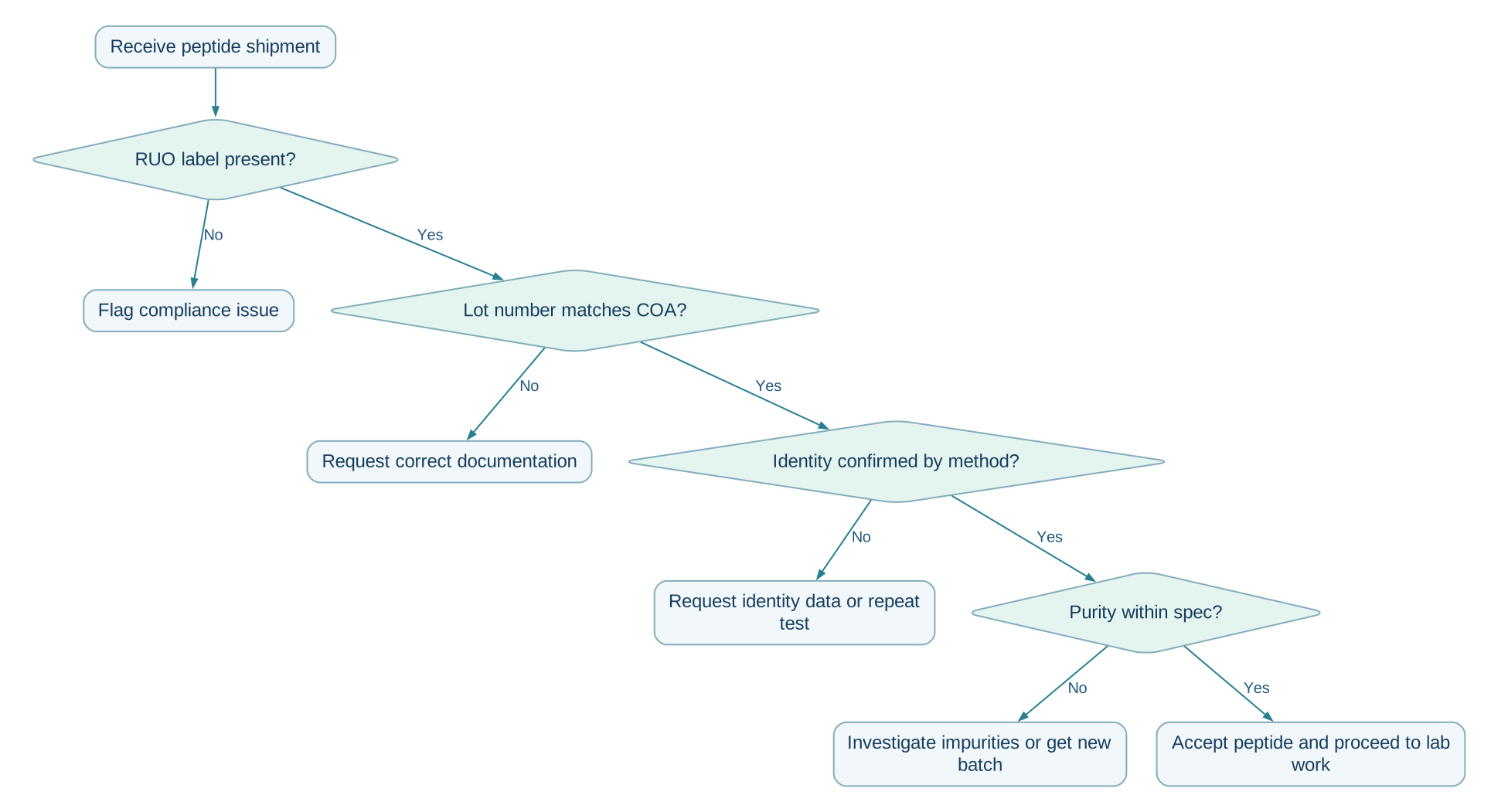
Text version of this diagram
- Receive peptide shipment → RUO label present?.
- RUO label present? — No → Flag compliance issue.
- RUO label present? — Yes → Lot number matches COA?.
- Lot number matches COA? — No → Request correct documentation.
- Lot number matches COA? — Yes → Identity confirmed by method?.
- Identity confirmed by method? — No → Request identity data or repeat test.
- Identity confirmed by method? — Yes → Purity within spec?.
- Purity within spec? — No → Investigate impurities or get new batch.
- Purity within spec? — Yes → Accept peptide and proceed to lab work.
This flowchart represents an overview of a typical peptide documentation review process for research procurement. It illustrates steps a lab might take to verify each batch’s documentation (label, COA, SDS) before use.
FAQs
What should be included in a peptide Certificate of Analysis (COA)?
A COA for a research peptide should list the peptide’s identification (name, sequence, and lot number) along with results from analytical tests. Key entries include the methods used (e.g. LC-MS, HPLC), the measured identity (mass or sequence confirmation), purity percentage, assay or content values, and any impurity or residual data. In other words, the COA must clearly show what was tested and whether each result met the predefined specifications. This lets researchers verify that the exact peptide batch they received matches the data on the COA.
Which analytical methods are typically reported on a peptide COA?
Common methods include mass spectrometry and chromatography. For identity, peptide COAs often report LC-MS or tandem MS/MS results to confirm molecular weight and sequence. For purity and assay, reversed-phase HPLC is standard (sometimes with UV or charged aerosol detection) to quantify the main peptide content. Orthogonal methods like NMR or peptide mapping can also appear for additional confirmation. The important point is each method listed on the COA should be appropriate for the attribute being measured (identity vs. purity), so the results are meaningful.
Why is the lot number on the COA important for research peptides?
The lot number links the analytical data to the specific peptide vial. By matching the vial’s lot number and label to the COA, a researcher ensures they are looking at the correct batch’s results. Lot-level traceability is a core element of research documentation: it means that if any issue arises later, one can trace it back to that specific batch. Having consistent lot numbers on the label, COA, and lab record helps prevent confusion and supports reliable recordkeeping for experiments.
Should I expect an SDS with every research peptide?
Yes. Safety Data Sheets (SDSs) are generally provided for chemical materials, including research peptides. An SDS lists hazard information (e.g. irritant, toxic, flammable), along with safe handling and storage guidelines. Even though peptides are for lab use, the seller should supply an SDS so the receiving lab knows any safety precautions. Researchers should consult the SDS to handle the peptide safely (e.g. using gloves, ventilation) and to comply with workplace safety rules.
What does “research use only” (RUO) labeling mean for a peptide?
“Research use only” indicates the peptide is intended solely for laboratory research, not for any clinical or therapeutic application. Legally, RUO labeling exempts the product from drug labeling requirements but also forbids claims of medical use. In practice, it means all product descriptions, COAs, and documentation should stay focused on analytical and laboratory context. Researchers should understand that an RUO peptide has not been evaluated for safety or efficacy in living subjects; it’s strictly a tool for in vitro or preclinical studies.
Next Steps
Always review batch-specific documentation before selecting or using any research peptide. Ensure the COA, SDS, and label information all match and that analytical results meet your needs. For peptides labeled research-use-only, prioritize suppliers (like Pure Lab Peptides) that provide complete COAs, clear RUO statements, and accessible documentation. This rigorous approach helps maintain research quality and reproducibility.
References
- McCarthy D, Han Y, Carrick K, Schmidt D, Workman W, Matejtschuk P, et al. “Reference Standards to Support Quality of Synthetic Peptide Therapeutics.” Pharm Res. 2023. doi.org/10.1007/s11095-023-03493-1
- CIKlab. “What is a Certificate of Analysis (CoA)?” CIKlab. 2023. ciklab.com/en/what-is-a-certificate-of-analysis-coa
- European Medicines Agency. *Guideline on the Development and Manufacture of Synthetic Peptides*. 2025. ema.europa.eu/…/synthetic-peptides_en.pdf
- U.S. Department of Labor, Occupational Safety and Health Administration. “Hazard Communication Standard: Safety Data Sheets.” OSHA (Brief). 2012. osha.gov/Publications/OSHA3514.html
- National Institute of Standards and Technology (NIST). “SRM Definitions.” 2026. nist.gov/srm/srm-definitions