


Types of Peptides: How Research Families Are Classified

TL;DR · The short version
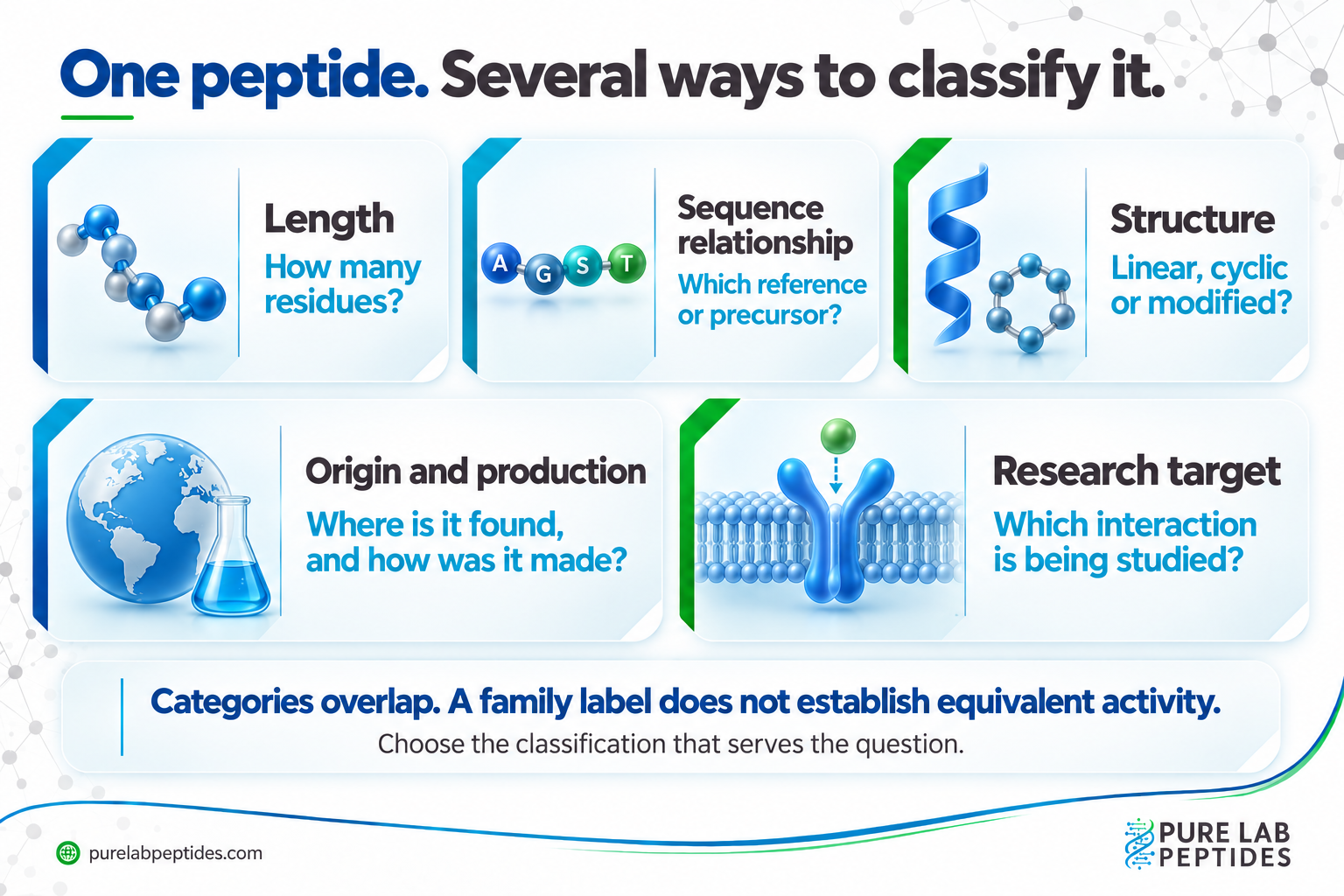
Types of peptides can be grouped by length, sequence, structure, origin or target. These categories overlap. A tripeptide can also be synthetic and modified; a shared family name does not establish the same activity, purity or handling requirements.
A peptide can be a tripeptide, a synthetic material and a receptor ligand at the same time. Those labels are not competing answers. Each describes a different feature.
The useful question when comparing types of peptides is: what are you trying to classify? Start with residue count for length, complete chemistry for identity, and matching experimental evidence for a research role. A broad family name cannot replace those details.
Types of peptides by chain length
TL;DR: Length names count residues. They do not identify activity or every structural feature.
Count amino acid residues to describe a chain’s length. A dipeptide has two residues, a tripeptide has three, and a tetrapeptide has four. These names identify a count, not a particular activity.
| Length category | Meaning | Illustrative sequence |
|---|---|---|
| Dipeptide | 2 residues | Gly-Ala |
| Tripeptide | 3 residues | Gly-His-Lys |
| Tetrapeptide | 4 residues | Gly-Ala-Ser-Lys |
| Oligopeptide | A short chain; numerical boundaries vary | Use the actual residue count when precision matters |
| Polypeptide | A longer peptide chain | The term alone does not state an exact length |
In an ordinary linear chain, adjacent residues are joined by peptide bonds, so a three-residue chain has two such links. A residue count does not reveal cyclization, attached groups or the detailed chemical form.
Sequence and origin
TL;DR: Check whether “family” means shared sequence, a common precursor or a practical research grouping.
Related sequences can point to a common precursor or evolutionary relationship. In protein classification, InterPro distinguishes families, domains and other entry types; a family is not simply a list of materials with similar advertising claims.
For short research peptides, check what an author means by “family.” It may describe fragments from one precursor, analogs of a particular hormone or a practical research grouping. Shared residues are informative, but a small change or different modification can alter the properties under study.
Chemical structure
TL;DR: Linear, cyclic, disulfide-containing and modified describe chemistry, and can overlap.
| Structural grouping | Question it helps answer |
|---|---|
| Linear or cyclic | Which bonds, if any, close a ring? |
| Disulfide-containing | Which residues are linked, and is connectivity specified? |
| Modified or conjugated | What additional groups belong to the complete chemical entity? |
| Natural sequence or synthetic analog | How does the tested material relate to the reference sequence? |
These descriptions can overlap. A cyclic peptide can also be synthetic and modified. A short linear sequence may contain nonstandard residues. A ring can involve the chain ends or side chains; a disulfide bridge is another specified connection, not something a residue count reveals. IUPAC’s derivative and cyclic-peptide notation distinguishes these connectivity details. IUPAC nomenclature also notes that the peptide/protein boundary is not governed by one universally applied chain-length cutoff.
Biological target or research role
TL;DR: A target-based category needs evidence for the specific material and interaction.
Terms such as receptor agonist, enzyme substrate or signaling peptide describe a relationship being investigated. They do not specify one chemical family. Different structures can interact with the same target, while one material may be studied in several pathways.
A target-based label should therefore lead to an experimental question: was the interaction directly measured, in which system, and with what comparator? Group membership does not transfer another member’s potency, selectivity, stability or biological outcome to the material you are considering.
Natural origin and laboratory production are different labels
TL;DR: A natural sequence can be made synthetically. Production method and sequence relationship are separate facts.
A naturally occurring sequence can also be prepared synthetically. “Synthetic” describes how material was produced; it does not necessarily mean that its sequence is new. Conversely, an analog may deliberately differ from a reference sequence through substitution, truncation or an added group.
When comparing records, ask two separate questions: what is the complete structure, and how does it relate to the named reference? The production label alone cannot answer either question or establish purity.
Catalog families are a separate convenience
TL;DR: Catalog families organize purchases; blend names do not prove a shared sequence or synergy.
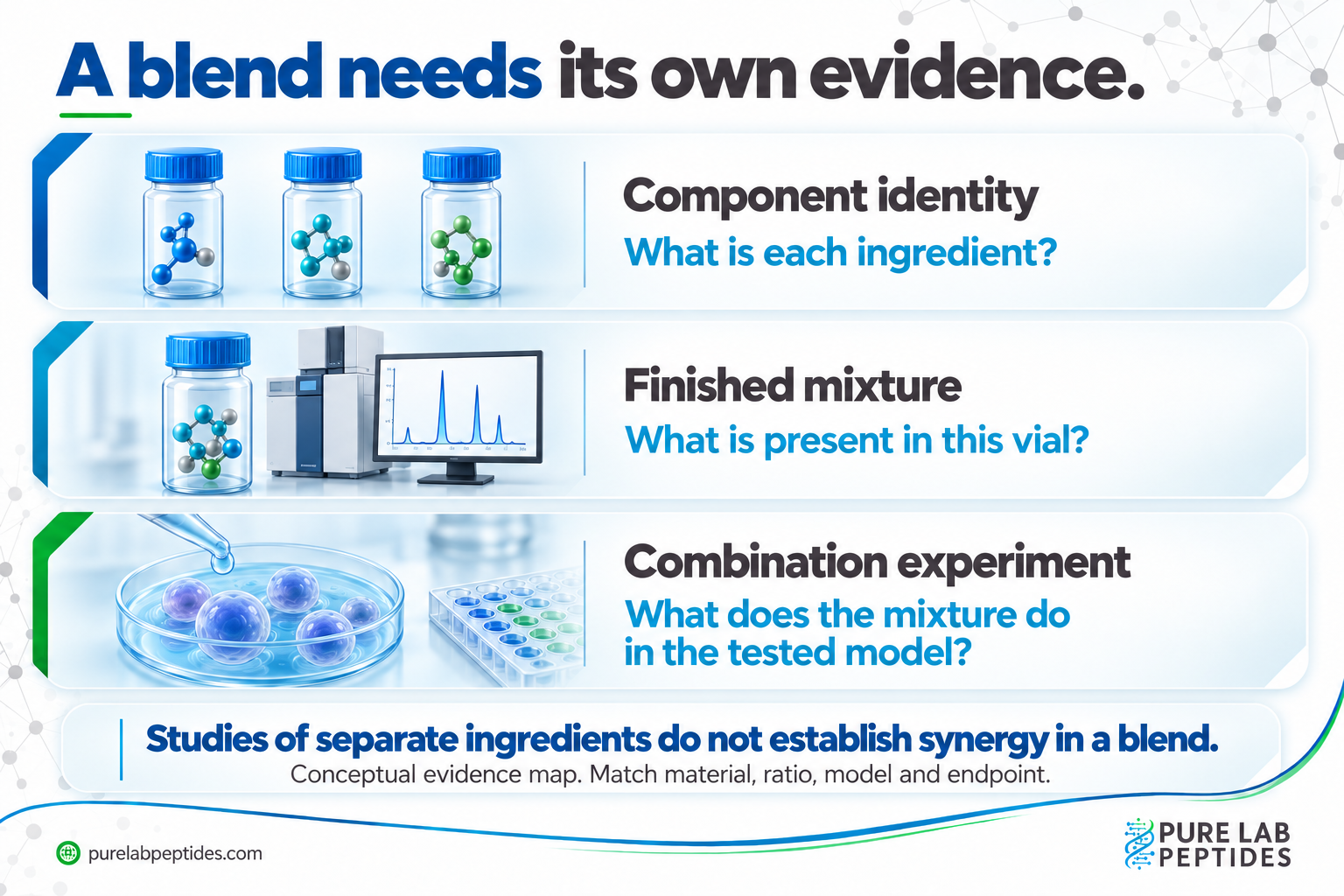
A website may group different vial amounts under a product family so that users can compare pack sizes. That is a purchasing relationship, not evidence of biological equivalence. Likewise, a blend contains multiple components; a blend name does not establish a new sequence family or prove that the components act synergistically.
Choose the classification that serves your question
TL;DR: Choose the classification that answers your actual identity, assay or procurement question.
For identity work, start with the complete sequence and modifications. For a receptor study, start with the target and the evidence linking the specific material to it. For analytical comparison, consider chemical properties and the method’s selectivity. For procurement, check the exact product, quantity and lot documentation.
Keeping these layers separate makes a classification useful without allowing a broad family name to substitute for the details of the individual material.
Need to decode an individual entry? Start with the amino acid abbreviation reference, then use the sequence guide to check order and modifications.