

$39.99
Research Studies:


FREE Shipping on
orders over $200
ALL ARTICLES AND PRODUCT INFORMATION PROVIDED ON THIS WEBSITE ARE FOR INFORMATIONAL AND EDUCATIONAL PURPOSES ONLY. The products offered on this website are intended solely for research and laboratory use. These products are not intended for human or animal consumption. They are not medicines or drugs and have not been evaluated or approved by the FDA to diagnose, treat, cure, or prevent any disease or medical condition. Any form of bodily introduction is strictly prohibited by law.
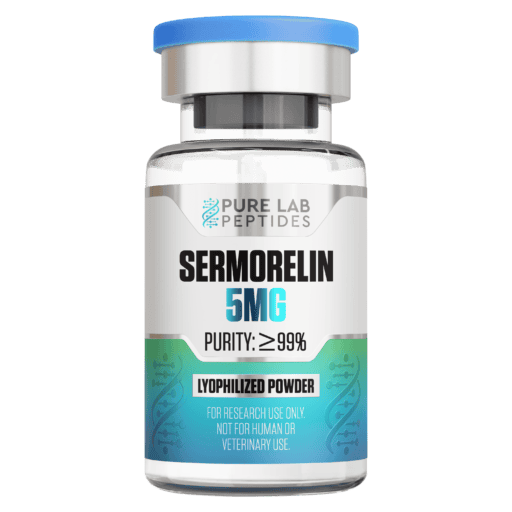
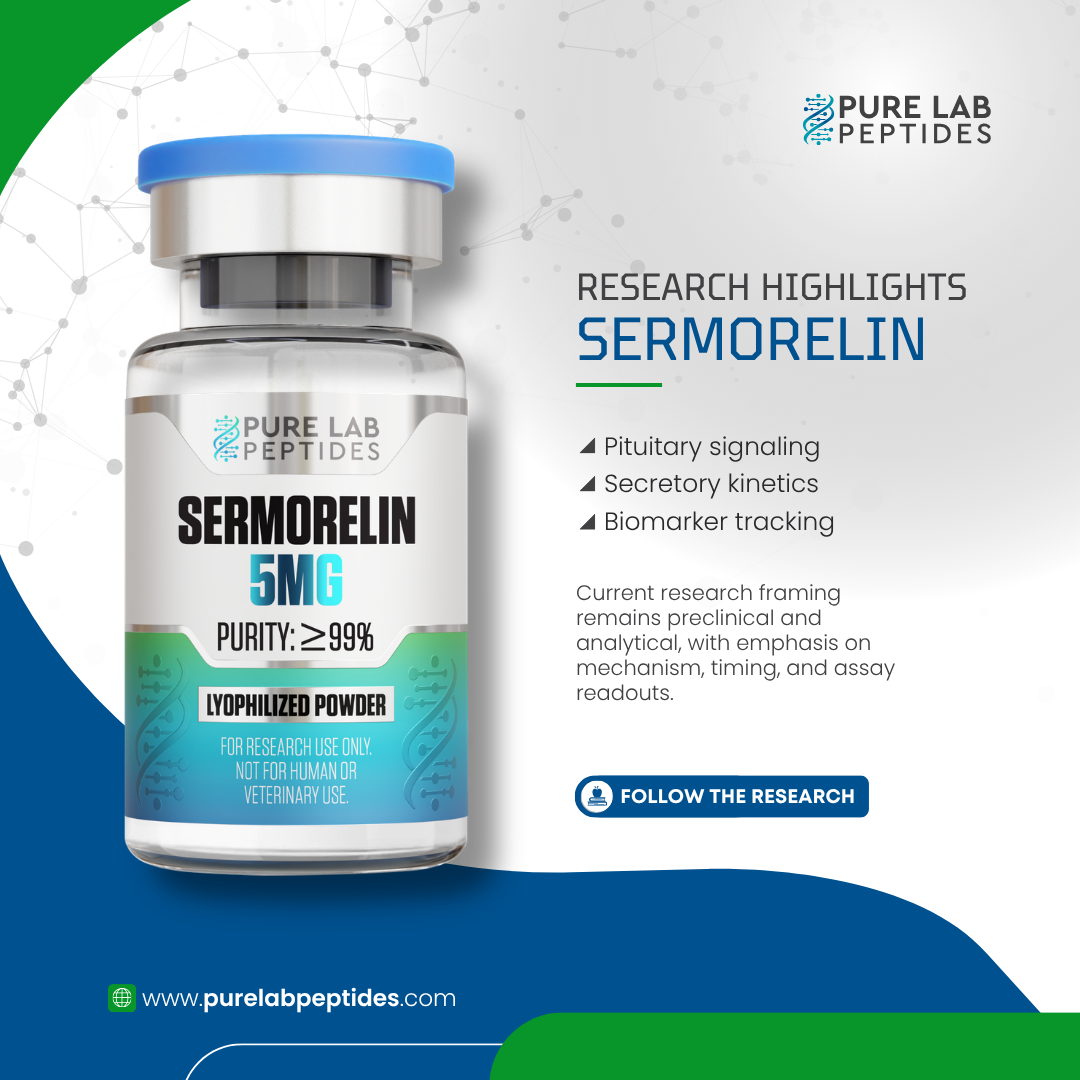
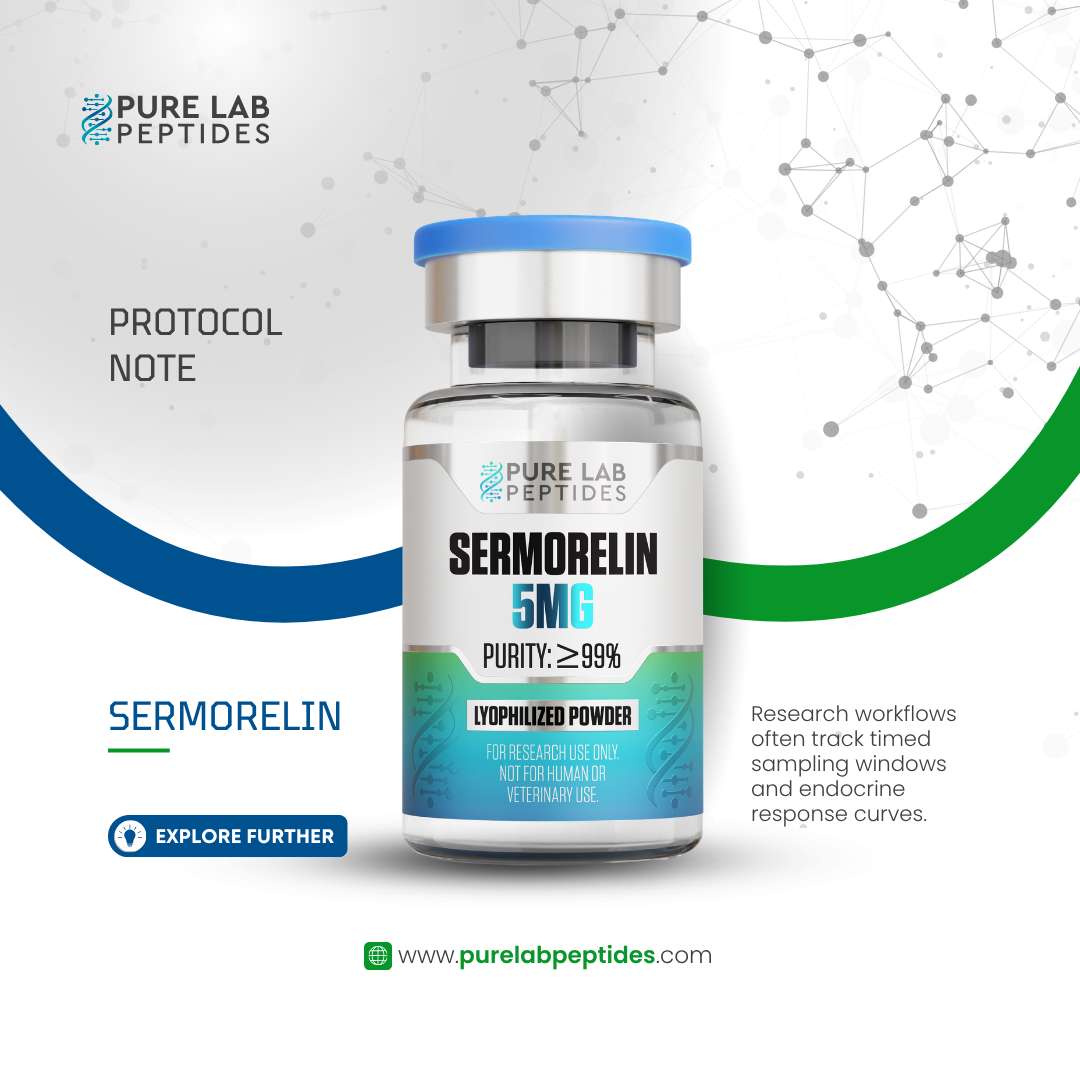
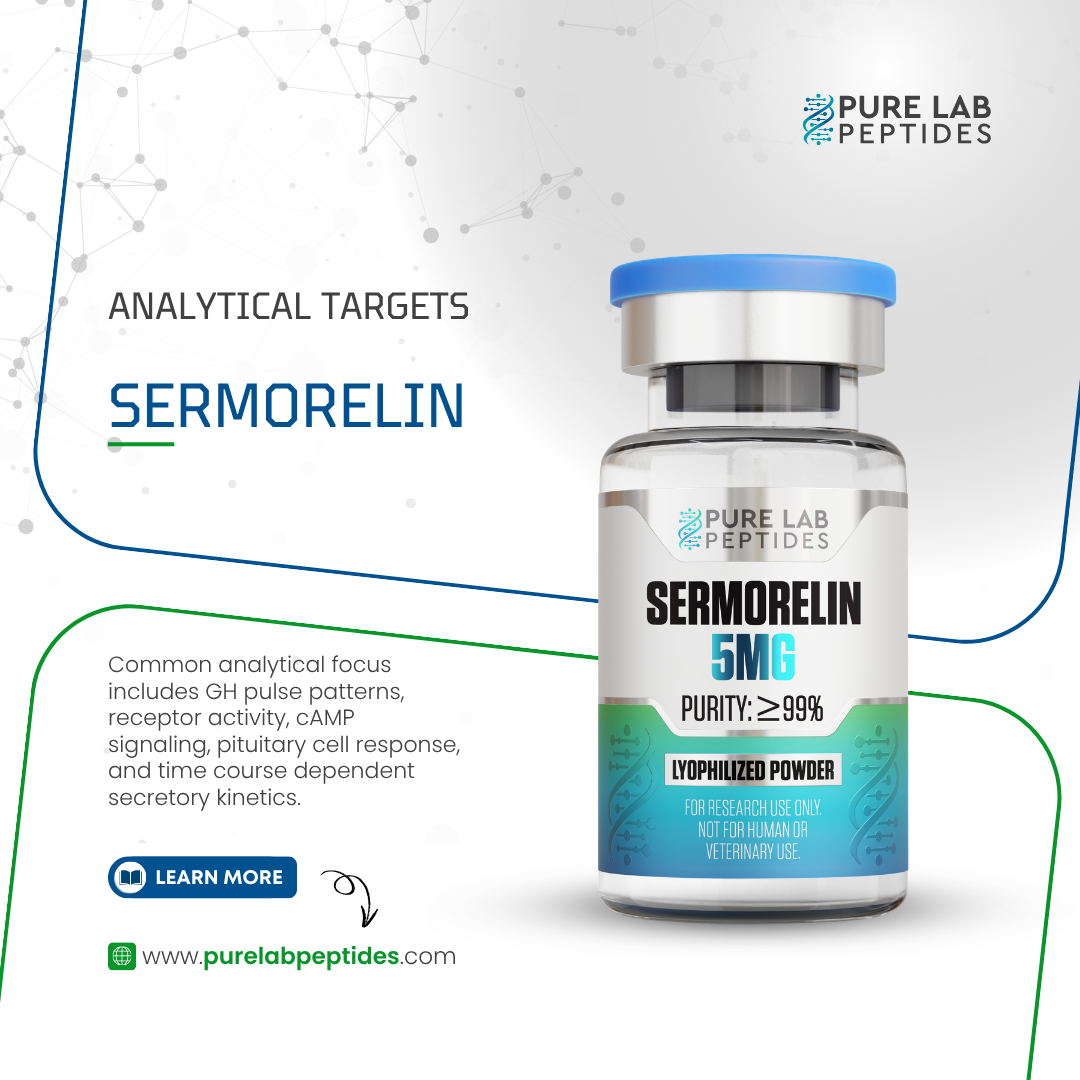
Sermorelin 5mg is a research-use-only laboratory material supplied for controlled research workflows, compound characterization, and analytical documentation review. It is manufactured under rigorous quality standards to support consistency, traceability, and batch-specific verification for qualified laboratory settings.
Sermorelin 5mg is intended strictly for laboratory research use only. This product is not intended for human or animal consumption, therapeutic use, diagnostic use, clinical use, veterinary use, or as a food, drug, cosmetic, dietary supplement, or household product.
| CAS No. | 86168-78-7 |
|---|---|
| Purity | ≥99% |
| Sequence | Tyr-Ala-Asp-Ala-Ile-Phe-Thr-Asn-Ser-Tyr-Arg-Lys-Val-Leu-Gly-Gln-Leu-Ser-Ala-Arg-Lys-Leu-Leu-Gln-Asp-Ile-Met-Ser-Arg-NH2 |
| Molecular Formula | C149H246N44O42S |
| Molecular Weight | 3357.88 g/mol |
| Synthesis | Solid-phase synthesis |
| Format | Lyophilized powder |
| Solubility | Soluble in water or 1% acetic acid |
| Stability & Storage | Stable for up to 24 months at -20°C. After reconstitution, may be stored at 4°C for up to 4 weeks or at -20°C for up to 6 months. |
| Applications | Growth hormone release studies, aging research, body composition improvement |
| Appearance | White lyophilized powder |
| Shipping Conditions | Shipped at ambient temperature; once received, store at -20°C |
| Regulatory/Compliance | Manufactured in a facility that adheres to cGMP guidelines |
| Safety Information | Refer to provided MSDS |
Consider these supplementary peptides for a comprehensive research approach.
For research teams evaluating where to buy Sermorelin for research, the key task is documentation review for a peptide cataloged in PubChem as C149H246N44O42S with an average molecular weight of 3357.9 g/mol [1]. IUPHAR and NCBI MeSH describe Sermorelin as GHRH(1-29)-amide, a 29-amino-acid fragment associated with growth hormone-releasing hormone research context [2], [3]. This Pure Lab Peptides guide is limited to research-use-only product-page evaluation, including compound identity, COA review, analytical testing, literature interpretation, and supplier documentation.
Researchers evaluating where to buy Sermorelin for research should first review RUO labeling, batch-specific COA details, peptide identity records, purity data, analytical-method notes, lot numbers, and supplier documentation consistency. Products discussed in this article are intended for laboratory research use only and are not intended for human or animal consumption. Published literature belongs in research context, not product-use positioning.
The commercial query becomes RUO-safe when it is framed as buy Sermorelin for research. That phrasing shifts the page away from consumer buying intent and toward research procurement, COA review, lot-level documentation, and compound-characterization checks.
A product page should answer a practical lab-buyer question: does the documentation support the listed research material? For Sermorelin, that means the product name, peptide classification, lot number, COA, analytical testing notes, and RUO label should align.
Start with the batch-specific certificate of analysis, because the COA should connect the listed compound to a lot, test date, method summary, and reported analytical values. ICH Q2(R2) identifies analytical validation considerations such as specificity, accuracy, precision, linearity, range, and detection-related characteristics for analytical procedures [21].
A useful documentation packet should also include supplier labeling, storage and handling records, and any available chromatogram or mass data. FDA analytical-method guidance describes method-validation data as supporting documentation for identity, quality, purity, and related attributes in regulated analytical contexts [22].
RUO labeling tells the reader how the product page is positioned. For Pure Lab Peptides, the page should remain about research materials, not consumer applications, product performance, or clinical-use language.
That boundary protects both the reader and the product page. It keeps the commercial path focused on supplier evidence: compound identity, COA availability, analytical records, lot traceability, and documentation completeness.
Sermorelin is a peptide listed in PubChem with the formula C149H246N44O42S and molecular weight of 3357.9 g/mol [1]. IUPHAR describes sermorelin as a synthetically produced 29-amino-acid peptide, GRF1-29-NH2, representing the amino-terminal segment of endogenous human growth hormone-releasing hormone [2].
NCBI MeSH also classifies Sermorelin as GHRH(1-29)-amide, which supports its placement in GHRH analog research rather than broad wellness or consumer-product framing [3]. In this article, Sermorelin is handled as a research compound and laboratory material.
A peptide is generally described as a chain of amino acids connected by peptide bonds, and NCBI Bookshelf defines peptides as short strings of amino acids formed by covalent bonds [6]. Sermorelin is a peptide in that structural sense and is documented as a 29-amino-acid GHRH fragment in pharmacology and indexing databases [2], [3].
For a product-page review, the useful identity fields are simple: compound name, synonym set, molecular formula, molecular weight, salt form if applicable, lot number, and test method. Those fields support research procurement without drifting into personal-use language.
Sermorelin acetate is the acetate salt form referenced by IUPHAR and listed in ChEMBL as Sermorelin acetate [2], [5]. FDA’s substance registration system also provides a UNII-linked identity record for Sermorelin, which can help documentation teams cross-check official naming conventions [4].
The practical issue is consistency. If a product listing, label, and COA reference Sermorelin or Sermorelin acetate, the documentation should make the relationship clear rather than leaving the research buyer to infer identity from incomplete files.
Growth hormone-releasing hormone, or GHRH, is cataloged by UniProt as somatoliberin, and the GHRH precursor entry supports its role as a reference entity for this research lane [7]. Endotext describes GHRH as a 44-amino-acid polypeptide produced in the hypothalamic research context and linked to anterior pituitary signaling models [10].
Because Sermorelin represents the 1-29 segment of GHRH, the GHRH analog frame clarifies why receptor and endocrine pathway literature may appear in the scientific background [2]. It also helps avoid vague product-category language.
A Sermorelin product page should not read like a wellness guide or a clinical overview. It should read like a documentation hub for qualified researchers and technical procurement teams.
For Pure Lab Peptides, the strongest page architecture is documentation-first. The page should help readers evaluate whether the research material listing is clear, whether COA data are available, and whether analytical records support identity and purity review.
A useful listing answers research procurement questions before commercial questions. It should identify Sermorelin as the canonical compound, avoid variant-specific SEO targeting, and keep catalog details separate from scientific claims.
When a lab team reviews a listing, the most useful signals are RUO positioning, compound identity, COA access, purity method notes, and lot-level traceability. Those elements support the safe commercial intent behind buy Sermorelin for research.
Documentation-focused language avoids implying outcomes. It describes what the product page can verify: name, identity, purity, analytical testing, batch records, storage notes, and supplier documentation.
That is different from consumer-facing copy. The page should not describe personal applications or product claims; it should describe how researchers can evaluate the material as a research-use-only compound.
GHRH research belongs to endocrine pathway literature. UniProt identifies the GHRH receptor as a receptor for growth hormone-releasing factor coupled to G proteins that activate adenylyl cyclase [8].
NCBI Gene describes GHRHR as the gene encoding the growth hormone-releasing hormone receptor, and Endotext describes the receptor as a seven-transmembrane G protein-coupled stimulatory cell-surface receptor in somatotroph pathway models [9], [10]. This background is useful for literature interpretation, not product positioning.
Growth hormone-releasing hormone is a core reference entity for Sermorelin because Sermorelin is described as the GHRH(1-29)-amide fragment [2], [3]. A classic GHRH review notes the broad research base around the hormone’s anatomy, chemistry, molecular biology, physiology, and pathology, which makes GHRH a foundational literature term for this compound class [14].
A research product page should use that context carefully. It can explain why GHRH appears in the literature, but it should not suggest that a research material produces any outcome.
The pituitary gland appears in this literature because GHRH receptor signaling is classically associated with somatotroph models. UniProt and Endotext both connect GHRHR to adenylyl cyclase and growth hormone pathway signaling in endocrine physiology literature [8], [10].
Structural work in Nature Communications describes GHRHR as a class B G-protein-coupled receptor expressed by somatotropic cells of the pituitary gland and discusses GHRH-linked cAMP pathway activation [11]. For an RUO page, that information is pathway context only.
Pathway relevance is not the same as product performance. A receptor paper, physiology review, or database record can explain why a compound belongs in a research lane, but it does not authorize claims for an RUO material.
This distinction matters for GH and hormone language. Research buyers can evaluate whether a product page accurately reflects the literature category while still keeping the product positioned only as a laboratory research material.
Published literature frames Sermorelin through peptide identity, GHRH analog classification, receptor-pathway context, and historical research categories. IUPHAR, PubChem, and NCBI MeSH provide the safest starting points because they support entity identity without commercial claims [1], [2], [3].
From there, researchers can review mechanistic literature on GHRH receptor signaling and analytical literature on peptide characterization. The evidence should be read as literature context, not product-use guidance.
Mechanistic literature can show how researchers have studied GHRH receptor signaling in defined models. Gaylinn’s review discusses the molecular and cell biology of the GHRH receptor, including its G-protein-linked receptor context [13].
Additional studies have examined GHRH-linked MAP kinase signaling and cAMP/PKA-related signaling in pituitary-cell models [16], [17], [18]. These papers inform pathway interpretation, not RUO product claims.
Some published literature outside the scope of RUO product use has examined this compound class in human study settings. That literature should not be interpreted as a use claim for research-use-only materials [19], [20].
The safer interpretation is to separate source type from product-page language. A historical clinical paper, mechanistic study, database entry, and COA each answer different questions, and none should be blended into consumer outcomes.
Source quality starts with the type of claim being made. Compound identity is best supported by official databases such as PubChem, IUPHAR, FDA GSRS, NCBI MeSH, ChEMBL, or UniProt [1], [2], [4], [5], [7].
Analytical claims need analytical sources. For example, LC-HRMS peptide-quality literature shows how mass-based methods can support peptide sequence confirmation and impurity review under defined laboratory conditions [25].
Evidence interpretation should help readers sort sources by what they can support. It should not imply that a research material is equivalent to a studied material in any applied setting.
| Research Area | What Literature Examines | Evidence Type | RUO Interpretation |
|---|---|---|---|
| Compound identity | Formula, molecular weight, synonym records, and peptide classification for Sermorelin [1], [2], [3] | Official database | Supports identity review, not product claims |
| GHRH receptor pathway | GHRHR, cAMP/PKA signaling, and endocrine pathway models [8], [10], [11] | Database, review, structural literature | Supports research-lane relevance only |
| Mechanistic signaling | MAP kinase and PKA-linked model observations in GHRH research [16], [17], [18] | Mechanistic literature | Supports literature context, not outcomes |
| Analytical verification | LC-HRMS, LC-MS, peptide mapping, impurity review, and method validation [21], [25], [27] | Analytical literature and guidance | Supports documentation review when tied to a batch |
Study findings should remain attached to their model, method, and limitations. The product page should not convert literature observations into claims about an RUO material.
A safer structure is: first identify the compound, then summarize the literature category, then explain documentation checks. This keeps the page commercially useful while remaining research-focused.
Translational limits begin with model type. In vitro, preclinical, human, database, and analytical sources do not carry the same meaning, and each should be interpreted in its own lane.
A research product page should therefore avoid broad claims. It should say what the documentation can confirm and what the literature can contextualize.
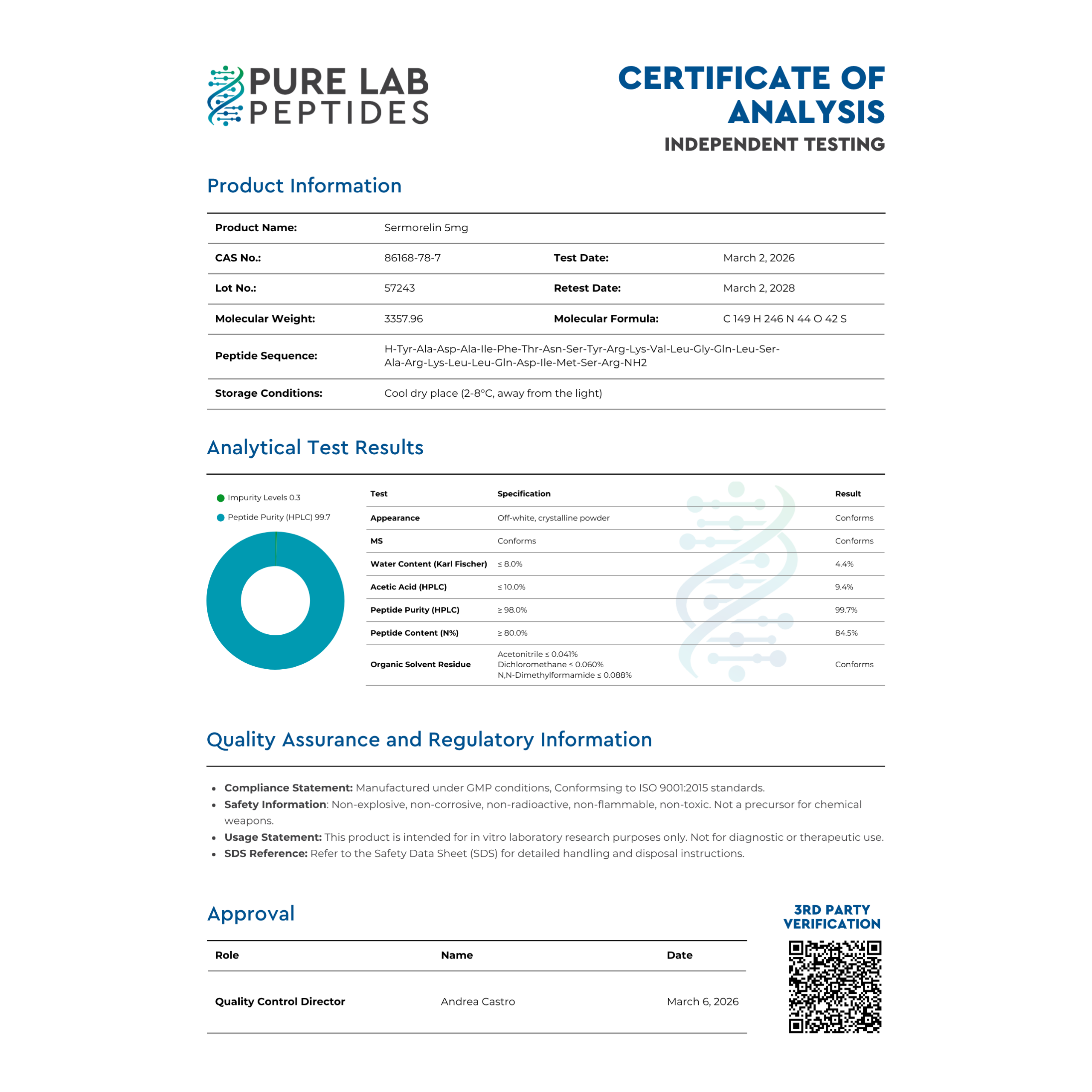
COA documentation is central when researchers buy Sermorelin for research because it connects the product listing to a specific batch. The COA should help confirm that the material being evaluated is represented by the analytical file.
ICH Q2(R2) and FDA analytical guidance both emphasize analytical procedures that support identity, purity, and related quality attributes in formal testing contexts [21], [22]. A product page does not need to reproduce those standards, but it should support the same document-first mindset.
A COA should confirm the compound name, lot number, test date, analytical method, and reported purity or identity-related findings. If available, chromatogram and mass data add useful review detail.
A COA should not stand alone if it lacks lot matching. The label, product listing, and COA should point to the same research material.
Batch-specific review reduces ambiguity. It helps research buyers check whether a COA belongs to the listed material rather than to a generic compound record.
The same principle appears in measurement-traceability thinking: NIST describes traceability as relying on a documented chain connecting measurements to specified references [24]. For RUO procurement, the practical translation is clear file linkage.
COA dates and lot numbers help reviewers understand document relevance. A recent product listing supported by a mismatched or undated file creates uncertainty.
The better approach is a single chain: listing, label, lot, COA, test method, and supplier record. That chain makes technical procurement easier to audit.
Analytical testing helps separate identity questions from purity questions. HPLC can support separation and purity review, while LC-MS can support mass-based identity review when the method and reference information are suitable [25], [27].
A documentation-focused lab-test verification sequence can include:
HPLC supports purity review by separating components under defined chromatographic conditions. ICH Q2(R2) notes that representative data such as chromatograms can be used to demonstrate analytical specificity where relevant [21].
For research buyers, the key question is not just the purity percentage. It is whether the COA names the method, links the data to a lot, and provides enough detail for technical review.
LC-MS supports identity verification by pairing chromatographic separation with mass spectrometric detection. Zeng and colleagues report that LC-HRMS can support amino-acid composition review, sequence confirmation, and impurity quantification for peptide quality-control research [25].
Wei and colleagues also describe liquid chromatography peptide mapping with mass spectrometric detection as an identity and characterization tool in biopharmaceutical research [27]. On a product page, that supports documentation review, not product claims.
Chromatogram and mass data add context behind summary values. A chromatogram can help reviewers understand peak separation, while mass data can help support identity-related review.
Peptide impurity literature shows why this matters. De Spiegeleer and colleagues found that peptide identity and impurity profiling could materially affect research interpretation, supporting the value of appropriate quality-control testing before peptide research [26].
Lot traceability is the link between the research material and the supporting file. Without it, a COA may be informative but not clearly tied to the product listing under review.
ISO/IEC 17025 is relevant as a quality concept because it addresses laboratory competence and reliable testing or calibration results [23]. For product-page evaluation, the safe takeaway is to prefer clear laboratory documentation and traceable batch records.
Research buyers should compare compound name, lot number, COA date, method notes, purity record, identity record, and supplier file consistency. Changes across lots should be documented rather than hidden.
A lot-level comparison is not a claim about product performance. It is a procurement quality check.
Traceability supports confidence because it gives reviewers a document path. NIST’s traceability framework focuses on a documented chain to specified references [24].
For Sermorelin research materials, that means the supplier file should make it easy to connect the listed compound with the exact batch being reviewed.
Supplier documentation should help a technical reviewer answer four questions: What is the compound? What batch is represented? What testing supports the file? What RUO label governs the listing?
That is the commercial value of a strong research product page. It reduces ambiguity before procurement.
Researchers should compare the product listing, COA, label text, lot number, method summary, storage documentation, and supplier contact record. FDA analytical guidance and ICH Q2(R2) both reinforce the importance of analytical procedures and validation concepts in documentation-heavy quality contexts [21], [22].
Use this practical checklist:
Labeling consistency means the product listing, COA, and supporting files describe the same material in the same research-safe way. If a label says Sermorelin and a COA says Sermorelin acetate, the relationship should be clear.
The goal is not marketing polish. The goal is document alignment.
Third-party testing can support review when the laboratory source, test method, and lot match are clear. ISO/IEC 17025 describes a framework for laboratories that perform testing, sampling, or calibration and need reliable reports [23].
A third-party statement is less useful if it does not identify the batch or method. Documentation detail matters more than vague assurance language.
Storage and handling documentation should be presented as laboratory recordkeeping, not as personal guidance. The product page should explain where storage notes appear and how procurement teams should preserve those notes in internal files.
Peptide LC-MS literature shows that peptide measurements can be affected by sample history and analytical conditions in research settings [30]. That is why documentation should record conditions rather than rely on memory.
Storage notes should come from supplier documentation, COA context, or validated laboratory records. They should not be rewritten into consumer instructions.
For research procurement, the key is traceable recordkeeping: document the stated conditions, retain the COA, and keep batch files accessible for review.
Environmental records support material stewardship. They help a lab team understand whether the stored research material remained under documented conditions.
This is not a performance claim. It is a documentation practice that supports research integrity.
The claim boundary is simple: literature can describe what researchers examined, while the product page can describe what documentation supports. Those are different claims.
Terms related to product performance, consumer outcomes, or clinical-use language require careful separation from RUO positioning. The page should keep the focus on compound identity, COA review, analytical testing, lot traceability, and supplier documentation.
Search intent can drift when a commercial query is paired with outcome language. That drift is especially risky in endocrine pathway research because growth hormone and hormone terms can sound like claims if not tied to literature context.
The safer approach is to answer commercial research intent with documentation. Research buyers need clarity about what the page can verify, not claims about what the compound does outside the lab.
RUO guardrails keep the page honest. The page can say that Sermorelin is a GHRH(1-29)-amide peptide listed in official databases [1], [2], [3].
It can also say that research buyers should review COA files, analytical methods, and lot traceability before procurement. It should not convert receptor or pathway relevance into applied claims.
Sermorelin research pages can become unclear when they mix scientific literature, supplier language, and commercial intent. The page should resolve that ambiguity with direct RUO framing.
The first misunderstanding is that published literature automatically supports product positioning. It does not.
The second is that a purity value alone proves complete identity. Peptide quality-control literature supports the value of identity and impurity review because structurally related peptide materials can create interpretation problems [26], [29].
The third is that pathway relevance equals a product claim. It does not; pathway relevance only explains why a research compound belongs in a specific literature lane.
Documentation resolves ambiguity when it is specific. A batch-linked COA, a matching lot number, identity-focused LC-MS data, HPLC purity data, and supplier files tell a clearer story than broad product-page language.
Strege and colleagues highlight chiral purity as one analytical concern in synthetic peptide quality evaluation, while Li and colleagues discuss LC-HRMS methods for structurally related peptide impurities [28], [29]. Those sources reinforce why summary labels should be supported by analytical detail.
For buy Sermorelin for research intent, the procurement workflow should be document-first. A research buyer should be able to move from product listing to COA to analytical method to lot record without guessing.
This checklist is suitable for internal review:
COA review should prioritize lot match, compound name, test date, method, purity record, and identity support. When available, chromatogram and mass data should be retained with the batch file.
Analytical validation guidance supports a method-focused mindset, especially where identity, purity, and specificity are part of the review question [21], [22]. For a research product page, those concepts translate into clearer supplier documentation.
Before procurement, the supplier evidence should include a clear RUO product listing, batch-specific COA, matching lot number, analytical-method notes, and identity-supporting data when available. A clear supplier record helps research teams evaluate the material without relying on claims.
Review the product-page documentation, COA details, and RUO labeling before evaluating this compound for laboratory research.
Pure Lab Peptides supplies compounds for laboratory research use only. Products are not intended for human or animal consumption, diagnostic use, therapeutic use, clinical use, veterinary use, or as food, drugs, cosmetics, dietary supplements, or household products. Researchers are responsible for ensuring lawful, appropriate handling and use in accordance with applicable regulations and institutional guidelines.
Explore Pure Lab Peptides for RUO peptide compounds with research-focused product information and available documentation. For research teams comparing peptide suppliers, prioritize COA availability, transparent labeling, and lot-level documentation.
Research-use-only means Sermorelin is positioned solely as a laboratory research material. In a product-page context, that means the focus should stay on research documentation, compound identity, peptide COA review, analytical testing, and RUO labeling rather than applied claims. Researchers should evaluate the documentation record before procurement decisions.
Researchers should consider documentation first before they buy Sermorelin for research. The key review points include RUO labeling, batch-specific documentation, peptide identity records, lot traceability, supplier documentation, and available analytical testing. A strong research listing should make the relationship between the product page, COA, lot number, and supporting files clear.
Sermorelin is considered a research peptide in this product-page context. The article identifies Sermorelin as GHRH(1-29)-amide and a 29-amino-acid peptide fragment associated with growth hormone-releasing hormone research [2], [3]. That classification supports compound documentation and receptor research context, not product-positioning claims.
Mass spectrometry supports Sermorelin documentation review by helping evaluate peptide identity when paired with suitable method details and batch records. In peptide research workflows, LC-MS can connect chromatographic separation with mass-based review, while HPLC can support peptide purity review [25], [27]. These methods should be interpreted as analytical documentation tools.
Preclinical literature provides model-specific research context for Sermorelin and related GHRH pathway questions. It may help explain receptor research, pathway models, and the role of growth hormone in endocrine literature, but it should not be converted into product claims. In vitro research and published literature should remain clearly separate from supplier documentation.
Sermorelin product pages should stay research-use-only by separating literature language from product positioning. Terms such as efficacy, absorption, bioavailability, and clinical outcomes can drift into applied claims if removed from model-specific context. A compliant page should redirect those terms back to compound identity, COA review, analytical testing, lot traceability, RUO labeling, and documentation boundaries.
The following authors are recognized for published research that helped shape the scientific context discussed in this article.
Author profile: PubMed Author Search
Bruce D. Gaylinn’s publications are relevant to the Sermorelin research context because they describe growth hormone-releasing hormone receptor structure, receptor pathway literature, and molecular biology themes connected to GHRH analog research. His work helps support the article’s discussion of receptor classification, pathway-focused research, and the need to keep scientific background separate from RUO product-page claims. These publications offer useful context for interpreting Sermorelin as a research peptide within the broader GHRH receptor literature.
Selected publications:
Author profile: University of Debrecen Research Profile
Gabor Halmos’s published work is relevant to the article’s GHRH analog research lane because it addresses growth hormone-releasing hormone receptor signaling, receptor-pathway mechanisms, and model-specific literature interpretation. His publications help frame how receptor signaling and pathway context can be discussed as scientific background without turning that context into product positioning. This is especially useful for an RUO Sermorelin product page that emphasizes compound identity, published literature, research documentation, and careful interpretation of pathway-focused evidence.
Selected publications:
This research disclaimer clarifies how this page handles published literature and search language around Sermorelin. In GH Secretagogue and GHRH Research content, phrases such as benefits of Sermorelin, Sermorelin therapy, Sermorelin online, buy Sermorelin online, prescription, pharmacy, compounded Sermorelin, HGH, growth hormone deficiency, muscle mass, body composition, and growth hormone levels can drift into consumer-facing, clinical-use, wellness, therapeutic, or product-claim language when framed incorrectly.
Here, those phrases are treated only as research-language examples that require careful separation from product positioning, not as outcomes, recommendations, personal-use guidance, or applied claims. The focus remains on Sermorelin identity, COA review, analytical testing, peptide purity, lot traceability, research-use-only labeling, product documentation, and published literature boundaries within model-specific research context.
Our team is ready to assist you with any inquiries regarding our catalogue of peptides and their applications.
Discount Applied Successfully!
Your savings have been added to the cart.
Pure Lab Peptides
You must be at least 21 years of age to enter this site. By entering, you confirm that you are of legal age and agree to our terms.
For research use only.
There are no reviews yet.