


GLP-1 Receptor Agonism in Academic Research: Mechanisms & Data
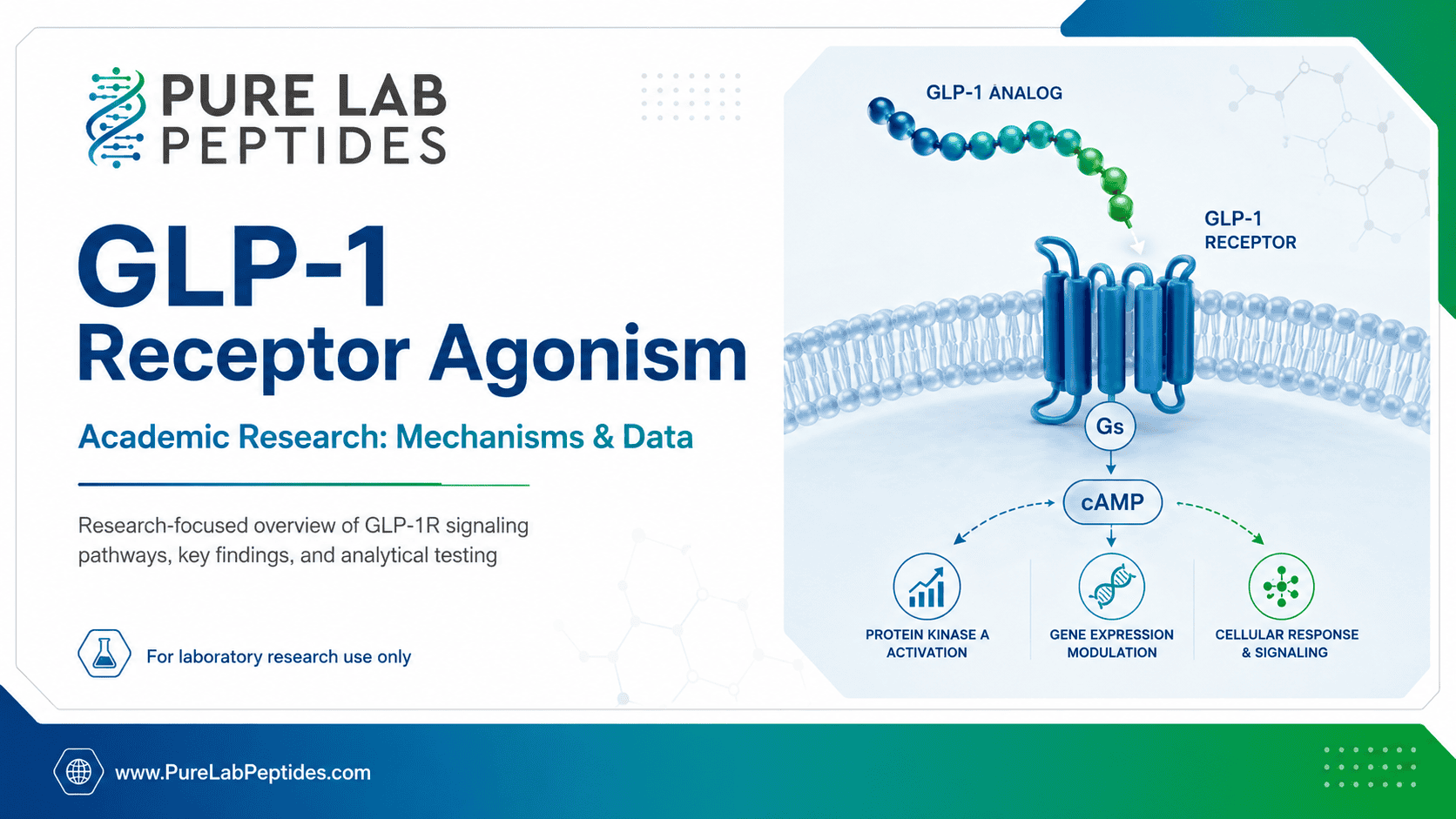
Glucagon-like peptide-1 (GLP-1) receptor agonism refers to the activation of the GLP-1 receptor (GLP-1R) by peptide ligands in research settings. GLP-1 is an incretin hormone secreted by enteroendocrine L cells after meals【33†L473-L479】. In laboratory studies, synthetic GLP-1 peptides and analogs (e.g. exendin-4–derived compounds) are used to probe GLP-1R signaling in cells and tissues. GLP-1R is a class B1 G protein–coupled receptor expressed in pancreatic β-cells, brain neurons, heart, kidney, and immune cells【64†L212-L221】【34†L499-L504】. In vitro and preclinical research on GLP-1R agonists focuses on intracellular signaling pathways (e.g. cAMP/PKA/Epac2), receptor trafficking, and metabolic regulation, all described strictly in research models【64†L224-L232】【50†L339-L347】. The information presented here is educational and for research use only. We emphasize that products discussed are intended only for laboratory investigation, not for any human or animal use.
Fast Answer
GLP-1 receptor agonists are peptides studied by researchers to activate GLP-1R signaling pathways in cell and tissue models. These agonists trigger Gs-protein coupling, raising cAMP and engaging downstream effectors like PKA and Epac2【64†L224-L232】. Products in this article are for laboratory research use only and are not intended for human or animal consumption.
GLP-1 Receptor: Structure and Signaling
GLP-1R is a 463-amino acid class B1 GPCR in the glucagon receptor family【34†L499-L504】. It has a large N-terminal extracellular domain that binds peptide agonists and a transmembrane domain for signaling. Upon ligand binding, GLP-1R undergoes a conformational change that activates associated G proteins【64†L224-L232】. In particular, GLP-1R primarily couples to Gs to stimulate adenylyl cyclase and increase intracellular cyclic AMP (cAMP)【64†L224-L232】. Local cAMP enrichment in receptor-associated nanodomains then engages protein kinase A (PKA) and Epac2, which phosphorylate targets and mobilize calcium, respectively【64†L224-L232】. For example, GLP-1R agonists cause Ca2+ mobilization in β-cells via an Epac2-dependent pathway【28†L575-L584】【60†】. Some synthetic agonists are designed to bias signaling; e.g. exendin-F1 (an exendin-4 derivative) is Gs-biased with reduced β-arrestin recruitment, which affects receptor internalization【28†L575-L584】. Below is a schematic of GLP-1R signaling in cells:
css
Copy
Studies show that GLP-1R is expressed mainly in pancreatic β-cells but also in brain regions (hypothalamus, brainstem), the heart’s sinoatrial node, kidney vasculature, and immune cells【64†L212-L221】. This wide expression underpins its role in metabolic and neural research contexts. In laboratory models, GLP-1R activation can modulate insulin secretion, neuronal activity, and signaling network dynamics【64†L212-L221】【50†L339-L347】.
GLP-1R Agonists in Research Context
Research-use GLP-1R agonists include native GLP-1 peptides (e.g. GLP-1(7–36)amide) and modified analogs derived from exendin-4 (a lizard peptide with GLP-1R activity). These compounds differ in stability and receptor potency【34†L499-L504】. In vitro, GLP-1R agonists are evaluated for binding affinity, cAMP stimulation, and kinetics. For example, high-throughput assays measure cAMP responses in cells expressing GLP-1R. Electrophysiology or calcium imaging in pancreatic islets or neurons can assess functional effects of agonists. Animal models, such as GLP-1R knockout or fluorescent reporter mice, also help map receptor localization. One study used ex vivo brainstem slices from mice to record nucleus tractus solitarius (NTS) neurons; exendin-4, a GLP-1R agonist, suppressed orexigenic NPY neuron firing via enhanced presynaptic GABA release【50†L339-L347】. This finding illustrates how GLP-1R agonists can modulate neural circuits in lab studies (a summary is in Table 1). All such experiments are preclinical and focus on signaling mechanisms without implying any therapeutic use.
| Study (Model) | GLP-1R Agonist | Key Finding |
| Shen et al., 2025 (Mouse brainstem slices) | Exendin-4 (54 aa, GLP-1R agonist) | Inhibited NTS NPY neurons via presynaptic GABAB signaling, demonstrating central GLP-1R action【50†L339-L347】. |
| Zhang et al., 2017 (Human GLP-1R + G-protein) | GLP-1 analog | Resolved the cryo-EM structure of activated GLP-1R bound to G protein, revealing the receptor–agonist interface (structural basis for signaling). |
Analytical Testing and Quality Considerations
As research-use peptides, GLP-1R agonists require rigorous analytical verification. Suppliers typically provide batch-specific Certificate of Analysis (COA) data on identity (e.g. mass spectrometry confirming sequence), purity (HPLC profile), and quantity. Researchers should verify peptide sequence by mass and check purity (>95%) via HPLC to ensure accurate dosing in experiments. Since GLP-1 and its analogs are susceptible to enzymatic degradation (e.g. by DPP-4), research peptides may include stabilizing modifications. All handling is done under RUO guidelines – researchers prepare and test peptides only in cell or tissue assays. Analytical methods common in GLP-1 peptide studies include LC-MS/MS for sequence confirmation and reversed-phase HPLC for purity【34†L499-L504】. Documentation such as COAs should be reviewed for each lot to ensure the peptide is fully characterized. Following these practices maintains data reliability in GLP-1R signaling research.
FAQs
What does “GLP-1 receptor agonism” mean in research?
GLP-1 receptor agonism refers to the activation of the GLP-1 receptor by a peptide ligand. Researchers apply GLP-1–like peptides to cells or tissues to trigger GLP-1R signaling pathways【64†L224-L232】. Unlike clinical use, this is strictly studied in laboratory settings (in vitro or animal models) to understand receptor mechanism without implying any therapeutic benefit.
Which GLP-1 peptides are commonly used in lab studies?
Common research peptides include native GLP-1(7–36)amide and analogs derived from exendin-4. Exendin-4 is a 39–54 amino acid peptide originally found in Gila monster saliva, and its sequences (e.g. exenatide) are used to activate GLP-1R in research【50†L339-L347】. These peptides are chosen for stability and potency in assays. Each peptide’s identity and purity are verified by the supplier via analytical tests (mass, HPLC) before use.
How do researchers measure GLP-1R activation in experiments?
Researchers often measure downstream signaling as a proxy for GLP-1R activation. A typical assay is cAMP production: agonist-bound GLP-1R stimulates Gs-protein to activate adenylyl cyclase, raising cAMP【64†L224-L232】. cAMP levels can be quantified with biochemical kits. Other methods include calcium imaging (via Epac2 activation) or electrophysiology in neurons. Reporter assays and β-arrestin recruitment assays are also used to profile agonist activity and bias.
Can GLP-1 receptor agonism affect cells beyond pancreatic β-cells?
Yes. GLP-1R is expressed in multiple tissues. In research, GLP-1 agonists have been applied to neurons, heart cells, and vascular cells. For example, GLP-1R agonists suppress certain hypothalamic and hindbrain neurons (e.g. NPY neurons) via GABAergic pathways【50†L339-L347】. In vitro, GLP-1 can also influence intracellular calcium and metabolism in other cell types. All findings are contextualized as receptor signaling events in lab models, not direct indications of in vivo effects.
What precautions are needed when obtaining GLP-1 peptides for experiments?
Researchers should ensure peptides are labeled “For Laboratory Research Use Only (RUO).” Before use, review the Certificate of Analysis for sequence identity and purity. Store peptides as directed (often lyophilized at –20°C) and reconstitute under appropriate conditions for assays. Since GLP-1 peptides can degrade (e.g. by DPP-4 enzyme), rapid handling and possibly inhibitors may be used in experiments. Confirming peptide stability and checking activity by a pilot assay is good practice.
How is GLP-1 receptor agonism relevant to preclinical studies?
Preclinical studies use GLP-1R agonists to understand metabolic and neuronal signaling. For instance, they reveal how GLP-1R activation affects insulin secretion in islets or neuron excitability in appetite circuits【64†L212-L221】【50†L339-L347】. This knowledge guides the design of new analogs and informs basic biology. Researchers stress that these studies are mechanistic and do not imply any direct human or veterinary application of GLP-1 compounds.
Next Steps
Researchers planning to work with GLP-1 receptor agonists should always consult batch-specific documentation. Review the Certificate of Analysis and validation data for each peptide lot. Explore Pure Lab Peptides’ catalog for RUO-grade GLP-1–related compounds with transparent COA data. In selecting a peptide supplier, prioritize companies that provide full peptide characterization and research-focused information to ensure the integrity of your experimental results.
References
- Austin G, Tomas A. Signaling architecture of the glucagon-like peptide-1 receptor. J Clin Invest. 2026. doi.org/10.1172/JCI194752
- Tan Q, Akindehin SE, Orsso CE, et al. Mechanisms of action and therapeutic applications of GLP-1 and dual GIP/GLP-1 receptor agonists. Front Endocrinol (Lausanne). 2024. doi.org/10.3389/fendo.2024.1431292
- Shen J, Wang M, Pang G, et al. GLP-1 receptor agonist exendin-4 suppresses food intake by inhibiting hindbrain orexigenic NPY neurons. Am J Physiol Endocrinol Metab. 2025. doi.org/10.1152/ajpendo.00528.2024
- Zhang Y, Sun B, Feng D, et al. Cryo-EM structure of the activated GLP-1 receptor in complex with a G protein. Nature. 2017;546:248–253. doi.org/10.1038/nature22394
- Dzhura I, Chepurny OG, Kelley GG, et al. Epac2-dependent mobilization of intracellular Ca2+ by GLP-1 receptor agonist exendin-4 is disrupted in β-cells of phospholipase C-ε knockout mice. J Physiol. 2010;588:4871–4889. doi.org/10.1113/jphysiol.2010.198424