

...
Research Peptides

Melanocortin Receptor Research Explained

Melanocortin Receptor Research Explained begins with a simple idea: the melanocortin system is a five-receptor class A GPCR family, numbered MC1R through MC5R, that responds to proopiomelanocortin-derived ligands such as ACTH and the melanocyte-stimulating hormones. For laboratory teams, the main challenge is not naming the receptors but separating subtype selectivity, accessory-protein effects, and assay-specific signaling in a strictly research-use-only framework.[1][2]

Fast Answer

The melanocortin receptor system is a peptide-responsive receptor network studied through ligand binding, cAMP signaling, beta-arrestin recruitment, receptor trafficking, and subtype-selectivity experiments. Products discussed in this article are intended for laboratory research use only and are not intended for human or animal consumption. In practice, “melanocortin receptor research” usually means comparing MC1R to MC5R biology and the peptide probes used to interrogate each subtype under controlled assay conditions.[1][2]

What the melanocortin receptor family includes

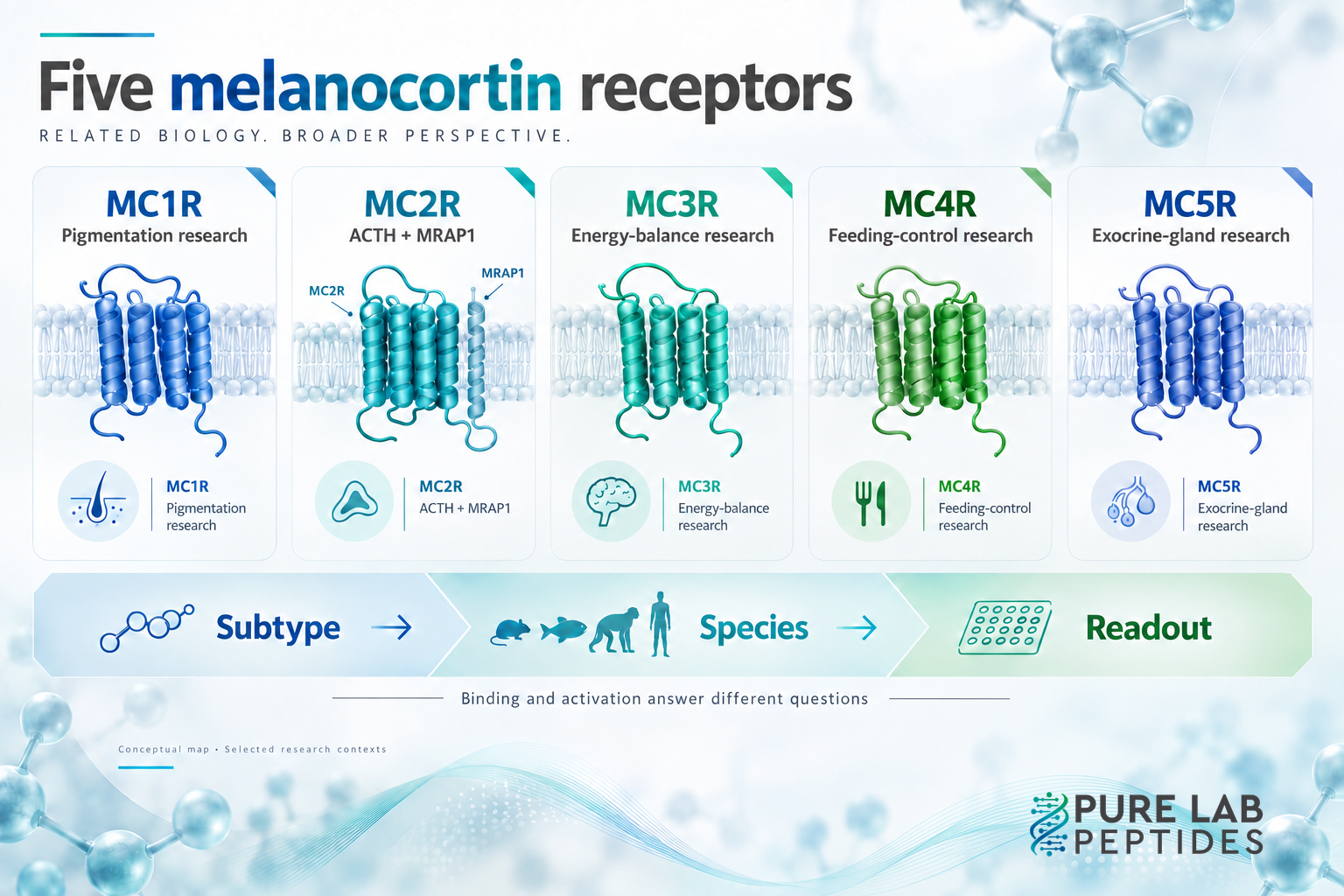
The melanocortin receptor family contains five receptors, but they are not interchangeable research targets. IUPHAR lists MC1R, MC2R, MC3R, MC4R, and MC5R as distinct GPCRs with different endogenous ligand rank orders and different commonly used research probes. Across the family, endogenous agonists are derived from the POMC precursor, while agouti and agouti-related protein function as endogenous antagonistic or inverse-agonistic regulators in selected contexts.[1][2]

Recent structural and review literature has sharpened the receptor-by-receptor picture. MC3R and MC5R structural work clarified subtype-selective ligand recognition, MC2R work explained why receptor accessory protein MRAP1 is central to ACTH-responsive signaling, and broader reviews emphasize that receptor localization, interacting proteins, and assay context can change the apparent behavior of MC1R and MC3R through MC5R.[3][4][5]

Receptor Dominant endogenous ligand pattern Key research complication Common laboratory focus
MC1R Typically most responsive to alpha-MSH among endogenous agonists reported in IUPHAR summaries.[1] Ligand binding and signaling can be influenced by calcium and local receptor context.[5][6] Pigmentation-pathway models, receptor structure, cAMP signaling, and ligand recognition studies.[6]
MC2R ACTH is the defining endogenous agonist.[1] Functional expression depends on MRAP1, making assay design unusually dependent on co-expression strategy.[4] ACTH-responsive cAMP assays, trafficking studies, and accessory-protein biology.[4]
MC3R Gamma-MSH is relatively favored in published potency summaries.[1] Subtype selectivity can shift with peptide sequence details and cellular background.[3][5] Comparative ligand pharmacology, constitutive activity questions, and inverse-agonism studies.[5]
MC4R Beta-MSH and alpha-MSH are prominent endogenous comparators in receptor pharmacology datasets.[1] Multiple reported outputs, including cAMP, beta-arrestin, Gq-linked signaling, constitutive activity, and inverse agonism, complicate interpretation.[5][7][8] Signal-bias studies, structure-guided ligand work, internalization assays, and subtype-selective probe development.[9]
MC5R Often reported as most responsive to alpha-MSH among endogenous ligands.[1] Less explored than MC4R, but recent cryo-EM work has improved subtype-selectivity mapping.[3][5] Peripheral signaling models, exocrine and secretory biology, and selective peptide-tool evaluation.[3]

How melanocortin signaling works

At the ligand level, melanocortin receptor research starts with POMC processing. Published reviews describe alpha-MSH, beta-MSH, gamma-MSH, and ACTH as the major melanocortin peptides, all sharing a conserved HFRW pharmacophore that anchors receptor recognition. That shared motif explains why endogenous ligands often show overlapping receptor activity while still differing in relative potency from one subtype to another.[2][5]

The canonical melanocortin readout is Gs-coupled cAMP accumulation, but that is no longer the whole story. Reviews and structural studies describe additional pathway behaviors, especially at MC4R, including beta-arrestin recruitment, Gq-linked signaling, and context-dependent alternative outputs. MC2R remains the clear outlier because ACTH responsiveness is organized through the receptor-plus-MRAP1 complex rather than the simpler ligand-to-receptor relationships seen at the other subtypes.[4][5][9]

Structural work has also made calcium impossible to ignore. MC1R, MC3R, MC4R, and MC5R structures have all contributed evidence that divalent ions, especially calcium in several reported complexes, help shape orthosteric recognition and signaling behavior. In MC4R research in particular, calcium has been reported as a cofactor for several peptide ligands, while newer ligands can deviate from that rule and still activate the receptor through a different structural solution.[6][7][8][3]

The diagram below is an editorial synthesis of a common melanocortin receptor research workflow based on the cited literature.

flowchart TD A[POMC precursor] --> B[ACTH and MSH ligands] B --> C{Select receptor subtype} C --> D[MC1R or MC5R models] C --> E[MC2R plus MRAP1 model] C --> F[MC3R or MC4R models] D --> G[cAMP and ligand-recognition assays] E --> H[Trafficking and ACTH-responsive signaling] F --> I[cAMP, beta-arrestin, IP1, and inverse-agonism assays] I --> J[Compare selectivity and pathway bias]

For laboratory interpretation, that means a melanocortin receptor result is usually a composite of ligand sequence, receptor subtype, ion conditions, cellular background, and chosen endpoint. A cAMP response, a beta-arrestin signal, and a binding displacement profile may all be informative, but they do not automatically rank ligands the same way.[5][9]

Why subtype selectivity is difficult

Subtype selectivity is difficult because the family combines shared architecture with small but important pocket-level differences. The endogenous ligands all carry the same core pharmacophore, and several receptors recognize more than one melanocortin peptide. At the same time, IUPHAR potency summaries and modern structural work show real distinctions, such as relative gamma-MSH preference at MC3R and alpha-MSH prominence at MC1R and MC5R, meaning selectivity is real but often incremental rather than absolute.[1][2][3]

Sequence engineering makes that even more obvious. Structural papers on MC3R, MC5R, and MC4R show that short ligands can change subtype behavior through cyclization, side-chain replacement, altered C-terminal contacts, or changes in how the peptide stabilizes the orthosteric pocket. In other words, names that differ by only a few residues or a single conformational constraint can behave very differently in receptor assays, which is why exact sequence notation matters in melanocortin research.[3][8]

Receptor context adds another layer. Reviews of MC4R signaling describe constitutive activity, inverse agonism by AgRP-derived ligands, and pathway bias as recurring features of neural melanocortin research. Older internalization studies also showed that agonist exposure can change receptor trafficking and desensitization. Together, those findings mean that a compound may look different depending on whether the readout is basal cAMP suppression, stimulated cAMP production, ERK signaling, beta-arrestin recruitment, or receptor internalization.[5][9][10][11]

How researchers study melanocortin receptors

Most melanocortin receptor studies are built around recombinant expression systems plus orthogonal assay panels. The goal is usually to separate affinity, efficacy, and pathway preference rather than relying on one single number. In published work, cAMP accumulation remains the backbone assay, but it is often paired with binding, trafficking, and second-pathway measurements to reduce the risk of over-interpreting a single readout.[1][5][11]

For MC3R and MC4R, researchers frequently compare stimulated cAMP with inverse-agonism or bias-sensitive assays because basal activity and AgRP-related behavior can materially change interpretation. For MC4R in particular, the literature now includes cAMP, beta-arrestin, IP1 or Gq-linked assays, and internalization measurements, which helps explain why two ligands can appear similar in one format but not in another.[9][10][11]

For MC2R, assay design is more constrained. Functional ACTH responses depend on MRAP1, and structural work shows why that accessory interaction is not an optional detail but part of the signaling system itself. A laboratory that evaluates ACTH or ACTH-derived probes without documenting the receptor-accessory protein configuration may generate data that are hard to compare with the modern literature.[4]

Tool-compound strategy has also matured. A 2024 review proposed a curated set of benchmark compounds for melanocortin receptor work, reflecting the field’s shift from broad peptide screening toward better-defined reference probes. In parallel, a 2024 Nature Communications study described pN162, an MC4R-specific agonistic nanobody that activated Gs, beta-arrestin2, and Gq-related signaling readouts while remaining subtype-specific in the tested receptor panel. That kind of probe is valuable not because it settles every signaling question, but because it helps isolate receptor-specific biology from family-wide cross-reactivity.[12][13]

Current evidence and open questions

The strongest current evidence in melanocortin receptor research is structural and mechanistic. The orthosteric pocket architecture of MC1R, MC3R, MC4R, and MC5R is much clearer than it was a few years ago, calcium’s role in several receptor-ligand complexes is better defined, and MC2R biology has advanced sharply because MRAP1 is now understood as a structural and functional component of the ACTH-responsive complex rather than a secondary variable.[3][4][6][7][8]

What remains less settled is how broadly those mechanistic insights transfer across tissue models and assay configurations. Reviews repeatedly note that receptor nanodomains, interacting proteins, dimerization, and pathway choice can change what a ligand appears to do. That does not weaken the field, but it does mean that published ligand rankings and bias profiles should be read as assay-bound measurements, not universal constants.[5][9][10]

Open questions / limitations

One practical limitation is comparability. Published melanocortin potency and efficacy values can shift with receptor construct, cell line, accessory-protein expression, calcium conditions, and chosen endpoint. The recent tool-compound literature improves standardization, but the field still benefits from explicit head-to-head assays run under matched conditions. For SEO readers with research intent, that is the key caution: evidence is mechanistically strong, but many conclusions remain context-specific.[5][9][12]

What to review before sourcing melanocortin research peptides

For melanocortin-related RUO procurement, documentation quality matters almost as much as peptide name recognition. Analytical validation guidance emphasizes fit-for-purpose methods, while peptide-analysis literature shows why HPLC and LC-MS answer different questions. In plain terms, a laboratory buyer should expect sequence-specific documentation, identity confirmation, and impurity-aware analytical support instead of relying on generic catalog language alone.[14][15][16]

  1. A lot-specific COA should distinguish identity from purity. HPLC is highly useful for peptide separation and impurity profiling, but LC-MS is typically needed to confirm expected mass and investigate structurally related species.[15][16]
  2. Exact sequence notation matters. In melanocortin research, substitutions, truncations, cyclization, amidation, and other modifications can materially shift receptor subtype selectivity and signaling output, so a shorthand name by itself is not enough.[2][3][8][12]
  3. Methods should be fit for purpose and described clearly enough to interpret the data. Validation language from Q2(R2) is especially relevant when a peptide is intended as a reference probe for comparative receptor assays.[14]
  4. If the material maps to a named literature probe, the documentation should make that linkage explicit. That is particularly useful for benchmark ligands and newer receptor-selective tools where reproducibility depends on matching the reported scaffold, not just the family label.[12][13]

FAQs

What does melanocortin receptor research usually refer to?

Melanocortin receptor research usually refers to laboratory work on MC1R through MC5R, their endogenous peptide ligands, and the signaling pathways used to compare receptor subtype behavior. In most published studies, that includes receptor binding, cAMP assays, alternative signaling readouts, and structure-function analysis rather than discussion of one peptide in isolation.[1][2][5]

Why is MC2R often treated as a special case in melanocortin receptor studies?

MC2R is often treated as a special case because published evidence shows that ACTH is its defining endogenous agonist and that MRAP1 is required for proper receptor trafficking and signaling. That means MC2R experiments depend heavily on how the receptor-accessory protein complex is built, validated, and reported in the assay system.[1][4]

Are melanocortin receptor ligands usually selective for only one receptor subtype?

Melanocortin receptor ligands are often only partly selective because the receptor family shares a conserved peptide-recognition core and the endogenous ligands share the HFRW pharmacophore. Selectivity can sometimes be improved through scaffold engineering, cyclization, residue substitution, or newer probe formats, but published results still depend strongly on receptor subtype and assay context.[1][2][3][12]

Which assay readouts are most common in melanocortin receptor research?

The most common melanocortin receptor readouts are cAMP accumulation and related CRE-based reporter assays, but many studies also use beta-arrestin recruitment, binding displacement, receptor internalization, and Gq-linked measurements such as IP1. For MC3R and MC4R, inverse agonism and basal activity can also be important parts of the assay strategy.[9][10][11][13]

What should a laboratory buyer review before selecting an RUO melanocortin peptide?

A laboratory buyer should review lot-specific identity and purity data, exact sequence notation, and whether the analytical methods are fit for purpose. In practical terms, that usually means looking for a meaningful COA, HPLC data for impurity separation, and LC-MS support for mass confirmation and impurity characterization before using the material as a receptor probe.[14][15][16]

Next Steps

Review batch-specific documentation before selecting any research-use-only peptide. Explore Pure Lab Peptides for RUO peptide compounds with clear labeling, research-focused product information, and available documentation. For research teams comparing melanocortin-related suppliers, prioritize COA availability, transparent sequence notation, and lot-level analytical data.

References

  1. IUPHAR/BPS Guide to Pharmacology. “Melanocortin receptors.” Database entry. Accessed 2026. https://www.guidetopharmacology.org/GRAC/FamilyDisplayForward?familyId=38
  2. Yuan XC, Tao YX. “Ligands for Melanocortin Receptors: Beyond Melanocyte-Stimulating Hormones and Adrenocorticotropin.” Biomolecules. 2022. https://www.mdpi.com/2218-273X/12/10/1407
  3. Feng W, Zhou Q, Chen X, et al. “Structural insights into ligand recognition and subtype selectivity of the human melanocortin-3 and melanocortin-5 receptors.” Cell Discovery. 2023. https://doi.org/10.1038/s41421-023-00586-4
  4. Luo P, Feng W, Ma S, et al. “Structural basis of signaling regulation of the human melanocortin-2 receptor by MRAP1.” Cell Research. 2023. https://doi.org/10.1038/s41422-022-00751-6
  5. Laiho L, Murray JF. “The Multifaceted Melanocortin Receptors.” Endocrinology. 2022. https://doi.org/10.1210/endocr/bqac083
  6. Ma S, Feng W, Shen Q, et al. “Structural mechanism of calcium-mediated hormone recognition and Gbeta interaction by the human melanocortin-1 receptor.” Cell Research. 2021. https://doi.org/10.1038/s41422-021-00557-y
  7. Yu J, Zhang C, Huo X, et al. “Determination of the melanocortin-4 receptor structure identifies Ca2+ as a cofactor for ligand binding.” Science. 2020. https://doi.org/10.1126/science.aaz8995
  8. Zhang H, Chen L, Yang D, et al. “Structural insights into ligand recognition and activation of the melanocortin-4 receptor.” Cell Research. 2021. https://doi.org/10.1038/s41422-021-00552-3
  9. Liu Z, Hruby VJ. “MC4R biased signalling and the conformational basis of biological function selections.” Journal of Cellular and Molecular Medicine. 2022. https://doi.org/10.1111/jcmm.17441
  10. Yang Z, Tao YX. “Biased signaling initiated by agouti-related peptide through human melanocortin-3 and -4 receptors.” Biochimica et Biophysica Acta – Molecular Basis of Disease. 2016. https://doi.org/10.1016/j.bbadis.2016.05.008
  11. Shinyama H, Masuzaki H, Fang H, Flier JS. “Regulation of Melanocortin-4 Receptor Signaling: Agonist-Mediated Desensitization and Internalization.” Endocrinology. 2003. https://doi.org/10.1210/en.2002-220931
  12. Weirath NA, Cai M, Hruby VJ, et al. “Recommended Tool Compounds for the Melanocortin Receptor System.” ACS Pharmacology & Translational Science. 2024. https://doi.org/10.1021/acsptsci.4c00129
  13. Fontaine T, De Groeve K, Mortezaei N, et al. “Structure elucidation of a human melanocortin-4 receptor specific orthosteric nanobody agonist.” Nature Communications. 2024. https://www.nature.com/articles/s41467-024-50827-7
  14. U.S. Food and Drug Administration. “Q2(R2) Validation of Analytical Procedures.” FDA Guidance Document. 2024. https://www.fda.gov/regulatory-information/search-fda-guidance-documents/q2r2-validation-analytical-procedures
  15. Mant CT, Chen Y, Yan Z, et al. “HPLC analysis and purification of peptides.” Methods in Molecular Biology. 2007. https://doi.org/10.1007/978-1-59745-430-8_1
  16. Lian Z, Wang S, Zhou X, et al. “Characterization of Synthetic Peptide Therapeutics Using Liquid Chromatography-Mass Spectrometry: Challenges, Solutions, Pitfalls, and Future Perspectives.” Journal of the American Society for Mass Spectrometry. 2021. https://doi.org/10.1021/jasms.0c00479
Pure Lab Peptides Logo with Black Letters