 Skip to content
COA Considerations for GHK-Cu Research Peptides
Introduction
Glycyl-L-histidyl-L-lysine copper (GHK-Cu) is a copper(II)-bound tripeptide used in biochemical and cell-culture research. It is supplied as a laboratory reference compound with research-use-only (RUO) labeling. A proper Certificate of Analysis (COA) is essential to verify each batch’s identity and purity. This article reviews key COA data and documentation practices for GHK-Cu in a research context.
Fast Answer
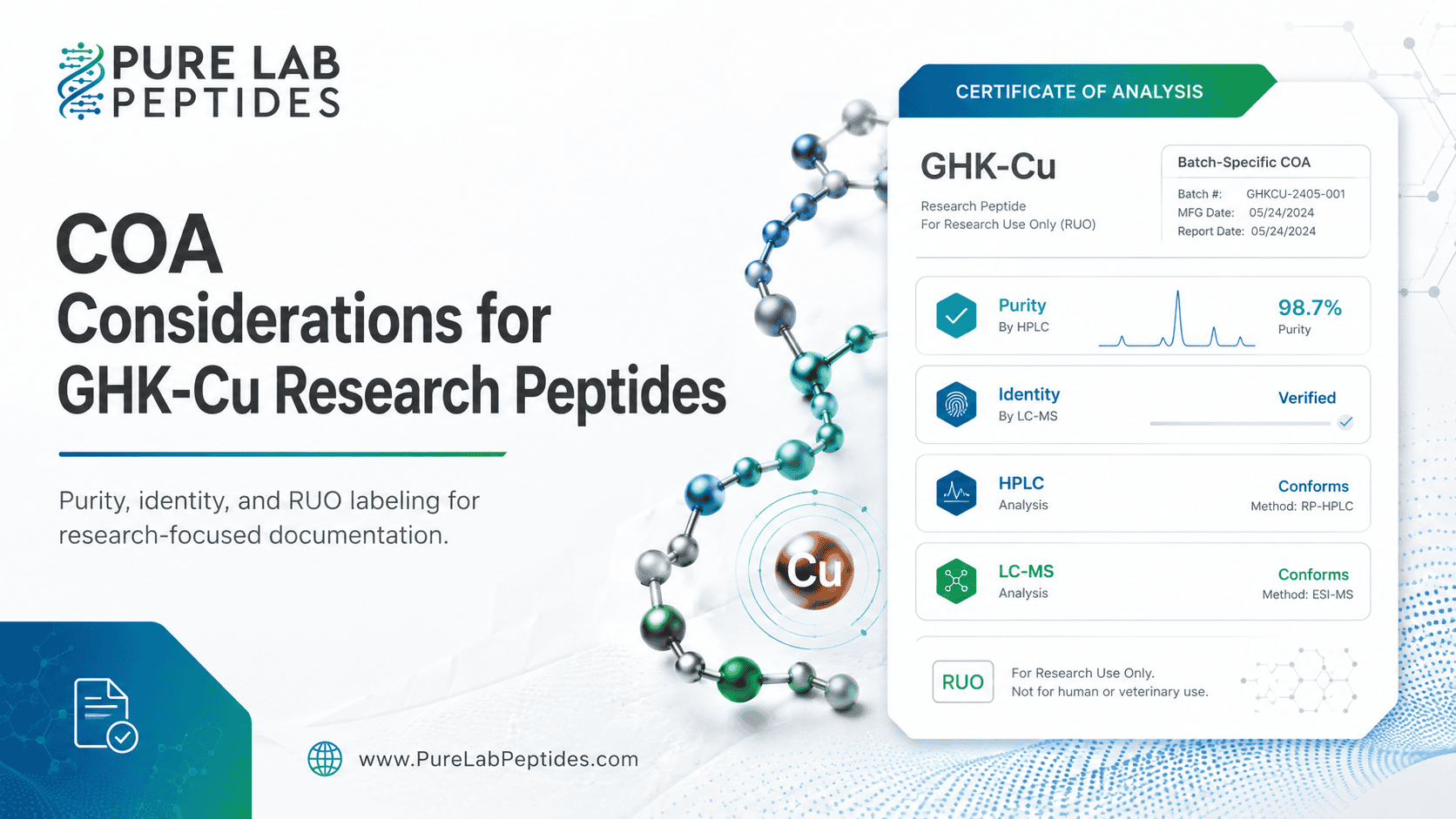
GHK-Cu COAs should confirm the exact tripeptide sequence, copper-binding stoichiometry, and high purity (often ≥98% by HPLC) for the batch. Critical data include HPLC purity with chromatogram, mass spectrometry confirming the peptide-copper complex, and any additional tests (e.g. amino acid or metal content analysis). Products discussed in this article are intended for laboratory research use only and are not intended for human or animal consumption.
GHK-Cu: Structure and Research Context
GHK-Cu is a naturally occurring copper(II) complex of the tripeptide glycyl-L-histidyl-L-lysine. The peptide binds copper in a 1:1 ratio, forming a stable chelate in solution. It has a long research history in cell-culture and animal studies related to collagen synthesis, wound healing, and antioxidant pathways. In laboratory settings, GHK-Cu is provided strictly as a research reference; reputable suppliers label it “for research use only” and do not make any human or veterinary use claims.
Role of a Certificate of Analysis in Peptide Research
A peptide COA is an official laboratory document detailing the analytical test results for a specific batch. It verifies that the material “is what it is designated to be” by reporting key parameters such as sequence, purity, and identity. For GHK-Cu, a COA gives researchers confidence that the compound’s identity (glycyl-L-histidyl-L-lysine bound to Cu²⁺) and purity meet specifications. Laboratories use COAs to ensure reproducibility and quality: for example, confirming a supplier’s claim of >98% purity via an HPLC chromatogram. In short, the COA is lab-verified evidence of the peptide’s composition and quality.
Key COA Tests for GHK-Cu Quality
COAs for GHK-Cu typically include several analytical tests. Reverse-phase high-performance liquid chromatography (RP-HPLC) is used to measure purity, providing a chromatogram and purity percentage. Mass spectrometry (MS) confirms identity, showing the expected m/z values for the GHK peptide and its copper complex. Because GHK-Cu is defined by its copper-binding, elemental or atomic analysis (e.g. ICP-MS or glow-discharge MS) can verify the 1:1 Cu:peptide ratio. Additional tests may include amino acid analysis (to confirm sequence) and moisture content (Karl Fischer titration) if requested. A COA may also list the analytical method used (RP-HPLC, LC-MS, etc.), the batch number, test date, and any calibration standards.
| Parameter | Purpose | Analytical Method |
| Purity | Assess fraction of desired peptide vs. impurities | RP-HPLC (UV detection) |
| Identity | Confirm peptide sequence and copper binding | Mass spectrometry (MALDI-TOF or ESI-MS) |
| Copper Content | Verify 1:1 Cu:peptide stoichiometry | Elemental analysis (ICP-MS, GDMS) |
| Additional Composition | Water, salts, etc. | Karl Fischer titration, ion chromatography |
These analyses together establish that a GHK-Cu batch is correctly synthesized, stored, and labeled. For example, if an HPLC purity is low or unexpected peaks appear, the COA will reveal it. If mass spectra show peaks for free peptide (without Cu), the COA highlights a complexation issue. Thus, a complete COA helps researchers detect and exclude substandard batches.
Evaluating GHK-Cu Supplier Documentation
Researchers should review supplier records to ensure thorough quality documentation. Key signals include batch-specific COAs and clear RUO labeling. Before procurement, verify that the product label and website state “for laboratory research only” and contain no exposure planning or clinical claims. Check that the lot number on the vial matches the COA. The COA should list identity and purity results – ideally from a third-party or accredited lab. Suppliers should also document storage conditions and stability data for each batch.
A practical QC workflow for new GHK-Cu inventory might proceed as follows:

Text version of this diagram
- Receive GHK-Cu Batch → RUO label present?.
- RUO label present? — No → Flag compliance issue.
- RUO label present? — Yes → Lot # matches COA?.
- Lot # matches COA? — No → Request batch documentation.
- Lot # matches COA? — Yes → Identity test provided?.
- Identity test provided? — No → Obtain HPLC or MS results.
- Identity test provided? — Yes → Review purity data.
- Review purity data → Purity meets spec?.
- Purity meets spec? — No → Reassess or reject batch.
- Purity meets spec? — Yes → Finalize COA and release batch.
FAQs
What is a certificate of analysis for GHK-Cu?
A GHK-Cu certificate of analysis (COA) is a batch-specific report from a lab detailing the compound’s analytical test results. It typically includes the peptide sequence, batch number, HPLC purity percentage (with chromatogram), mass spectrometry identity data, and other measured properties. The COA proves that the GHK-Cu sample was tested to meet quality criteria, which helps researchers trust its identity and purity before use.
Why is HPLC purity important for GHK-Cu?
HPLC purity indicates how much of the sample is the target GHK-Cu peptide versus impurities. High purity (often ≥98%) is crucial because contaminants or side-products can affect experimental results. The COA’s HPLC data lets researchers confirm the supplier’s purity claim. If the measured purity is lower, it may indicate synthesis or storage issues, so confirming it prevents using substandard material.
How is GHK-Cu identity confirmed on the COA?
Identity is confirmed by analytical methods such as mass spectrometry or NMR. For GHK-Cu, MS should show the expected molecular weight of the copper-bound tripeptide. The COA may list the m/z values or spectra that match GHK plus Cu. Sometimes a UV spectrum or chromatographic retention time is provided. Together, these data confirm the sample is indeed the specified GHK-Cu compound.
Can GHK-Cu be used for human or animal treatments?
No. All GHK-Cu products discussed here are research-use-only. Suppliers explicitly label GHK-Cu for laboratory research, not for therapeutic or cosmetic use. Regulatory agencies require that research reagents bear no claims about treating diseases or benefiting people. Always verify that labels and documentation avoid any human-use language.
What should I do if a GHK-Cu COA is missing information?
If a COA lacks critical details (like purity percentage, analytical method, or identity confirmation), you should request the full documentation from the supplier. Reputable vendors provide complete COAs or online access by lot number. Don’t proceed with purchasing until you can review the missing data. This ensures you have all quality information before using the material in your research.
Next Steps
Before ordering GHK-Cu, review its batch-specific COA and supplier documentation. Prioritize research-grade peptides with transparent labeling and analytics. Explore Pure Lab Peptides for RUO GHK-Cu, where clear COAs, purity data, and identity confirmation are provided for every lot.
References
- Verified Peptides. “Certificates of Analysis for Peptides: What Researchers Need to Know.” VerifiedPeptides.com Knowledge Hub (2025). verifiedpeptides.com
- AmbioPharm. “What data is provided on the Certificate of Analysis (CoA)?” AmbioPharm FAQ. 2024. ambiopharm.com
- William. “GHK-Cu UK 2026: Complete Research Reference.” Peptides Lab UK Blog, April 11, 2026. peptideslabuk.com
- Pure Lab Peptides. “Buy GHK-Cu 50mg | Peptide for Skin Regeneration & Repair.” PureLabPeptides.com. 2024. purelabpeptides.com
- Wikipedia. “Copper peptide GHK-Cu.” Wikipedia, The Free Encyclopedia. 2024. wikipedia.org
- Xu X, Pan Y, King F. “Extending the applicability of pulsed glow discharge mass spectrometry to GHK-Cu determination.” Int J Mass Spectrom. 2020. doi.org/10.1016/j.ijms.2019.116274