



CJC-1295 vs Sermorelin: Structure, DAC and Research Evidence

TL;DR · The short version
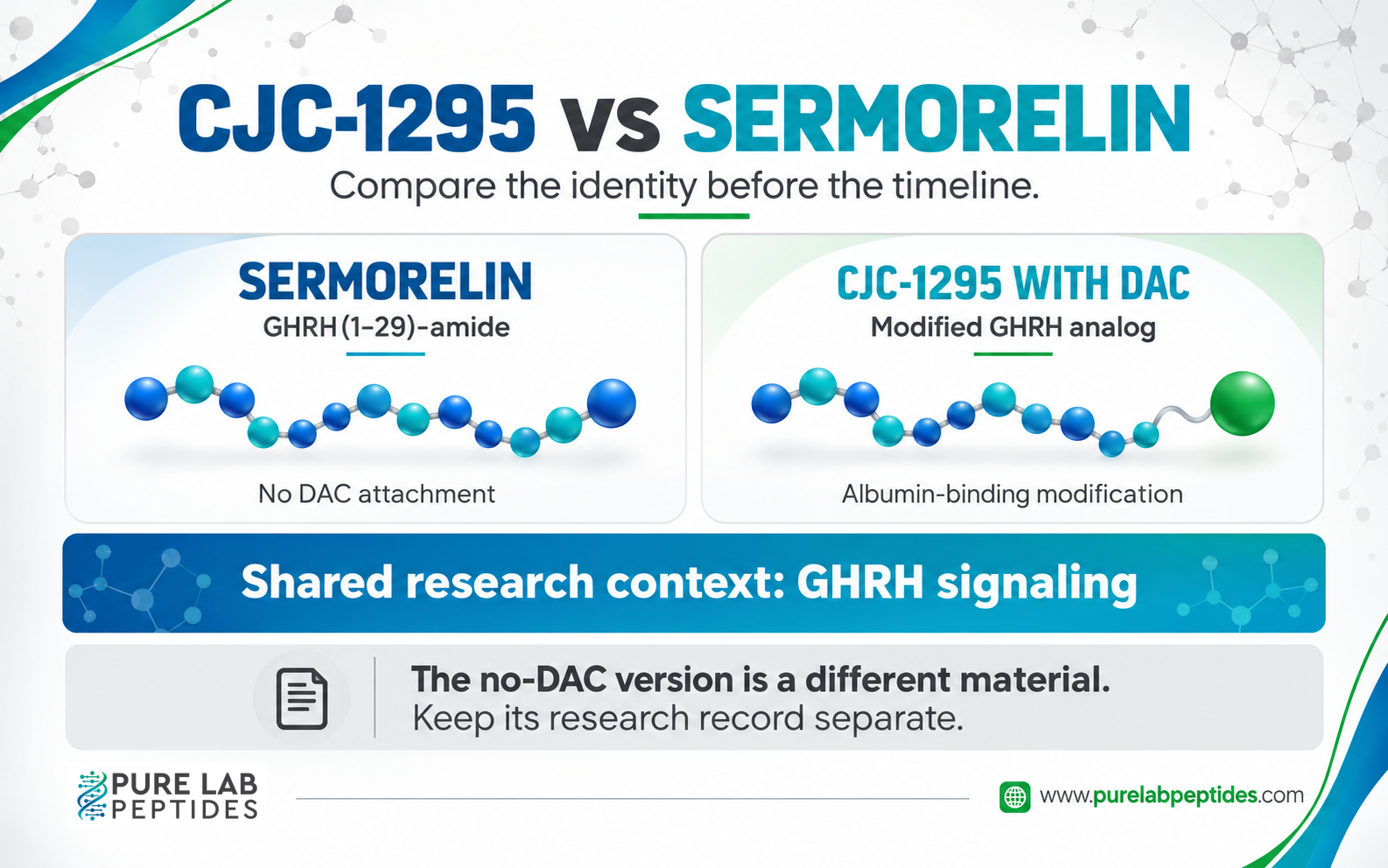
Sermorelin is GHRH(1–29)-amide. CJC-1295 with DAC is a modified GHRH analog designed to bind albumin. They share a research pathway, but their structures and exposure profiles differ. A product labeled CJC-1295 no DAC is a separate material; DAC study findings shouldn’t be carried over to it.
A CJC-1295 vs sermorelin comparison often begins with short- and long-acting labels. First identify which CJC material the comparison uses. Without that detail, the duration discussion may concern a different construct.
Sermorelin and CJC-1295 with DAC share a GHRH research context, but differ chemically. We’ll follow those identities and published experiments so similarly named compounds don’t merge in the methods review.
Sermorelin vs CJC-1295: two GHRH molecules
TL;DR: Shared GHRH context doesn’t make the two molecules interchangeable.
| Feature | Sermorelin | CJC-1295 with DAC |
|---|---|---|
| Starting identity | GHRH(1–29)-amide | A modified GHRH(1–29) analog |
| Structural distinction | The first 29 residues of GHRH with an amidated terminus | Residue substitutions and an albumin-binding attachment |
| DAC attachment | Not part of the sermorelin structure | Part of the construct discussed in the original CJC research |
| Comparison priority | Check the fragment, terminal chemistry and supplied form | Check the full construct, including the DAC modification |
| Evidence to carry forward | Findings for the material and model actually studied | DAC findings only when the studied and supplied constructs correspond |
The National Library of Medicine’s sermorelin entry and original CJC-1295 albumin-conjugation study support the structural comparison. Use the lower rows as reading checks rather than evidence that one compound is universally better.
What the name sermorelin tells you
TL;DR: The fragment and its amidated terminus are part of the identity, not optional detail.
The NLM defines sermorelin as GHRH(1–29)-amide: the first 29 amino acids from GHRH’s N-terminal end, with an amide at the other end. That compact notation tells you more than “GHRH peptide” does. It identifies the fragment and a terminal feature.
Retain the fragment and terminal notation when matching a paper with a specification. A similar residue chain can still have different end chemistry. The peptide sequence guide explains those annotations.
A material name leaves that chemistry to be checked.
What DAC changes in CJC-1295 research
TL;DR: DAC adds albumin-binding chemistry; it isn’t another name for extra peptide in the vial.
In Jetté and colleagues’ 2005 study, CJC-1295 was a tetrasubstituted GHRH(1–29) analog with a maleimidolysine attachment at the C-terminus. It was designed to form a covalent connection with albumin at cysteine 34. That attachment is central to the compound’s prolonged-exposure design.
The paper included rat pituitary-cell and animal experiments. It reported growth hormone release from the cell model and examined the albumin-conjugated compound’s persistence in animals. Those are findings in specified models. They don’t make every peptide bearing a CJC label the same construct. Read the original study and abstract.
Structure matters within the GHRH family more broadly. In a 1998 structure–activity study, Cervini and colleagues tested modified GHRH(1–29) analogs and found that different changes affected biological activity. “Related analog” is a useful category, but it isn’t evidence that two reagents will act identically.
Keep CJC-1295 with DAC and no DAC separate
TL;DR: Check the DAC designation before borrowing a half-life or exposure claim.
Product catalogs also use the label CJC-1295 no DAC. At Pure Lab Peptides, listings marked no DAC identify that separate material; our DAC listings say DAC. Check the full product record and specification rather than stopping at “CJC-1295.”
In a hypothetical mismatch, a paper studies albumin binding while the bench reagent says no DAC. Record the difference before borrowing its sampling rationale or using it to explain a result.
A sermorelin vs CJC-1295 comparison needs the construct before a duration label. Once that identity is clear, you can choose the applicable experiments.
How sermorelin and CJC-1295 research should be compared
TL;DR: Read the study design and endpoint before turning a result into a general claim.
A 2006 study by Teichman and colleagues reported two randomized, placebo-controlled, double-blind studies of CJC-1295 in healthy adults. It measured pharmacokinetics and GH and IGF-I responses. The estimated CJC-1295 half-life was 5.8 to 8.1 days in that study context.
The estimate describes the tested compound in that study. It isn’t storage life, a universal CJC value or a personal-use schedule. Nor were those studies a head-to-head sermorelin comparison.
A separate 2006 study by Ionescu and Frohman examined overnight GH secretion before and one week after CJC-1295 administration in healthy men. Pulsatility was preserved while mean and trough GH levels increased. The result doesn’t support a simplistic claim that one compound produces “natural pulses” while DAC necessarily makes secretion flat.
The published finding is useful precisely when the conclusion retains that narrower scope.
Turn the comparison into a research question
TL;DR: Choose the material that fits the experiment, and document why its evidence applies.
Compare construct, form, model, exposure, sampling and endpoint. Intact compound, receptor response, GH and IGF-I concentrations address different questions, even when they appear in one study.
For albumin binding, the attachment defines the experiment. For fragment activity, identity and assay conditions may come first. Specify the measurement before asking which peptide is better.
For catalog and document review, you can compare our sermorelin material record, CJC-1295 with DAC record and CJC-1295 no DAC record. Check the current specifications and lot documentation for the reagent you’re reviewing. These are research material records, not treatment recommendations.
Keeping the comparison tied to those details gives another reviewer an explanation to follow, rather than a winner selected from unlike results.