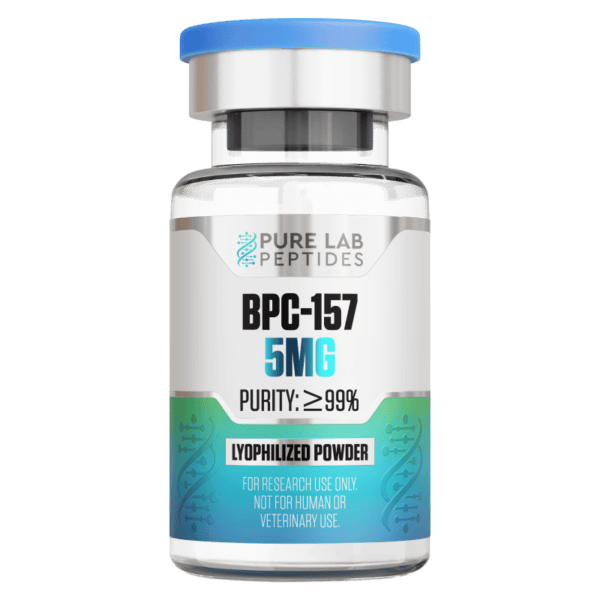

BPC-157 10mg

$89.99

(5.0)

Research Studies:

  • Facilitates analysis of nitric oxide-mediated angiogenic and cytoprotective signaling cascades
  • Supports investigation into vascular endothelial growth factor upregulation and receptor activation
  • Enables research on growth factor-mediated fibroblast migration and collagen synthesis pathways
  • Useful for evaluating modulation of G-protein coupled receptor-dependent gastrointestinal protective mechanisms

Out of stock

Description

BPC-157 10mg is a research-use-only laboratory material supplied for controlled research workflows, compound characterization, and analytical documentation review. It is manufactured under rigorous quality standards to support consistency, traceability, and batch-specific verification for qualified laboratory settings.

Key Product Details

  • Manufactured in accordance with rigorous quality standards to support ≥99% purity, as reflected in batch-specific documentation where available.
  • Every batch is third-party analyzed for identity, assay/potency, and sterility documentation where applicable.
  • Supplied in lyophilized powder form to help preserve stability throughout transport and storage.
  • Produced with lot-level traceability to support research documentation and laboratory recordkeeping.

Research Documentation Context

  • Supports compound characterization in controlled laboratory settings.
  • Provides batch-specific identity and purity documentation for research review.
  • Allows lot-level traceability across laboratory documentation workflows.
  • Supports comparison of product labeling, analytical documentation, and storage information during research planning.
  • Supports analytical review of peptide research materials within a strictly laboratory-focused context.

Specifications and Documentation

  • Certificate of Analysis: Available with batch-specific documentation where applicable.
  • Material Safety Data Sheet: Coming Soon.
  • Handling and Storage Instructions: Coming Soon.
  • Product Form: Lyophilized powder.
  • Purity Specification: ≥99% purity.
  • Intended Use: Laboratory research use only.

BPC-157 10mg is intended strictly for laboratory research use only. This product is not intended for human or animal consumption, therapeutic use, diagnostic use, clinical use, veterinary use, or as a food, drug, cosmetic, dietary supplement, or household product.

Additional information

CAS No.

137525-51-0

Purity

≥99%

Sequence

Gly-Glu-Pro-Pro-Pro-Gly-Lys-Pro-Ala-Asp-Asp-Ala-Gly-Leu-Val

Molecular Formula

C62H98N16O22

Molecular Weight

1419.5 g/mol

Applications

Tissue repair studies, inflammation research, gastrointestinal health investigations, musculoskeletal healing research

Synthesis

Solid-phase synthesis

Format

Lyophilized powder

Solubility

Soluble in water or 1% acetic acid

Stability & Storage

Stable for 24 months at -20°C in lyophilized form. After reconstitution, store at 4°C for up to 2 weeks or -20°C for up to 6 months.

Appearance

White crystalline powder

Shipping Conditions

Shipped at room temperature. Upon receipt, store at -20°C

Regulatory/Compliance

Complies with research use only standards. Not for drug, household, or other uses.

Safety Information

Refer to MSDS; handle according to established laboratory safety procedures

There are no reviews yet.

We value your feedback. Please leave a review below:

Research Procurement Information

Buy BPC-157 Online for Research | COA Guide

Researchers searching for buy BPC-157 online should evaluate BPC-157 as a research-use-only laboratory material, not a consumer product. For laboratory buyers, the key considerations are compound identity, purity documentation, batch-specific COAs, lot traceability, product labeling, and storage information. This guide explains how qualified researchers and technical procurement teams can evaluate BPC-157 research material through Pure Lab Peptides while keeping commercial search intent limited to controlled laboratory research procurement.

Fast Answer: buy BPC-157 online

Researchers can buy BPC-157 online for laboratory research by reviewing RUO labeling, batch-specific COA documentation, purity data, identity information, storage guidance, and supplier transparency before selecting a source. Products discussed in this article are intended for laboratory research use only and are not intended for human or animal consumption.

What Does “Buy BPC-157 Online” Mean in a Research Context?

The phrase `buy BPC-157 online` is addressed here as laboratory research procurement intent, not personal-use intent. In an RUO context, the search is about source evaluation: whether the material is clearly labeled for research use only, whether documentation is available before procurement, and whether the supplier avoids language that would position the compound for use outside controlled laboratory settings.

Qualified laboratory buyers should evaluate BPC-157 research-use-only labeling, the BPC-157 COA, lot traceability, product-name consistency, storage documentation, and supplier language. The goal is not to interpret published literature as product-use guidance. The goal is to confirm that the research compound can be documented, cataloged, and controlled within a laboratory procurement workflow.

BPC-157 Research Material Overview

BPC-157 is identified in chemical databases as a peptide or pentadecapeptide research compound. PubChem lists BPC-157 under CID 9941957 and provides structural and formula information, while ChEMBL identifies the compound as CHEMBL4297358 with the molecular formula C62H98N16O22 [1] [2]. FDA’s UNII record lists BPC-157 with UNII 8ED8NXK95P, and NCATS Inxight Drugs and DrugBank provide additional database identifiers used for substance cross-checking [3] [4] [5].

In laboratory procurement, those identity records help researchers compare the listed compound name, synonym set, formula, and database identifiers against supplier documentation. They do not establish suitability for any personal, clinical, diagnostic, veterinary, or consumer purpose.

Published literature discusses BPC-157 in cellular pathway, nitric-oxide-system, central-nervous-system, and review-based research contexts [6] [7] [8]. Research literature related to cellular pathways should not be converted into product-use claims for RUO materials.

Why Researchers Search “Buy BPC-157 Online”

Researchers search “buy BPC-157 online” to determine whether a laboratory supplier provides clear RUO labeling, accessible documentation, transparent lot-level records, and a product form that fits research inventory needs. A qualified buyer looking to buy BPC-157 should prioritize documentation over promotional language.

Useful procurement signals include BPC-157 purity documentation, BPC-157 identity testing, batch-specific COA availability, product-label consistency, supplier documentation, storage information, and a documented lyophilized powder form. Supplier language matters: a research-focused supplier should not frame BPC-157 as a consumer product or make outcome-based claims.

Research Procurement Checklist for BPC-157

  • Verify that BPC-157 is labeled for research use only.
  • Review the batch-specific certificate of analysis before procurement.
  • Confirm that the COA includes identity and purity documentation.
  • Check whether HPLC, LC-MS, mass spectrometry, or another analytical method is listed.
  • Compare the product name, lot number, and documentation for consistency.
  • Assess whether the supplier avoids dosing, injection, therapeutic, or human-use claims.
  • Document storage and handling information in laboratory records.
  • Evaluate whether the lyophilized powder form matches the needs of the research inventory workflow.
  • Confirm that the product is not marketed for human or animal consumption.

BPC-157 Quality Signals to Review Before Buying Online

Before researchers buy BPC-157 online for laboratory research, the strongest procurement signals are documentation-based. HPLC is widely used in peptide analysis and purification, while LC-MS is commonly used for mass-based characterization and impurity review in synthetic peptide workflows [9] [10]. Peptide storage and handling records should also be evaluated as part of controlled laboratory inventory documentation [11].

Evaluation Area What Researchers Should Review Why It Matters for RUO Procurement
RUO labeling Confirm the product is clearly labeled for research use only Helps separate research procurement from human-use positioning
COA availability Review the available batch-specific certificate of analysis Supports lot-level documentation and quality review
Purity data Look for analytical support for the stated purity Helps evaluate material consistency
Identity testing Review HPLC, LC-MS, mass spectrometry, or related identity data Helps confirm the material matches the listed compound
Lot traceability Match lot numbers across product and documentation Supports research recordkeeping
Product form Confirm whether the material is supplied as lyophilized powder or another documented form Supports laboratory planning
Storage information Review storage and handling documentation Helps maintain material integrity in laboratory settings
Supplier language Confirm the supplier avoids dosing, therapeutic, or personal-use claims Supports research-use-only positioning

COA, Purity, and Identity Documentation

COA review should be systematic. Researchers should look for the compound name, product name, lot number, test date, purity percentage, test method, identity confirmation, molecular weight or formula where applicable, chromatogram or mass data where available, product form, and storage documentation. ICH Q2(R2) and ICH Q14 describe validation and development concepts for analytical procedures, including fitness for purpose and validation characteristics [12] [13].

A purity percentage alone does not establish complete compound identity; researchers should evaluate purity, identity, method, lot number, and documentation together. FDA bioanalytical guidance, USP chromatography guidance, ISO/IEC 17025 laboratory competence information, NIST reference-material documentation, and eCFR laboratory-record requirements all reinforce the broader principle that analytical records should connect methods, samples, results, and traceable documentation [14] [15] [16] [17] [18].

RUO labeling should also be treated as part of documentation review. FDA’s RUO/IUO guidance for IVD products and 21 CFR 809.10 provide useful labeling context for research-use-only language, even though BPC-157 procurement is not being framed here as diagnostic use [19] [20].

For synthetic peptide documentation, researchers may also review impurity, reference-standard, and quality-system concepts from FDA peptide guidance, peer-reviewed peptide reference-standard literature, USP validation material, and ICH Q7 quality guidance [21] [22] [23] [24].

flowchart TD A[Receive product and COA] --> B{RUO labeling present?} B -- No --> C[Flag procurement gap] B -- Yes --> D{Lot number matches across label and COA?} D -- No --> E[Request batch-specific documentation] D -- Yes --> F{Identity supported by analytical method?} F -- No --> G[Request HPLC, LC-MS, or equivalent] F -- Yes --> H[Proceed to laboratory documentation and storage]

Research Literature Context

BPC-157 appears in published literature as a peptide research compound discussed in several scientific contexts, including cellular pathway research, nitric-oxide-system literature, central-nervous-system literature, and broader review-based literature [6] [7] [8]. The existence of research literature does not convert a research-use-only material into a product for personal, clinical, diagnostic, veterinary, or consumer use.

The evidence landscape is mixed in form. Some sources are database-based and support molecular identification. Some sources are reviews or pathway discussions. Some publications involve preclinical or development-stage contexts. Those distinctions matter because procurement teams should separate literature context from supplier documentation, COA review, and batch-specific analytical records.

Published clinical literature should not be interpreted as use guidance for RUO materials. For BPC-157 research-use-only procurement, the practical question is whether the supplier provides transparent documentation and whether the product page avoids product-use claims. Research literature related to cellular pathways should not be converted into product-use claims for RUO materials.

Evidence Landscape

Research Area What Literature Examines Evidence Type RUO Interpretation
Compound identity Molecular structure, sequence, formula, identifiers, or classification Database / analytical Supports identification, not product-use claims
Pathway or category context Cellular pathway, nitric-oxide-system, or model-specific research area Review / preclinical / pathway literature Useful for research context, not therapeutic claims
Analytical testing Purity, identity, and batch verification HPLC / LC-MS / mass spectrometry / COA Supports documentation review
Storage and stability Material form and handling considerations Laboratory documentation Supports research workflow planning

For procurement teams, the evidence table should be read as a documentation map. Database records help confirm identity. Analytical-method literature helps frame COA review. Supplier records establish lot-level traceability. None of these sources should be used as product-use instructions.

Claim Boundary Table

Research-Safe Statement Why It Is Acceptable Non-Compliant Version to Avoid
“BPC-157 is discussed in published research related to cellular pathway and peptide characterization contexts.” Describes literature context without making a product claim “BPC-157 helps with a human outcome.”
“Researchers should review COA and identity data before procurement.” Focuses on documentation and quality review “Users should buy BPC-157 for results.”
“Pure Lab Peptides supplies BPC-157 as a research-use-only material.” Clarifies intended use “Pure Lab Peptides supplies BPC-157 for therapy.”
“The phrase buy BPC-157 online is addressed as research procurement intent.” Qualifies commercial search intent “Buy BPC-157 online for personal use.”
“BPC-157 supplier documentation should be evaluated with lot-level records.” Keeps the focus on traceability and documentation “Supplier claims can replace analytical documentation.”

How Pure Lab Peptides Presents BPC-157

Pure Lab Peptides presents BPC-157 10mg as a research-use-only material. The product is supplied as lyophilized powder with a ≥99% purity claim, and a batch-specific COA is available for documentation review. Researchers should review the product page and batch-specific documentation to confirm RUO labeling, purity information, product form, storage information, and lot-level traceability.

Review the Pure Lab Peptides BPC-157 research-use-only product details page for RUO labeling, product details, purity information, and batch-specific documentation. Researchers comparing related laboratory materials can also review the research peptide collection, educational materials on the Pure Lab Peptides blogs, and logistics information on the shipping and returns page.

Common Misunderstandings About Buying BPC-157 Online

Misunderstanding: “Buy BPC-157 online” means personal use

Buy BPC-157 online should not be interpreted as personal-use guidance on this page. The phrase is addressed as laboratory procurement intent for qualified researchers reviewing RUO labeling, documentation, purity data, identity information, and supplier transparency.

Misunderstanding: Published literature equals product-use guidance

Published literature may provide scientific context, but it does not create use guidance for a research-use-only compound. BPC-157 literature should be reviewed as background context while procurement decisions remain focused on COA availability, identity testing, lot records, and RUO labeling.

Misunderstanding: Purity percentage alone proves identity

A high stated purity percentage is not the same as complete identity confirmation. Researchers should evaluate BPC-157 purity documentation alongside method details, chromatographic data where available, mass-based identity information where available, lot number consistency, and supplier documentation.

Misunderstanding: COA documentation does not need to be batch-specific

For research procurement, COA documentation should be tied to the specific lot being evaluated. Batch-specific records help the laboratory connect the received material to the reported identity, purity, product form, test date, and analytical method.

Misunderstanding: RUO labeling supports clinical or consumer positioning

RUO labeling narrows the intended context to laboratory research. It does not support consumer positioning, personal-use language, diagnostic framing, therapeutic claims, or instructions for use outside controlled laboratory research documentation.

FAQs About Buying BPC-157 Online for Research

Where can researchers buy BPC-157 online for laboratory research?

Researchers can buy BPC-157 online for laboratory research by reviewing suppliers that present the compound as RUO only and provide documentation for identity, purity, batch-specific COA review, storage, and lot traceability. Pure Lab Peptides provides a BPC-157 10mg product page for qualified research procurement review.

What should researchers check before buying BPC-157 online?

Before buying BPC-157 online, researchers should check RUO labeling, BPC-157 COA availability, product form, purity documentation, identity testing, lot number consistency, storage information, and supplier language. A supplier should avoid dosing, therapeutic, personal-use, consumer-use, or veterinary-use positioning.

Why does a COA matter when buying BPC-157?

A COA matters when buying BPC-157 because it connects a specific lot to analytical documentation. Researchers should review the compound name, lot number, purity result, test method, identity information, product form, and date of analysis as part of laboratory procurement records.

Is BPC-157 intended for human or animal consumption?

BPC-157 discussed here is not intended for human or animal consumption. This page addresses BPC-157 as a research-use-only laboratory material for qualified researchers, laboratory buyers, research institutions, and technical procurement teams evaluating documentation and supplier transparency.

What does research use only mean for BPC-157?

Research use only means BPC-157 is positioned for controlled laboratory research procurement, documentation, and recordkeeping. RUO positioning does not provide directions for personal, clinical, diagnostic, veterinary, or consumer use and should not be interpreted as product-use guidance.

How should published literature about BPC-157 be interpreted?

Published literature about BPC-157 should be interpreted as scientific context, not as guidance for RUO material use. Researchers should separate literature review from procurement review and prioritize batch-specific documentation, identity testing, purity records, supplier language, and storage information.

Next Steps

Qualified researchers evaluating BPC-157 should review product labeling, COA status, identity documentation, purity information, storage information, and supplier transparency before selecting any research-use-only material. Review the BPC-157 10mg product page for RUO labeling, purity information, and available batch-specific documentation.

References

  1. National Center for Biotechnology Information. “PubChem Compound Summary for CID 9941957, BPC-157.” PubChem. 2026. pubchem.ncbi.nlm.nih.gov/compound/9941957
  2. European Bioinformatics Institute. “Compound: BPC-157 (CHEMBL4297358).” ChEMBL. 2026. ebi.ac.uk/chembl/explore/compound/CHEMBL4297358
  3. U.S. Food and Drug Administration. “BPC-157, UNII 8ED8NXK95P.” GSRS / UNII Search Service. 2026. precision.fda.gov/uniisearch/srs/unii/8ed8nxk95p
  4. National Center for Advancing Translational Sciences. “BPC-157.” Inxight Drugs. 2026. drugs.ncats.io/drug/8ED8NXK95P
  5. DrugBank Online. “BPC-157: Uses, Interactions, Mechanism of Action.” DrugBank. 2026. go.drugbank.com/drugs/DB11882
  6. Vukojevic J, Milavic M, Perovic D, et al. “Pentadecapeptide BPC 157 and the central nervous system.” Neural Regeneration Research. 2022;17(3):482-487. doi.org/10.4103/1673-5374.320969
  7. Sikiric P, Seiwerth S, Rucman R, et al. “Stable gastric pentadecapeptide BPC 157-NO-system relation.” Current Pharmaceutical Design. 2014;20(7):1126-1135. doi.org/10.2174/13816128113190990411
  8. Jozwiak M, Bauer M, Kamysz W, Kleczkowska P. “Multifunctionality and Possible Medical Application of the BPC 157 Peptide-Literature and Patent Review.” Pharmaceuticals. 2025;18(2):185. doi.org/10.3390/ph18020185
  9. Mant CT, Chen Y, Yan Z, Popa TV, Kovacs JM, Mills JB, Tripet BP, Hodges RS. “HPLC analysis and purification of peptides.” Methods in Molecular Biology. 2007;386:3-55. doi.org/10.1007/978-1-59745-430-8_1
  10. Lian Z, Wang N, Tian Y, Huang L. “Characterization of Synthetic Peptide Therapeutics Using Liquid Chromatography-Mass Spectrometry: Challenges, Solutions, Pitfalls, and Future Perspectives.” Journal of the American Society for Mass Spectrometry. 2021;32(8):1852-1860. doi.org/10.1021/jasms.0c00479
  11. Hoofnagle AN, Whiteaker JR, Carr SA, et al. “Recommendations for the generation, quantification, storage, and handling of peptides used for mass spectrometry-based assays.” Clinical Chemistry. 2016;62(1):48-69. doi.org/10.1373/clinchem.2015.250563
  12. International Council for Harmonisation. “Q2(R2) Validation of Analytical Procedures.” ICH Harmonised Guideline. 2023. database.ich.org/sites/default/files/ICH_Q2%28R2%29_Guideline_2023_1130.pdf
  13. International Council for Harmonisation. “Q14 Analytical Procedure Development.” ICH Harmonised Guideline. 2023. database.ich.org/sites/default/files/ICH_Q14_Guideline_2023_1116.pdf
  14. U.S. Food and Drug Administration. “Bioanalytical Method Validation Guidance for Industry.” FDA Guidance Document. 2018. fda.gov/files/drugs/published/Bioanalytical-Method-Validation-Guidance-for-Industry.pdf
  15. United States Pharmacopeia. “General Chapter 621 Chromatography.” USP Harmonized General Chapter. 2021. usp.org/sites/default/files/usp/document/harmonization/gen-chapter/harmonization-november-2021-m99380.pdf
  16. International Organization for Standardization. “ISO/IEC 17025: Testing and calibration laboratories.” ISO. 2026. iso.org/ISO-IEC-17025-testing-and-calibration-laboratories.html
  17. National Institute of Standards and Technology. “Reference materials.” NIST. 2026. nist.gov/reference-materials
  18. U.S. Electronic Code of Federal Regulations. “21 CFR 211.194 – Laboratory records.” eCFR. 2026. ecfr.gov/current/title-21/chapter-I/subchapter-C/part-211/subpart-J/section-211.194
  19. U.S. Food and Drug Administration. “Distribution of In Vitro Diagnostic Products Labeled for Research Use Only or Investigational Use Only.” FDA Guidance Document. 2013. fda.gov/regulatory-information/search-fda-guidance-documents/distribution-in-vitro-diagnostic-products-labeled-research-use-only-or-investigational-use-only
  20. U.S. Electronic Code of Federal Regulations. “21 CFR 809.10 – Labeling for in vitro diagnostic products.” eCFR. 2026. ecfr.gov/current/title-21/chapter-I/subchapter-H/part-809/subpart-B/section-809.10
  21. U.S. Food and Drug Administration. “ANDAs for Certain Highly Purified Synthetic Peptide Drug Products That Refer to Listed Drugs of rDNA Origin.” FDA Guidance Document. 2021. fda.gov/media/107622/download
  22. McCarthy D, Han Y, Carrick K, et al. “Reference Standards to Support Quality of Synthetic Peptide Therapeutics.” Pharmaceutical Research. 2023;40(6):1317-1328. doi.org/10.1007/s11095-023-03493-1
  23. United States Pharmacopeia. “General Chapter 1225 Validation of Compendial Procedures.” USP-NF. 2026. doi.usp.org/USPNF/USPNF_M99945_04_01.html
  24. International Council for Harmonisation. “Q7 Good Manufacturing Practice Guide for Active Pharmaceutical Ingredients.” ICH Harmonised Guideline. 2000. database.ich.org/sites/default/files/Q7%20Guideline.pdf