 Skip to content
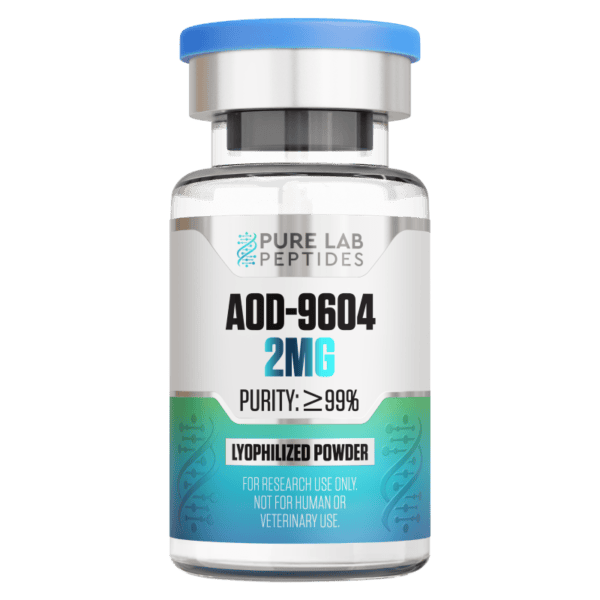
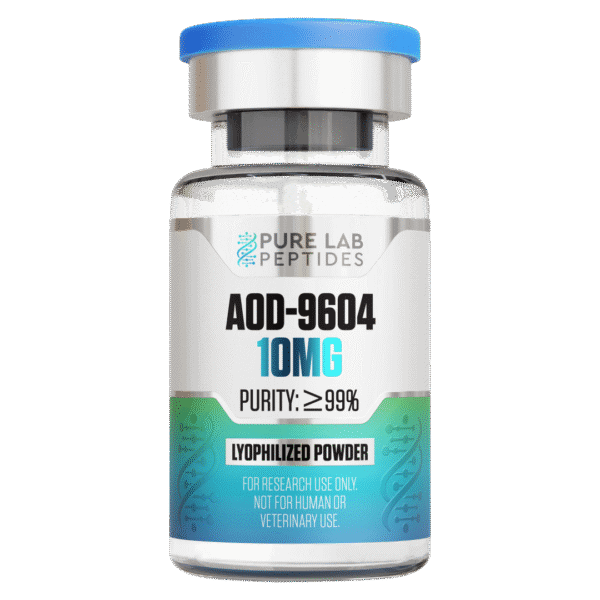
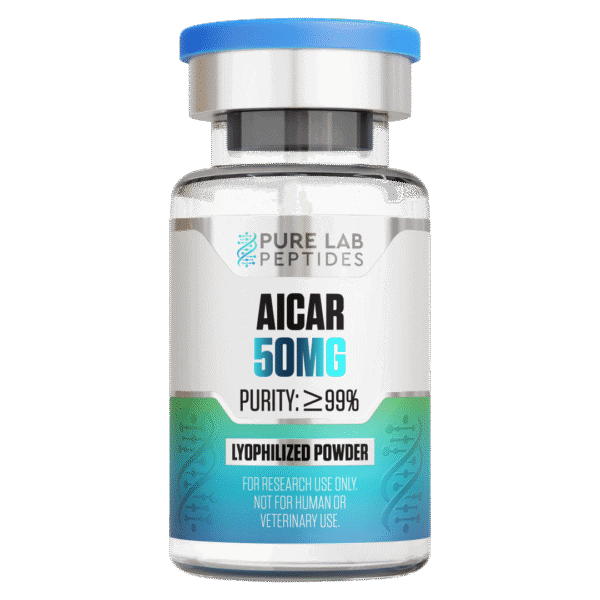
For research teams evaluating where to buy AOD-9604 for research, the central question is whether the product page gives enough documentation for laboratory review. This Pure Lab Peptides guide frames AOD-9604 as a research-use-only peptide and keeps the focus on compound identity, published literature, COA review, analytical testing, and batch traceability. It keeps the page within RUO boundaries by focusing on records, not outcomes.
- AOD-9604 is cataloged by PubChem as a synthetic peptide with the sequence YLRIVQCRSVEGSCGF, formula C78H123N23O23S2, and molecular weight of 1815.1 g/mol [1].
- AOD 9604, AOD-9604, and AOD9604 are naming variants that should map back to the same canonical research compound record [1].
- Published research describes AOD9604 as a C-terminal human growth hormone fragment with an additional N-terminal tyrosine residue [3].
- Literature around this compound belongs in metabolic pathway research and peptide fragment research, not consumer-facing outcome language [4] [5].
- COA review should check peptide identity, purity method, lot number, testing date, and whether analytical records match the product listing [11] [12].
- HPLC, LC-MS, and mass spectrometry are useful documentation concepts because they support peptide separation, identity review, and synthetic peptide characterization [14] [15] [16].
- RUO product-page readers should compare label consistency, COA details, analytical testing, storage documentation, and supplier transparency before procurement.
Fast Answer: What Should Researchers Check Before They Buy AOD-9604 for Research?
Researchers evaluating where to buy AOD-9604 for research should first review RUO labeling, batch-specific COA availability, peptide identity data, purity testing, and lot traceability. Products discussed in this article are intended for laboratory research use only and are not intended for human or animal consumption. AOD-9604 is cataloged as a synthetic peptide with sequence and molecular-weight data that should match supplier documentation [1].
How Does Research Intent Reframe Buy AOD-9604 for Research Searches?
The commercial phrase “buy AOD-9604 for research” should be treated as a technical procurement query. The right page should help laboratory buyers evaluate documentation, not make consumer-facing claims.
For Pure Lab Peptides, this means the product-page article should answer practical research questions: what compound is listed, what documentation is available, what analytical testing supports identity, and whether RUO positioning is clear.
What Documentation Should Come First on a Research Product Page?
The first review layer is simple: name, lot number, COA, analytical method, purity record, and label consistency. If these records do not align, the procurement review should pause until the documentation story is clear.
A peptide listing should also make the compound identity easy to verify against independent records. PubChem provides a useful outside reference for AOD-9604 naming, sequence, formula, and molecular weight [1].
Why Does Research-Use-Only Labeling Matter Before Procurement?
RUO language defines the scope of the page. FDA’s RUO guidance for in vitro diagnostic products is category-specific, but it illustrates the broader principle that labeling and promotion must not drift into non-research positioning [10].
For a research peptide product page, clear RUO labeling helps keep the focus on laboratory material review, analytical testing, and supplier documentation.
What Is AOD-9604 in Research Literature?

AOD-9604 is a synthetic peptide listed in PubChem with the sequence YLRIVQCRSVEGSCGF and molecular weight of 1815.1 g/mol [1]. Cox et al. describe AOD9604 as a peptide consisting of the C-terminal fragment of human growth hormone from amino acids 177–191 with an added tyrosine residue at the N-terminus [3].
Peptide Identity and Research Classification
The compound belongs in peptide fragment research because its literature context is tied to a defined segment of human growth hormone. UniProt lists human somatotropin under GH1 and provides the canonical sequence context for the full protein entry [2].
For product-page purposes, the key identity fields are the compound name, naming variants, peptide sequence, formula, molecular weight, and batch-specific records. These should stay consistent across the product listing, COA, and laboratory records.
How Does AOD 9604 Relate to Human Growth Hormone Fragment Literature?
AOD 9604 appears in the literature as a modified C-terminal fragment connected to human growth hormone sequence studies [3] [9]. Earlier C-terminal sequence work examined hGH 177–191 in metabolic model settings, which helps explain why AOD-9604 is discussed in the same literature lane [9].
That connection should not be turned into a product claim. It is a source-discovery and compound-classification point.
Why Does Canonical Naming Help Research Buyers?
Canonical naming reduces confusion. AOD-9604, AOD 9604, and AOD9604 can appear across databases, papers, COAs, and product listings.
For procurement teams, the best practice is to map every naming variant back to the same compound identity record. That helps catch label mismatches, incomplete COAs, or supplier pages that rely on vague peptide descriptions.
AOD-9604 Peptide Background for Laboratory Research
AOD-9604 is best understood as a research peptide with a defined sequence and a literature trail tied to peptide fragment studies. The product-page role is not to summarize it as a consumer compound, but to organize the data needed for laboratory evaluation.
Where Does the C-Terminal Sequence Fit in Peptide Fragment Research?
The C-terminal connection matters because the compound is discussed in relation to hGH fragment literature [3] [9]. PubChem’s AOD-9604 entry records the sequence and disulfide-linked peptide structure details, while UniProt provides the larger human somatotropin protein context [1] [2].
This is useful for documentation review. It gives researchers an outside reference for verifying sequence, identity, and naming consistency.
What Does Same-Lane Metabolic Pathway Context Add?
Same-lane context helps readers understand why AOD-9604 appears in metabolic pathway literature. Ng et al. studied AOD9604 in a preclinical metabolic research setting, and Heffernan et al. later examined receptor-pathway context in knockout models [4] [5].
A product page should state that this literature is model-specific. It should not convert pathway relevance into a claim about an RUO material.
How Should Researchers Interpret Mechanism of Action Context?
Mechanism of action context should be framed as a literature summary, not as product positioning. A safer approach is to describe what a study examined, which model it used, and what limits apply.
How Do Mechanistic Models Differ From Product Claims?
A mechanistic model explains a proposed pathway in a research setting. A product claim tells the buyer what a product will do.
That distinction matters for AOD-9604 because published studies have examined pathway signals, receptor context, and peptide fragment behavior in specific models [4] [5] [6]. The Pure Lab Peptides page should keep those findings separate from RUO product positioning.
How Does Preclinical Literature Describe Pathway Signals?
Heffernan et al. reported beta-3 adrenergic receptor RNA expression findings in a preclinical knockout-model study involving hGH and AOD9604 [5]. A separate study discussed hGH receptor binding and cell-proliferation assays as part of AOD9604 pathway characterization [6].
These findings help define research questions. They do not establish product performance for an RUO listing.
Why Does Receptor Activation Language Require Precision?
Receptor activation language needs care because receptor systems vary by model, tissue type, assay design, and species context. Strosberg’s review describes beta-3 adrenergic receptors as a distinct adrenergic receptor subtype with structural and functional properties that differ from beta-1 and beta-2 receptors [18].
For an AOD-9604 research page, that means receptor language should stay narrow. The page can discuss receptor-pathway literature, but it should not overstate downstream meaning.
How Does Published Literature Frame AOD 9604 Peptide Research?
Published literature frames the AOD 9604 peptide through compound identity, C-terminal hGH fragment context, metabolic pathway models, receptor-pathway studies, and analytical detection work [3] [4] [5]. A useful research page should show the evidence landscape without overextending it.
| Research Area | What Literature Examines | Evidence Type | RUO Interpretation |
|---|---|---|---|
| Compound identity | Sequence, formula, synonyms, and molecular weight for AOD-9604 [1] | Official database | Supports documentation checks, not product claims |
| Fragment context | C-terminal human growth hormone fragment research [3] [9] | Mechanistic literature | Helps classify the peptide lane |
| Pathway context | Metabolic model endpoints, including lipolysis-related measures in model-specific settings [4] [5] | Preclinical literature | Supports hypothesis framing only |
| Analytical detection | AOD9604 detection and in vitro metabolism methods [3] | Analytical and in vitro research | Supports testing-context discussion |
| Evidence boundaries | Reviews and human study settings outside RUO product positioning [7] [8] | Review and human study literature | Should not become product positioning |
What Can Preclinical Literature Support?
Preclinical literature can support background context, model selection, and pathway hypotheses. Ng et al. and Heffernan et al. provide examples of AOD9604 being evaluated in metabolic and receptor-pathway models [4] [5].
The correct RUO interpretation is limited. A product page can cite what the literature examined, but it cannot convert study findings into promises about a research material.
Where Should Translational Limits Be Stated?
Translational limits should appear near the evidence summary, not buried at the end. If a study uses a model-specific design, the page should say that the evidence applies to that model.
Wilding’s review and Stier et al.’s human study summary belong in evidence interpretation, not product positioning [7] [8]. Some published literature outside the scope of RUO product use has examined this compound class in human study settings. That literature should not be interpreted as a use claim for research-use-only materials.
How Should Higher-Level Evidence Stay Source-Based?
Higher-level evidence should be cited and described in neutral language. The safest pattern is: source type, research setting, endpoint category, and limitation.
That approach prevents the article from using selective literature snippets as marketing language. It also helps editors avoid turning boundary-sensitive phrases into consumer-facing claims.
How Should Research Literature Stay Separate From Product Claims?

Research literature and product claims serve different functions. Literature explains what researchers examined; product-page copy explains what documentation supports an RUO material listing.
Why Should Study Findings Not Become Product Claims?
Study findings are tied to their models, methods, and assumptions. That is why AOD-9604 literature should be summarized with source-specific limits.
Phrases related to product performance require careful framing because they can become product claims when separated from model-specific evidence. RUO copy should return the reader to compound identity, COA review, analytical testing, and lot traceability.
What Do Claim Boundaries Mean for RUO Positioning?
Claim boundaries mean the page should not imply a consumer, wellness, fitness, or therapeutic purpose. The article should instead describe how laboratory buyers evaluate documentation.
For AOD-9604, the boundary is especially important because some search phrases around this compound can drift into non-RUO intent. Pure Lab Peptides should keep the commercial research query focused on documentation quality.
How Does Product Documentation Keep Research Pages Focused?
Product documentation gives the page a safe center of gravity. COAs, analytical testing records, lot numbers, labels, and storage notes are procurement facts.
That focus also helps the article serve commercial research intent without sounding like a wellness guide or product review. The buyer’s question becomes: “Can this material be documented for laboratory research?”
Why Does COA Documentation Matter for AOD-9604?

COA documentation matters because it ties a product listing to batch-level analytical records. FDA’s analytical-method guidance describes analytical procedures as supporting documentation of identity, quality, purity, and related attributes in regulated submission contexts [12].
What Should Batch-Specific COA Details Show?
A batch-specific COA should show the compound name, lot number, testing date, purity method, identity method, and laboratory source. The lot number should match the product label and any supporting supplier documents.
The COA should also be recent enough to make sense for the listed batch. If a COA is generic, undated, or mismatched, it should not be treated as a complete documentation record.
How Does Peptide Purity Appear in COA Review?
Peptide purity is usually tied to a stated analytical method. For peptides, HPLC is widely used for separation and analysis, and reversed-phase HPLC is a common technique in peptide purification and analytical workflows [14].
A purity value is more useful when the chromatogram, method conditions, and batch match are available. A single percentage without method context is not a full identity review.
Where Do Lot Numbers Support Traceability?
Lot numbers connect the listed material to the COA and related records. They make it easier for a laboratory buyer to verify whether the documentation belongs to the same batch being reviewed.
Traceability also supports internal laboratory records. It lets procurement teams record which documentation was checked and where uncertainty remains.
What Can Analytical Testing Confirm for a Research Peptide?

Analytical testing can support identity and purity review when the method, sample, and batch record are clear. ICH Q2(R2) provides a framework for validating analytical procedures, and Q14 covers science-based analytical procedure development [11] [13].
Documentation-focused verification sequence:
- Verify that the compound name, lot number, and label match across documents.
- Review the batch-specific COA.
- Check whether the purity testing method is listed.
- Confirm whether identity testing is supported by LC-MS or another suitable analytical method.
- Review chromatogram or mass data when available.
- Check the COA date and laboratory source.
- Record storage and handling requirements in a laboratory record.
How HPLC Supports Purity Review
HPLC can separate peptide components and support purity review through chromatographic data. Mant et al. describe HPLC as a versatile approach for peptide isolation, purification, separation, and structural-characterization support [14].
For COA review, the key is context. The chromatogram, retention time, integration method, and batch match all affect how useful the purity value is.
How LC-MS Supports Peptide Identity Verification
LC-MS can support identity verification by pairing liquid chromatography with mass spectrometry. Prabhala et al. describe mass spectrometry as well suited for synthetic peptide identity and purity analysis, including LC-MS and MALDI-TOF-MS workflows [15].
For AOD-9604, LC-MS documentation should be compared against expected molecular-weight data and the listed peptide identity. That comparison is a documentation check, not a product claim.
Why Mass Spectrometry Adds Confidence to Identity Review
Mass spectrometry adds confidence because it can measure mass-related signals and, in tandem workflows, support peptide-sequence interpretation. Steen and Mann describe how tandem MS can generate partial amino-acid-sequence information and how database matching should be interpreted carefully [16].
That caution is valuable for product-page copy. Mass data are powerful, but they still need method context, reference expectations, and batch-specific records.
Supplier Documentation Review for Buy AOD-9604 for Research Decisions
Supplier documentation review is the practical bridge between commercial research intent and RUO compliance. The strongest product-page experience gives the buyer enough information to evaluate records before procurement.
What Research Buyers Should Compare Across Listings
Research buyers should compare compound naming, peptide identity fields, COA availability, testing method, lot number, storage notes, and RUO labeling. If one listing uses AOD 9604 while another uses AOD9604, the documentation should still connect to the same canonical compound identity.
This comparison should not become a vendor-ranking claim. It is a technical review process.
How Labeling Consistency Supports RUO Positioning
Labeling consistency supports RUO positioning by keeping the page aligned with laboratory research intent. FDA’s RUO guidance for IVD products shows how labeling and surrounding promotion can affect research-only positioning in that specific regulatory context [10].
For a peptide product page, the same editorial lesson applies: avoid language that pushes the material outside research documentation.
Why Third-Party Testing Documentation Matters
Third-party testing documentation can add value when the laboratory source, method, date, and batch match are clear. ISO explains that ISO/IEC 17025 enables testing and calibration laboratories to demonstrate competent operation and valid outputs, which is relevant when evaluating laboratory-source claims [17].
A product page should not overstate third-party testing. It should simply show what was tested, by whom, when, and for which lot.
Storage and Handling Documentation for Research Materials
Storage and handling documentation helps laboratories preserve record consistency after procurement. It should be written as laboratory record guidance, not as non-laboratory directions.
What Storage Notes Should Clarify
Storage notes should clarify temperature range, light sensitivity when relevant, seal status, and documentation date. The page should make clear whether storage language belongs to the supplier record, COA, or internal laboratory procedure.
Good storage documentation is specific enough for recordkeeping. It should not shift into practical instructions for non-laboratory contexts.
Why Lyophilized Material Documentation Matters
When a listing describes a lyophilized material, the product page should record that catalog state clearly. This helps the lab compare the listing, label, COA, and storage notes.
The key is neutrality. Lyophilized status is a catalog and handling-documentation detail, not a reason to create variant-specific SEO targeting.
Common Misunderstandings Around AOD 9604 Research Pages
AOD 9604 research pages can become confusing when literature terms, supplier claims, and commercial queries blend together. A safe product page separates them.
Common misunderstandings to clarify:
- Published literature does not equal product positioning.
- Preclinical findings should not be converted into claims about an RUO material.
- A purity percentage does not prove complete compound identity without method context [14] [15].
- A COA should be batch-specific, not generic.
- Pathway relevance does not equal a product claim.
Why Metabolic Pathway Terms Need Careful Framing
Metabolic pathway terms can be scientifically relevant, but they can also drift into consumer-facing language. The safer approach is to say which model or paper examined the pathway and what the limits are.
For AOD-9604, the page can discuss lipid pathway literature, receptor-pathway context, and peptide fragment research. It should avoid turning those topics into outcome language.
What Product Pages Should Avoid Promising
A product page should avoid promises. It should not imply that the material has consumer, wellness, therapeutic, cosmetic, fitness, or body-outcome purposes.
The page should promise only what it can document: accurate listing information, RUO scope, available COA details, analytical testing context, and clear procurement review points.
Research Procurement Checklist for AOD-9604 Peptide Listings

A procurement checklist turns the article into a useful product-page guide. It gives research buyers a repeatable review path without drifting into non-RUO intent.
Procurement documentation checklist:
- Verify that the compound is labeled for research use only.
- Review the batch-specific certificate of analysis.
- Confirm that purity data are supported by analytical testing.
- Check that the lot number on the COA matches the product documentation.
- Compare compound name, molecular weight, and sequence across documentation [1].
- Assess whether the product page avoids non-RUO claims.
- Record storage and handling conditions in a laboratory record.
- Note any uncertainty before procurement is finalized.
What Documentation Supports Technical Review
Technical review is supported by COA data, identity testing, purity method, lot number, product label, storage notes, and supplier documentation. FDA and ICH analytical guidance both emphasize that method documentation and validation principles matter when analytical data support quality-related decisions [11] [12] [13].
For a research peptide, the same logic helps procurement teams ask better questions.
How Researchers Assess Supplier Transparency
Supplier transparency is not just a marketing statement. It is shown through accessible documentation, clear batch matching, stated testing methods, and label consistency.
If a supplier makes scientific statements without source support, the product-page editor should either cite reliable literature or remove the statement. Unsupported scientific claims weaken both SEO trust and RUO compliance.
Where Procurement Notes Should Record Uncertainties
Procurement notes should record missing COA data, unclear method descriptions, label mismatches, or storage-documentation gaps. These notes help the lab decide whether more documentation is needed.
The goal is not to overcomplicate the buying process. It is to make sure the research buyer is comparing records rather than relying on claims.
Product-Page Documentation Path for Pure Lab Peptides
Pure Lab Peptides can serve commercial research intent by making the product page a documentation hub. AOD-9604 content should be structured around compound identity, literature context, COA review, analytical testing, traceability, and RUO boundaries.
How Product Pages Guide Research Material Review
A good product page guides research material review in a logical order. Start with compound identity, then move to literature context, COA documentation, analytical testing, traceability, and storage notes.
That flow mirrors how a technical procurement team evaluates research materials. It also keeps the page useful without turning it into a blog-style overview.
What Documentation Supports Buy AOD-9604 for Research Decisions
Buy AOD-9604 for research decisions should be supported by batch-specific documentation, not broad claims. Researchers should be able to review the COA, confirm analytical testing context, and match lot details to the product listing.
Pure Lab Peptides should keep the product-page focus on research documentation, peptide identity, and laboratory procurement clarity.
Where Next-Step Review Should Remain Documentation-Focused
The next step is to review the product-page documentation, COA details, analytical testing context, and RUO labeling before evaluating this compound for laboratory research.
Pure Lab Peptides supplies compounds for laboratory research use only. Products are not intended for human or animal consumption, diagnostic use, therapeutic use, clinical use, veterinary use, or as food, drugs, cosmetics, dietary supplements, or household products. Researchers are responsible for ensuring lawful, appropriate handling and use in accordance with applicable regulations and institutional guidelines.
Review batch-specific documentation before selecting any research-use-only peptide. Explore Pure Lab Peptides for RUO peptide compounds with research-focused product information and available documentation.
FAQs
What is AOD-9604 in research literature?
AOD-9604 is described in research literature as a peptide-based compound connected to C-terminal human growth hormone fragment studies. PubChem lists AOD-9604 with a defined peptide sequence and molecular-weight record [1]. Earlier literature also discusses the 176-191 sequence region as part of the compound’s research context [3].
What should researchers consider before they buy AOD-9604 for research?
Researchers should consider whether the AOD-9604 listing provides clear research documentation before procurement. That review should include RUO labeling, COA availability, peptide identity records, analytical testing details, lot traceability, and batch-specific documentation. The procurement question should stay focused on research purposes and documentation quality.
Why does compound characterization matter for AOD-9604?
Compound characterization matters for AOD-9604 because it helps connect the product listing to verifiable identity records. Researchers can compare the listed name, sequence, molecular weight, COA details, and testing records. This supports research documentation review without turning published literature into product claims.
How should published literature be interpreted for AOD-9604?
Published literature should be interpreted as research context for AOD-9604, not as product positioning. Studies may describe model-specific observations, peptide fragment background, or receptor signaling context, but those findings should remain separate from RUO product-page claims. A safer review keeps the focus on source quality and documentation.
What documentation should researchers review for AOD-9604 materials?
Researchers should review AOD-9604 documentation that connects the product label, COA, lot number, peptide identity, and analytical testing record. HPLC may support purity review, while LC-MS may support identity review when paired with suitable batch documentation [14] [15]. Missing or mismatched records should be noted before procurement.
How should AOD-9604 product pages stay research-use-only?
AOD-9604 product pages should stay research-use-only by focusing on compound identity, COA review, analytical testing, lot traceability, and published literature boundaries. They should not frame model-specific literature as product claims. Clear RUO language helps keep the page aligned with laboratory research purposes.
Contributing Authors
The following authors are recognized for published research that helped shape the scientific context discussed in this article.
Frank M. Ng
Author profile: PubMed Author Search
Frank M. Ng’s published work is central to the AOD9604 peptide-fragment literature discussed in this article. His research record includes AOD9604-specific publications connected to human growth hormone fragment research, biochemical context, and pathway-focused interpretation. These publications are especially relevant to the article’s discussion of compound identity, C-terminal fragment literature, and the need to keep model-specific findings separate from RUO product-page claims.
Selected publications:
- A peer-reviewed study relevant to AOD9604 peptide-fragment research — Hormone Research, 2000. DOI: 10.1159/000053183. PMID: [11146367]
- A receptor-pathway model study relevant to AOD9604 research context — Endocrinology, 2001. DOI: 10.1210/endo.142.12.8522. PMID: [11713213]
Roger J. Summers
Author profile: Monash University Profile
Roger J. Summers’s published work is relevant to the receptor-pathway and G protein-coupled receptor context used in this article. His research profile and publications provide background for interpreting beta-adrenoceptor literature, receptor signaling models, and pathway-focused research around AOD9604 without turning literature findings into product claims. This makes his work useful for the article’s RUO framing, especially in sections covering mechanism context and literature interpretation.
Selected publications:
- A receptor-pathway model study relevant to AOD9604 research context — Endocrinology, 2001. DOI: 10.1210/endo.142.12.8522. PMID: [11713213]
- Atypical pharmacologies at β-adrenoceptors — British Journal of Pharmacology, 2008. DOI: 10.1038/bjp.2008.293. PMID: [18641673]
REFERENCES
- National Center for Biotechnology Information. PubChem Compound Summary: AOD-9604. PubChem. Updated 2025.
- UniProt Consortium. GH1 – Somatotropin – Homo sapiens. UniProtKB/Swiss-Prot. Accessed 2026.
- Cox HD, Smeal SJ, Hughes CM, Cox JE, Eichner D. Detection and in vitro metabolism of AOD9604. Drug Testing and Analysis. 2015. PMID: 25208511.
- Ng FM, Sun J, Sharma L, Libinaka R, Jiang WJ, Gianello R. Metabolic studies of a synthetic lipolytic domain of human growth hormone. Hormone Research. 2000. DOI: 10.1159/000053183. PMID: 11146367.
- Heffernan M, Summers RJ, Thorburn A, Ogru E, Gianello R, Jiang WJ, Ng FM. AOD9604 receptor-pathway study in knockout models. Endocrinology. 2001. DOI: 10.1210/endo.142.12.8522. PMID: 11713213.
- Heffernan MA, Thorburn AW, Fam B, Summers R, Conway-Campbell B, Waters MJ, Ng FM. Modified C-terminal hGH fragment study in metabolic models. International Journal of Obesity. 2001. DOI: 10.1038/sj.ijo.0801740.
- Wilding J. AOD-9604 Metabolic. Current Opinion in Investigational Drugs. 2004. PMID: 15134286.
- Stier H, Vos E, Kenley D. Safety and Tolerability of the Hexadecapeptide AOD9604 in Humans. Journal of Endocrinology and Metabolism. 2013. DOI: 10.4021/jem157w.
- Wu Z, Ng FM. C-terminal hGH sequence 177-191 study. Biochemistry and Molecular Biology International. 1993. PMID: 8358331.
- U.S. Food and Drug Administration. Distribution of In Vitro Diagnostic Products Labeled for Research Use Only or Investigational Use Only. FDA Guidance. 2013.
- U.S. Food and Drug Administration. Q2(R2) Validation of Analytical Procedures. FDA Guidance adopting ICH Q2(R2). 2024.
- U.S. Food and Drug Administration. Analytical Procedures and Methods Validation for Drugs and Biologics. FDA Guidance. 2015.
- U.S. Food and Drug Administration. Q14 Analytical Procedure Development. FDA Guidance adopting ICH Q14. 2024.
- Mant CT, Chen Y, Yan Z, Popa TV. HPLC Analysis and Purification of Peptides. Methods in Molecular Biology. 2007. DOI: 10.1007/978-1-59745-430-8_1.
- Prabhala BK, Mirza O, Højrup P, Hansen PR. Characterization of Synthetic Peptides by Mass Spectrometry. Methods in Molecular Biology. 2015. DOI: 10.1007/978-1-4939-2999-3_9. PMID: 26424265.
- Steen H, Mann M. The ABC’s and XYZ’s of peptide sequencing. Nature Reviews Molecular Cell Biology. 2004. DOI: 10.1038/nrm1468.
- International Organization for Standardization. ISO/IEC 17025 — Testing and calibration laboratories. ISO. 2017; confirmed current in 2023.
- Strosberg AD. Structure and function of the beta 3-adrenergic receptor. Annual Review of Pharmacology and Toxicology. 1997. DOI: 10.1146/annurev.pharmtox.37.1.421. PMID: 9131260.
Research Disclaimer
This research disclaimer clarifies how this page handles published literature and search language around AOD-9604. In Metabolic Pathway Research content, terms such as fat metabolism, insulin sensitivity, peptide therapy, fat loss, peptide for weight loss, bioavailability, clinical trials, body composition, weight management, and adipose tissue can drift into consumer-facing, clinical-use, wellness, or product-claim language when framed incorrectly. On this page, those phrases are treated only as examples of language that requires careful separation from product positioning.
The focus remains on AOD-9604 compound identity, COA review, analytical testing, peptide purity, lot traceability, RUO labeling, product documentation, and published literature boundaries. Related terms such as glucose levels, insulin resistance, osteoarthritis, and cartilage repair should be interpreted only as boundary-sensitive research-language examples when they appear in broader literature or search contexts. This framing keeps model-specific research interpretation separate from intended uses, outcomes, instructions, recommendations, and product-performance claims.
There are no reviews yet.