 Skip to content

Ipamorelin vs GHRP-2: Secretagogue Peptide Research Comparison
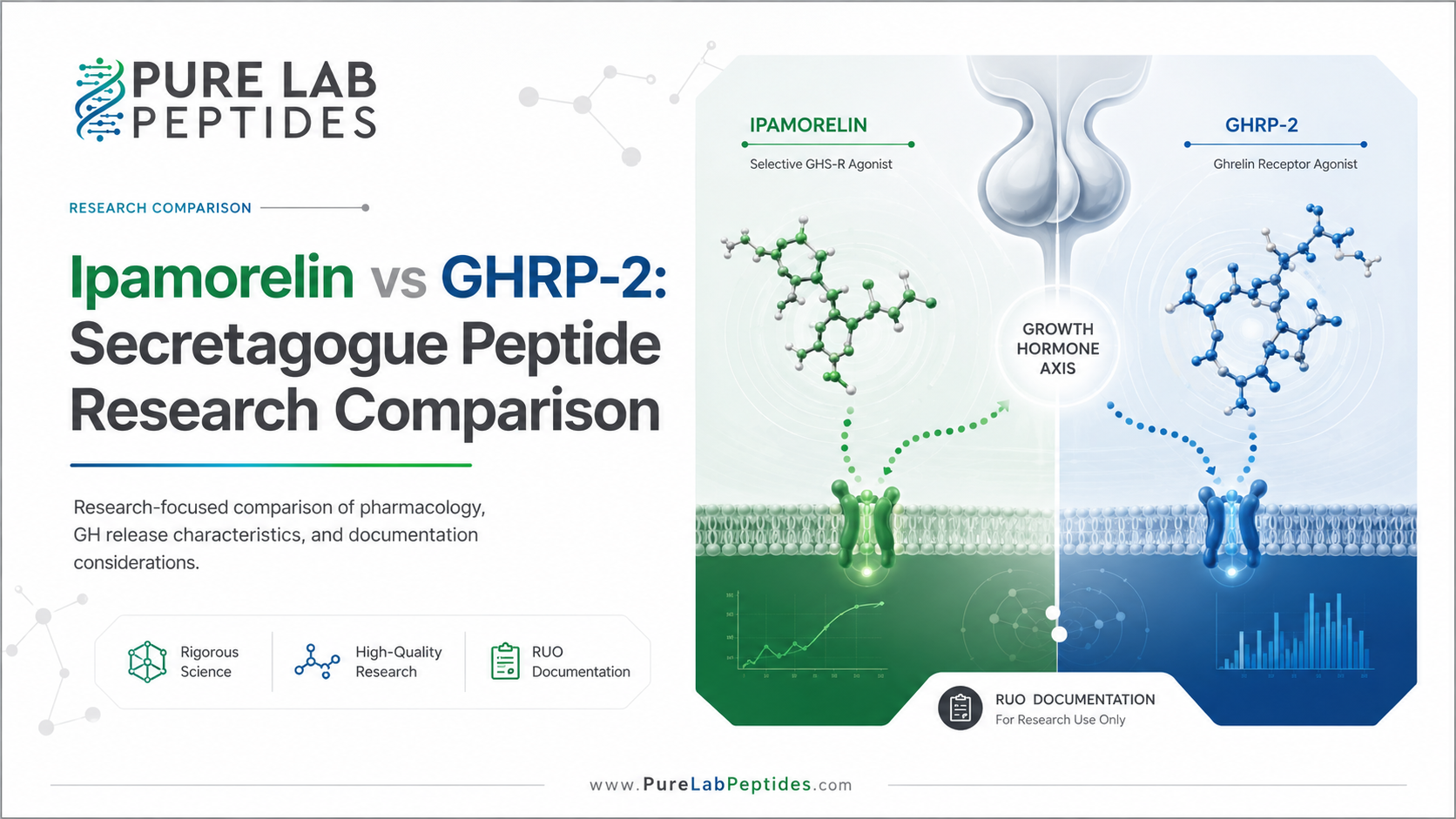
Fast answer: Ipamorelin and GHRP-2 are both synthetic growth hormone secretagogue peptides used in laboratory research. GHRP-2 is more potent (eliciting GH release at lower exposure level) whereas ipamorelin is highly selective for GH release with minimal cortisol/ACTH elevation. Products discussed in this article are intended for laboratory research use only and are not intended for human or animal consumption.
Definition and Compound Profiles
Ipamorelin and GHRP-2 are short synthetic peptides that activate the growth hormone secretagogue receptor (GHS-R1a), a ghrelin receptor on pituitary cells. Ipamorelin (NNC 26-0110) is a pentapeptide (Aib-His-D-2Nal-D-Phe-Lys-NH2) developed to mimic ghrelin’s GH-stimulatory effect. GHRP-2 (also known as KP-102) is a hexapeptide (His-DTrp-D-Ala-Trp-DPhe-Lys-NH2) one of the earliest GHS peptides. Both bind the ghrelin receptor to raise GH levels, but they have distinct biochemical profiles. In laboratory terms, Ipamorelin was reported as the “first selective” GHS peptide because it releases GH similar to growth hormone–releasing hormone, without off-target effects. GHRP-2, by contrast, has high potency but is less selective, affecting multiple hormones.
Mechanism of Action
Ipamorelin and GHRP-2 both act via the GHS-R1a receptor on somatotroph cells to trigger GH secretion. Binding of either peptide to this Gq-coupled GPCR activates phospholipase C, raising intracellular IP3 and calcium levels, which induce vesicular release of GH. Because both mimic the natural ghrelin signal, they engage the same signaling cascade in the pituitary. In preclinical research, this effect is typically measured as a transient GH spike following compound use. GHRP-2, like ghrelin itself, has additional effects (e.g. stimulating appetite), whereas ipamorelin’s action appears limited to GH release.
The diagram below illustrates this signaling pathway:

Text version of this diagram
- Ipamorelin → GHS-R1a Activation.
- GHRP-2 → GHS-R1a Activation.
- GHS-R1a Activation → PLC/IP3 Signaling.
- PLC/IP3 Signaling → Increased intracellular Ca^2+.
- Increased intracellular Ca^2+ → GH Exocytosis (Pituitary).
- GHRP-2 → ACTH & Cortisol Release.
- Ipamorelin → Minimal ACTH/Cortisol Release.
This flowchart shows that both peptides initiate GH release through GHS-R1a, but in animal models GHRP-2 also triggers ACTH/cortisol, whereas ipamorelin does not. In other words, ipamorelin preferentially drives GH secretion, while GHRP-2 produces a broader endocrine response.
Pharmacological Comparison and Preclinical Findings
Published studies compare GHS-R1a binding, receptor selectivity, time-course behavior, and off-target signaling in controlled models. Those findings are useful for mechanism-focused study design but do not establish clinical performance or personal outcomes for an RUO catalog material.
| Comparison area | Ipamorelin literature | GHRP-2 literature |
| Primary receptor | GHS-R1a | GHS-R1a |
| Research emphasis | Receptor selectivity and signaling profile | Potency and broader endocrine signaling profile |
| Procurement evidence | Lot-specific identity and purity documentation | Lot-specific identity and purity documentation |
Analytical and Research Considerations
As research-use-only peptides, Ipamorelin and GHRP-2 require proper quality documentation. A batch-specific certificate of analysis (COA) should accompany each RUO peptide, confirming its identity and purity. Identity is usually confirmed by techniques like mass spectrometry or peptide mapping, since a single HPLC peak is not definitive. Purity is typically assessed by reversed-phase HPLC, and for research peptides a purity specification is often set around 97–99%. For example, an early GMP specification might require ≥97% purity with no impurity >1%. The COA should also report counterion content (e.g. acetate, HCl salt) and water content, since these contribute to total mass balance.
Laboratory researchers should verify that suppliers label these peptides for research use only and provide full analytical data. Critical items to check include the COA (with HPLC chromatogram and MS spectra), lot number consistency, and any stability notes. Neither Ipamorelin nor GHRP-2 has any approved therapeutic use, so all vendor information should avoid human or animal claims. By focusing on documented peptide characteristics (sequence, purity, counterions, moisture) and batch-level verification, a lab can ensure it works with properly characterized GH secretagogues for controlled experiments.
FAQs
What is the main difference between Ipamorelin and GHRP-2?
Both Ipamorelin and GHRP-2 are GH secretagogues, but they differ in potency and selectivity. GHRP-2 is more potent (requiring a lower exposure level to release GH) and can elevate ACTH/cortisol, whereas Ipamorelin is less potent but highly selective for GH release with minimal cortisol impact. In research, Ipamorelin is favored when a cleaner GH signal is needed, and GHRP-2 when a strong secretagogue effect is desired.
How do Ipamorelin and GHRP-2 trigger GH secretion?
Both peptides bind the growth hormone secretagogue receptor (GHS-R1a) on pituitary somatotrophs. This activates intracellular signaling (PLC/IP3/Ca^2+) that causes GH-containing vesicles to fuse with the membrane and release GH. In effect, they mimic ghrelin’s action on the pituitary. The difference is that GHRP-2’s activation is often accompanied by broader endocrine responses, whereas Ipamorelin’s action remains focused on GH.
How are Ipamorelin and GHRP-2 compared in research?
Researchers compare receptor binding, signaling selectivity, time-course behavior, and defined laboratory biomarkers under controlled model conditions. Results remain model-specific and are not product outcome claims.
Do these secretagogues affect other hormones?
In animal studies, GHRP-2 and similar early secretagogues were found to raise ACTH and cortisol at GH-stimulating exposure levels. Ipamorelin is distinct because it does not significantly increase ACTH, cortisol, or prolactin when used at GH-effective exposure levels. Thus, ipamorelin’s effect is limited to the GH axis, whereas GHRP-2 has broader pituitary and adrenal effects.
How should researchers verify the quality of Ipamorelin and GHRP-2?
Researchers should ensure each peptide lot has a certificate of analysis showing identity and purity. Identity confirmation (e.g. by mass spectrometry) is essential, because HPLC peak alone cannot distinguish a peptide from a similar analog. Purity should be high (typically ≥97% by HPLC). The COA should list any counter-ion and water content for mass balance. Verifying lot number consistency and RUO labeling helps ensure the compound is documented for research use only.
Next Steps
Researchers should review batch-specific documentation (COAs, analytical data) before selecting any growth hormone secretagogue for experimentation. Prioritize RUO peptide suppliers that provide detailed purity and identity reports. Pure Lab Peptides offers a catalog of research-grade secretagogue peptides with transparent quality data and strict RUO labeling to support reliable laboratory studies.
References
- Raun K, Hansen BS, Johansen NL, et al. “Ipamorelin, the first selective growth hormone secretagogue.” European Journal of Endocrinology. 1998. doi.org/10.1530/eje.0.1390552
- Laferrère B, Abraham C, Bowers CY, et al. “Growth hormone releasing peptide-2 (GHRP-2), like ghrelin, increases food intake in healthy men.” Journal of Clinical Endocrinology & Metabolism. 2005. doi.org/10.1210/jc.2005-0385
- Swietlow A, Lax R. “Quality control in peptide manufacturing: specifications for GMP.” Chimica Oggi / Chemistry Today. 2004. polypeptide.com