


GHRP-2 vs GHRP-6: Research-Use-Only Peptide Comparison
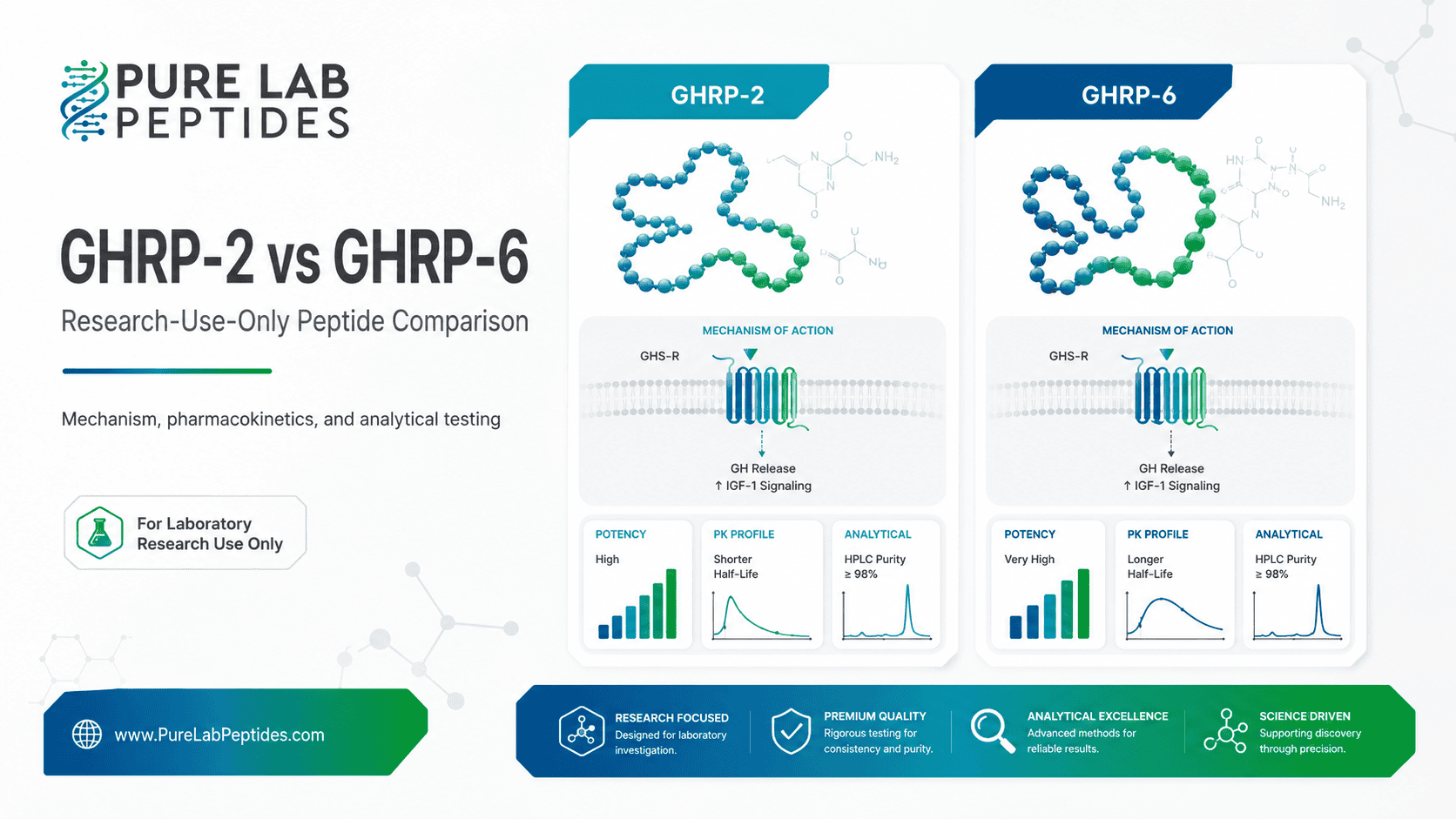
GHRP-2 and GHRP-6 are synthetic hexapeptides that both bind the ghrelin (growth hormone secretagogue) receptor in research studies【46†L65-L68】【7†L169-L174】. Each peptide is used as a research tool to stimulate the growth hormone (GH) axis via GHS-R1a, but they differ in structure, half-life, and metabolic effects. Published studies compare their receptor activity and downstream signaling (see Mermaid diagram) and note that GHRP-6 often induces stronger appetite-related responses in animal models【34†L109-L117】, whereas GHRP-2 has a shorter duration of action in circulation【17†L100-L108】【22†L74-L81】. Both are provided with certificates of analysis and verified by analytical methods for laboratory research use only.
Fast Answer
Both GHRP-2 and GHRP-6 are research-grade growth hormone secretagogues that act on the same ghrelin receptor. They share similar mechanisms of action (activating GHS-R1a to release GH), but GHRP-2 has a shorter systemic half-life and relatively milder orexigenic effect, while GHRP-6 tends to cause more appetite stimulation in preclinical models【46†L65-L68】【34†L109-L117】. Products discussed in this article are intended for laboratory research use only and are not intended for human or animal consumption.
Definitions and Research Context
GHRP-2 (pralmorelin) and GHRP-6 (growth hormone releasing peptide-6) are synthetic peptides belonging to the growth hormone secretagogue (GHS) family. GHRP-6 was first described in 1994 and has the amino acid sequence His-(D-Trp)-Ala-Trp-(D-Phe)-Lys-NH2【22†L97-L100】. GHRP-2 is a structurally related analog that includes an N-terminal pyroglutamate modification (pyr-His-(D-Trp)-Ala-Trp-(D-Phe)-Lys-NH2). Both peptides were originally developed to probe the regulation of the GH axis and are now used in preclinical research on GH release and cytoprotection【7†L169-L174】. GHRP compounds have broad safety profiles in research settings and have been investigated for cellular protective effects in cardiac, neuronal, and other tissues【7†L169-L174】.
Mechanisms and Receptor Binding
Both GHRP-2 and GHRP-6 act as agonists at the growth hormone secretagogue receptor, GHS-R1a, which is a G-protein-coupled receptor expressed in hypothalamus and pituitary. A comparative study in rat pituitary cells confirmed that GHRP-2 stimulates GH release via the same receptor and intracellular mechanism as GHRP-6【46†L65-L68】. Upon binding GHS-R1a, these peptides activate the Gq/11-PLC pathway (increasing intracellular IP3 and Ca2+) leading to pulsatile GH secretion【46†L65-L68】. In addition, GHRP-2 and GHRP-6 are known to bind a second receptor, CD36 (a scavenger receptor), in peripheral tissues【7†L169-L174】. Engagement of CD36 triggers PI3K/Akt survival signaling and cytoprotective effects in cells under stress【7†L169-L174】. The diagram below summarizes the receptor targets and downstream pathways for GHRP-2/GHRP-6:
Figure: Flowchart of GHRP-2/GHRP-6 signaling pathways in laboratory research (adapted from published mechanistic studies【7†L169-L174】【46†L65-L68】).
Pharmacology and Preclinical Effects
In research studies, both peptides show potent GH-releasing activity when administered in vitro or in vivo. A direct comparison in rat pituitary cells showed that combining GHRP-2 and GHRP-6 produced no additive effect beyond either peptide alone, indicating overlapping GH secretagogue potency【46†L65-L68】. Published clinical pharmacology data in humans report that GHRP-2 produces a robust GH surge similar to other secretagogues, and GHRP-2 in pediatric trials was generally well tolerated【17†L100-L108】. GHRP-6 similarly induces strong GH release but has been noted for its orexigenic (hunger-stimulating) action. For example, GHRP-6 administration in animal models increases feeding drive and fat deposition; one rodent study noted that ghrelin and GHRP-6 significantly stimulate food intake and weight gain【34†L109-L117】. GHRP-2 can also raise appetite in some contexts, but it is generally considered to have a milder effect on feeding. Importantly, these observations are from controlled research studies and do not translate into consumer usage claims.
| Attribute | GHRP-2 | GHRP-6 |
| Peptide structure | Heptapeptide (pyr-His-DTrp-Ala-Trp-DPhe-Lys-NH2) | Hexapeptide (His-DTrp-Ala-Trp-DPhe-Lys-NH2)【22†L97-L100】 |
| Receptor targets | GHS-R1a and CD36【7†L169-L174】【46†L65-L68】 | GHS-R1a and CD36【7†L169-L174】【46†L65-L68】 |
| GH secretion potency | Strong GH release; synergizes with GHRH【46†L65-L68】 | Strong GH release; similar overall effect【46†L65-L68】 |
| Appetite effect | Moderate (some studies report increased hunger) | High (noted to increase food intake in animal studies【34†L109-L117】) |
| Elimination half-life (IV, human) | ~0.5 hours (33 min)【17†L100-L108】 | ~2.5 hours【22†L74-L81】 |
| Primary research focus | GH axis studies; metabolic/endocrine models | GH release and cytoprotection studies; metabolic effects |
The above table summarizes published attributes of each peptide. For example, pharmacokinetic studies found that GHRP-2 is cleared rapidly (elimination t1/2 ≈0.55 h) when given intravenously【17†L100-L108】, whereas GHRP-6 shows a longer elimination half-life (~2.5 h)【22†L74-L81】. Both peptides exhibit robust GH-releasing activity with GHRH, but GHRP-6’s prominent orexigenic profile has been documented in preclinical literature【34†L109-L117】. In research protocols, these differences can influence experimental design (e.g. timing of sampling), but they do not imply therapeutic use.
Analytical Characterization and Quality Control
As with all research peptides, GHRP-2 and GHRP-6 are supplied with detailed Certificates of Analysis (COAs) to verify identity and purity. Standard analytical methods include reversed-phase HPLC and mass spectrometry. For instance, published pharmacokinetic studies quantified GHRP-6 in plasma using a validated LC–MS method【22†L68-L76】. Peptide COAs typically report the sequence, molecular weight, purity percentage (by HPLC), mass spec data, and a representative chromatogram【57†L43-L49】. By following vendor documentation, researchers can confirm that GHRP peptides meet expected quality standards. Any additional impurities (e.g. solvent, counterions) are usually quantified, especially if peptides were produced by cGMP processes【57†L43-L49】. When planning experiments, labs should review batch-specific COAs and, if needed, perform independent identity tests (e.g. MS/MS sequencing or amino acid analysis) on received materials to ensure analytical compliance.
Implications for Research Use
For laboratory research, choosing between GHRP-2 and GHRP-6 often depends on the specific study goals. If a short-acting GH secretagogue is needed, GHRP-2’s rapid clearance might be advantageous. If studying metabolic pathways related to appetite or tissue cytoprotection, GHRP-6’s orexigenic and cardioprotective profile might be more relevant. Both peptides require careful handling as RUO materials: use appropriate solvents, avoid peptide degradation, and refer only to peer-reviewed literature for context【46†L65-L68】【34†L109-L117】. Researchers should strictly avoid extrapolating any preclinical findings to humans or animals outside the lab setting. In all cases, ensure that purchased GHRP-2 or GHRP-6 products are clearly labeled as research-use-only and accompany thorough documentation like COAs and analytical reports【57†L43-L49】.
FAQs
How do GHRP-2 and GHRP-6 differ mechanistically in lab research?
GHRP-2 and GHRP-6 are functionally very similar: both are ghrelin receptor (GHS-R1a) agonists that stimulate GH release via intracellular signaling【46†L65-L68】. They also both engage the CD36 receptor for cytoprotective signaling【7†L169-L174】. No distinct new pathways have been identified that one activates independently of the other. Key reported differences lie in their pharmacokinetics and secondary effects (e.g. GHRP-6 tends to trigger stronger hunger signals in animal studies【34†L109-L117】, whereas GHRP-2 is shorter acting). However, the core mechanism of GH-axis activation is shared【46†L65-L68】.
What receptors do GHRP-2 and GHRP-6 bind in research models?
Both GHRP-2 and GHRP-6 bind the growth hormone secretagogue receptor type 1a (GHS-R1a), often called the ghrelin receptor【46†L65-L68】. This binding activates pituitary GH release. In addition, research has shown they also bind the scavenger receptor CD36 in peripheral tissues【7†L169-L174】. CD36 engagement leads to PI3K/Akt pathway activation and cytoprotective effects in preclinical models【7†L169-L174】. No studies indicate binding to receptors outside this GHSR1a/CD36 pathway for these peptides.
How do the half-lives of GHRP-2 and GHRP-6 compare?
Pharmacokinetic studies indicate that GHRP-2 is eliminated from blood much faster than GHRP-6. For example, an intravenous study found GHRP-2’s beta-phase half-life is around 0.55 hours (33 minutes)【17†L100-L108】. By contrast, GHRP-6’s elimination half-life in humans was reported as about 2.5 hours【22†L74-L81】. These rapid clearance rates (minutes to a few hours) are typical for synthetic peptides. In experimental design, this means GHRP-2 effects are shorter-lived than GHRP-6, which may influence sampling times in assays.
How are GHRP-2 and GHRP-6 verified for purity and identity?
Labs verify GHRP peptide identity and purity using analytical methods like HPLC and mass spectrometry【22†L68-L76】【57†L43-L49】. Reputable suppliers provide a COA with each batch that lists the peptide’s amino acid sequence, molecular weight, observed purity (e.g. >98% by HPLC), and MS confirmation【57†L43-L49】. Researchers should review these COAs, which often include chromatograms and MS spectra. If needed, additional QC (like MS/MS sequencing or amino acid analysis) can confirm the structure. Both peptides should match expected analytical profiles before use in experiments.
Why might a researcher choose GHRP-2 over GHRP-6, or vice versa?
The choice depends on study needs. GHRP-2’s faster clearance may be useful when a brief GH spike is desired, and its milder appetite effect might be preferred in metabolic models. GHRP-6’s longer action and stronger effect on feeding make it useful for studying appetite regulation and tissue protection. Both should only be compared in terms of lab results; published data do not support any human or animal use outside controlled research. In any case, researchers should obtain detailed COAs and follow RUO guidelines when selecting either peptide.
Next Steps
Review batch-specific documentation before selecting any research peptide. Explore Pure Lab Peptides for RUO peptide compounds with transparent labeling, detailed research-focused product information, and accessible quality documentation (COAs, spectra, etc.).
References
- Berlanga-Acosta J, Abreu-Cruz A, García-del Barco Herrera D, et al. “Synthetic Growth Hormone-Releasing Peptides (GHRPs): A Historical Appraisal of the Evidences Supporting Their Cytoprotective Effects.” Clinical Medicine Insights: Cardiology. 2017. doi.org/10.1177/1179546817694558
- Pihoker C, Kearns GL, et al. “Pharmacokinetics and Pharmacodynamics of GHRP-2: A Phase I Study in Children.” Journal of Clinical Endocrinology & Metabolism. 1998. doi.org/10.1210/jcem.83.4.4744
- Cabrales A, Gil J, Fernández E, et al. “Pharmacokinetic study of Growth Hormone-Releasing Peptide 6 (GHRP-6) in nine male healthy volunteers.” European Journal of Pharmaceutical Sciences. 2013. doi.org/10.1016/j.ejps.2012.10.006
- Cheng J, Wu T, Butler B, Cheng K. “A comparison of the growth hormone releasing activities of GHRP-2 and GHRP-6 in rat primary pituitary cells.” Life Sciences. 1997. doi.org/10.1016/S0024-3205(96)00655-8
- Granado M, García-Cáceres C, Frago LM, et al. “The Positive Effects of Growth Hormone-Releasing Peptide-6 on Weight Gain and Fat Mass Accrual Depend on the Insulin/Glucose Status.” Endocrinology. 2010. doi.org/10.1210/en.2009-1394
- AmbioPharm, Inc. “What data is provided on the Certificate of Analysis (CoA)?” AmbioPharm FAQ. 2023. ambiopharm.com/faq/data-provided-on-certificate-of-analysis/