


GLP-1 Receptor Research in Laboratory Models
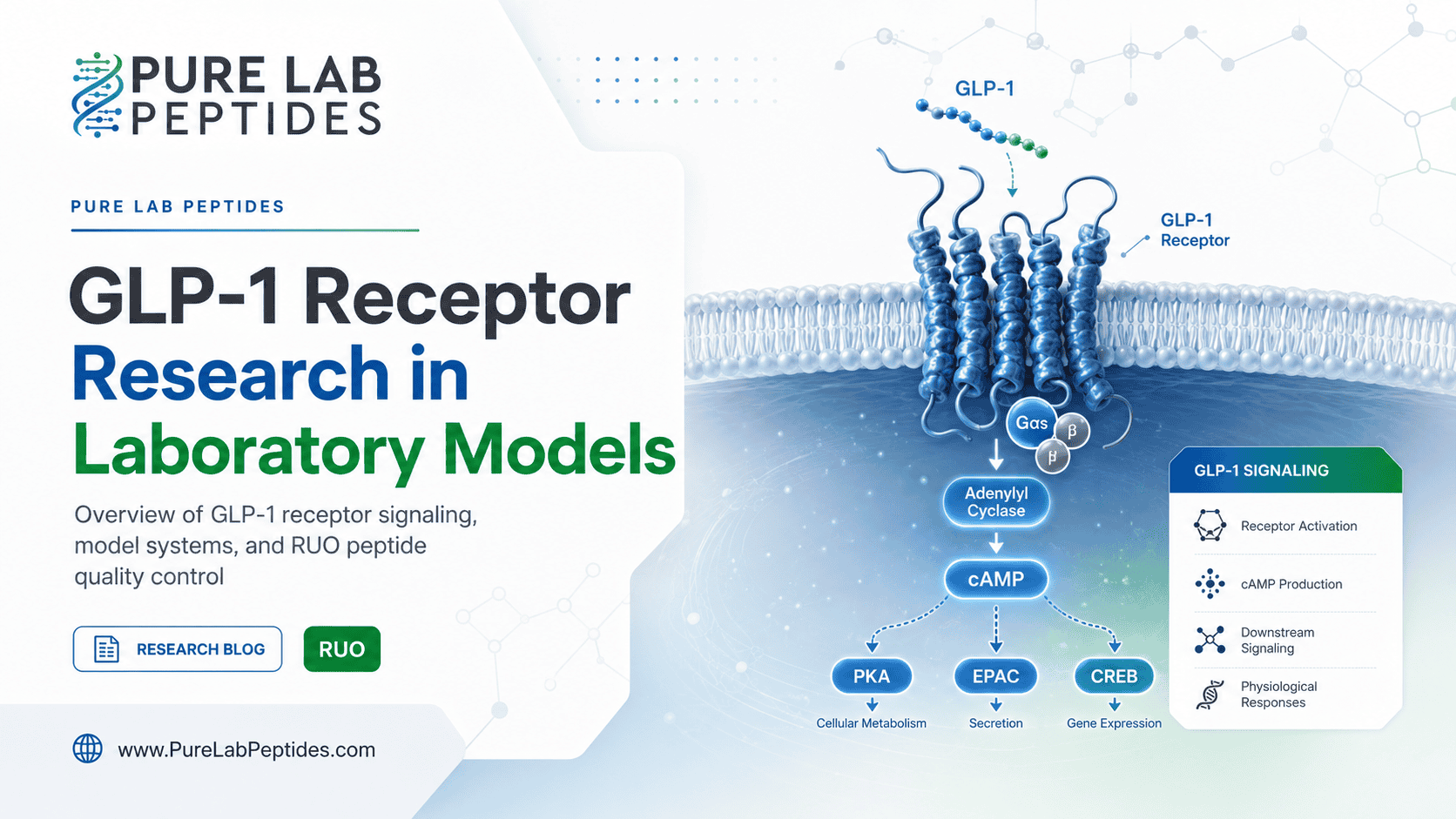
The glucagon-like peptide-1 receptor (GLP-1R) is a class B G protein-coupled receptor activated by the incretin hormone GLP-1. In research settings, GLP-1R is studied in metabolic and cellular signaling contexts (not human therapy). GLP-1 itself is produced by intestinal L-cells (and pancreatic α-cells and certain brain neurons)【33†L63-L70】. In vitro and animal studies use GLP-1 or its analogs to probe GLP-1R signaling. This article provides an evidence-based overview of GLP-1 receptor research in laboratory models. All discussed compounds are research-use-only.
Fast Answer
GLP-1 receptor research in laboratory models focuses on understanding the receptor’s signaling pathways and biological roles. In brief, GLP-1 binds GLP-1R to activate Gαs-mediated cAMP/PKA pathways in cells, affecting insulin secretion, glucagon suppression, and other cellular responses. Products discussed in this article are intended for laboratory research use only and are not intended for human or animal consumption.
GLP-1 Receptor Structure and Function
The GLP-1 receptor is a seven-transmembrane GPCR in the class B family. It is activated by GLP-1 (typically GLP-1(7-36)amide), a peptide derived from proglucagon in enteroendocrine cells【33†L63-L70】. GLP-1R is expressed in pancreatic β-cells and in various tissues (including brain, heart, lung, and gastrointestinal tract)【33†L69-L77】【8†L164-L172】. In β-cells, GLP-1R stimulation augments glucose-induced insulin release. At the molecular level, GLP-1 binding induces a conformational change that triggers G protein signaling【13†L249-L258】【33†L69-L77】. GLP-1R is often studied in human cell lines (e.g. HEK293 cells transfected with GLP1R or pancreatic β-cell lines like INS-1) to analyze ligand binding and activation under controlled conditions【33†L69-L77】. GLP-1R agonists such as exendin-4 (Ex-4) are common research ligands; Ex-4 is a naturally occurring GLP-1 mimic identified from the Gila monster that potently activates GLP-1R【33†L69-L77】. These research agonists are used to probe receptor pharmacology, but must be sourced with certificate-of-analysis confirmation of purity and identity.
GLP-1R Signaling Pathways
Upon GLP-1 binding, GLP-1R couples to the stimulatory G protein (Gs). The activated Gαs subunit dissociates from Gβγ and stimulates adenylyl cyclase (AC) to produce cyclic AMP【13†L249-L258】. The rise in cAMP activates protein kinase A (PKA) and the exchange protein Epac2, which then phosphorylate downstream targets【13†L259-L264】. This cAMP/PKA cascade modulates ion channels, gene transcription, and exocytosis. For example, in β-cells PKA phosphorylation of CREB promotes insulin gene transcription, while PKA and Epac stimulate calcium influx and granule fusion, increasing insulin secretion【13†L259-L264】【33†L69-L77】. These signaling events have been detailed in live-cell studies: for instance, GLP-1R ligand binding triggers AC and cAMP nanodomains that robustly activate PKA in the cell【13†L249-L258】【13†L259-L264】. In summary, the GLP-1R pathway in lab models follows the classic Gs-cAMP-PKA route (and may engage Gαq or Gαi to minor extents in some contexts)【13†L249-L258】. The flowchart below schematizes this core pathway.
GLP-1 release from intestinal L-cells
GLP-1 binds GLP-1R
Activates Gs protein
Adenylyl cyclase activation
↑ cAMP
PKA activation
Epac activation
↑ Ca²⁺, insulin secretion
Show code
Flowchart: GLP-1 receptor signaling cascade in pancreatic β-cells. The flowchart is an editorial synthesis of GLP-1R activation leading to cAMP-mediated PKA and Epac2 signaling.
Laboratory Models for GLP-1R Research
Researchers use various in vitro and in vivo models to study GLP-1R. Common cell systems include pancreatic β-cell lines (e.g. INS-1, MIN6) that naturally express GLP-1R, and heterologous cells (e.g. HEK293) transfected with human GLP1R, to assay receptor binding and signaling. In vivo, mouse and rat models are widely employed. Wild-type rodents are treated with GLP-1R agonists to study physiological effects (e.g. glucose tolerance tests). Genetic models include GLP-1R knockout (Glp1r–/–) mice and, recently, a “humanized” GLP-1R mouse. The knockout mice have helped delineate GLP-1R’s role: for example, Glp1r–/– mice resist high-fat diet–induced insulin resistance, showing enhanced muscle glucose uptake and Akt/AMPK signaling【4†L321-L329】. The humanized GLP-1R mouse carries the human receptor gene, enabling evaluation of small-molecule GLP-1R modulators that do not activate rodent GLP-1R【23†L64-L70】. Table 1 summarizes key GLP-1R models and findings.
| Preclinical Model | Key Findings |
| GLP-1R knockout mouse (Glp1r–/–) | Protected from diet-induced insulin resistance; exhibited increased muscle glucose uptake and enhanced Akt/AMPK signaling【4†L321-L329】. |
| Humanized GLP-1R mouse | Expresses human GLP-1R in place of mouse receptor; improves translation of drug effects (rodent GLP-1R is less sensitive to some ligands)【23†L64-L70】. |
| β-cell lines (e.g. INS-1, MIN6) | In vitro systems show GLP-1R activation raises cAMP/PKA, enhancing insulin secretion and β-cell proliferation【33†L77-L84】【13†L259-L264】. |
| Alzheimer’s disease rodent model | GLP-1R agonist treatment reduced amyloid pathology and neuroinflammation, improving cognitive behaviors【35†L1597-L1600】. |
Analytical Characterization and Documentation
For any GLP-1–related peptide used in research, stringent quality control is essential. Peptide identity and purity should be confirmed by analytical methods such as HPLC chromatography and mass spectrometry. Suppliers typically provide a certificate of analysis (COA) for each peptide lot, detailing purity (often ≥95%) and confirming sequence identity. Researchers should review this batch-specific documentation before use. High-quality GLP-1 analogs (e.g. native GLP-1(7-36)amide, Exendin-4) are synthesized under GMP-like conditions even for RUO use, and come with certificates verifying low impurity levels. Analytical methods also test stability; for example, GLP-1 peptides lack DPP-4 cleavage sites for extended half-life in vivo (a design consideration noted in peptide modifications【33†L69-L77】). Overall, reliable GLP-1R research relies on using well-characterized peptides with accessible COAs, plus validated bioassays to confirm receptor engagement (e.g. dose-dependent cAMP generation in GLP-1R reporter assays).
FAQs
What is GLP-1 receptor and why is it studied in research?
GLP-1 receptor (GLP-1R) is a G protein–coupled receptor activated by the hormone GLP-1. In the lab, researchers study GLP-1R to understand signaling pathways and metabolism, rather than to treat patients. GLP-1R is especially important in pancreatic β-cells, where its activation increases insulin secretion. It is studied in cell cultures and animal models to probe its effects on cAMP/PKA signaling and metabolic regulation【33†L69-L77】【13†L259-L264】.
How do researchers model GLP-1 receptor signaling in vitro?
In vitro models include β-cell lines (INS-1, MIN6) and transfected cells expressing GLP-1R. These systems allow measurement of GLP-1R activation by monitoring cAMP production or reporter gene activity. For example, GLP-1 binding to GLP-1R on these cells triggers Gs-mediated cAMP increase and PKA activation, which can be quantified. Such assays provide controlled settings to evaluate GLP-1R agonists and antagonists at the receptor level【13†L249-L258】【13†L259-L264】.
What have GLP-1R knockout mice revealed?
Glp1r–/– mice lack functional GLP-1R. Studies have shown these mice exhibit altered glucose metabolism. For instance, one report found that knockout mice on a high-fat diet were protected against muscle insulin resistance, showing higher muscle glucose uptake and activated Akt signaling【4†L321-L329】. This indicates GLP-1R normally modulates insulin action in muscle and liver, highlighting its role in glucose disposal in preclinical models.
Why use humanized GLP-1R mice?
Rodent GLP-1R has some pharmacological differences from human GLP-1R, especially with small-molecule ligands. Humanized GLP-1R mice have the human receptor gene, enabling more accurate preclinical testing of compounds intended for human GLP-1R. This model bridges the gap between basic research and clinical drug development【23†L64-L70】.
What key data should a GLP-1 peptide certificate of analysis include?
A GLP-1 peptide COA should report the peptide’s purity (via HPLC), confirmation of molecular weight (via mass spectrometry), and sequence identity. It may also include tests for endotoxin or other impurities. Researchers should verify the peptide lot meets these specifications and note any provided structural or stability data. All documentation is critical to ensure reproducibility of experimental results.
Are GLP-1R agonists studied in neurological models?
Yes. Preclinical studies have evaluated GLP-1R agonists in models of neurodegeneration. For example, in a mouse model of Alzheimer’s disease, GLP-1R agonist treatment reduced amyloid plaque load and neuroinflammatory markers, and improved memory-related behaviors【35†L1597-L1600】. These findings are purely mechanistic/preclinical and do not imply clinical efficacy; they demonstrate how GLP-1R signaling can be probed in diverse lab models.
Next Steps
Review batch-specific documentation before selecting any research-use-only GLP-1 peptide. Ensure each peptide has a detailed certificate of analysis and documented purity. For further resources, explore Pure Lab Peptides for RUO compounds with transparent labeling and available documentation. Prioritize suppliers that emphasize clear analytical data and RUO compliance for GLP-1 research applications.
References
- Doyle ME, Egan JM. “Mechanisms of action of glucagon-like peptide 1 in the pancreas.” Pharmacol Ther. 2007. doi.org/10.1016/j.pharmthera.2006.11.007
- Austin G, Tomas A, et al. “Signaling architecture of the glucagon-like peptide-1 receptor.” J Clin Invest. 2026. doi.org/10.1172/JCI194752
- Duffet L, Williams ET, et al. “Optical tools for visualizing and controlling human GLP-1 receptor activation with high spatiotemporal resolution.” eLife. 2023. doi.org/10.7554/eLife.86628.3
- Ayala JE, Bracy DP, et al. “Glucagon-like peptide-1 receptor knockout mice are protected from high-fat diet–induced insulin resistance.” Endocrinology. 2010. doi.org/10.1210/en.2010-0289
- Sonne N, Roque M, et al. “Generation and characterisation of a humanised GLP-1 receptor mouse model for translational drug development.” eBioMedicine. 2026. doi.org/10.1016/j.ebiom.2026.106121
- Zheng Z, Ma Y, Tian Y, Pang Y, Zhang C, Gao J. “GLP-1 receptor: mechanisms and advances in therapy.” Sig Transduct Target Ther. 2024. doi.org/10.1038/s41392-024-01931-z