



Peptide Half-Life: How to Read Stability and PK Results

TL;DR · The short version
Peptide half life describes a defined amount or concentration falling by half under stated conditions. Identify what was measured, where and by which assay before comparing estimates. Tube stability, plasma concentration and biological response duration answer different questions.
A chart of names and hours looks straightforward until it mixes incubated samples with human pharmacokinetics. The number needs its setting to remain useful.
Find the endpoint before copying the estimate. It gives the rest of the paper a clearer reading route.
What does a peptide half-life actually measure?
Takeaway: Half-life needs a named measurement and a defined setting. A peptide name alone is not enough.
IUPAC’s biological half-life definition describes the reduction of an amount by half through biological processes, approximately following exponential behavior. In peptide research, the measured quantity might be intact material in a prepared sample or a concentration recorded during a pharmacokinetic study.
A simplified example: imagine a measurement falling from 100 to 50 units in one interval, then from 50 to 25 in the next. If the same decay behavior continues, those intervals represent the same half-life. This is an illustration, not a peptide result. It assumes a consistent process with no new input; actual study curves need their own model and uncertainty.
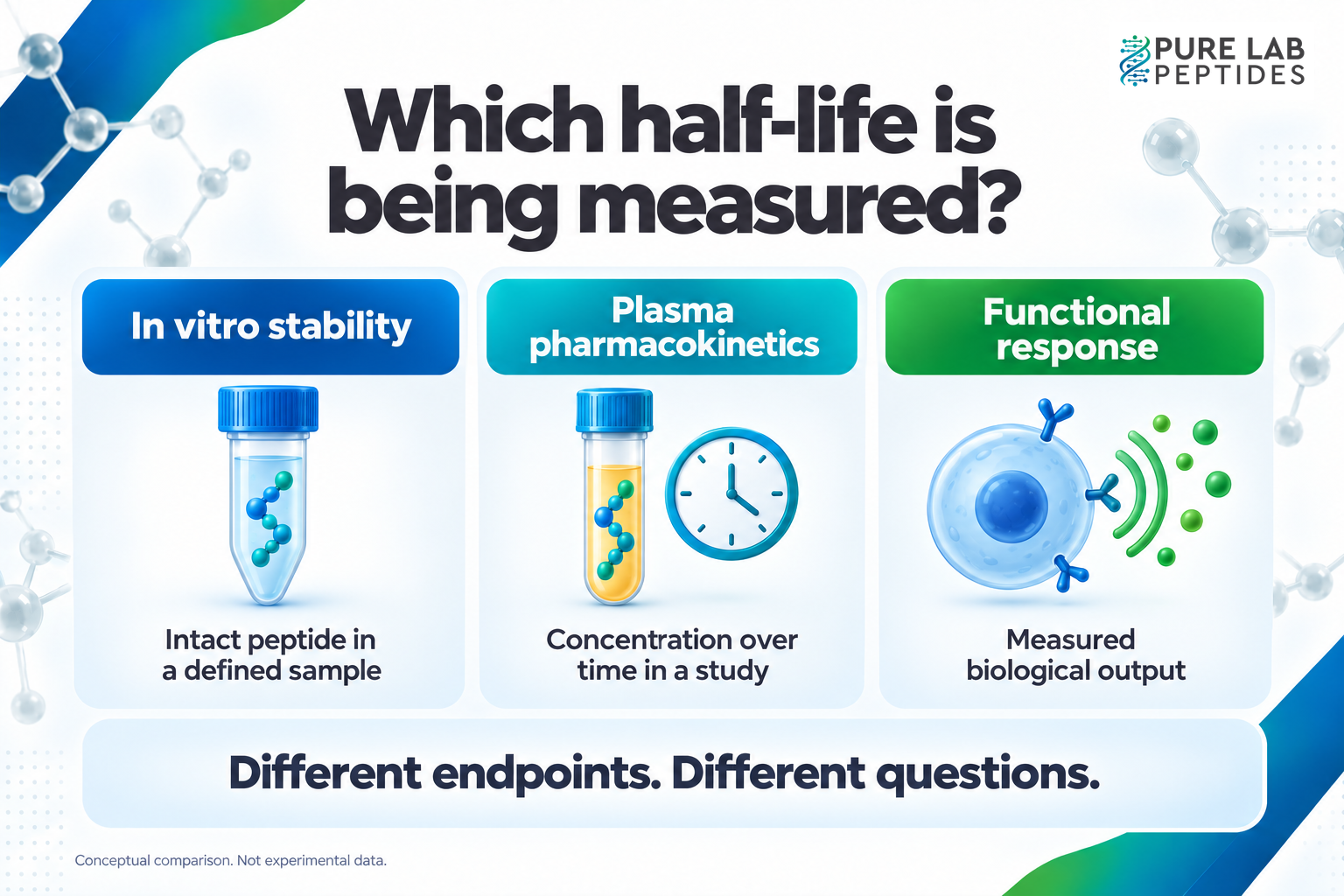
Three questions that should stay separate
Takeaway: Ask whether the number describes sample stability, plasma pharmacokinetics or a functional response.
| Question | What to look for | What the result cannot establish alone |
|---|---|---|
| How much intact peptide remains in this sample? | Sample matrix, temperature, starting concentration, collection times and an intact-material assay | A circulating half-life in a person |
| How does plasma concentration change during this study? | Studied molecular form, population, sampling schedule, assay and fitted pharmacokinetic phase | How long every biological effect lasts |
| How long does the measured response persist? | The named response, comparator, time course and measurement method | The amount of intact peptide still present |
Underline what the assay measured: intact peptide, immunoreactivity, plasma or hormone concentration, or another response. If that definition is missing, leave the estimate out of a direct comparison.
This is also why a storage instruction and a plasma half-life should not share a label. Our peptide stability guide covers the storage and degradation questions separately.
The assay can change what the number means
Takeaway: Check whether the assay distinguishes the intact peptide from its metabolites.
In Deacon and colleagues’ 1995 GLP-1 experiment, researchers used chromatography and radioimmunoassays to examine intact GLP-1 and a shortened metabolite. Some antibody measurements recognized both forms. The study reported a half-life of about 20.4 minutes for intact GLP-1 incubated in human plasma in vitro at 37°C. That is a specific sample experiment, not a universal circulating half-life.
Read the detected species beside the method. An assay signal may include more than the peptide named in the heading, so the name alone can’t define the measured quantity.
If the paper uses chromatograms to make that distinction, our HPLC reading guide explains how to follow the method and peak information. For a broader comparison, see HPLC, LC-MS and NMR testing methods.
Why a GHRH analog needs a precise identity
Takeaway: Keep the studied analog and its pharmacokinetic endpoint attached to the result.
Teichman and colleagues’ 2006 CJC-1295 trials studied a long-acting GHRH analog in healthy adults. They estimated a CJC-1295 half-life of 5.8 to 8.1 days and separately followed growth hormone and IGF-I concentrations. Those hormone measurements describe responses; they are not interchangeable with the peptide’s pharmacokinetic estimate.
A GHRH-analog label doesn’t identify the modified construct behind a duration estimate. Check the original material before carrying a long-acting result to another analogue or catalogue specification.
That extra identity detail often explains why two estimates appear to conflict.
A useful record for comparing published results
Takeaway: Save the conditions beside the estimate, so the number remains interpretable later.
The original 2016 PEPlife paper retained sequence, modifications, biological sample and assay information alongside peptide half-life records. Its organization is a useful reminder that these details belong with the result.
For your own notes, use one row per study result:
- Identity: the sequence or named analog, with relevant terminal and other modifications.
- Setting: the sample matrix or study population, plus the conditions being compared.
- Measurement: the assay, detected species and reported units.
- Time course: collection points, fitted phase and any uncertainty supplied by the authors.
- Provenance: the original paper and the specific figure, table or methods section.
Mark an unclear field as missing. A plausible replacement value makes the table look complete without strengthening its comparison.
When a chart provides only name and duration, find the cited study before treating the estimate as a fixed material property. The reading peptide research walks through that source check.