 Skip to content
COA Considerations for BPC-157: Ensuring Research Quality
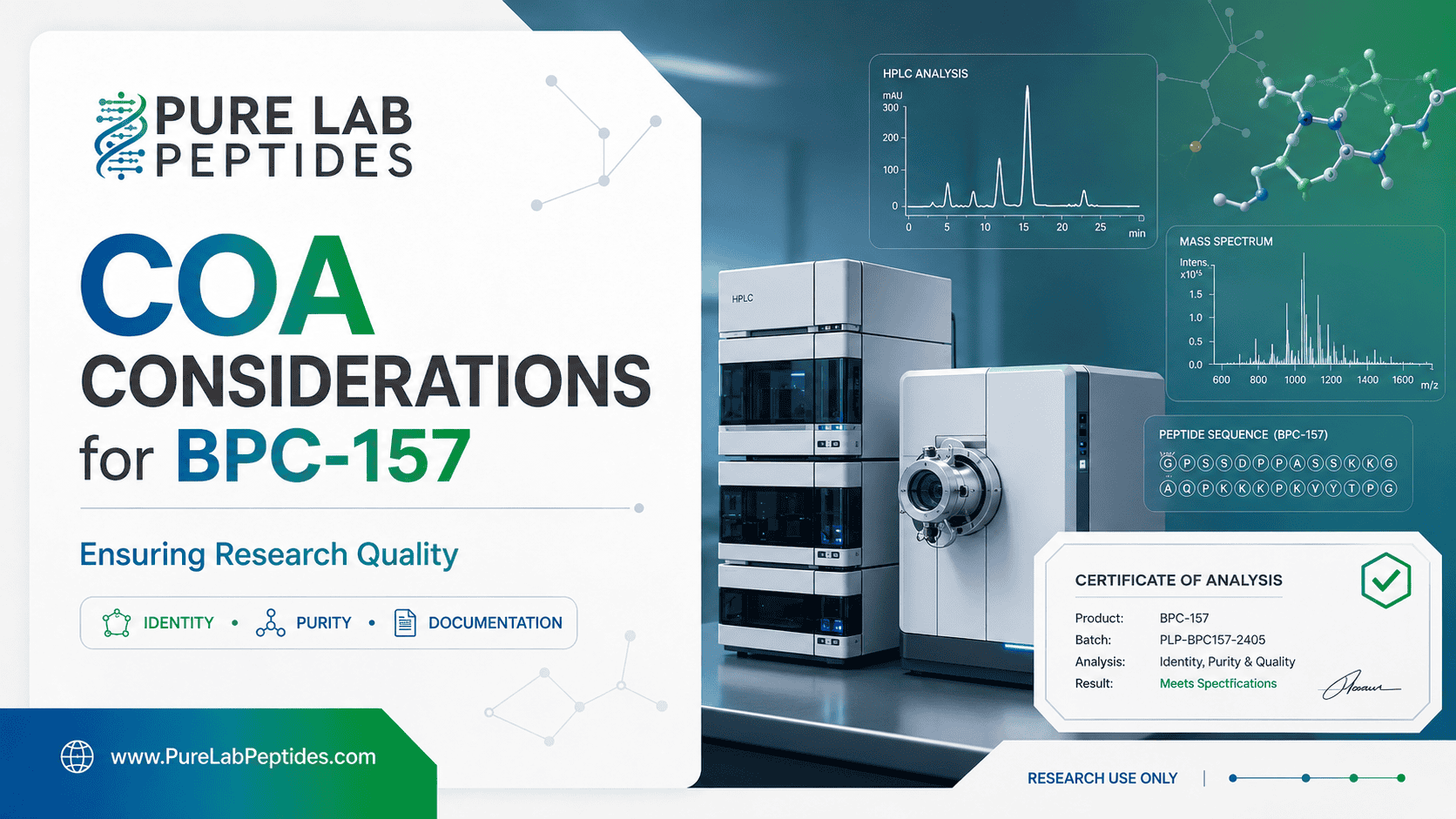
For researchers using BPC-157 as a research peptide, verifying batch quality through a Certificate of Analysis (COA) is essential. The COA documents the analytical tests that confirm the peptide’s identity and purity, and provides safety data (e.g. endotoxin levels) for that specific lot. This article explains key COA elements for BPC-157, including required analytical methods and standards, to help laboratories select high-quality peptide research materials for in vitro and preclinical work.
Fast Answer
Fast Answer: Certificates of Analysis (COAs) for BPC-157 document identity and purity testing, confirming that the peptide matches its expected sequence and quality. They typically include analytical data (HPLC chromatograms, mass spectrometry results, etc.) for the specific lot. Products discussed in this article are intended for laboratory research use only and are not intended for human or animal consumption.
BPC-157 and Research Context
BPC-157 is a 15-amino-acid peptide fragment originally identified in human gastric juice. It is unusually stable for a peptide, remaining intact under conditions (acidic gastric fluid) that rapidly degrade most peptides. This stability and high purity make it suitable for use in research models. In any study, researchers must verify the primary sequence of BPC-157 (Gly-Glu-Pro-Pro-Pro-Gly-Lys-Pro-Ala-Asp-Asp-Ala-Gly-Leu-Val) and its purity. According to quality standards, critical attributes include the correct sequence and minimal impurities. The COA provides the evidence for these attributes for each batch of peptide used in the laboratory.
COA Components: Identity and Purity
A peptide COA typically includes tests for identity and purity. Identity tests must be “highly specific” and often use more than one method. For BPC-157, identity confirmation usually involves mass spectrometry (MS) and/or chromatographic co-elution with a reference standard. For example, LC-MS (or MALDI-TOF) is used to confirm the molecular weight matches the expected 1419.55 Da for BPC-157. Purity is often evaluated by reverse-phase HPLC: the main peptide peak’s area is reported as a percentage of total chromatogram area. High-quality peptide COAs will show ≥95% purity (with minimal detectable impurities). The COA should list the methods used (e.g. HPLC column type, solvent gradient) and acceptance criteria. Amino acid analysis may also be used to verify composition or net peptide content. Together, these orthogonal tests ensure that the sample is indeed BPC-157 and of acceptable purity before use in research.
Analytical Methods in BPC-157 COAs
Standard analytical methods for peptide COAs include HPLC, mass spectrometry, and sometimes amino acid analysis (AAA). High-performance liquid chromatography (HPLC) is the primary method for assessing peptide purity. A typical HPLC assay for BPC-157 uses a C18 reverse-phase column and a water-acetonitrile gradient; the COA should show a chromatogram with a single main peak (BPC-157) and report % area. Mass spectrometry (LC-MS) provides identity confirmation by detecting the peptide’s mass-to-charge ratio. COAs often include an LC-MS spectrum or report the observed m/z (e.g. [BPC-157+H]^+). Amino acid analysis (AAA) can quantify the peptide’s net content by hydrolyzing to its amino acids, though this method is less common as a COA requirement for synthetic peptides. For safety and quality, additional tests like endotoxin (LAL assay) and microbial limits may be reported.
Regulatory Guidance and Best Practices
While RUO peptides are not regulated as drugs, pharmaceutical guidelines offer relevant best practices. ICH Q6B notes that identity tests “should be highly specific” and may require multiple orthogonal methods. It also recognizes that absolute purity is difficult to define, so purity is assessed by combining methods. Pharmacopoeial monographs (when available) include tests for sterility, endotoxin, and impurity limits. For example, ICH Q6B explicitly advises that pharmacopoeial tests (e.g. endotoxin) be performed on the drug substance as appropriate. In practice, a COA for BPC-157 should reference any applicable monograph or standard methods (even if unpublished) and specify limits (e.g. endotoxin < 0.1 EU/µg). Institutions often expect peptide COAs from ISO/IEC 17025-accredited labs. In summary, COA requirements align with best practices: confirming sequence/mass (identity), purity (HPLC), and safety tests (endotoxin, heavy metals).
COA Checklist for BPC-157
Below is a checklist of key COA attributes and why each matters for BPC-157 research. Higher purity and clear identity reduce confounding variables in experiments. Thorough documentation (methods, batch numbers) ensures traceability.
| COA Parameter | Analytical Method | Purpose/Criteria |
| Identity | LC-MS (mass spec) and/or HPLC retention time | Confirm peptide mass and sequence (BPC-157’s exact m/z). Allows detection of misincorporations. |
| Purity (%) | Reverse-phase HPLC | Measure main peak area; high purity (typically ≥95–98%) ensures minimal contaminants or truncated peptides. |
| Peptide Content | Amino acid analysis or HPLC assay | Determine net peptide content (accounting for water/TFA). Ensures consistent exposure planning of peptide mass in experiments. |
| Counter-ion Residue | HPLC (e.g. USP <503.1> method) | Quantify residual TFA or other salts from synthesis. Important for solubility and toxicity (low levels desired). |
| Endotoxin | LAL assay | Measures bacterial endotoxin. Low levels are required for cell/tissue studies to avoid inflammatory responses. |
| Sterility | Microbial culture or PCR | Confirms absence of microbial contamination if peptide is used in sensitive assays. |
| Batch Info | Document review | Includes lot number, date, and lab accreditation. Ensures traceability to synthesis records. |

Text version of this diagram
- Order BPC-157 peptide → Receive batch-specific COA.
- Receive batch-specific COA → Verify identity via LC-MS (expected m/z).
- Verify identity via LC-MS (expected m/z) → Assess purity by HPLC (main peak ≥ 95% area).
- Assess purity by HPLC (main peak ≥ 95% area) → Check additional data: endotoxin, residual salts.
- Check additional data: endotoxin, residual salts → Ensure batch meets research-quality standards.
Figure: Workflow for verifying BPC-157 batch quality via COA analysis (illustrative).
FAQs
What does a BPC-157 COA show about purity?
A COA for BPC-157 typically reports purity as the percentage of the target peptide peak in an HPLC chromatogram. A purity ≥95% indicates that most of the sample is BPC-157 (with minimal other peaks). This metric helps researchers gauge whether there are significant synthetic byproducts. If purity is low or multiple peaks appear, that batch may not be suitable for research-grade work.
How is BPC-157 identity confirmed on a COA?
The COA should include a test demonstrating the peptide’s identity. Commonly, this is done by liquid chromatography–mass spectrometry (LC-MS), showing the correct mass/charge ratio for BPC-157. Alternatively, co-elution with a known BPC-157 standard in HPLC can be used. Identity tests ensure the sequence (15 amino acids for BPC-157) is correct and no major sequence errors occurred during synthesis.
Should I be concerned about BPC-157 stability or storage?
Published data indicate BPC-157 is unusually stable (remaining intact in harsh conditions). As a result, it can often be stored as a lyophilized powder at room temperature without significant degradation. However, COAs still typically include a suggested storage condition (e.g. -20°C or 2–8°C) to maintain maximum stability and avoid moisture exposure. Real-time stability data for reference standards also underscore the importance of protected storage and timely use.
What endotoxin levels are acceptable on a BPC-157 COA?
The COA should report any endotoxin (bacterial LPS) level. For in vitro or cell culture studies, researchers generally look for endotoxin <0.1 EU/µg peptide. This threshold minimizes inflammatory effects in sensitive assays. If endotoxin is higher, researchers may need to further purify or use a different batch. Checking the COA ensures that endotoxin testing was performed and meets these low limits.
Why are batch numbers and dates important on a COA?
Batch information ties the COA to the exact vial purchased. This allows traceability: if any issue arises, the batch number links back to synthesis records (raw materials, purification logs). The date ensures the COA is current (often within 90 days). Having this documentation helps researchers verify that the data applies specifically to their peptide batch, not a generic profile.
What if a COA shows 100% purity for BPC-157?
Occasionally a COA lists “100% purity,” but this often means “no detectable impurities” within instrument resolution. Realistically, synthetic peptides rarely exceed ~98% by HPLC. Very high reported purity should be confirmed by examining the actual chromatogram or MS. A trustworthy COA will include the raw data (chromatogram or spectra) so users can verify the result. Always treat “100%” purity claims with caution and request detailed documentation if needed.
Next Steps
Before using any BPC-157 peptide in research, review the complete batch documentation. Ensure you have a current COA showing identity verification and high purity, along with safety test results. Pure Lab Peptides provides research-grade peptides with clear labeling and downloadable COAs for every lot. For any peptide supplier evaluation, prioritize transparency: choose vendors that offer ISO/IEC 17025-certified testing, batch-level COAs, and full disclosure of analytical methods. This diligence helps secure reliable, reproducible results in the lab.
References
- Sikiric P et al. “Stable gastric pentadecapeptide BPC 157: novel therapy in gastrointestinal tract.” Curr. Pharm. Des. 2011. doi.org/10.2174/138161211796196954
- Whitehouse M. “Concerning BPC-157, a natural pentadecapeptide…”. Inflammopharmacol. 2025. doi.org/10.1007/s10787-025-01882-z
- He L et al. “Pharmacokinetics, distribution, metabolism, and excretion of body-protective compound 157… in rats and dogs.” Front. Pharmacol. 2022. doi.org/10.3389/fphar.2022.1026182
- ICH Expert Working Group. “Q6B: Test Procedures and Acceptance Criteria for Biotechnological/Biological Products.” ICH Harmonized Tripartite Guideline, 1999. ich.org/Q6B_Guideline.pdf
- McCarthy D et al. “Reference Standards to Support Quality of Synthetic Peptide Therapeutics.” Pharm. Res. 2023;40:1317–1328. doi.org/10.1007/s11095-023-03493-1
- Rastogi S et al. “Peptide-based therapeutics: Quality specifications, regulatory considerations…”. Drug Discov Today. 2019;24(1):148–62. doi.org/10.1016/j.drudis.2018.10.005
- AltaBioscience. “Peptide Purification and Product Analysis.” (Peptide QC methods overview) 2023. altabioscience.com/peptide-synthesis-purification
- HolistiCare. “Vetting Peptide Vendors with AI: GMP, Potency, and Lot Traceability Checklist.” 2023. holisticare.io/blog/vetting-peptide-vendors-ai-checklist
- U.S. Food and Drug Administration. “FDA Publishes Revised Draft Product-Specific Guidances for Certain Generic Peptide Products.” FDA Drug Alert. July 28, 2026. fda.gov/revised-peptide-guidances