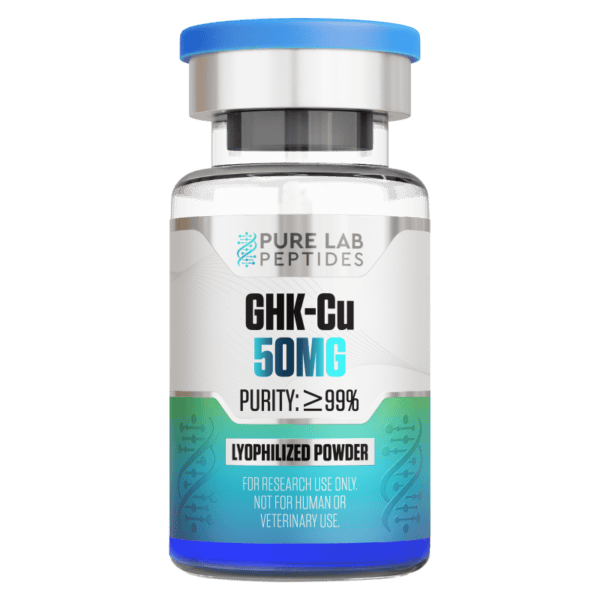

Researchers evaluating GHK-Cu should begin with compound identity, batch-specific documentation, and RUO labeling. GHK-Cu is a copper peptide complex connected to glycyl-L-histidyl-L-lysine records and copper-component records in official chemical databases 1 2 3 . Published studies provide scientific context, while lot-specific records support evaluation of the supplied material.
- GHK-Cu is discussed in research literature as a copper-linked tripeptide complex associated with the GHK sequence, glycyl-L-histidyl-L-lysine [1] [2].
- Research buyers should evaluate the compound name, chemical identity, lot number, COA, testing method, label consistency, and supplier documentation before procurement.
- Published literature can describe model-specific findings, but those findings should not be converted into claims about a research-use-only product.
- Analytical review should pair peptide purity information with identity-supporting data, because purity alone does not fully characterize a peptide material 14 15.
- COA documentation should be batch-specific, method-specific, and traceable to the product listing and label.
Fast Answer: What Should Researchers Check Before They Buy GHK-Cu for Research?
Research teams should verify RUO labeling, the compound name, batch-specific COA, analytical method, purity record, identity record, lot number, and storage documentation before procurement. Products discussed in this article are intended for laboratory research use only and are not intended for human or animal consumption. Published GHK-Cu literature describes model-specific findings, not verified effects of a supplier’s product 6 .
What Documentation Should Come First?
The first review point is the match between the product listing, the label, and the batch-specific certificate of analysis. A useful COA should identify the compound, lot, testing method, testing date, purity result, and source of the analytical record.
Researchers should also check whether the documentation distinguishes peptide purity from peptide identity. HPLC can support purity review, while LC-MS or related mass-spectrometry methods can add identity evidence for synthetic peptide materials [14] [15].
Why Should RUO Labeling Be Reviewed Before Procurement?
RUO labeling identifies the intended research context of the material. FDA guidance for certain laboratory products distinguishes research-phase materials from diagnostic representation; that guidance applies to IVD products and does not establish that a different product category meets those requirements 17 .
What Is the GHK-Cu Peptide in Research Literature?
GHK-Cu is commonly described as a copper peptide complex related to the tripeptide GHK. PubChem lists GHK-Cu as a copper-containing compound and identifies glycyl-L-histidyl-L-lysine as the parent compound in the record [1] [2].
Research literature often discusses GHK and GHK-Cu together because the peptide and copper-complex context are closely connected.
Copper Tripeptide Identity and Research Classification
GHK-Cu is a copper peptide complex. Copper coordination is relevant to its chemical characterization and to interpretation of studies involving the complex.
Classic coordination studies examined interaction between Cu(II) and glycyl-L-histidyl-L-lysine using methods such as potentiometric titration and visible-absorption spectrophotometry 4. Later work compared copper complexes of GHK and synthetic analogues using multiple chemical-characterization methods 5.
Where Does Glycyl-L-Histidyl-L-Lysine Copper Fit?
Glycyl-L-histidyl-L-lysine copper fits as a copper-bound tripeptide research entity. The GHK record gives the peptide sequence context, while the copper record identifies the elemental component that appears in the complex [2] [3].
Why Do Amino Acid Sequence Details Matter?
The amino acid sequence helps researchers confirm that the listed peptide corresponds to the expected GHK identity. PubChem records the GHK sequence as glycyl-histidyl-lysine, which gives a baseline for documentation comparison [2].
Sequence context is not the same as a full analytical confirmation. It is one piece of the documentation file that should be reviewed alongside mass data, chromatographic data, and lot-specific records.
GHK-Cu in Copper Peptide Research
Research on GHK-Cu includes chemical coordination, fibroblast culture models, extracellular matrix studies, and gene-expression analysis.
Cellular Pathway Context for GHK-Cu
Published reviews describe GHK as a naturally occurring tripeptide studied across multiple cellular pathway models [6]. Some literature examines gene-expression signatures, matrix-related pathways, and fibroblast model variables.
Extracellular Matrix Research
Extracellular matrix literature is relevant because several studies have used fibroblast or related cell models to examine matrix-associated variables. One study investigated sulfated glycosaminoglycan synthesis in relation to the GHK-Cu complex 7.
These findings describe the experimental materials and conditions studied, not established effects of a supplier’s product.
Why Should Pathway Relevance Stay Separate From Claims?
Pathway relevance means a compound appears in research models connected to a pathway or biological process. It does not mean a supplier product has been evaluated for the same context.
Published Research on GHK-Cu
Published GHK-Cu research examines compound identity, copper coordination, in vitro models, matrix-related variables, and gene expression. Evaluation of a supplier’s material requires separate batch-specific documentation.
Literature helps readers understand the compound’s research context, while COA and testing records help evaluate the listed material.
What Can Preclinical and In Vitro Literature Show?
Preclinical and in vitro literature can show what researchers investigated under defined model conditions. For example, fibroblast culture studies have examined matrix metalloproteinase-2 expression and related matrix remodeling variables in the context of GHK-Cu 8.
Those findings remain model-specific and do not establish expected performance of a catalog product.
Why Study Context Should Stay Separate From Supplier Claims?
The batch-specific material needs its own COA and identity documentation.
Evidence Interpretation Framework for GHK-Cu Peptide Information
A strong evidence framework prevents overstatement.
| Research Area | What Literature Examines | Evidence Type | RUO Interpretation |
|---|---|---|---|
| Compound identity | GHK-Cu, parent GHK, and copper-component database records [1] [2] [3] | Official database | Supports identity review, not product claims |
| Copper complex chemistry | Cu(II) interaction with glycyl-L-histidyl-L-lysine [4] [5] | Chemical characterization | Supports copper-complex context |
| Matrix-associated cell models | Sulfated glycosaminoglycan synthesis and fibroblast variables [7] [8] | In vitro literature | Model-specific context only |
| Gene-expression analysis | Connectivity Map methods and GHK-related signatures 9 10 11 | Bioinformatics and cell-model literature | Literature interpretation, not supplier claim |
| Analytical verification | LC-MS and LC-HRMS for peptide characterization [14] [15] | Analytical chemistry | Supports identity and impurity review |
Source Quality Filters for Copper Peptide Literature
A good source-quality filter ranks official database records, peer-reviewed studies, review articles, analytical chemistry papers, and official standards above marketing claims. It also asks whether the source describes GHK, GHK-Cu, a related copper complex, or a different peptide entity.
The Connectivity Map literature is useful for understanding gene-expression methods. Lamb and colleagues described the Connectivity Map as a way to connect small molecules, genes, and disease signatures through gene-expression profiles, and Broad’s CMap program describes large-scale perturbational expression profiling [9] [10].
What Uncertainty Signals Should Remain Visible?
Uncertainty signals include model type, limited scope, indirect evidence, source age, and whether the source is a review or original study. These signals help research buyers see the difference between a database fact, a chemical-characterization study, and a biological model.
Reported effects depend on the experimental materials, methods, and model. Findings from one study cannot be assumed to apply to a different preparation or setting.
Why COA Documentation Matters for GHK-Cu
COA documentation matters because it connects the product listing to a specific batch record. It helps researchers review whether the listed peptide material has analytical support.
Official analytical-method guidance emphasizes that validation characteristics are part of a general framework for analytical procedures, and FDA methods guidance discusses documentation that supports identity, quality, purity, and potency in regulated drug and biologic contexts 12 13. For RUO research materials, those sources provide useful analytical concepts without changing the product’s intended research status.
What Should Certificates of Analysis Identify?
Certificates of analysis should identify the compound name, lot number, analytical method, testing date, and reported values. They should also make it possible to connect the COA back to the product label and listing.
If a COA does not match the product record, it should not be treated as strong documentation for that material. Batch matching is the core requirement.
How Do Researchers Review COA Consistency?
Researchers review COA consistency by comparing the product name, lot number, method, date, and analytical result across the label, listing, and COA. If third-party testing is listed, the laboratory identity and report scope should be clear.
ISO/IEC 17025 is a widely used standard for testing and calibration laboratories, and ISO describes it as a way for laboratories to demonstrate competent operation and valid results 16.
Analytical Testing Review for GHK-Cu Peptide
Analytical testing review should combine purity screening with identity support. HPLC, LC-MS, and high-resolution mass spectrometry can each contribute different information when used in a suitable analytical workflow.
The USP notes that peptide standards and analytical reference materials can support method development, method validation, equipment qualification, and quality control for peptide drug substance and product batches 19 . These analytical uses do not establish equivalence between RUO materials and regulated products.
How HPLC Supports Peptide Purity Review
HPLC can support peptide purity review by separating components and generating chromatographic records. A purity percentage should be interpreted with the method, chromatogram, and batch context.
A purity number alone does not establish complete identity. FDA-linked peptide quality research has noted that HPLC-UV methods can be insufficient for distinguishing some peptide impurities or changed peptide sequences [15].
How LC-MS Supports Identity Verification
LC-MS supports identity review by pairing chromatography with mass-spectrometry information. Reviews of peptide LC-MS methods describe the value of mass-spectrometric detection for peptide analysis and quantification 20.
Laboratory documentation verification workflow:
- Verify that the compound name, label, and lot number match across the product listing, COA, and batch record.
- Review the batch-specific COA for testing date, method, and report source.
- Check whether the purity method is listed and whether a chromatographic record is available.
- Confirm whether identity review is supported by LC-MS, HRMS, or another suitable analytical method.
- Review mass data, retention-time context, and method notes when available.
- Check whether the COA source and documentation scope are clear.
- Record storage and handling notes in the laboratory file.
Lot Traceability and Batch Documentation
Lot traceability links the product label, COA, testing record, storage note, and procurement record. It helps a lab team determine whether the documents all refer to the same material.
Without lot-level matching, even a well-written COA has limited value. The document must map to the batch being evaluated.
What Do Lot Numbers Connect Across Records?
Lot numbers connect the material to the batch-specific documentation file. They should appear consistently on the label, COA, supplier documentation, and internal procurement record.
This connection is especially important for peptide products because synthetic peptides can have batch-specific impurity profiles and stability considerations [14] [15].
Why Should COA Dates and Labels Align?
COA dates and labels should align because timing and traceability affect document interpretation. A COA created for a different batch, date range, or listing does not provide the same confidence.
Researchers should treat every batch as its own documentation unit. A general claim is not a substitute for a batch-specific file.
Storage and Handling Documentation for Lyophilized Peptide Materials
Storage and handling documentation should describe the supplied form and the conditions expected for laboratory records. Many peptide materials are supplied in lyophilized form, and solid-state peptide literature notes that proteins and peptides are often formulated in solid state for stabilization during storage, while degradation can still occur in solid-state materials 18.
What Should Storage Notes Clarify for Lab Teams?
Storage notes should clarify the supplied form, labeled storage conditions, shipment notes, and the source of handling requirements for laboratory use.
A research team’s internal record should preserve the supplier’s storage statement, the lot number, the COA, and the date the material entered the lab inventory.
How Handling Records Support Laboratory Continuity
Handling records support continuity by making it easier to reconstruct the chain of documentation. This matters when more than one lab member reviews the same peptide material.
A consistent record can include the product listing, COA, label image, lot number, receipt date, storage notation, and analytical files. That record supports research continuity without implying any non-research purpose.
Supplier Documentation Review Before Research Procurement
Research buyers can compare supplier statements with the available records for the specific material and lot.
A useful documentation set connects the listing, COA, label, and analytical files.
What Should Research Buyers Compare Across Suppliers?
Research buyers should compare RUO labeling, COA availability, batch specificity, analytical methods, lot traceability, and storage documentation. They should also compare how clearly each supplier separates published literature from product claims.
Use this supplier documentation checklist:
- Verify that the product is labeled for research use only.
- Review the batch-specific certificate of analysis.
- Confirm that purity data are supported by analytical testing.
- Check that the lot number on the COA matches the product documentation.
- Compare compound name, molecular identity, and sequence context across records.
- Distinguish published study findings from evidence about the supplied material.
- Document storage and handling conditions in a laboratory record.
How Third-Party Testing Supports Documentation Confidence
Third-party testing can support documentation confidence when the report is batch-specific and method-specific. It should show what was tested, what method was used, when testing occurred, and how the result connects to the product lot.
It is strongest when paired with a report that can be reviewed.
Why Do Peptide Products Need Separate Documentation?
Peptide products need separate documentation because each compound and batch can have different identity, purity, and analytical records. The fact that two products are both peptides does not mean their documentation can be shared.
This is why lot traceability and batch-specific COAs matter. They keep procurement review tied to the exact research material.
Final GHK-Cu Procurement Review
A final documentation review should establish whether the identity, test methods, results, and lot details are sufficient to evaluate the material for the intended laboratory study. Unsupported claims cannot replace those records.
For GHK-Cu, the strongest final review covers identity, literature context, COA, analytical testing, lot traceability, storage documentation, supplier transparency, and claim boundaries.
What Should Lab Teams Verify Before Procurement?
Common misunderstandings to avoid:
- Published literature does not equal product positioning.
- Preclinical and in vitro findings should not be converted into broad claims.
- A purity percentage does not prove complete peptide identity.
- A COA should be batch-specific.
- Pathway relevance does not equal a supplier claim.
- Catalog amounts are listing specifications, not research conclusions.
Pure Lab Peptides supplies compounds for laboratory research use only. Products are not intended for human or animal consumption, diagnostic use, therapeutic use, clinical use, veterinary use, or as food, drugs, cosmetics, dietary supplements, or household products. Researchers are responsible for ensuring lawful, appropriate handling and use in accordance with applicable regulations and institutional guidelines.
How Product Documentation Supports Next-Step Review
Product documentation supports next-step review by giving research teams a clear file to examine before selection. The file should include the listing, label, COA, method notes, lot number, storage statement, and any available analytical data.
Review the product-page documentation, COA details, and RUO labeling before evaluating GHK-Cu for laboratory research.
FAQs
What should researchers consider before they buy GHK-Cu for research?
Before procurement, researchers should review GHK-Cu RUO labeling, batch-specific COA details, analytical testing information, and lot traceability. Supplier documentation should consistently identify the compound and connect the analytical records to the supplied lot.
What is GHK-Cu in research documentation?
GHK-Cu is documented as a copper peptide research material tied to compound identity, peptide classification, and batch-level analytical records. In product-page review, the key question is whether the listed GHK-Cu copper peptide matches the COA, label, lot number, and identity documentation. Research documentation should remain separate from consumer-facing interpretation.
How should researchers evaluate GHK copper peptide listings?
Researchers should evaluate GHK copper peptide listings by comparing the compound name, COA, lot number, testing method, and supplier documentation. Peptides online should be reviewed through documentation quality, not marketing language. Strong listings keep research-use-only status visible and provide enough information for technical procurement review.
Why does molecular weight matter for GHK-Cu documentation?
Molecular weight matters for GHK-Cu documentation because it can help research teams compare compound identity details across product records, COA files, and analytical testing notes. It should not be treated as a standalone proof of identity. A stronger review pairs molecular weight context with HPLC, LC-MS, lot traceability, and batch-specific records.
What Should Supplied-Form Documentation Clarify?
Supplied-form documentation identifies the research material’s physical form and provides storage and handling information for laboratory records.
How should researchers interpret in vitro research for GHK-Cu?
Researchers should interpret in vitro research for GHK-Cu as model-specific literature context, not product-page proof. In vitro research can help explain why a compound appears in academic discussion, but it does not replace batch-specific COA review, peptide identity testing, or supplier documentation.
Researchers Cited in This Guide
The researchers listed below are cited for relevant published work. Their inclusion does not imply that they wrote, reviewed, or endorsed this guide or Pure Lab Peptides products.
Loren Pickart
Author profile: PubMed Author Search
Loren Pickart authored and co-authored publications on GHK, GHK-Cu, copper peptide chemistry, and cellular pathways. His work provides background on compound identity, copper-complex characterization, and findings in specific experimental models.
Selected publications:
- A peer-reviewed review relevant to GHK peptide cellular pathway literature — BioMed Research International, 2015. DOI: 10.1155/2015/648108. PMID: 26236730
- Structure of the Glycyl-L-histidyl-L-lysine–copper(II) complex in solution — Biochemistry, 1982. DOI: 10.1021/bi00262a004. PMID: 6291585
Bibudhendra Sarkar
Author profile: SickKids Profile
Bibudhendra Sarkar’s publications include studies examining copper(II) interaction with glycyl-L-histidyl-L-lysine using analytical and spectroscopic methods. This work contributes to the characterization of copper peptide complexes.
Selected publications:
- A Biochemical Journal study of copper(II) and glycyl-L-histidyl-L-lysine interaction — Biochemical Journal, 1981. DOI: 10.1042/bj1990649. PMID: 7340824
- An NMR and EPR investigation of copper(II) and glycyl-L-histidyl-L-lysine — Biochemical Journal, 1983. DOI: 10.1042/bj2090533. PMID: 6303307
REFERENCES
- National Center for Biotechnology Information. GHK-Cu compound record. PubChem. Accessed 2026.
- National Center for Biotechnology Information. Glycyl-L-histidyl-L-lysine compound record. PubChem. Accessed 2026.
- National Center for Biotechnology Information. Copper compound record. PubChem. Accessed 2026.
- Lau SJ, Sarkar B. Copper(II) and glycyl-L-histidyl-L-lysine interaction study. Biochemical Journal. 1981. DOI: 10.1042/bj1990649. PMID: 7340824.
- Conato C, Gavioli R, Guerrini R, Kozlowski H, Mlynarz P, Pasti C, Pulidori F, Remelli M. Copper complexes of glycyl-histidyl-lysine and synthetic analogues. Biochimica et Biophysica Acta. 2001. DOI: 10.1016/S0304-4165(01)00127-1. PMID: 11325542.
- Pickart L, Vasquez-Soltero JM, Margolina A. GHK peptide cellular pathway review. BioMed Research International. 2015. DOI: 10.1155/2015/648108. PMID: 26236730.
- Wegrowski Y, Maquart FX, Borel JP. GHK-Cu and sulfated glycosaminoglycan synthesis study. Life Sciences. 1992. DOI: 10.1016/0024-3205(92)90504-I. PMID: 1522753.
- Siméon A, Emonard H, Hornebeck W, Maquart FX. GHK-Cu and matrix metalloproteinase-2 expression in fibroblast cultures. Life Sciences. 2000. DOI: 10.1016/S0024-3205(00)00803-1. PMID: 11045606.
- Lamb J, Crawford ED, Peck D, et al. The Connectivity Map gene-expression framework. Science. 2006. DOI: 10.1126/science.1132939. PMID: 17008526.
- Broad Institute. Connectivity Map program overview. Broad Institute. Accessed 2026.
- Campbell JD, McDonough JE, Zeskind JE, et al. GHK-related gene-expression signature and fibroblast model study. Genome Medicine. 2012. DOI: 10.1186/gm367. PMID: 22937864.
- U.S. Food and Drug Administration. Q2(R2) Validation of Analytical Procedures. FDA Guidance. 2024.
- U.S. Food and Drug Administration. Analytical Procedures and Methods Validation for Drugs and Biologics. FDA Guidance. 2015.
- Lian Z, Wang N, Tian Y, Huang L. Synthetic peptide LC-MS characterization review. Journal of the American Society for Mass Spectrometry. 2021. DOI: 10.1021/jasms.0c00479. PMID: 34110145.
- U.S. Food and Drug Administration authors. Liquid chromatography-high resolution mass spectrometry for peptide quality control. The AAPS Journal. 2015. PMCID: PMC4406950.
- International Organization for Standardization. ISO/IEC 17025 testing and calibration laboratories. ISO. Accessed 2026.
- U.S. Food and Drug Administration. Distribution of products labeled for research use only or investigational use only. FDA Guidance. 2013.
- Lai MC, Topp EM. Solid-state chemical stability of proteins and peptides. Journal of Pharmaceutical Sciences. 1999. DOI: 10.1021/js980374e. PMID: 10229638.
- United States Pharmacopeia. Peptide standards and analytical reference materials. USP Biologics. Accessed 2026.
- John H, Walden M, Schäfer S, Genz S, Forssmann WG. Liquid chromatography-mass spectrometry procedures for peptide analysis. Analytical and Bioanalytical Chemistry. 2004. DOI: 10.1007/s00216-003-2298-y. PMID: 14647953.
-
Research Disclaimer
This material is supplied strictly for in vitro laboratory research and is not for human or veterinary use. Published studies describe specific experimental materials, models, and methods; they do not establish the safety, efficacy, or suitability of this catalog product for non-research use. Review the original publications and the lot-specific analytical documentation independently.

There are no reviews yet.